

Solar PV Panels Market
Solar PV Panels Market Size, Share, Trends, Growth, and Industry Analysis, By Technology (Thin Film, Crystalline Silicon, Others), By Grid Type (Adults, Children, Geriatric), By Application (Residential, Commercial, Industrial), Regional Analysis and Forecast Period 2026-2035
Solar PV Panels Market Overview
As per Econ Market Research analysis, the Global Solar PV Panels Market reached a valuation of US$ 345 Billion in 2026 and is anticipated to grow to US$ 694.5 Billion by 2035, at a CAGR of 8.1% during the forecast timeline 2026–2035. The base year considered is 2025.
Solar PV Panels Market Size 2025-2035 (USD Billion)

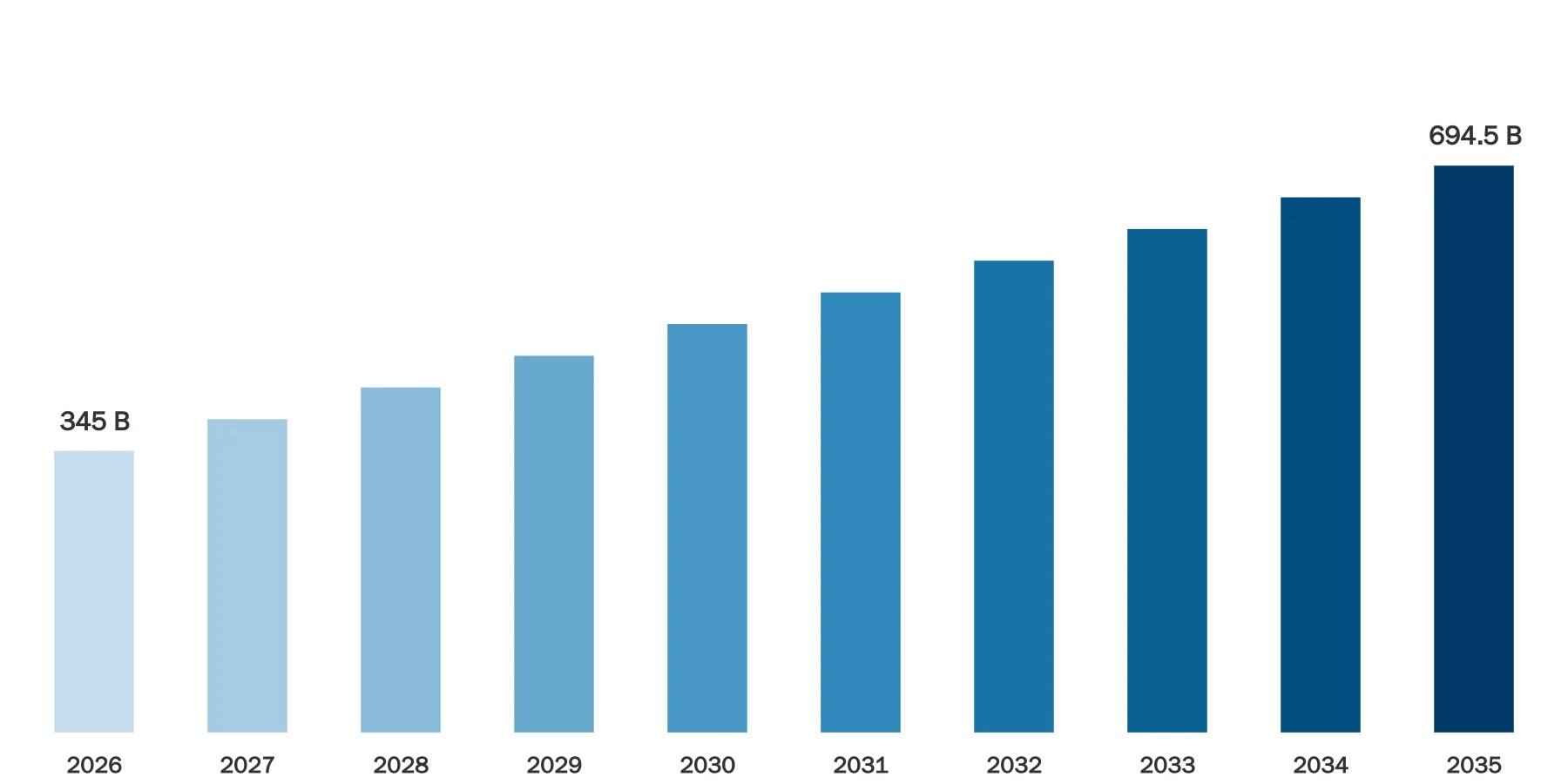
Source: Econ Market Research
The Global Solar PV Panels Market refers to the worldwide industry involved in the manufacturing, distribution, and installation of Photovoltaic (PV) panels, which convert sunlight into electricity. These panels are crucial components of solar energy systems, ranging from small residential setups to large-scale commercial and utility projects. The market encompasses a diverse array of technologies, including monocrystalline, polycrystalline, and thin-film Solar Panels, each with its own advantages and applications.
In recent years, the market has experienced significant growth driven by several factors, including increasing awareness of environmental issues, government incentives and subsidies for renewable energy adoption, technological advancements leading to cost reductions, and the growing demand for sustainable energy sources. Key players in the industry are continually investing in research and development to enhance panel efficiency, durability, and affordability, further driving market expansion. Additionally, the push towards decarbonization and the transition to clean energy sources, as outlined in various international agreements and initiatives, such as the Paris Agreement, is expected to fuel continued growth in the solar PV panels market globally. However, challenges such as intermittency of solar power generation, grid integration issues, and supply chain constraints may pose hurdles to market development in certain regions. Despite these challenges, the outlook for the global solar PV panels market remains promising, with forecasts indicating sustained growth in installations and investment, particularly in emerging markets where solar energy adoption is rapidly increasing.
Solar PV Panels Dynamics
A number of variables that affect supply and demand combine to shape the dynamics of the global market for solar PV panels. Demand for renewable energy sources, like solar power, has increased as a result of growing environmental consciousness and initiatives to mitigate climate change. Investment in solar PV installations is encouraged by government policies, incentives, and regulations that are designed to encourage the adoption of clean energy, which in turn propels market growth. Furthermore, as a result of technological developments and economies of scale, the cost of solar photovoltaic technology has decreased, making solar power a more viable alternative to traditional energy sources. This has increased demand for solar power in the residential, commercial, and utility-scale segments.
Manufacturers are in fierce competition with one another to improve product affordability, dependability, and efficiency on the supply side of the market. The dynamics of the market are largely determined by technological innovation, with continuous R&,D projects aimed at enhancing solar cell efficiency, investigating novel materials, and cutting production costs. Market trends and pricing are also influenced by the dynamics of the global supply chain, which include the availability of raw materials, trade regulations, and geopolitical considerations. Variations in essential inputs, like silicon, a major component in the creation of solar cells, can have an effect on production costs and, eventually, market dynamics.
Solar PV Panels Drivers
Government Incentives and Policies
Government policies and incentives are major factors propelling the global market for solar photovoltaic panels. Investment in solar PV installations is encouraged by subsidies, tax credits, feed-in tariffs, and renewable energy mandates, which increase their financial appeal to utilities, businesses, and consumers. For instance, strong feed-in tariff policies have been put in place in nations like China and Germany, which has led to a notable increase in solar PV capacity. Furthermore, the global government',s renewable energy targets provide a regulatory framework that encourages the deployment of solar photovoltaic systems and thus expands the market.
Technological Advancements
Ongoing technological advancements in solar PV technology contribute to market growth by improving panel efficiency, reducing costs, and expanding applications. Innovations such as PERC (Passivated Emitter Rear Cell) technology, bifacial solar cells, and tandem solar cells enhance the energy conversion efficiency of solar PV panels, increasing their competitiveness compared to traditional energy sources. Moreover, advancements in manufacturing processes, such as the use of automated production lines and innovative materials, drive down production costs, making solar PV installations more affordable and accessible to a wider range of consumers and businesses. As research and development efforts continue, breakthroughs in energy storage, smart grid integration, and panel durability further bolster the attractiveness of solar PV as a reliable and sustainable energy solution.
Restraints
Intermittency and Grid Integration Challenges
The intermittent nature of solar power generation and the related difficulties associated with grid integration are two of the main obstacles facing the global market for solar photovoltaic panels. Weather-related variations in solar PV generation make it challenging to instantly balance supply and demand. In order to maintain grid stability and reliability, this intermittency can put a strain on electricity systems and necessitate additional investment in grid infrastructure, such as energy storage systems and smart grid technologies. Grid integration problems can also be brought on by antiquated grid infrastructure, regulatory obstacles, and opposition from established energy stakeholders. These factors will hinder the uptake of solar PV and reduce its potential contribution to the energy mix.
Supply Chain Constraints
Supply chain constraints pose another significant restraint on the global solar PV panels market. The production of solar PV panels relies on a complex global supply chain involving various raw materials, components, and manufacturing processes. Disruptions or shortages in key inputs such as silicon, silver, and glass can lead to supply shortages, price volatility, and production delays, affecting the availability and cost of solar PV panels. Moreover, geopolitical tensions, trade disputes, and logistical challenges, exacerbated by factors like the COVID-19 pandemic, can disrupt supply chains and hinder the growth of the solar PV market by increasing uncertainty and reducing market predictability.
Opportunities
Energy Transition and Decarbonization
Global decarbonisation and the transition to clean energy sources offer the solar PV panels market yet another sizable opportunity. Global commitments to cut greenhouse gas emissions and move towards a low-carbon economy are predicted to fuel a spike in demand for renewable energy technologies like solar photovoltaics. International agreements like the Paris Agreement, carbon pricing schemes, and renewable energy targets stimulate investment in solar PV infrastructure and foster an atmosphere of policies that support market expansion. Further accelerating the adoption of solar PV as a crucial element of the energy transition are corporate sustainability initiatives, rising consumer awareness of environmental issues, and investor interest in green technologies.
Segment Overview
By Technology
The market is segmented based on technology into thin film, crystalline silicon, and others. Thin film solar PV panels utilize thin layers of Semiconductor materials deposited on substrates, offering flexibility and lower manufacturing costs compared to crystalline silicon panels. Crystalline silicon panels, including monocrystalline and polycrystalline variants, dominate the market due to their high efficiency and reliability. Other emerging technologies such as bifacial solar cells, tandem solar cells, and organic photovoltaics hold promise for further innovation and differentiation within the market, driving technological advancement and enhancing the diversity of solar PV offerings.
By Grid Type
Solar PV installations are categorized by grid type into residential, commercial, and industrial segments. Residential installations typically cater to individual households, providing clean and renewable energy for domestic consumption. Commercial installations serve businesses, institutions, and commercial properties, meeting their electricity needs while offering potential cost savings and environmental benefits. Industrial-scale solar PV projects encompass large utility-scale installations serving grid-connected power generation, contributing to regional energy infrastructure and supporting grid stability. The diversity of grid types reflects the versatility of solar PV technology in addressing various energy demands across residential, commercial, and industrial sectors, contributing to energy security and sustainability.
By Application
Solar PV panels find application across residential, commercial, and industrial sectors. In residential settings, solar PV systems power homes, reducing reliance on grid electricity and offering homeowners energy independence and potential savings on utility bills. Commercial applications encompass a wide range of businesses and institutions, including offices, schools, retail stores, and hospitals, where solar PV installations contribute to operational efficiency, cost reduction, and corporate sustainability goals. Industrial applications involve large-scale solar PV projects integrated into industrial facilities, manufacturing plants, and utility-scale power plants, providing renewable energy for industrial processes, grid stabilization, and electricity generation.
Solar PV Panels Overview by Region
In regions with abundant sunlight and supportive regulatory frameworks, such as parts of Asia-Pacific, including China, India, and Southeast Asian countries, solar PV installations have experienced rapid growth driven by increasing electricity demand, urbanization, and government incentives. Similarly, regions with high environmental awareness and renewable energy targets, such as Europe, have seen significant adoption of solar PV technology, facilitated by favourable feed-in tariffs, net metering schemes, and ambitious climate goals.
North America, particularly the United States, boasts a mature solar PV market fuelled by federal tax credits, state-level incentives, and a strong renewable energy market ecosystem. Emerging markets in Latin America, Africa, and the Middle East present untapped opportunities for solar PV market expansion, supported by improving investment climates, growing energy demand, and declining technology costs. However, regional variations in regulatory policies, grid infrastructure, and financing mechanisms influence market dynamics and growth trajectories.
Solar PV Panels Market Competitive Landscape
Leading manufacturers such as JinkoSolar, Trina Solar, and Canadian Solar dominate the market with their extensive product portfolios, global presence, and economies of scale. These companies invest heavily in research and development to improve panel efficiency, durability, and affordability, while also focusing on expanding manufacturing capacities to meet growing demand. Additionally, vertical integration along the value chain enables major players to control costs and optimize supply chain management, enhancing their competitiveness in the market. Alongside established players, a multitude of smaller manufacturers and emerging start-ups contribute to market dynamism, fostering innovation and driving technological advancements. Moreover, the competitive landscape is shaped by the increasing involvement of energy conglomerates, technology giants, and financial institutions, reflecting the broader convergence of energy and digital industries. Strategic collaborations, mergers, and acquisitions are common strategies employed by market players to strengthen their market position, broaden product offerings, and access new markets.
Key Players: Solar PV Panels Market
JinkoSolar (China)
LONGi Green Energy Technology (China)
Trina Solar (China)
JA Solar (China)
Canadian Solar (Canada/China)
First Solar (USA)
Hanwha Qcells (South Korea)
Risen Energy (China)
Suntech Power (China)
Astronergy (Chint Group - China)
SunPower Corporation (USA)
REC Group (Singapore/Norway)
Sharp Corporation (Japan)
Solar PV Panels Recent Developments
Aug 2023, Reliance Industries (RIL) intends to inaugurate the initial phase, consisting of 5 gigawatts (GW), of its planned 20 GW module manufacturing capacity by March 2024. RIL is establishing a solar photovoltaic giga factory in Jamnagar, which will have a cumulative capacity of 20 GW, to be completed in four phases, each comprising 5 GW.
June 2023, Canadian Solar is constructing a cutting-edge solar photovoltaic module manufacturing facility capable of producing 5 GW annually, translating to roughly 20,000 high-power modules daily. This venture entails an investment exceeding $250 million and is projected to generate approximately 1,500 skilled employment opportunities upon full operation. Commencing production by late 2023, this facility marks Canadian Solar',s inaugural manufacturing presence in the United States, complementing its established production sites in Canada, China, Brazil, Thailand, and Vietnam.
Solar PV Panels Market Report Scope & Segmentation
| Attributes | Details |
|---|---|
Market Size (Current) | US$ 345 Billion in 2026 |
Market Size (Forecast) | US$ 694.5 Billion in 2035 |
Growth Rate | CAGR of 8.1% from 2026 to 2035 |
Forecast Period | 2026 – 2035 |
Base Year | 2025 |
Historical Data Available | Yes |
Regional Scope | Global |
Segments Covered | By Technology
By Grid Type
By Application
|
Frequently Asked Questions
Common questions about this report
The study period covers historical insights and forecast projections for the period 2026-2035.
About the Author
Market research expert with years of industry experience

Related Reports
Explore more market insights from the same category