

Hydrogen Compressor Market
Hydrogen Compressor Market Size, Share, Trends, Growth, and Industry Analysis, By Technology Type (Single-Stage, Multi-Stage), By Lubrication Type (Oil-based, Oil-free), By End User Industry (Oil and Gas, Chemical, Automotive, Others), Regional Analysis and Forecast Period 2026-2035
Market Overview
As per Econ Market Research analysis, Global Hydrogen Compressor Market size stood at US$ 1.26 Billion in 2026 and is projected to reach US$ 2.03 Billion by 2035, growing at a CAGR of 5.48% over the forecast period 2026–2035. 2025 is taken as the base year.
Hydrogen Compressor Market Size 2025-2035 (USD Billion)

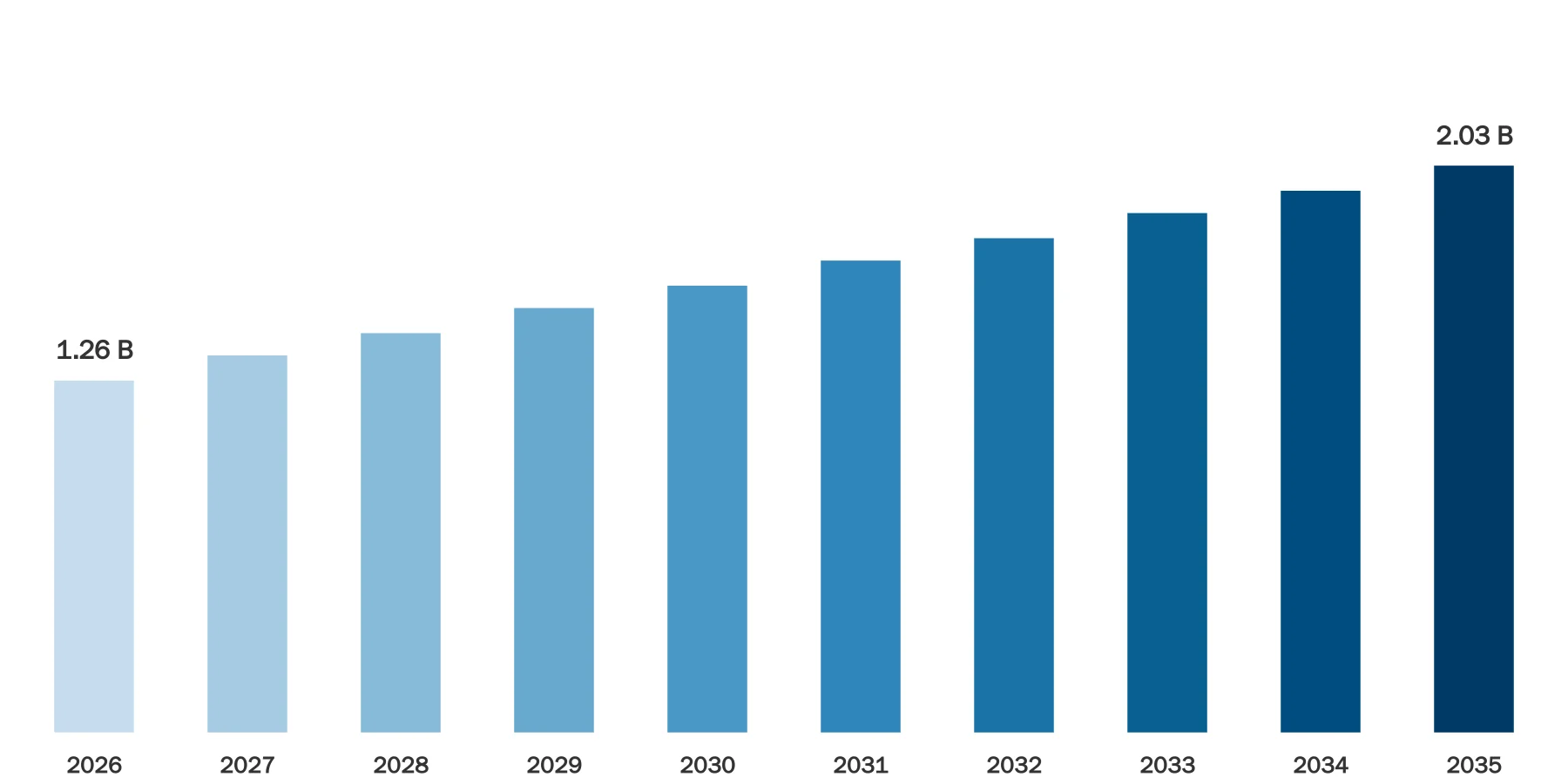
Source: Econ Market Research
A hydrogen compressor is a device that increases the pressure of hydrogen gas by decreasing its volume. Reduced vapor liquid hydrogen: most compressors used for gaseous hydrogen compression are either positive displacement or negative displacement, depending on the application. Hydrogen fuels are considered one of the most important technologies and are expected to drive the market during the forecast period. The hydrogen compressor market consists of the sale of hydrogen compressor devices by entities (organizations, partnerships, or sole proprietors) that increase the pressure of hydrogen by reducing gas volume. The compression in a hydrogen compressor is achieved by moving hydrogen through a compressor that reduces gas volume between the inlet and the discharge. The decrease in volume results in compressed hydrogen or liquid hydrogen.
Market Growth
The global hydrogen compressor market is still in the growth stage. However, the growth rate is expected to be slow owing to the recent discovery of new shale oil deposits in the U.S. and the disagreement related to oil and gas supply between Russia and the Organization of the Islamic Conference Petroleum Exporting Countries (OPEC). Therefore, this discovery and the dispute between The U.S., Russia, and OPEC will potentially make petrol, diesel, and other fuels cheaper. Besides, there are popular alternatives, such as solar power and wind power. Electricity generated from these sources has a more developed market, which will limit the growth of hydrogen compressor market.
Increasing demand for hydrogen from end-use industries is expected to propel the growth of the global hydrogen compressor market. The end-use sectors, such as household energy distribution companies, oil and gas companies, and power generation companies, are increasingly investing in new hydrogen distribution and generation plants to meet consumer requirements and comply with government measures against environmental pollution. For instance, in 2020, in the UK, a groundbreaking hydrogen trial project (HyDeploy) will be underway at Keele University. And this pilot project is LED by Cadent in partnership with Northern Gas Networks (NGN) in the UK as an injection of zero-carbon hydrogen into Keele University&rsquo,s gas grid, which is feeding approximately 101 houses and 31 faculty buildings. Thus, the increase in demand for hydrogen from end-user industries is expected to boost the market for hydrogen compressors.
Segments covered for the Hydrogen Compressor Market
By Lubrication type
Based on lubrication type, the market is segmented into oil-free and oil-based segments. The oil-based segment dominates the forecast period, owing to its advantages and applications in several end-user industries. In addition, oil-based compressors are considered more efficient than oil-free ones. Oil-based compressors are considered more efficient than oil-free compressors, as oil acts as a cooling medium, taking out approximately 80% of the compressor',s heat during the compression process. They are also considered more suitable for industrial usage due to the requirement of a high compression ratio. Although oil-based compressors are more affordable than oil-free compressors, they require continuous maintenance and greater attention when replacing filters and other components used to eliminate the risk of oil leakage. Ongoing oil contamination may result in severe consequences, such as legal issues, spoiled or unsafe products, production downtime, etc. Oil-based hydrogen compressors are mostly preferred in the manufacturing industry (Glass Purification, Iron and Steel Industry, Semiconductor Manufacturing, etc. for operations like gas welding, welding, annealing, and heat treating of metals), Power Plants (Coolant for Generators), Aerospace Applications, Pharmaceuticals, etc.
By Technology Type
Based on technology type, the market is segmented into single-stage and multi-stage (Mechanical Compressors, Non-Mechanical Compressors). The fundamental difference between multi-stage compressors and single-stage compressors is the number of times the gas gets compressed between the inlet valve and the tool nozzle. Multi-stage compressors are primarily used in the filling of storage tanks and hydrogen production plants, as well as for the transportation of hydrogen through pipelines. These compressors can be customized and sized to match the flow of hydrogen gas produced by an electrolyzer.
By End User Industry
The energy and power segment are expected to grow at a CAGR of XX% during the forecast period. High-pressure compressed hydrogen can be used in fuel cells to generate electricity, water, and heat for a wide variety of applications and industries, including drive power for lorries, cars, buses, trains, ships, and aircraft, backup power, portable power for remote areas, and distributed or coupled heat and power. There is a rapidly growing understanding that reducing carbon footprints while maintaining economic development might be a game changer in the hydrogen compressor market.
The Toyota Mirai and the Honda Clarity are cars from manufacturers that are already developing hydrogen-fueled vehicles that use fuel cells. Major ship motor producers are also working to develop technologies like dual-fuel ships that use hydrogen along with conventional fuels, diesel and hydrogen-powered combustion engines, and hydrogen as a substitute for electricity on cruise ships. However, hydrogen needs to be much more cost-competitive in order to be widely adopted by end consumers in their homes. This calls for a reduction in the price of equipment, storage, maintenance, and delivery as well as an optimization of clean hydrogen production processes.
Regional Analysis
Based on regional analysis, the market is divided into North America, Europe, Asia Pacific, Central and South America, the Caribbean, the Middle East, and Africa. The hydrogen compressor market in Europe has seen significant growth in recent years due to the seismic shift in regional energy consumption from fossil fuels to alternative fuels. This shift in consumer preference is driven by the various actions taken by the regional government, focusing on fueling the energy sector&rsquo,s growth through alternative sources. For instance, Hydrogen Mobility Europe (H2ME), a flagship project that focuses on developing strategies to make hydrogen-fueled transport a competitive alternative to fossil fuel. Under the H2ME project, the region focuses on deploying more than 140 alternative-fueled cars and vans and 49 new hydrogen refuelling stations. The total cost of the project is estimated to be around USD 195.4 million. As the initiatives increase the number of fueling stations in Germany, the country leads the countrywide hydrogen compressor market. This growth in the country market can be attributed to the presence of many hydrogen fuel cell vehicles and filling stations.
Asia-Pacific is expected to be the most promising market for fuel cells in the coming years, on account of the favourable government policies in countries such as China, Japan, and India. China is one of the world',s largest and fastest-growing markets for hydrogen compressors. In recent years, the country has witnessed significant growth in the chemical, oil and gas, and manufacturing sectors. Hydrogen centrifugal compressors are used for cracked-gas compression and refrigeration services in the refining and petrochemical industries, such as ethylene plants. Due to ethylene and benzene production shortages, the country has been investing increases in the ethylene and benzene production capacity.
Competitive Landscape
The global hydrogen compressor market Some of the major companies include:
Idex Corporation
Ariel Corporation
Atlas Copco Ab
Burckhardt Compression Ag
Fluitron, Inc
Haug Sauer Kompressoren Ag
Hitachi, Ltd
Howden Group
Ingersoll Rand Inc,
Nel Asa
Hydrogen Compressor Market Report Scope & Segmentation
| Attributes | Details |
|---|---|
Market Size (Current) | US$ 1.26 Billion in 2026 |
Market Size (Forecast) | US$ 2.03 Billion in 2035 |
Growth Rate | CAGR of 5.48% from 2026 to 2035 |
Forecast Period | 2026 – 2035 |
Base Year | 2025 |
Historical Data Available | Yes |
Regional Scope | Global |
Segments Covered | By Technology Type
By Lubrication Type
By End User Industry
|
Frequently Asked Questions
Common questions about this report
The study period covers historical insights and forecast projections for the period 2026-2035.
About the Author
Market research expert with years of industry experience

Related Reports
Explore more market insights from the same category