

Solar Control Glass Market
Solar Control Glass Market Size, Share, Trends, Growth, and Industry Analysis, By Glass Type (Absorbing Glass, Reflective Glass, Low-E Glass), By Coating Type (Hard Coated, Soft Coated), By Application (Residential, Commercial, Automotive, Others), Regional Analysis and Forecast Period 2026-2035
Solar Control Glass Market Overview
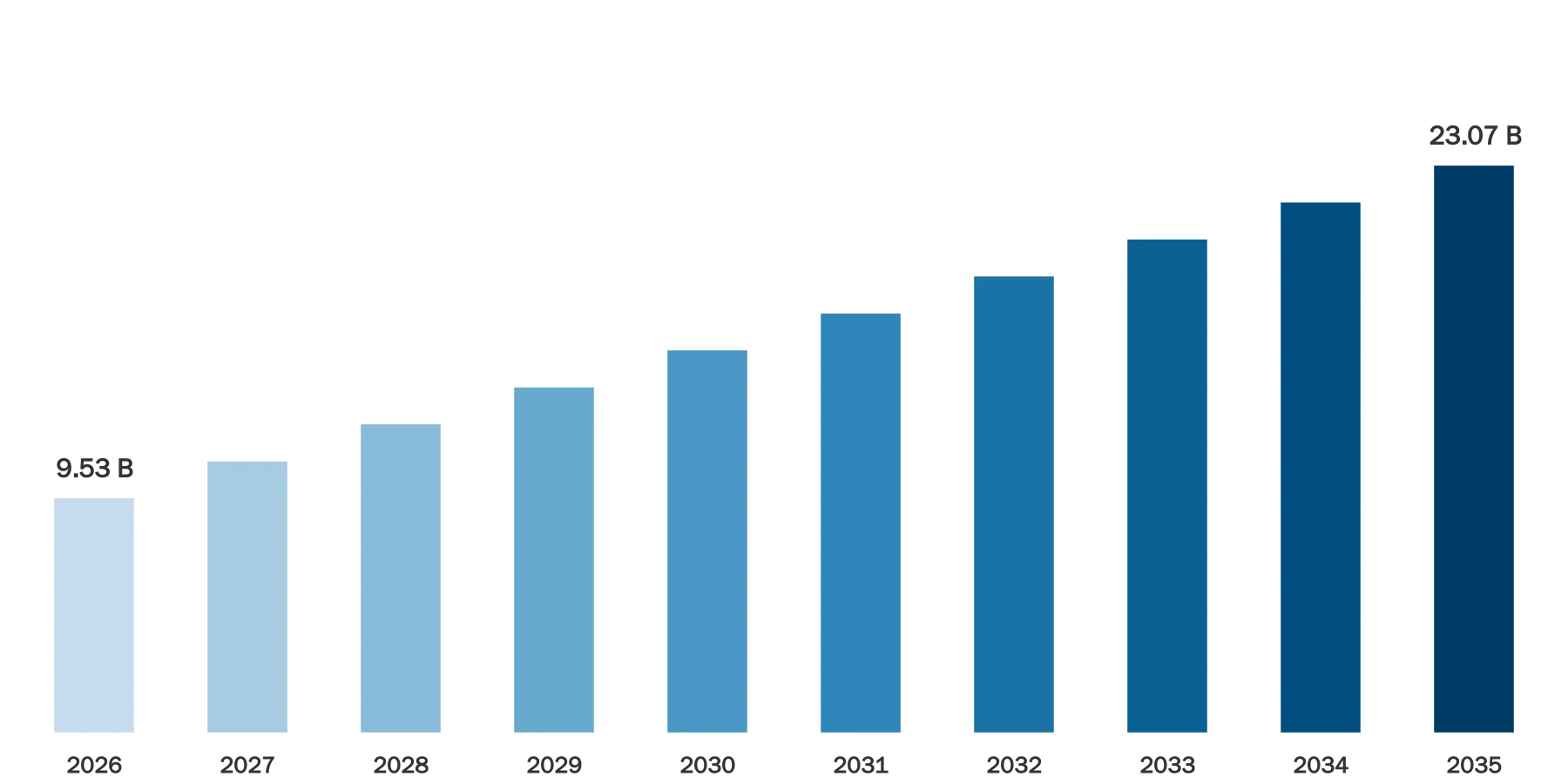
As per Econ Market Research analysis, the Global Solar Control Glass Market reached a valuation of US$ 9.53 Billion in 2026 and is anticipated to grow to US$ 23.07 Billion by 2035, at a CAGR of 10.32% during the forecast timeline 2026–2035. The base year considered is 2025.
Solar Control Glass Market Size 2025-2035 (USD Billion)

Source: Econ Market Research
The global solar control glass market refers to the type of glass that has a specific coating that reduces the amount of heat that enters a structure. It both reflects and absorbs heat while also filtering light to lessen glare. Using solar control glass might help you save money on air conditioning and blinds. Solar control glass has numerous applications in the construction business. Solar glass can be utilized in a variety of construction applications, including the roof, windows, skylights, and facades. The market is driven by the increasing demand for Photovoltaic glass in residential and commercial buildings.
Market Dynamics
The market dynamics of solar control glass are influenced by several factors. The increasing demand for photovoltaic glass in residential and commercial buildings and the government initiatives for energy efficient structures drive market growth. However, raw material price volatility and availability act as restraints. Opportunities arise from the increasing demand from automotive industry. The nature of competition is highly intense, with various companies striving to gain a competitive edge through innovation and customer-centric offerings. As the market evolves and consumer demand continues to rise, the dynamics of the solar control glass market are expected to remain dynamic and highly competitive.
Market Drivers
Increasing demand for photovoltaic glass in residential and commercial buildings
The increasing demand for photovoltaic glass in residential and commercial buildings is one of the major factor driving the growth of the global solar control glass market. Photovoltaic glasses are used to generate electricity for their homes and buildings, to reduce the energy cost and the carbon footprint. The photovoltaic glass can be installed on rooftops, windows and skylights. Photovoltaic glasses require very low maintenance making it a cost-effective choice for both residential and commercial purposes. It is also highly durable and can withstand a variety of weather conditions. Thus, with the increasing demand for photovoltaic glass in residential and commercial buildings it is expected to grow the global solar control glass market during the forecast period.
Government initiatives for energy efficient structures
The government initiative for energy efficient structure is one of the major drivers in the global solar control glass market. Government have adopted building codes that require new buildings to be energy efficient with minimum energy performance standards for insulation, windows and other building components. Governments are also providing financial incentives such as tax breaks, rebates and low-interest loans. As the government promotes the use of solar control glass for energy efficiency and sustainability the demand for global solar control glass market is expected to grow during the forecast period.
Restraints
Raw material price volatility and availability
The raw material price volatility and availability is one of the major restraints in the global solar control glass market. Float glass and coating materials are used in the production of solar control glass. The prices of these raw materials can fluctuate significantly due to supply and demand difference, change in transportation and energy costs. Additionally, the availability of raw materials is a major concern due to disruptions in the supply chain. Thus, the raw material price volatility and availability acts as a major restraint in the global solar control glass market during the forecast period.
Opportunities
Increasing demand from the automotive industry
The increasing demand from the automotive industry is a major opportunity in the global solar control glass market. Solar control glass are used in windshields, side windows and sunroofs to reduce the amount of heat and glare that enters the vehicle interior to improve the visibility and comfort of the passengers. As the demand from the automotive industry increases it creates an immense opportunity for the global solar control glass market during the forecast period.
Segment Overview
By type
The market for solar control glass is segmented based on type into four categories: Float glass, heat strengthened glass, laminated glass and tempered glass. Tempered glass is dominating the market segment due to its durability and strength. Tempered glass is a kind of safety glass created by heating and cooling float glass. This technique strengthens the glass and makes it more resistant to shattering. Tempered glass can be covered with a number of compounds to provide solar control. The most often used type of sun control glass is float glass. It is created by floating molten glass over molten tin.
Float glass is normally clear, but it can be coated with a range of compounds, including as metals and metal oxides, to provide solar control. Heat-strengthened glass is a type of safety glass created by rapidly heating and cooling annealed glass. This procedure forms a compressive layer on the glass',s surface, making it stronger and more resistant to shattering. Laminated glass is a type of safety glass composed of a layer of polyvinyl butyral (PVB) sandwiched between two layers of float glass. In the event of a break, the PVB layer helps to keep the glass together. Laminated glass can also be coated with a variety of compounds to provide solar control. Thus, this segment allows the consumer to select the type of solar control glass according to their specific needs and preferences.
By coating method
The solar control glass market is categorized based on coating method into hard coated and soft coated. Hard coated segment is dominating the market due to its super performance and durability. Hard-coated solar control glass has a long-lasting layer of metal or metal oxide coating. A chemical vapour deposition (CVD) or physical vapour deposition (PVD) procedure is commonly used to apply this covering. Hard-coated solar control glass is scratch and abrasion resistant, and it has the best solar heat rejection and visible light transmission characteristics.
A small layer of organic material coats soft-coated sun control glass. This coating is often applied with a spray or roller coating method. Soft-coated solar control glass is less expensive than hard-coated solar control glass, but it is also less robust and performs worse in terms of solar heat rejection and visible light transmission. Thus, this segment allows the consumer to select the coating method of solar control glass according to their specific needs and preferences.
By Application
The solar control glass market is segmented based on application into residential buildings, commercial buildings and automotive. Residential buildings segment is dominating the market due to the increasing demand for energy-efficient homes. Solar control glass is utilized in many residential construction applications, including windows, doors, and skylights. By limiting the amount of heat that enters through the windows, solar control glass can help to minimize the energy consumption of residential buildings.
Solar control glass is also used in office buildings, retail businesses, and hotels. Solar control glass can help commercial buildings save energy by minimizing heat gain via windows and improving indoor comfort. Solar control glass is utilized in numerous vehicle applications, including windshields, side windows, and rear windows. Solar control glass can help to reduce interior vehicle temperatures and enhance fuel efficiency. Thus, this segment allows the consumer to select the type of application of solar control glass according to their specific needs and preferences.
Overview by Region
Europe
Europe currently dominates the global solar control glass market, and this dominance is expected to continue in the future. Europe region is one of the early adopters of solar control glasses in residential and commercial buildings due to increasing demand for energy efficient buildings. As the demand for solar control glass continues to rise, Europe is projected to maintain its leading position in the market in the coming years.
Asia Pacific
Asia-Pacific is experiencing significant growth in the global solar control glass market, with a significant compound annual growth rate (CAGR). This is owing to the region',s increasing urbanization and economic growth, which is driving up demand for new buildings and infrastructure. In the Asia Pacific region, solar control glass is commonly utilized in buildings to minimize energy use and increase indoor comfort. With the continuous advancements in solar control glass technology and with the rising demand in buildings and infrastructure, Asia-Pacific is expected to witness a substantial CAGR in the coming years.
Competitive Landscape
The competitive landscape of the market is marked by a wide array of players competing for market dominance. To address the growing demand for solar control glass, the key companies are anticipated to focus on extending their presence in emerging regions and creating new products. The competition is fierce, with companies continually striving to gain an edge through technological innovations, customer-centric features, and expanding their product ranges. As consumer demand for solar control glass continues to grow, the market is anticipated to witness even more intense competition among these players.
Key Players:
Asahi Glass Company (AGC Inc.)
Saint-Gobain
NSG Group
Xinyi Glass Holdings Limited
CSG Holding Co., Ltd.
Corning Incorporated
Central Glass Co., Ltd.
SCHOTT AG
Şişecam Group
AGC Glass Europe
Cardinal Glass Industries, Inc.
Guardian Glass LLC
Nippon Sheet Glass Co., Ltd.
PPG Industries, Inc.
Recent Developments
March 2023, Triveni Glass has announced plans to build a solar glass manufacturing plant in Andhra Pradesh, India. The factory, which will be capable of producing 840 metric tons of solar glass each day, is expected to employ 2,000 people.
September 2022, Ubiquitous Energy, a US solar window expert, claims it intends to convert skyscrapers into vertical solar farms by installing solar windows.
Solar Control Glass Market Report Scope & Segmentation
| Attributes | Details |
|---|---|
Market Size (Current) | US$ 9.53 Billion in 2026 |
Market Size (Forecast) | US$ 23.07 Billion in 2035 |
Growth Rate | CAGR of 10.32% from 2026 to 2035 |
Forecast Period | 2026 – 2035 |
Base Year | 2025 |
Historical Data Available | Yes |
Regional Scope | Global |
Segments Covered | By Glass Type
By Coating Type
By Application
|
Frequently Asked Questions
Common questions about this report
The study period covers historical insights and forecast projections for the period 2026-2035.
About the Author
Market research expert with years of industry experience

Related Reports
Explore more market insights from the same category