

Ready Mix Concrete Market
Ready Mix Concrete Market Size, Share, Trends, Growth, and Industry Analysis, By Product Type (Standard Ready Mix Concrete, Architectural Ready Mix Concrete, Fiber Reinforced Ready Mix Concrete), By Application (Residential, Commercial, Infrastructure, Industrial), Regional Analysis and Forecast Period 2026-2035
Market Overview
As per Econ Market Research analysis, the Global Ready Mix Concrete Market was valued at US$ 1171.67 Billion in 2026 and is expected to reach US$ 2606.27 Billion by 2035, registering a CAGR of 9.1% during the forecast period 2026–2035. The base year considered is 2025.
Ready Mix Concrete Market Size 2025-2035 (USD Billion)

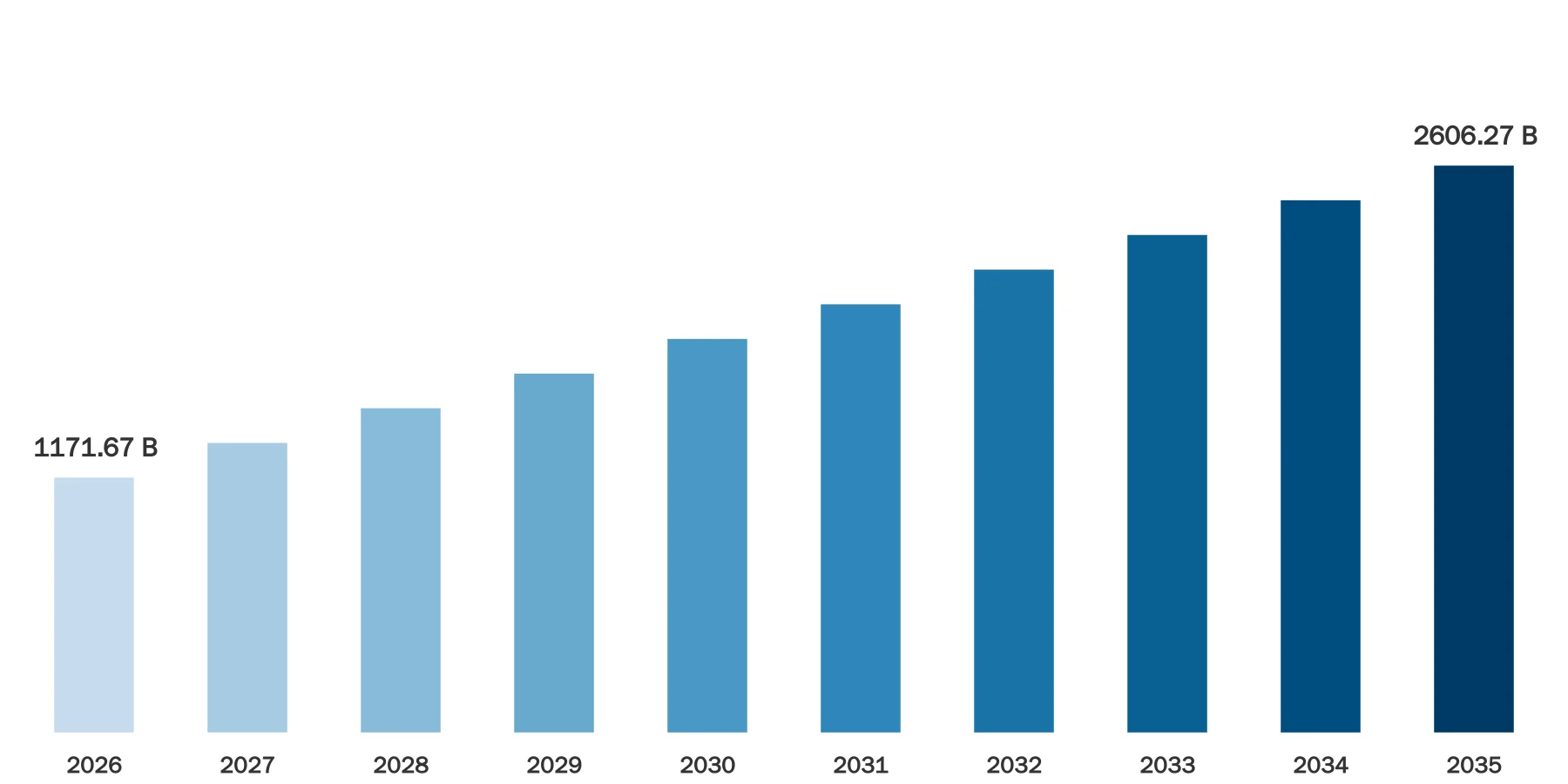
Source: Econ Market Research
The Ready Mix concrete is made up of cement, water, aggregates like sand or gravel, and sometimes additives, all mixed together in a factory or batching plant following a specific recipe. This mixture is then transported to construction sites in trucks, where it is poured into molds or forms to make buildings, roads, bridges, and other structures. Ready Mix Concrete is essential for the construction industry because it provides convenience, consistency, and quality control in concrete production, saving time and labor on-site.
The Global Ready Mix Concrete market has been growing steadily in recent years, fueled by urbanization, infrastructure development, and construction around the world. Factors like rapid urbanization, population growth, and the push for sustainable construction are driving the demand for Ready Mix Concrete. Technology advancements and environmentally friendly practices have also played a role in expanding the market.
Despite this growth, challenges like fluctuating raw material prices, regulations, and competition from other construction materials persist. In general, the global ready mix concrete market is set to experience more growth as the construction sector expands worldwide, fuelled by developing economies', need for infrastructure and urban development projects.
Even though there are obstacles like changing raw material costs and rules, the Ready-Mix Concrete industry is progressing thanks to improvements in materials, manufacturing, and sustainability. Businesses are putting money into research to create efficient solutions that cater to the changing demands of construction while reducing harm to the environment. Therefore, the future looks bright for the Global Ready Mix Concrete market, fuelled by urbanization, infrastructure projects, and technological progress in the construction industry.
Ready Mix Concrete Dynamics
The demand for ready mix concrete is driven by urbanization trends, especially in developing countries, as cities grow and infrastructure requirements increase. This demand is fuelled by population growth, urban migration, and the necessity for updated infrastructure to facilitate economic growth. Moreover, the growing emphasis on sustainable construction techniques is influencing the market dynamics. Countries and companies all over the world are increasingly focusing on utilizing environmentally friendly building materials. This has resulted in a growing preference for Ready Mix Concrete because of its efficient use of resources and minimal environmental footprint, in comparison to conventional concrete mixing techniques.
Technology is really making a big impact on the Ready-Mix Concrete market. By using automation and digitization in batching plants and delivery systems, companies are able to improve efficiency, quality control, and safety in producing and delivering concrete. Not only that, but with new innovations in concrete admixtures, we are able to create unique concrete mixes that have better durability, strength, and workability to meet different construction needs. Of course, there are still challenges in the market.
Changes in the prices of raw materials, like cement and aggregates, can affect how much money Ready-Mix Concrete producers make. Rules about the environment and transportation can also make things difficult for companies in the market. The Global Ready Mix Concrete industry is influenced by trends in cities, efforts to be more sustainable, new technologies, and rules and regulations. These factors affect how much people want, how much is available, and how competitive the sector is.
Ready Mix Concrete Drivers
Urbanization and Infrastructure Development
Urbanization in emerging economies is driving the global Ready Mix Concrete market. As more people move to cities, the need for residential, commercial, and industrial buildings increases. Ready Mix Concrete provides a convenient and effective way to meet the construction demands of urban areas. Infrastructure projects like roads, bridges, airports, and railways also contribute to the demand for Ready Mix Concrete. Governments and private investors are investing heavily in infrastructure to support economic growth, driving the demand for construction materials like Ready Mix Concrete.
Advancements in Technology
Innovations in technology are improving efficiency and quality in the Ready-Mix Concrete market. Automation and digitalization in batching plants and delivery systems are streamlining production processes, enhancing quality control, and raising safety standards. Advanced equipment and software allow for precise monitoring and adjustment of concrete mixtures, ensuring consistency and reliability in performance.
Additionally, the creation of specialized concrete admixtures with enhanced properties like durability, strength, and sustainability is expanding the potential uses of Ready-Mix Concrete, attracting more customers and stimulating market growth. Overall, technological advancements play a pivotal role in enhancing the competitiveness and appeal of Ready-Mix Concrete in the construction industry.
Restraints:
Fluctuating Raw Material Prices
The production of Ready-Mix Concrete depends on materials like cement, aggregates, and water. The prices of these materials can fluctuate due to market demand, supply chain issues, and geopolitical tensions. These price fluctuations can greatly affect the profitability of Ready-Mix Concrete manufacturers, impacting their margins and pricing strategies. To manage these risks, companies might need to improve their procurement methods, consider using different materials, or change pricing tactics. These adjustments could be challenging in a competitive market.
Regulatory Constraints
Government regulations can pose hurdles for the Ready-Mix Concrete market. Meeting environmental standards on emissions, waste, and water may require investments in pollution control, waste treatment, or sustainable practices, raising operational expenses. Transport and quarry restrictions can also influence material availability and costs, impacting production and distribution of Ready-Mix Concrete. Adapting to regulatory changes while maintaining competitiveness and profitability requires careful planning and resource allocation by market players.
Opportunities:
Infrastructure Investment Programs
The government',s efforts to improve infrastructure offer great potential for the Ready-Mix Concrete market. As transportation networks and public facilities continue to grow in both established and up-and-coming economies, there is a consistent need for construction materials like Ready Mix Concrete. Manufacturers and suppliers of Ready-Mix Concrete stand to benefit from participating in major infrastructure projects, as they can secure reliable income and expanded opportunities for growth by delivering top-notch products efficiently.
Segment Overview
By Product Type
Ready Mix Concrete comes in three primary product types: Shrink Mixed Concrete, Transit Mixed Concrete, and Central Mixed Concrete. Shrink Mixed Concrete involves partial mixing at the plant and finishes while in transit, allowing for flexibility on projects with different needs. Transit Mixed Concrete is fully mixed at the plant, ensuring consistency and uniformity, making it suitable for a variety of construction projects. Central Mixed Concrete goes through the entire mixing process at the batching plant, ensuring superior consistency and quality control, making it perfect for large-scale projects with strict performance requirements.
By End-Use Sector
The Ready-Mix Concrete market caters to different industries such as Infrastructure, Residential, Commercial, and Industrial &, Institutional. Infrastructure projects like roads, bridges, airports, and railways need sturdy and top-notch concrete solutions. Residential construction uses Ready Mix Concrete for foundations, floors, and structures, prioritizing efficiency and dependability.
In the commercial sector, Ready Mix Concrete is essential for building office buildings, shopping centers, and other commercial structures, necessitating uniform and high-quality concrete mixes. The Industrial &, Institutional sector, covering factories, warehouses, schools, and hospitals, relies on Ready Mix Concrete for robust and versatile building materials to meet specific project needs.
Ready Mix Concrete Overview by Region
The Ready-Mix Concrete market varies regionally based on factors like economic growth, infrastructure investments, construction levels, and regulations. North America',s market is well-established with high quality standards and a need for sustainable materials. Europe has a thriving market that prioritizes innovation, eco-friendly practices, and modernizing infrastructure.
Asia Pacific is a growing region due to urbanization, population growth, and major infrastructure projects in countries like China and India. In the Middle East and Africa, there is a lot of construction happening due to urbanization, industrialization, and government projects to boost the economy. Latin America is also seeing steady growth thanks to investments in infrastructure, housing, and commercial projects. Both regions offer distinct chances and obstacles that affect market trends, competition, and the use of Ready-Mix Concrete. It',s important for stakeholders to grasp these regional differences and adjust their strategies to take advantage of new opportunities and manage market challenges successfully.
Ready Mix Concrete Market Competitive Landscape
The market has the presence of both multinational corporations and regional players vying for market share. Major companies such as LafargeHolcim, CEMEX, HeidelbergCement, and CRH plc dominate the market with extensive geographic reach, diversified product portfolios, and strong brand recognition. These industry leaders leverage their global presence and technological advancements to maintain a competitive edge in terms of product quality, innovation, and customer service.
Additionally, strategic initiatives such as mergers and acquisitions, partnerships, and expansions into emerging markets contribute to their market dominance. Alongside these giants, numerous regional and local players operate within specific geographical areas, catering to the unique demands and preferences of local markets. These players often focus on niche segments, customer relationships, and operational efficiency to compete effectively.
Ready Mix Concrete Market Leading Companies,
LafargeHolcim
CEMEX
HeidelbergCement
CRH plc
Buzzi Unicem SpA
UltraTech Cement Ltd.
Sika AG
Votorantim Cimentos S.A.
China Resources Cement Holdings Limited
Martin Marietta Materials, Inc.
US Concrete, Inc.
Eurocement Group
Cementir Holding N.V.
Titan Cement Co. S.A.
Dangote Cement Plc
Vicat SA
Grupo Cemen
Ready Mix Concrete Recent Developments
June 2023, Buzzi SpA',s subsidiary, Dyckerhoff GmbH, agreed to sell assets in Ukraine and its ready-mix concrete division in eastern Slovakia to CRH, enhancing operational focus.
May 2023, ACC and Ambuja Cements, part of the Adani Group, opened an R&,D facility in Mumbai to drive innovation and sustainability in the cement and concrete industry.
Feb 2023, ACC Limited introduced ',Coolcrete',, a temperature-controlled concrete solution, to prevent excessive heat during large pours, reducing risks of cracking in structures.
Ready Mix Concrete Report Segmentation
Ready Mix Concrete Market Report Scope & Segmentation
| Attributes | Details |
|---|---|
Market Size (Current) | US$ 1171.67 Billion in 2026 |
Market Size (Forecast) | US$ 2606.27 Billion in 2035 |
Growth Rate | CAGR of 9.1% from 2026 to 2035 |
Forecast Period | 2026 – 2035 |
Base Year | 2025 |
Historical Data Available | Yes |
Regional Scope | Global |
Segments Covered | By Product Type
By Application
|
Frequently Asked Questions
Common questions about this report
The study period covers historical insights and forecast projections for the period 2026-2035.
About the Author
Market research expert with years of industry experience

Related Reports
Explore more market insights from the same category