

HVAC Chillers Market
HVAC Chillers Market Size, Share, Trends, Growth, and Industry Analysis, Operation Type (Vapor Compression Chillers, Vapor Absorption Chillers), Product type (Reciprocating, Centrifugal, Screw, Scroll), Condenser Type (Water Cooled, Air Cooled, Evaporative), Application (Commercial, Industrial, Residential), Regional Analysis and Forecast Period 2026-2035
HVAC Chillers Market Overview
As per Econ Market Research analysis, Global HVAC Chillers Market size stood at US$ 14.88 Billion in 2026 and is projected to reach US$ 23.2 Billion by 2035, growing at a CAGR of 5% over the forecast period 2026–2035. 2025 is taken as the base year.
HVAC Chillers Market Size 2025-2035 (USD Billion)

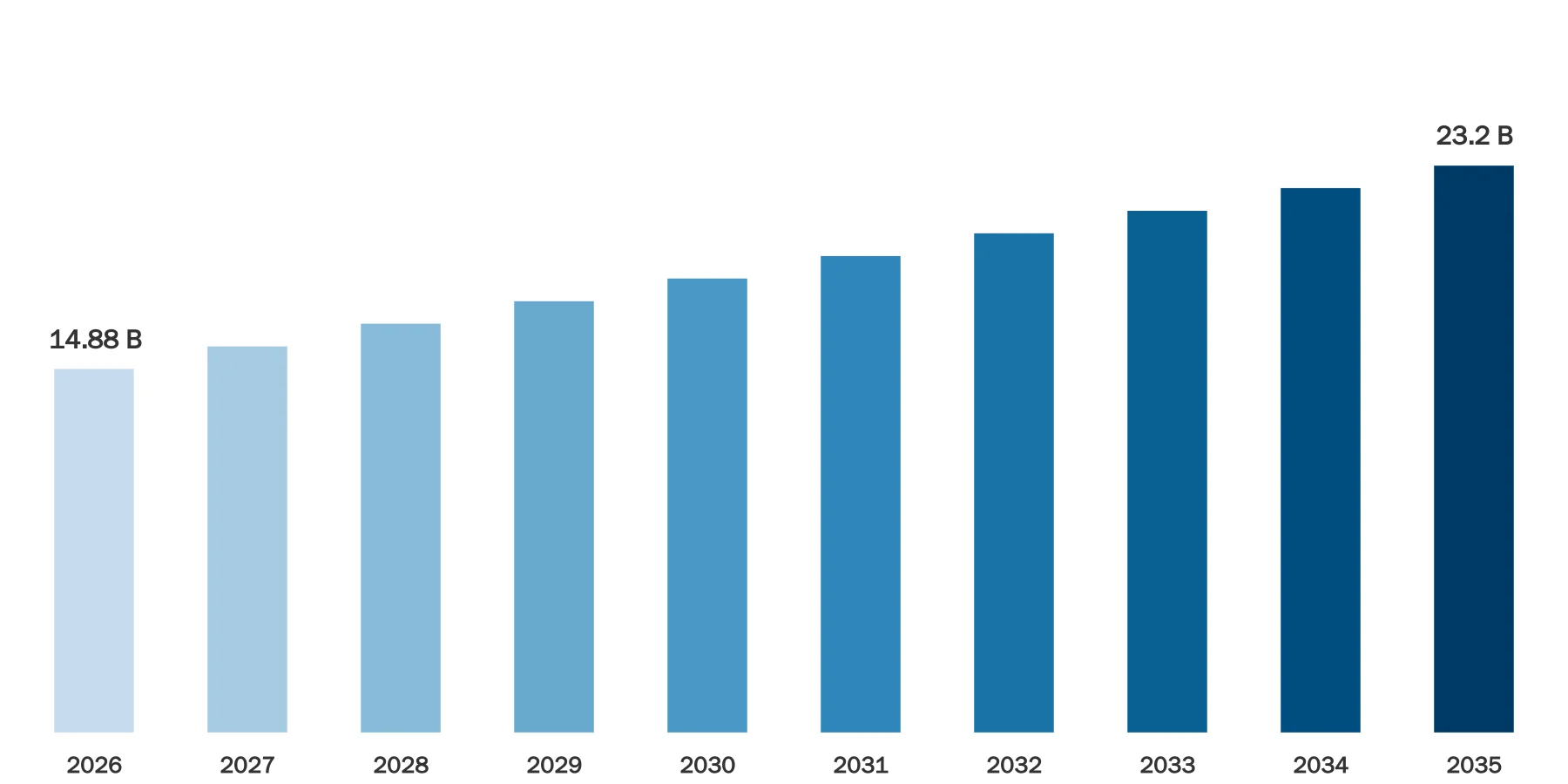
Source: Econ Market Research
HVAC chillers play a crucial role in maintaining the required temperature of any space, machinery, equipment, etc. HVAC chillers remove the heat and transfer it somewhere else, and make it cool. These chillers can be utilized in numerous residential spaces, for example, small to large rooms, garages, basements, and crawlspaces. The popularity of HVAC chillers is increasing due to various advantages such as portability, convenience, and quick and easy maintenance. Moreover, the adoption of HVAC chillers is rising in restaurants, hotels, kitchens, and dining rooms to handle concerns regarding temperature levels. Other industry verticals where these chillers are used are rubber, petrochemicals, medical, plastic, commercial office buildings, industrial, sports venues, etc.
The increase in demand for district cooling systems in many industries and high-rise buildings is expected to boost the HVAC chillers market's growth during the forecast period. District cooling, also known as centralized generation and distribution of cooling energy, replaces traditional air-cooling systems, as it is less expensive and more energy efficient. Moreover, developments in the tourism industry boost the construction of hotels and public infrastructure where HVAC chillers can be used on a large scale. Furthermore, as these chillers are widely used in the cooling and ventilation of skyscrapers, the growth of skyscrapers is expected to fuel the growth of the HVAC chillers market opportunity.
Chillers from Arctic Chiller Group, Ltd. are installed in high-end residential complexes throughout North America and serve as the primary air-conditioning system. The Arctic Chiller Group also serves skating facilities across the United States and Canada through direct ice freezing, ice rink cooling, and chiller maintenance. The expanding aviation industry, as well as the growing number of new commercial construction buildings, drives demand for respective chillers. As a result, demand for the respective chillers is expected to rise. Screw chillers are vapour compressor chillers that make use of a screw compressor for transporting the coolant through the system. These chillers are suitable for high-rise buildings considering their quiet operation, compact installation, high energy efficiency, and lower maintenance costs. With a growing Real Estate sector all over the world, the requirement for screw chillers is forecast to increase remarkably.
COVID-19 Impact
The COVID-19 pandemic impact has had a significant impact on the HVAC chillers market. The market for chillers is largely driven by demand from the commercial, industrial, and residential sectors, which were all impacted by the pandemic. In the initial stages of the pandemic, many businesses and industrial operations were shut down or operating at reduced capacities, resulting in lower demand for chillers. The construction industry, which is a significant user of chillers, also experienced a slowdown due to supply chain disruptions and labor shortages.
As businesses and industries started to reopen and resume operations, the demand for chillers began to recover. In particular, there has been an increased demand for HVAC systems that improve indoor air quality, which has become a top priority for many businesses and building owners due to concerns about the spread of the virus. Chillers are a key component of such systems and are used to control the temperature and humidity of indoor spaces. The trend towards remote work and online shopping has increased the demand for data centers, which require large amounts of cooling to prevent equipment from overheating. This has led to an increase in the demand for chillers in the Data Center industry.
Segment Analysis
The HVAC chillers market is segmented by operation type, condenser type, and application type. On the basis of operation type, the market is segmented into two categories: vapor compression chillers and vapor absorption chillers. On the basis of condenser type, the market is also segmented into two categories: water-cooled, air-cooled, and evaporative. On the basis of application, the market is classified into residential, commercial, industrial, and other. On the basis of region, the global market analysis is conducted across North America (the U.S., Canada, and Mexico), Europe (the UK, France, Germany, Italy, and the Rest of Europe), Asia-Pacific (China, Japan, India, South Korea, Indonesia, Thailand, Taiwan, and the Rest of Asia-Pacific), and LAMEA (Latin America, the Middle East, and Africa).
Recent Key Developments
Increasing use of variable speed chillers:
Variable-speed chillers are gaining popularity in the market because they provide greater energy efficiency and control over the cooling process. These chillers can adjust their cooling capacity in response to changing conditions, resulting in energy savings and improved performance.
Adoption of natural refrigerants:
Natural refrigerants such as ammonia, carbon dioxide, and hydrocarbons are increasingly being used in chillers instead of traditional synthetic refrigerants such as chlorofluorocarbons (CFCs) and hydrofluorocarbons (HFCs). Natural refrigerants have a lower impact on the environment and can help to reduce greenhouse gas emissions.
Integration with building automation systems:
The chillers are increasingly being integrated with building automation systems to optimize their performance and reduce energy consumption. This enables the regulation of chillers based on real-time building data, such as occupancy levels and exterior temperature, leading to higher energy savings and increased occupant comfort.
Growing demand for air-cooled chillers:
The air-cooled chillers are becoming more popular in the market due to lower installation and maintenance costs compared to water-cooled chillers. They are also more suitable for smaller spaces and buildings, making them a popular choice for commercial and residential applications.
Increasing demand for smart chillers:
Smart chillers, which use Artificial Intelligence (AI) and machine learning algorithms to optimize their performance, are gaining more popularity in the market. These chillers can predict and prevent potential maintenance issues, optimize energy consumption, and improve the overall efficiency of the cooling systems.
Regional Analysis
Asia-Pacific is the largest growing market. China and Japan contribute the most to the HVAC chillers market. A growing focus on the construction of skyscrapers in China and Japan has increased awareness about chilled water-cooled systems and is offering new opportunities to drive demand in the region.
The other regions of the North American chiller market include the US and Canada. As urbanization and economic growth have increased, so has the building of theaters, hospitals, offices, and massive retail establishments. The development of smart cities and the expansion of airport infrastructure are supported by the governments of the countries in North America. As a result, the need for chillers in the region's residential, commercial, and industrial sectors is being driven by an increase in tourism, smart city initiatives, and construction activities. To increase the bar for energy efficiency, the US Department of Energy (DOE) is investing heavily nationwide.
Competitor Analysis
To increase their consumer base, businesses innovate and offer new products. Also, important businesses are implementing the merger and acquisition strategy to increase their market revenue on a global scale. The following are a few of the leading key players in the HVAC chillers market:
LG Electronics
Mitsubishi Electric Corporation
Carrier Global Corporation
DAIKIN INDUSTRIES, Ltd.
Thermal Care, Inc.
Trane
Kaltra
SKM Air Conditioning
Johnson Controls, Inc.
AIREDALE INTERNATIONAL AIR CONDITIONING LTD.
HVAC Chillers Market Report Scope & Segmentation
| Attributes | Details |
|---|---|
Market Size (Current) | US$ 14.88 Billion in 2026 |
Market Size (Forecast) | US$ 23.2 Billion in 2035 |
Growth Rate | CAGR of 5% from 2026 to 2035 |
Forecast Period | 2026 – 2035 |
Base Year | 2025 |
Historical Data Available | Yes |
Regional Scope | Global |
Segments Covered | Operation Type
Product type
Condenser Type
Application
|
Frequently Asked Questions
Common questions about this report
The study period covers historical insights and forecast projections for the period 2026-2035.
About the Author
Market research expert with years of industry experience

Dipali Bhingare serves as the Market Research Director at Econ Market Research. With a focus on translating complex global economic shifts into actionable business intelligence, she oversees the strategic direction of comprehensive market studies. Her work empowers organizations to navigate volatile industries through data-driven forecasting and deep-dive competitive analysis.
Related Reports
Explore more market insights from the same category