

Modular Construction Market
Modular Construction Market Size, Share, Trends, Growth, and Industry Analysis, By Material (Concrete, Steel, Plastic, Wood, Other), By Construction (Permanent Modular, Relocatable Modular), By Product (Walls, Roofs and Floor, Columns and Beams, Others), By Application (Residential, Commercial, Industrial), Regional Analysis and Forecast Period 2026-2035
Market Overview
As per Econ Market Research analysis, the Global Modular Construction Market was recorded at US$ 183.4 Billion in 2026 and is projected to expand to US$ 302 Billion by 2035, registering a CAGR of 5.7% over the forecast period. The base year used is 2025.
Modular Construction Market Size 2025-2035 (USD Billion)

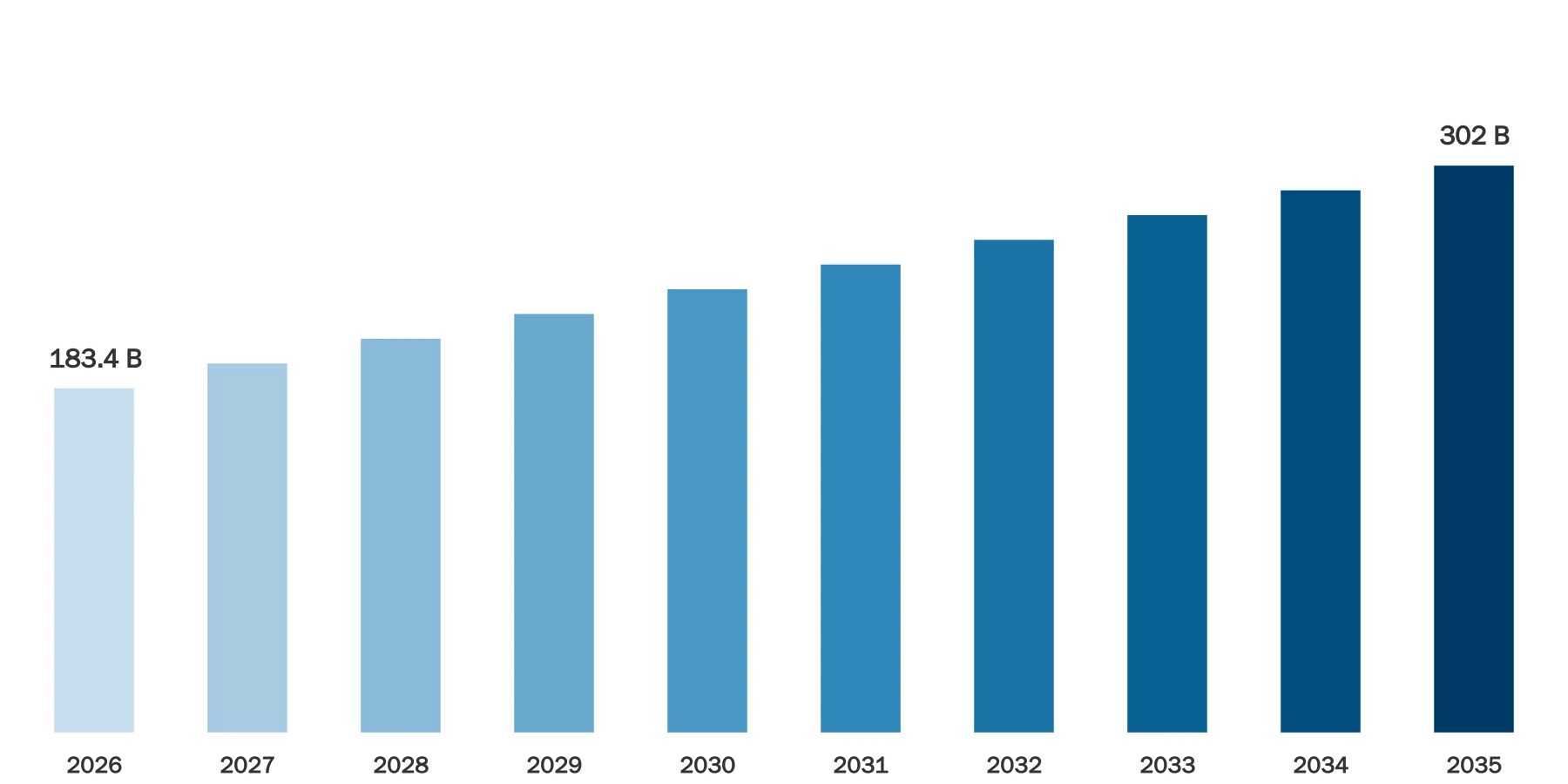
Source: Econ Market Research
Modular construction is a process in which the off-site construction of a building is completed using the same design, standards, and materials. The buildings are constructed in modules, which are then put together on-site. The modular construction creates fewer site disturbances and generates less waste as compared to traditional construction. Furthermore, modular buildings can be easily disassembled, refurbished, and relocated for use as new modular homes, reducing the demand for raw materials as well as the energy required to construct new buildings.
The global modular construction market has great success and enormous growth. The market's growth resembles industrialization and urbanization across the globe. Furthermore, the global modular construction market has witnessed large investment growth in the last few years. The growth of the market we can witness today is because of the high investment in the construction sector. Furthermore, the world's growing population persuaded the construction industry to ramp up its infrastructure development efforts. However, the growing number of government initiatives and schemes adopting the manufacturing technique will likely offer more opportunities to market players worldwide.
The launch of modular houses: Construction News has learned that Project Etopia has stopped conducting business in the development sector. The company has laid off its final personnel from the development division as it shifts its emphasis to the production of modular construction panels. The business fired members of its planning team earlier this year and also made layoffs in the sales department in the past few weeks. Project Etopia focuses on 2D modular construction, which requires finishing projects offsite before bringing them onsite. For instance, the components might already have windows, doors, external cladding, or internal lining. In contrast, 3D modular refers to larger systems in which components are manufactured in advance and assembled on location.
Scope of the Report
The modular construction market involves the delivery and assembling of prefabricated, engineered building units at the construction site. The volumetric building modular units are usually in the form of highly serviced units, such as kitchens, toilets, complete rooms, bedrooms, halls, or parts of a room. The construction process of modular buildings is faster than the conventional process because it requires less time. Furthermore, other advantages associated with modular construction include greater flexibility, improved air quality, and a reduced construction schedule. The modular construction market is segmented by construction, material, end-user industry, application, and region. By construction, the market is segmented into two types: permanent modular and relocatable modular. By material, the market is segmented into steel, concrete, wood, plastic, and others. By application, the market is segmented into commercial, industrial/institutional, and residential. The report also covers the market size and forecasts for the modular construction market in 15 countries across the major regions, and for each segment, market sizing and forecasts have been done based on revenue (USD million).
Market Dynamics:
Market Drivers
The demand for construction is increasing as industrialization and urbanization increase. Infrastructure investments have increased over the last few years. Rising infrastructure investments are a crucial driver for the modular construction market. The population in the urban area is surging every year. It is a crucial requirement to offer comfortable living and professional places to urban citizens. Rapid urbanisation is the main driver of the modular construction industry.
Growth Opportunities
The adoption rate of the lean manufacturing technique provides many growth opportunities for the market. The adoption of these techniques can offer permanent and durable modular buildings. Also, the adoption of this construction technique provides profitability and other benefits to the market. Plenty of verticals will offer exceptional investment opportunities, and using these techniques in modular building will create plenty of growth prospects. This growth opportunity will ultimately benefit the overall modular construction market forecast.
Market Restraints
Lack of dependability in earthquake-prone areas, as well as a scarcity of skilled labor, can be major issues. for market growth Due to the lightweight module units and how they are put together, modular structures can fail. There are many things that are not good during earthquakes, including Due to the precast frame panels, the modular construction structures cannot stand up to a big earthquake. Also, roofs and walls made of light wood or metal can bend and deform in an earthquake because they are not as rigid as they used to be. So, modular construction is less common in places where there are a lot of earthquakes. The growth of the market is slowed down by the fact that people are afraid of modular construction technology.
Market Challenges
The rise in industrialization and urbanization is a driving factor as well as a challenge for the modular construction market. The rising rate of urbanization puts more demand on building construction. Also, the requirement to make efficient use of space and money is difficult in the modular construction market. The need to create innovative buildings for every modular construction is difficult in this market. With the modular construction, the customers require uniqueness in the building's construction.
Regional Analysis
Asia-Pacific is expected to dominate the global modular construction market during the forecast period. This is attributed to increased construction activities as a result of rising demand from the residential and commercial sectors. Furthermore, proactive government initiatives to promote eco-friendly housing result in an increase in demand for modular buildings.
North America accounted for the second-largest revenue share in the global market in 2022 and is expected to register a significantly faster revenue growth rate over the forecast period, owing to increasing oil and gas exploration and production in the region. The use of modular fabrication in the oil and gas industry is increasing due to a number of benefits, which include shortened project timelines, cost-effectiveness, better quality, and improved safety over the traditional method of facility development.
In Europe, supportive government initiatives in the U.K. are further expected to result in the growth of the market. For example, the United Kingdom government's accelerated construction programs and home building fund encourage innovators to develop land for housing, including modular projects, creating a positive impact on construction and fabrication providers and their clients' perceptions of modular construction. Also, the government has planned to achieve a 50% reduction in greenhouse gas emissions, which will bode well for the implementation of green modular infrastructure.
Competitive Landscape
The global Modular Construction Market Some of the major companies include: -
Skanska
Bouygues Construction
WillScot Mobile Mini Holdings Corp.
ATCO Ltd
SEKISUI CHEMICAL CO., LTD
Tempohousing
Supertech Industries LLC
Honomobo Corporation
Giant Containers Inc.
Anderco Pte. Ltd
Recent Developments in the market
In December 2022, a memorandum of agreement for the development of small modular nuclear reactors in the UK was signed by Balfour Beatty, Holtec Britain, and Hyundai Engineering and Construction (HDEC).
On February 17, 2022, Sioux Falls-based Hegg, a leading Real Estate firm, announced adding a modular construction division manufacturing facility with a 127,000-square-foot facility in Brandon. The site that will be used for manufacturing and storing the mods will be located at Hegg's Encore Park development on Brandon's western outskirts.
Modular Construction Market Report Scope & Segmentation
| Attributes | Details |
|---|---|
Market Size (Current) | US$ 183.4 Billion in 2026 |
Market Size (Forecast) | US$ 302 Billion in 2035 |
Growth Rate | CAGR of 5.7% from 2026 to 2035 |
Forecast Period | 2026 – 2035 |
Base Year | 2025 |
Historical Data Available | Yes |
Regional Scope | Global |
Segments Covered | By Material
By Construction
By Product
By Application
|
Frequently Asked Questions
Common questions about this report
The study period covers historical insights and forecast projections for the period 2026-2035.
About the Author
Market research expert with years of industry experience

Dipali Bhingare serves as the Market Research Director at Econ Market Research. With a focus on translating complex global economic shifts into actionable business intelligence, she oversees the strategic direction of comprehensive market studies. Her work empowers organizations to navigate volatile industries through data-driven forecasting and deep-dive competitive analysis.
Related Reports
Explore more market insights from the same category