

High Performance Door Market
High Performance Door Market Size, Share, Trends, Growth, and Industry Analysis, By Material (Metal, PVC, Rubber, Composite), By Product Type (Rolling Doors, Folding Doors, Sliding Doors), By Application (Cold Storage, Clean Rooms, Warehousing andamp; Distribution, Manufacturing), Regional Analysis and Forecast Period 2026-2035
Market Overview
As per Econ Market Research analysis, the Global High Performance Door Market was valued at approximately US$ 1.34 Billion in 2026 and is predicted to reach US$ 2.28 Billion by 2035, expanding at a CAGR of 6.1% over the forecast duration. The base year is 2025.
High Performance Door Market Size 2025-2035 (USD Billion)

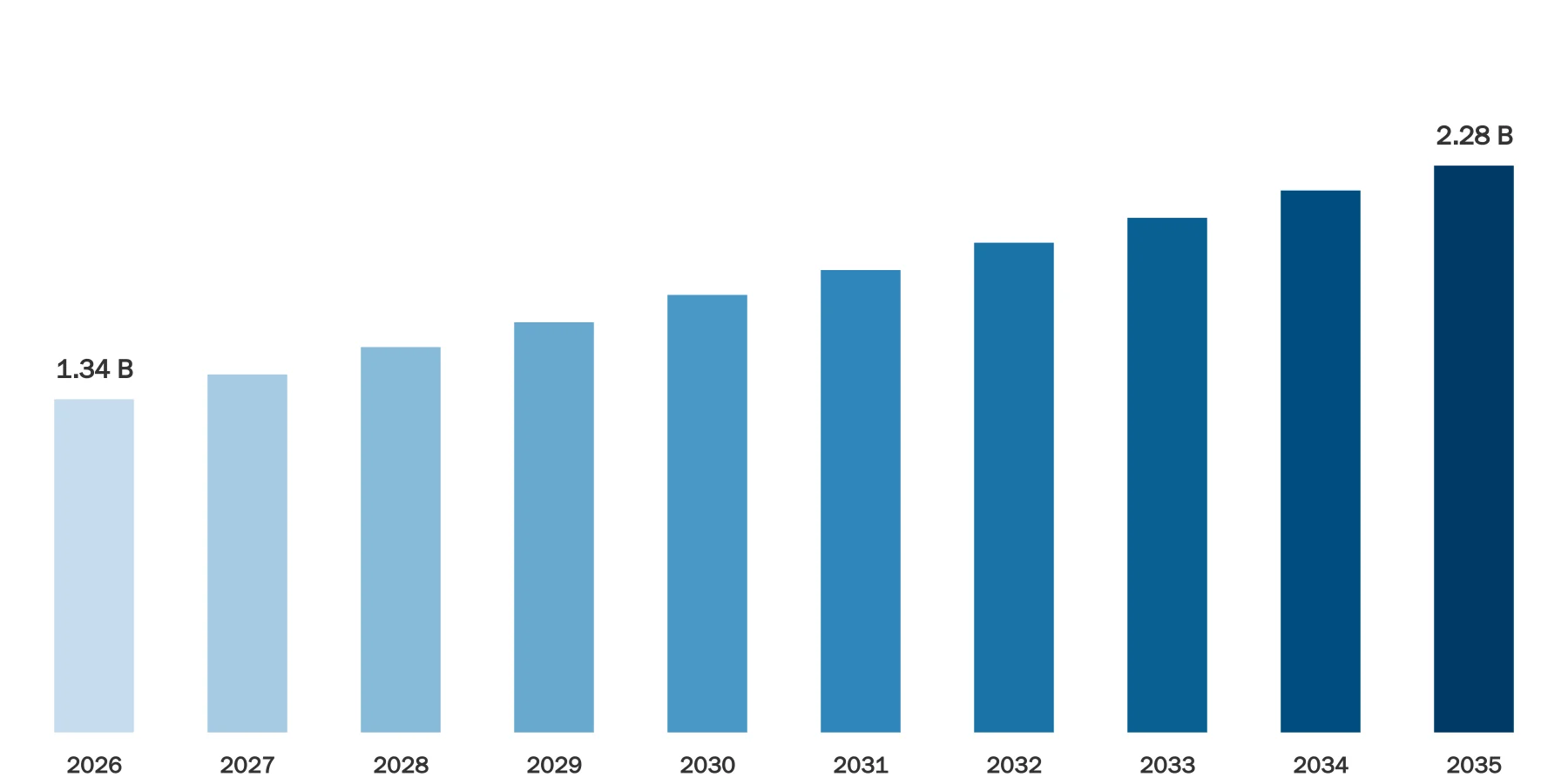
Source: Econ Market Research
High-performance doors are characterized by their ability to withstand heavy usage, high-speed operation, and robust construction. These doors find extensive applications in industrial, commercial, and institutional sectors, where they play a crucial role in enhancing operational efficiency, ensuring safety, and maintaining environmental control. Factors such as rapid industrialization, stringent regulations pertaining to energy efficiency and workplace safety, and technological advancements in door automation systems are fuelling market growth. Additionally, the growing emphasis on sustainability and the need for advanced security solutions are further augmenting the adoption of high-performance doors globally.
The roll-up, sliding, folding, and other products that meet a variety of end-user needs are included in the broader category of products that make up the global market for high-performance doors. In order to obtain a competitive edge, major players in the market concentrate on product innovation, strategic alliances, and geographic expansion. The market is known for its fierce competition. Due in large part to the region',s rapid industrialization, advancements in infrastructure, and rising investments in institutional and commercial sectors throughout emerging economies, Asia Pacific is the market leader geographically. Furthermore, strict regulatory requirements and the replacement of conventional doors with high-performance alternatives are driving the steady growth that is being observed in North America and Europe.
High Performance Door Dynamics
The growing focus on workplace efficiency and safety in sectors like manufacturing, logistics, and pharmaceuticals is one of the main motivators. Fast opening and closing times, sturdy construction, and cutting-edge safety features are just a few of the characteristics of high-performance doors that not only improve operational effectiveness but also reduce the chance of mishaps and injuries.
Furthermore, the use of high-performance doors is being driven by strict regulations pertaining to environmental sustainability and energy conservation. These doors are made to reduce air leakage and heat transfer, which maximises energy efficiency in buildings. Furthermore, by providing improved convenience, security, and control over access points, technological developments in door automation systems&mdash,such as sensor-based controls, RFID integration, and remote monitoring capabilities&mdash,are supporting market growth.
The integration of high-performance doors with IoT platforms and building management systems is also being driven by the growing trend towards smart buildings and Industry 4.0 initiatives. This integration enables real-time data monitoring and predictive maintenance, which in turn is driving demand in the market. However, obstacles like the high upfront costs of buying and installing high-performance doors also have an impact on the market dynamics, especially for small and medium-sized businesses. Additionally, a competitive threat to market expansion is the availability of low-cost and conventional alternatives to doors.
High Performance Door Drivers
Increasing Emphasis on Workplace Safety and Efficiency
The need for high-performance doors is growing as a result of the emphasis placed on workplace safety by sectors like manufacturing, logistics, and pharmaceuticals. These doors have strong construction, quick opening and closing times, and cutting-edge safety features that reduce the chance of mishaps and injuries while also improving operational effectiveness. Adopting high-performance doors becomes essential for companies looking to protect worker well-being while preserving productivity levels as workplace safety regulations become more stringent.
Technological Advancements in Door Automation Systems
The market for high-performance doors is expanding significantly due to the development of door automation systems. More convenience, security, and control over access points are provided by cutting-edge technologies like RFID integration, sensor-based controls, and remote monitoring capabilities. Through the simplification of procedures pertaining to entry and exit points within facilities, these innovations empower businesses to optimise their operations. Additionally, the trend towards smart buildings and Industry 4.0 initiatives is supported by the integration of high-performance doors with IoT platforms and building management systems, which enables real-time data monitoring and predictive maintenance, thereby driving up market demand.
Restraints:
One of the primary challenges hindering market growth is the high initial investment required for purchasing and installing high-performance doors, particularly for small and medium-sized enterprises (SMEs). The upfront costs associated with acquiring these technologically advanced doors can deter budget-conscious businesses from investing in them, despite their long-term benefits in terms of safety, efficiency, and energy savings. Addressing this barrier may require manufacturers to explore innovative financing options or develop cost-effective solutions without compromising on quality and performance.
Availability of Alternative Door Solutions
High-performance doors have advantages, but conventional doors and less expensive alternatives are competitive in the market. Even though high-performance doors are the best in terms of speed, toughness, and security, conventional doors might still work well in some situations, particularly in situations where there is less demand or money is tight. Market participants must stress the distinctive value proposition of high-performance doors, emphasising their better performance and long-term cost-effectiveness in comparison to alternative options, in order to overcome this constraint.
Opportunities:
Expansion of Industrial and Commercial Infrastructure
The ongoing expansion of industrial and commercial infrastructure, particularly in emerging economies, presents a significant growth opportunity for the high-performance door market. As industries invest in new facilities or upgrade existing ones to accommodate growing demand and improve operational efficiency, the need for advanced door solutions becomes apparent. Market players can capitalize on this trend by offering tailored high-performance door solutions that address specific requirements and challenges across diverse sectors, ranging from manufacturing plants and warehouses to retail outlets and healthcare facilities.
Segment Overview
By Materials
The segmentation by materials categorizes high-performance doors based on the primary material used in their construction. This includes options such as metal, fabric, glass, and others. Metal doors are known for their durability and strength, making them suitable for heavy-duty applications in industrial settings. Fabric doors offer flexibility and lightweight design, often used in environments requiring rapid opening and closing speeds. Glass doors provide a modern aesthetic appeal and transparency, commonly found in commercial and architectural applications. The ",others", category encompasses alternative materials or composite constructions, catering to specific requirements or niche markets within the high-performance door industry.
By Product Types
Segmentation by product types classifies high-performance doors into various categories based on their design and functionality. Options include rolling doors, sectional doors, folding doors, sliding doors, and others. Rolling doors feature vertical operation and compact storage, ideal for spaces with limited overhead clearance. Sectional doors consist of multiple horizontal panels that slide vertically, offering versatility and insulation properties.
Folding doors utilize a concertina-like mechanism for space-saving operation and are often used in large openings or industrial environments. Sliding doors offer seamless operation and are commonly used in both interior and exterior applications. The ",others", category encompasses specialized door designs or hybrid configurations that may not fit into conventional classifications, providing additional options for specific use cases or custom requirements.
By Operation Methods
Segmentation by operation methods categorizes high-performance doors based on how they are operated. This includes manual, automatic, and high-speed options. Manual doors require physical effort to open and close, suitable for smaller openings or applications where automation is not feasible or necessary. Automatic doors feature motorized mechanisms for convenient and hands-free operation, enhancing accessibility and efficiency in various environments. High-speed doors are designed for rapid opening and closing cycles, minimizing air infiltration and improving workflow in high-traffic areas or controlled environments requiring quick access.
By Applications
Segmentation by applications identifies the diverse use cases and environments where high-performance doors are deployed. This includes interior doors, exterior doors, Cold Storage doors, cleanroom doors, and fire-rated doors. Interior doors separate different areas within a building, providing privacy, noise control, and temperature regulation. Exterior doors serve as entry points to buildings or facilities, requiring durability, security, and weather resistance.
Cold storage doors maintain temperature-controlled environments in refrigerated or freezer spaces, preventing energy loss and preserving product integrity. Cleanroom doors ensure contamination control and air quality in sensitive environments such as laboratories or pharmaceutical facilities. Fire-rated doors provide passive fire protection, restricting the spread of flames and smoke during emergencies, and are essential for building safety and compliance with regulatory standards.
High Performance Door Overview by Region
Asia Pacific holds a significant share in the market, fuelled by rapid industrialization, urbanization, and infrastructure investments across countries like China, India, and Southeast Asian nations. The region',s burgeoning manufacturing sector, coupled with increasing adoption of advanced door solutions to enhance operational efficiency and safety, drives market growth. Moreover, stringent regulations regarding workplace safety, energy efficiency, and environmental sustainability further accelerate the demand for high-performance doors in Asia Pacific.
North America and Europe also contribute substantially to the market, propelled by robust industrial sectors, technological advancements, and emphasis on compliance with safety standards. These regions witness steady growth, driven by replacement demand for aging infrastructure, renovation projects, and the adoption of high-performance doors in commercial and institutional applications. Additionally, stringent building codes and regulations pertaining to energy conservation and fire safety stimulate market demand in North America and Europe.
Meanwhile, regions like Latin America, the Middle East, and Africa present untapped opportunities for market expansion, driven by infrastructure development, urbanization, and growing awareness about the benefits of high-performance doors. However, economic challenges, political instability, and fluctuating raw material prices may pose barriers to market growth in these regions.
High Performance Door Market Competitive Landscape
Major companies operating in the market include ASSA ABLOY, Rytec Corporation, Hormann, Rite-Hite, and Dortek Ltd., among others. These players focus on offering a diverse range of high-performance door solutions tailored to meet the specific requirements of various industries and applications. Product differentiation through technological advancements, such as sensor-based controls, RFID integration, and energy-efficient designs, is a key strategy employed by market participants to gain a competitive edge.
Moreover, strategic collaborations with distributors, suppliers, and end-users enable companies to enhance their market presence and penetrate new geographical regions. Geographic expansion through mergers and acquisitions or establishing manufacturing facilities in emerging markets is another common tactic adopted by leading players to capitalize on growing demand and gain a competitive advantage. Additionally, the competitive landscape is characterized by the presence of regional players offering specialized door solutions catering to niche markets or specific customer requirements.
High Performance Door Market Leading Companies:
ASSA ABLOY Group
Hormann Group
Rite-Hite
Efaflex
Rytec Corporation
Global High Performance Door report segmentation
High Performance Door Market Report Scope & Segmentation
| Attributes | Details |
|---|---|
Market Size (Current) | US$ 1.34 Billion in 2026 |
Market Size (Forecast) | US$ 2.28 Billion in 2035 |
Growth Rate | CAGR of 6.1% from 2026 to 2035 |
Forecast Period | 2026 – 2035 |
Base Year | 2025 |
Historical Data Available | Yes |
Regional Scope | Global |
Segments Covered | By Material
By Product Type
By Application
|
Frequently Asked Questions
Common questions about this report
The study period covers historical insights and forecast projections for the period 2026-2035.
About the Author
Market research expert with years of industry experience

Dipali Bhingare serves as the Market Research Director at Econ Market Research. With a focus on translating complex global economic shifts into actionable business intelligence, she oversees the strategic direction of comprehensive market studies. Her work empowers organizations to navigate volatile industries through data-driven forecasting and deep-dive competitive analysis.
Related Reports
Explore more market insights from the same category