

Head Mounted Display Market Overview
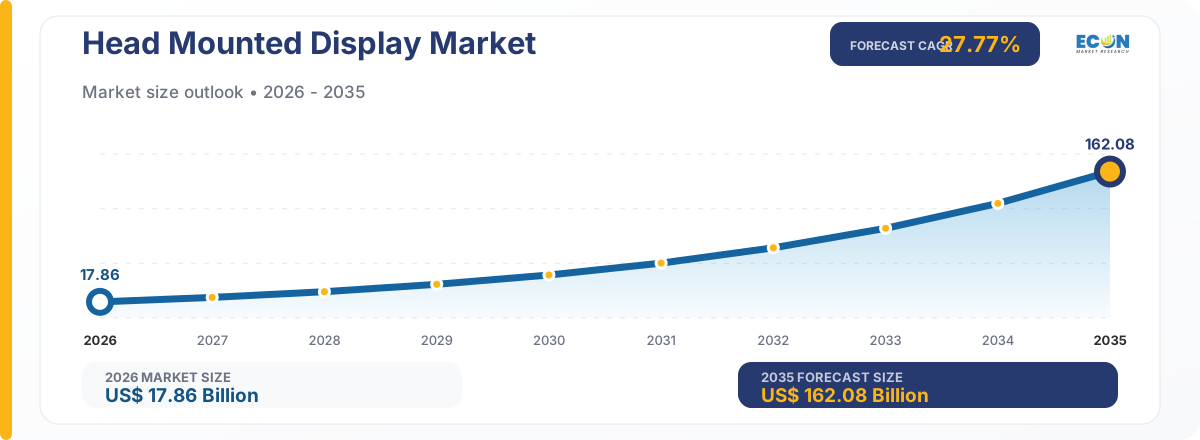
As per Econ Market Research analysis, the Global Head Mounted Display Market valuation stood at US$ 17.86 Billion in 2026 and is expected to reach US$ 162.08 Billion by 2035, growing at a steady CAGR of 27.77% from 2026 to 2035. 2025 serves as the base year.
The global Human Computer Interaction Head Mounted Display Market is experiencing substantial transformation due to the rapid penetration of virtual environments, enterprise visualization, and immersive industrial training systems. In 2024, more than 6.7 million AR and VR headsets were shipped globally, while over 74% of global headset shipments were controlled by a single manufacturer, indicating high market concentration. Enterprise deployment of head mounted display devices increased by 31% across healthcare simulation, aviation training, and industrial maintenance environments. More than 52 countries integrated augmented visualization systems into defense modernization programs between 2023 and 2025.
VR-based training modules reduced operational training time by nearly 40% in manufacturing applications. Over 110° field-of-view displays became standard in premium HMD systems, while refresh rates above 90 Hz accounted for nearly 68% of newly launched devices. Wireless head mounted display adoption exceeded 58% of total installations in 2024 due to reduced latency below 20 milliseconds and increased battery efficiency above 3 hours per session. Gaming applications continued to dominate with approximately 55% unit deployment share globally.
The USA Head Mounted Display Market remains one of the most technologically advanced ecosystems globally, supported by defense investments, enterprise digitization, and consumer gaming demand. North America accounted for nearly 39% of total global market share in 2024, with the United States contributing the majority of installations. More than 5.6 million consumer-grade VR headsets were distributed by leading vendors across the US market during 2024. The US military Integrated Visual Augmentation System program planned long-term procurement involving up to 10 years of deployment activity for combat visualization systems.
Approximately 41% of enterprise XR adoption in the United States came from healthcare, aerospace, and industrial engineering sectors. More than 300 universities and technical institutes in the US integrated immersive learning platforms using AR and VR head mounted display systems. Average headset display resolution in premium US devices exceeded 4K per eye in 2025 product launches. The US gaming community represented nearly 48 million active VR-capable users across console and PC environments.
The European Head Mounted Display Market demonstrates strong growth in automotive engineering, defense simulation, healthcare visualization, and smart manufacturing applications. Germany, France, and the UK together represented more than 61% of European HMD deployments in 2024. Over 2,000 industrial facilities across Europe adopted mixed reality maintenance solutions for production line optimization. European aerospace companies increased AR headset integration in aircraft assembly operations by 28% between 2023 and 2025. In medical environments, more than 90 surgical research projects evaluated optical see-through head mounted display systems for augmented surgical guidance applications.
Automotive companies in Europe deployed immersive prototyping solutions capable of reducing physical prototype dependency by nearly 35%. Wireless smart glasses represented over 44% of enterprise installations across logistics and warehouse management operations. More than 17 European defense agencies invested in augmented battlefield visualization technologies for pilot and infantry training applications. Europe also experienced rapid growth in standalone MR headset adoption due to increasing 5G coverage exceeding 78% urban penetration.
Head Mounted Display Market Latest Trends
The Head Mounted Display Market Trends indicate accelerated movement toward lightweight mixed reality systems, AI-powered smart glasses, and enterprise-grade immersive collaboration platforms. In 2024, global AR and VR headset shipments increased by approximately 10% after two years of market contraction. AI integration into XR devices became a major technology trend, especially in smart glasses and real-time visualization systems. More than 63% of newly introduced devices included integrated AI-based gesture recognition and eye-tracking capabilities. Standalone wireless devices represented over 58% of all shipments, replacing wired architectures in gaming and enterprise environments.
The adoption of OLED microdisplays above 3000 pixels per inch increased significantly among premium HMD manufacturers. More than 68% of premium VR headsets introduced in 2025 featured refresh rates above 90 Hz to minimize motion sickness. Enterprise applications expanded rapidly, with industrial simulation deployments increasing by nearly 31%. Healthcare institutions adopted AR-assisted surgical visualization systems in over 90 clinical studies globally. The automotive sector increased immersive engineering deployment by nearly 35% to improve virtual prototyping workflows.
Consumer preferences also shifted toward compact Augmented Reality Glasses instead of bulky VR systems. In China, AR glasses shipments increased by more than 32%, while VR headset sales declined by over 34% during 2024. Smart glasses shipments in Q1 2026 surged by 111% year over year, highlighting changing consumer adoption behavior. Defense modernization remained another important trend, with over 17 countries expanding military HMD procurement programs for battlefield awareness and pilot simulation training. AI-enabled voice interfaces, spatial mapping systems, and biometric authentication solutions became standard functionalities across next-generation head mounted display devices.
Head Mounted Display Market Dynamics
The Head Mounted Display Market Analysis reflects expanding enterprise adoption, increasing AI integration, and continuous improvements in display technology. More than 6.7 million units were shipped globally in 2024, while enterprise adoption increased across healthcare, aerospace, defense, education, and industrial sectors. Consumer demand remains concentrated in gaming applications, representing nearly 55% of total device deployments. Wireless systems accounted for more than 58% of market installations due to improvements in battery life, processor efficiency, and low-latency connectivity. Mixed reality systems are increasingly replacing traditional VR devices in industrial environments because of enhanced situational awareness and real-time visualization capabilities. Market competition intensified as over 25 major manufacturers introduced new AR and MR products between 2023 and 2025. Security, comfort, software optimization, and ecosystem integration remain critical factors influencing adoption decisions.
DRIVER
Increasing Adoption of Immersive Enterprise Training
Enterprise digital transformation is the primary driver accelerating the Head Mounted Display Market Growth across industrial and commercial environments. More than 41% of enterprise XR deployments were associated with industrial simulation, healthcare training, and aerospace maintenance operations during 2024. Manufacturing companies reduced workforce training time by nearly 40% through VR simulation modules. Aviation maintenance training using AR overlays improved procedural accuracy by approximately 32% in pilot studies. Over 300 educational institutions in the United States deployed immersive learning systems for technical training programs.
Defense modernization is another major contributor to market expansion. More than 17 military agencies adopted augmented visualization systems for tactical awareness and combat simulation. Military-grade mixed reality helmets enabled real-time battlefield mapping, drone integration, and operational analytics. Industrial facilities implementing AR-assisted maintenance systems reported productivity improvements exceeding 28%. Healthcare simulation systems using optical see-through displays increased anatomical visualization precision in more than 90 surgical studies globally. The growing requirement for remote collaboration and digital twin visualization further accelerated enterprise procurement of mixed reality head mounted display solutions.
RESTRAINT
High Device Costs and Limited Consumer Retention
High hardware costs and inconsistent consumer engagement remain major restraints affecting the Head Mounted Display Industry Analysis. Premium mixed reality devices exceeded price thresholds above $1,000 in many regions, limiting mass-market accessibility. Industry estimates indicated that premium devices represented only 5% to 6% of total market shipments in 2024. Global VR headset shipments declined by approximately 12% during 2024 due to limited content ecosystems and insufficient mainstream use cases.
Consumer retention also remains a challenge because many users discontinue headset usage within several months after purchase. Device discomfort, battery limitations, eye strain, and motion sickness continue to influence adoption rates negatively. Enterprise-focused systems often require additional investments in infrastructure, specialized software, and workforce training. In China, VR headset sales declined by more than 34% during 2024 as consumers shifted toward lightweight smart glasses and mobile-compatible AR devices. Heavy devices exceeding 500 grams also reduced long-duration usability for enterprise professionals and gaming consumers. Software fragmentation and lack of universal standards further slowed ecosystem development across mixed reality hardware platforms.
OPPORTUNITY
Expansion of AI-Integrated Smart Glasses
AI-integrated augmented reality glasses represent a major opportunity within the Head Mounted Display Market Forecast. Smart glasses shipments increased by more than 111% year over year in Q1 2026 across major Asian markets. AI-enabled voice interaction, real-time translation, contextual visualization, and object recognition capabilities are creating strong enterprise and consumer demand. Logistics companies deploying AR smart glasses improved warehouse picking accuracy by approximately 25%.
Healthcare environments are adopting lightweight visualization systems for remote diagnostics and procedural support. More than 90 medical research studies evaluated optical see-through HMD applications for surgical guidance and anatomical mapping. Retail and e-commerce sectors increasingly use augmented visualization tools for virtual product demonstrations and customer interaction. Automotive companies are integrating AR visualization into assembly line maintenance and quality control systems.
The rapid rollout of 5G infrastructure also supports future market opportunities. Urban 5G coverage exceeded 78% across multiple developed regions by 2025, enabling cloud-based rendering and ultra-low latency visualization. AI-powered biometric authentication systems and eye-tracking analytics further increase the commercial value of advanced smart glasses platforms. Enterprise demand for collaborative holographic workspaces is expected to create additional procurement opportunities across engineering and design industries.
CHALLENGES
Privacy, Security, and Technical Limitations
The Head Mounted Display Market Outlook continues to face significant challenges related to privacy protection, cybersecurity, and technical performance limitations. Research analyzing 500 VR applications identified widespread vulnerabilities involving privacy leaks and inconsistent data collection practices. Head mounted displays frequently collect biometric information including eye movement, facial mapping, and spatial environment data, increasing cybersecurity concerns for enterprises and consumers.
Hardware limitations also remain problematic. Many devices continue to experience battery durations below 3 hours during intensive workloads. Motion sickness and eye fatigue affect nearly 20% to 40% of users in prolonged immersive sessions according to usability studies. Thermal Management challenges become increasingly critical as processors integrate AI acceleration and higher-resolution displays.
Software ecosystem fragmentation creates compatibility problems between operating systems, application stores, and hardware architectures. More than 25 major manufacturers currently operate different proprietary XR platforms. Defense-grade HMD systems also face durability and environmental resistance challenges in extreme operational conditions. Security researchers additionally identified vulnerabilities associated with shoulder-surfing attacks and unauthorized biometric access in smart headset authentication systems. Standardization gaps continue to affect interoperability across industrial and enterprise deployments worldwide.
SWOT Analysis
Strengths
More than 6.7 million AR and VR headsets shipped globally in 2024.
Wireless head mounted displays represented over 58% of total market deployments.
Enterprise XR adoption increased by approximately 31% across industrial sectors.
Gaming applications contributed nearly 55% of total device utilization globally.
Premium devices now support refresh rates above 90 Hz and field-of-view exceeding 110°.
Defense modernization programs in over 17 countries support long-term procurement demand.
AI-based gesture recognition and eye-tracking features are integrated into over 63% of new devices.
Weaknesses
VR headset shipments declined by approximately 12% during 2024.
Premium mixed reality devices above $1,000 represented only 5% to 6% of total shipments.
Battery duration in many high-performance devices remains below 3 hours.
Motion sickness affects nearly 20% to 40% of users during extended sessions.
Software fragmentation exists across more than 25 proprietary XR ecosystems.
Heavy headset designs exceeding 500 grams reduce comfort during long-term usage.
Opportunities
Smart glasses shipments increased by more than 111% in Q1 2026.
Urban 5G penetration exceeded 78% in developed regions, enabling cloud XR.
Over 90 healthcare studies evaluated AR-assisted surgical visualization systems.
Industrial maintenance productivity improved by approximately 28% using AR systems.
Automotive companies reduced physical prototyping requirements by nearly 35%.
AI-enabled contextual visualization expands enterprise software integration opportunities.
Threats
Privacy vulnerabilities identified across 500 VR applications in cybersecurity studies.
China VR market shipments declined by more than 34% during 2024.
Consumer retention rates remain inconsistent after initial hardware purchases.
Hardware overheating and thermal management limitations affect device performance.
Lack of interoperability standards slows enterprise integration projects.
Competition among more than 25 major manufacturers increases pricing pressure.
Segmentation Analysis
The Head Mounted Display Market Research Report demonstrates strong segmentation across applications, installation methods, connectivity systems, and end-user industries. Consumer gaming remains the largest application segment with approximately 55% unit utilization, while enterprise deployments continue expanding in healthcare, aerospace, engineering, and defense operations. Wireless installation methods accounted for more than 58% of deployments due to improved mobility and lower latency performance.
Mixed reality integration increased rapidly in industrial simulation and collaborative engineering environments. Commercial deployments in retail visualization and remote assistance applications grew by nearly 24% between 2023 and 2025. Educational institutions expanded VR-based learning systems across more than 300 universities globally. Distribution strategies also shifted significantly toward online sales channels, especially for consumer-grade VR and AR products.
By Product Type
Virtual Reality headsets continue dominating the Head Mounted Display Market Share with approximately 60% of total device installations globally. VR systems remain highly popular in gaming, simulation training, and immersive entertainment environments. More than 5.6 million VR-capable consumer devices were distributed during 2024. Augmented Reality headsets represented nearly 25% of the market due to increasing enterprise and industrial adoption. AR smart glasses experienced over 32% shipment growth in China during 2024.
Mixed Reality headsets accounted for approximately 15% of market deployments but demonstrated rapid expansion in engineering visualization, healthcare simulation, and defense operations. MR systems provide simultaneous physical and digital interaction, increasing enterprise demand. More than 17 military organizations deployed MR-enabled battlefield awareness systems between 2023 and 2025. OLED microdisplay integration above 3000 PPI became increasingly common across premium VR and MR devices.
By Connectivity
Wired head mounted displays accounted for nearly 42% of total deployments in 2024, primarily within gaming, aviation simulation, and industrial engineering applications requiring low-latency visualization. Wired systems continue supporting high-bandwidth graphics rendering and stable performance for professional environments. However, wireless HMD systems dominated with over 58% market share due to improvements in Wi-Fi 6, Bluetooth 5.3, and 5G connectivity infrastructure. Wireless devices reduced setup complexity and increased mobility for enterprise collaboration and remote maintenance applications.
Average wireless latency declined below 20 milliseconds in premium models introduced during 2025. Battery optimization also improved substantially, enabling over 3 hours of active operation in standalone devices. AI-powered cloud rendering solutions are further reducing dependency on physical computing infrastructure. Consumer demand for portable standalone VR systems accelerated the migration away from tethered architectures across gaming and education sectors.
By Type
Integrated HMD systems held approximately 47.5% of the global Head Mounted Display Market Size in 2024 due to self-contained processing and simplified deployment capabilities. These devices integrate displays, sensors, processors, and batteries into a single wearable unit. Slide-on HMD systems accounted for nearly 30% market share because of compatibility with smartphones and lower entry-level costs. Educational institutions and budget-conscious consumers widely adopted slide-on systems for immersive learning and mobile VR applications.
Discrete HMD systems represented approximately 22.5% of deployments, primarily in military simulation, aviation training, and industrial engineering. Discrete systems provide modular customization and advanced graphical processing for professional use cases. More than 68% of integrated HMD launches during 2025 featured eye-tracking and gesture recognition capabilities. Lightweight designs below 450 grams also became increasingly important for long-duration professional usage.
By End User
Consumers represented approximately 41.3% of total Head Mounted Display Industry Report deployments in 2024, mainly driven by gaming and entertainment applications. Enterprise users accounted for nearly 24% of installations due to digital transformation initiatives and remote collaboration requirements. Aerospace and defense represented around 14% of market demand because of increasing simulation and battlefield awareness programs. Engineering and design sectors contributed approximately 11% through immersive prototyping and digital twin visualization systems.
Commercial retail and logistics applications represented nearly 7% of deployments, while healthcare and education accounted for the remaining share. Over 90 surgical research programs evaluated AR-assisted visualization systems globally. Military procurement initiatives expanded significantly, with more than 17 countries integrating mixed reality systems into defense modernization programs. Industrial simulation systems improved workforce productivity by approximately 28% across manufacturing facilities.
By Distribution Channel
Online distribution channels accounted for nearly 64% of consumer-grade head mounted display sales during 2024 due to expanding e-commerce accessibility and direct-to-consumer strategies. Online channels enabled broader geographic reach and rapid product comparison for gaming and smart glasses buyers. Offline retail channels represented approximately 36% of market distribution, particularly for enterprise procurement and premium product demonstrations. Physical retail stores remained important for experiential testing, especially for VR gaming systems and mixed reality enterprise devices.
Commercial distributors increasingly partnered with industrial solution providers to support healthcare, manufacturing, and defense installations. More than 40% of enterprise procurement contracts included bundled software and hardware integration services. Regional warehouse expansion and faster logistics delivery improved online sales penetration in Asia-Pacific and North America. Offline enterprise channels also benefited from technical support requirements and customized integration services for industrial deployments.
Regional Analysis
North America maintained approximately 39% global market share in 2024.
Europe demonstrated strong adoption in automotive engineering and healthcare.
Asia-Pacific experienced rapid smart glasses shipment growth exceeding 32%.
Middle East & Africa expanded defense and industrial visualization deployments.
Wireless systems represented more than 58% of installations across all regions.
Enterprise applications contributed significantly to regional diversification.
North America
North America dominates the Head Mounted Display Market Insights landscape with approximately 39% global market share. The United States leads regional demand through consumer gaming ecosystems, enterprise digitization, and military modernization programs. More than 48 million users in North America actively engage with VR-capable gaming environments across console and PC platforms. Consumer adoption accelerated due to the availability of standalone wireless devices supporting refresh rates above 90 Hz and ultra-low latency rendering.
Defense procurement remains a major growth engine. The US military Integrated Visual Augmentation System program supports long-term deployment plans involving battlefield visualization, drone coordination, and tactical analytics. Aerospace and aviation companies across the region increased immersive simulation usage by approximately 27% between 2023 and 2025. More than 300 educational institutions integrated VR and AR learning systems into technical training programs.
Healthcare providers increasingly adopted AR visualization systems for medical training and surgical planning. Enterprise deployments also expanded in manufacturing and logistics environments, improving workflow productivity by approximately 28%. North America additionally benefits from advanced semiconductor ecosystems, 5G infrastructure penetration above 80% in urban zones, and strong AI integration capabilities. The region remains highly competitive, with more than 12 major HMD technology developers operating research facilities across the United States and Canada.
Europe
Europe represents one of the most technologically mature Head Mounted Display Market Opportunities regions due to advanced automotive engineering, aerospace manufacturing, and Industrial Automation capabilities. Germany, France, and the UK together accounted for more than 61% of European HMD installations during 2024. Automotive companies increasingly used immersive prototyping systems capable of reducing physical prototype dependency by nearly 35%.
European healthcare institutions also expanded augmented reality research activities significantly. More than 90 surgical studies globally evaluated optical see-through HMD systems, with European universities contributing substantial clinical research activity. Manufacturing facilities integrated mixed reality maintenance systems to improve operational efficiency and worker training accuracy. Industrial simulation systems reduced equipment downtime by approximately 22% across selected engineering environments.
Defense modernization programs expanded across multiple NATO member states. More than 17 defense agencies invested in mixed reality pilot simulation and battlefield visualization systems. Wireless AR smart glasses represented approximately 44% of enterprise visualization deployments in logistics and warehouse operations. Europe additionally benefits from strong industrial IoT integration and growing 5G infrastructure penetration exceeding 78% urban coverage. The region continues prioritizing sustainable lightweight device manufacturing and ergonomic industrial design standards for enterprise-grade mixed reality hardware.
Asia-Pacific
Asia-Pacific demonstrates the fastest technology adoption patterns within the Head Mounted Display Market Forecast ecosystem. China, Japan, South Korea, and India continue expanding immersive technology investments across gaming, manufacturing, healthcare, and smart city applications. AR smart glasses shipments in China increased by approximately 32% during 2024, while Q1 2026 shipments surged by more than 111% year over year.
Consumer gaming remains a dominant application across Asia-Pacific, particularly in China, Japan, and South Korea. More than 55% of regional device utilization was associated with gaming and entertainment applications. However, VR headset shipments in China declined by approximately 34% during 2024 as consumers shifted toward lightweight AR systems. Regional manufacturers increasingly focused on compact smart glasses integrating AI-powered translation, object recognition, and voice assistance features.
Asia-Pacific also experienced rapid enterprise adoption in logistics and manufacturing. Industrial facilities implementing AR visualization improved workflow productivity by nearly 28%. Semiconductor manufacturing ecosystems in Taiwan, South Korea, and China accelerated microdisplay innovation above 3000 PPI. The region additionally benefits from extensive electronics manufacturing capacity and highly competitive consumer pricing strategies. India and Southeast Asia are emerging as important educational and healthcare XR deployment markets due to expanding digital infrastructure and affordable wireless headset availability.
Middle East & Africa
The Middle East & Africa Head Mounted Display Market Outlook is expanding steadily through defense modernization, industrial training, and smart infrastructure initiatives. Gulf countries increased investments in immersive military simulation systems between 2023 and 2025. Defense organizations across the region adopted AR-enabled pilot training and tactical awareness platforms to improve operational preparedness. Oil and gas industries integrated wearable visualization systems to support remote maintenance and hazardous environment operations.
Smart city development projects in the UAE and Saudi Arabia accelerated demand for mixed reality collaboration systems in architecture, engineering, and construction environments. Industrial simulation technologies reduced workforce training durations by approximately 30% across selected energy sector deployments. Healthcare institutions also began implementing AR-assisted medical education systems in urban hospitals and universities.
Africa demonstrated growing interest in affordable mobile-compatible VR systems for educational applications. Wireless standalone devices represented the majority of deployments due to lower infrastructure requirements. Logistics and warehousing sectors in the Middle East increasingly adopted AR smart glasses for inventory management and operational efficiency improvements. Enterprise demand continues rising as regional 5G infrastructure expands across urban business hubs. Mixed reality visualization platforms are also supporting digital transformation initiatives in mining, transportation, and infrastructure planning projects throughout the region.

Competitive Landscape
The Head Mounted Display Competitive Landscape is highly concentrated, with a limited number of manufacturers controlling the majority of global shipments. One leading company captured approximately 74.6% market share in 2024, while another major technology vendor maintained approximately 5.2% share. Competition intensified between consumer-focused VR companies and enterprise-oriented mixed reality developers. More than 25 major manufacturers introduced new AR, VR, and MR devices between 2023 and 2025.
Competition increasingly centers around display resolution, latency optimization, AI integration, and ergonomic design. Premium devices now feature refresh rates exceeding 90 Hz, field-of-view above 110°, and OLED microdisplays exceeding 3000 PPI. Enterprise-focused manufacturers continue emphasizing industrial software integration, remote collaboration, and digital twin compatibility.
Defense partnerships also became strategically important. Military-grade mixed reality systems support battlefield visualization, drone integration, and situational awareness applications. AI-enabled gesture recognition and eye-tracking functionalities appeared in over 63% of newly launched devices during 2025. Manufacturers additionally focused on lightweight hardware below 450 grams to improve long-duration usability.
Software ecosystem development remains a critical competitive differentiator. Companies with larger application libraries and integrated cloud services maintain stronger enterprise retention rates. Hardware manufacturers are increasingly partnering with semiconductor firms, AI software providers, and telecommunications companies to accelerate next-generation wireless mixed reality platforms.
List of Top Head Mounted Display Companies
NATIONAL INSTRUMENTS CORP.
Siemens
HEAD acoustics GmbH
Brüel & Kjær
Meta
Sony Corporation
Microsoft
SAMSUNG
BAE Systems
HTC Corporation
Leading Companies by Market Share
Meta held approximately 74.6% of global AR/VR headset shipments during 2024, driven by strong consumer gaming ecosystems and standalone wireless headset adoption. The company maintained leadership through affordable hardware positioning and extensive software ecosystems.
Apple represented approximately 5.2% market share in 2024 through premium mixed reality device deployments. The company focused primarily on enterprise professionals, developers, and high-end immersive productivity applications.
Investment Trends & Opportunities
Investment activity in the Head Mounted Display Market Report continues accelerating due to AI integration, enterprise digitization, and smart glasses innovation. More than 25 manufacturers launched new immersive hardware products between 2023 and 2025. Defense modernization projects involving mixed reality visualization systems expanded across more than 17 countries globally. Military simulation programs increasingly integrate drone analytics, battlefield mapping, and tactical visualization into wearable display systems.
Enterprise software companies increased investments in digital twin visualization and remote collaboration environments. Manufacturing firms implementing immersive training systems reduced operational training durations by approximately 40%. Healthcare organizations expanded AR-assisted surgical research involving more than 90 global studies. Automotive engineering companies also increased spending on immersive prototyping systems capable of reducing physical prototype dependency by nearly 35%.
AI-enabled smart glasses represent one of the strongest investment opportunities. Q1 2026 smart glasses shipments increased by over 111% year over year in key Asian markets. Semiconductor investments also expanded significantly to support OLED microdisplay production above 3000 PPI. Telecommunications providers continue supporting cloud-rendered XR infrastructure through expanding 5G deployment exceeding 78% urban penetration in developed regions.
Investors increasingly prioritize companies focusing on lightweight ergonomics, biometric security, AI-powered visualization, and industrial software integration. Logistics, retail visualization, healthcare simulation, and industrial maintenance remain high-potential enterprise investment segments within the evolving head mounted display ecosystem.
Product Innovation & Development
Product innovation within the Head Mounted Display Market Trends ecosystem focuses heavily on lightweight form factors, AI integration, ultra-high-resolution displays, and improved comfort systems. Premium VR and MR devices introduced during 2025 increasingly supported display resolutions above 4K per eye and refresh rates exceeding 90 Hz. OLED microdisplay adoption above 3000 PPI significantly improved image clarity and reduced motion blur.
Manufacturers are prioritizing standalone wireless architectures with latency below 20 milliseconds and battery performance exceeding 3 hours. AI-powered gesture recognition and eye-tracking capabilities appeared in more than 63% of newly introduced devices. Smart glasses developers additionally integrated real-time translation, contextual visualization, and object recognition systems into lightweight wearable formats.
Defense-oriented product innovation accelerated through battlefield visualization systems integrating drone feeds and operational analytics. Medical device developers introduced AR-assisted surgical navigation platforms supporting anatomical overlay precision. Automotive companies deployed immersive engineering systems enabling collaborative digital twin visualization across global design teams.
Security-focused innovation also became increasingly important. Researchers evaluated biometric authentication systems using vibration-based identification and eye movement analytics. Ergonomic improvements reduced average headset weight below 450 grams in several premium models. Manufacturers further emphasized foldable optics, modular battery systems, and adaptive cooling technologies to improve long-duration usability across enterprise and consumer applications.
Recent Developments
In 2024, Meta captured approximately 74.6% of global AR/VR headset shipments after launching updated Quest devices and expanding standalone wireless ecosystem adoption.
In 2024, Apple introduced premium mixed reality systems supporting ultra-high-resolution displays exceeding 4K per eye, while shipping approximately 400,000 units globally.
In 2025, smart glasses shipments in China increased by approximately 111% year over year, highlighting rapid migration toward lightweight AR devices.
In 2024, the US military expanded mixed reality battlefield visualization collaboration programs involving Integrated Visual Augmentation Systems and tactical drone analytics.
During 2024, enterprise XR deployments increased significantly across healthcare and industrial simulation sectors, with training systems reducing operational learning durations by nearly 40%.
Scope of the Head Mounted Display Market Report
The Head Mounted Display Market Research Report covers comprehensive analysis of AR, VR, and mixed reality technologies across consumer, enterprise, defense, healthcare, industrial, and educational sectors. The report evaluates more than 25 major manufacturers operating within the global immersive technology ecosystem. Coverage includes wireless and wired connectivity architectures, integrated and slide-on headset systems, and optical visualization innovations above 3000 PPI display density.
The report analyzes shipment trends exceeding 6.7 million units globally during 2024 and examines market penetration across North America, Europe, Asia-Pacific, and Middle East & Africa regions. It includes segmentation analysis by product type, connectivity, distribution channel, installation method, and end-user industries. Enterprise digital transformation trends involving healthcare simulation, aerospace maintenance, automotive prototyping, and industrial training are evaluated extensively.
Technology assessment covers AI integration, biometric security systems, eye-tracking analytics, gesture recognition, cloud rendering infrastructure, and 5G-enabled low-latency visualization. The report additionally reviews ergonomic developments reducing device weight below 450 grams and performance improvements supporting refresh rates above 90 Hz.
Competitive analysis focuses on market concentration, software ecosystems, strategic partnerships, defense procurement initiatives, and enterprise collaboration platforms. The study further examines cybersecurity vulnerabilities, privacy concerns, interoperability challenges, and evolving consumer adoption patterns across global immersive visualization markets.
Head Mounted Display Market Report Scope & Segmentation
| Attributes | Details |
|---|---|
Market Size (Current) | US$ 17.86 Billion in 2026 |
Market Size (Forecast) | US$ 162.08 Billion in 2035 |
Growth Rate | CAGR of 27.77% from 2026 to 2035 |
Forecast Period | 2026 – 2035 |
Base Year | 2025 |
Historical Data Available | Yes |
Regional Scope | Global |
Segments Covered | By Product Type
By Connectivity
By Type
By End User
By Distribution Channel
|
Frequently Asked Questions
Common questions about this report
The study period covers historical insights and forecast projections for the period 2026-2035.
About the Author
Market research expert with years of industry experience

Dipali Bhingare serves as the Market Research Director at Econ Market Research. With a focus on translating complex global economic shifts into actionable business intelligence, she oversees the strategic direction of comprehensive market studies. Her work empowers organizations to navigate volatile industries through data-driven forecasting and deep-dive competitive analysis.
Related Reports
Explore more market insights from the same category