Field Service Management Market Overview
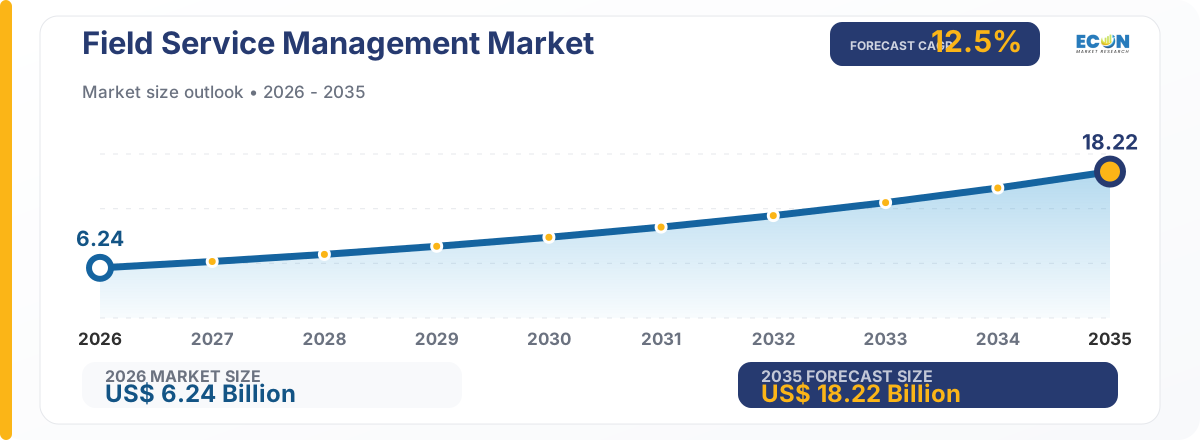
As per Econ Market Research analysis, the Global Field Service Management Market generated revenue of US$ 6.24 Billion in 2026 and is forecast to achieve US$ 18.22 Billion by 2035, at a CAGR of 12.5% during the study period 2026–2035. The base year considered is 2025.
With more businesses realizing the benefits of efficient operations, the field service management market has experienced rapid expansion. This industry focuses on using data analytics, automation, and cutting-edge technologies to maximize field-based operations. Businesses use field service management solutions to guarantee effective resource allocation, increase worker productivity, and improve customer satisfaction. This market is always changing, with new options for scheduling, dispatching, and real-time communication being offered by the proliferation of mobile devices, IoT, and Cloud Computing. The field service management market continues to be a key driver of operational excellence in a variety of industries, as companies place an increasing emphasis on smooth field operations.
Field Service Management Market Dynamics
This industry is driven by innovation because to the growing need for workforce optimization, predictive maintenance, and real-time visibility. Customers are happier and operations are run more efficiently when cloud, IoT, and Artificial Intelligence are all integrated. Competitors and product innovators are encouraged by market participants', constant adaptation to shifting consumer needs.
Further transforming service delivery paradigms include mobile accessibility and distant connectivity. A rising emphasis on sustainability and environmental concerns also has an impact on market dynamics. Technological innovations, client demands, and industry-specific requirements all interact dynamically to shape the field service management market.
Field Service Management Drivers
Technological Advancements
Businesses can now improve productivity, efficiency, and customer experiences because to the quick development of technologies like cloud computing, artificial intelligence, and the Internet of Things. Processes are revolutionized by automation, data analytics, and real-time connection, allowing firms to act quickly and decisively. Industries that adopt these developments get a competitive advantage, optimize processes, and investigate novel avenues. In today',s dynamic and fast-paced corporate climate, technological advancements guarantee continued growth and relevance by not only promoting immediate benefits but also cultivating a culture of continual innovation.
Remote Connectivity
Real-time communication and data interchange are made possible by the broad adoption of digital technology, cloud computing, and secure networking solutions. With the ability to connect, participate, and access centralized systems from any place, this driver empowers remote workforces. Having more connectivity makes it easier to be flexible, responsive, and maintain operations especially when dealing with major international emergencies like pandemics. The capacity to establish and maintain robust distant connectivity becomes critical to preserving productivity, innovation, and overall business continuity as firms place a higher priority on flexibility and resilience.
Restraints:
For small and medium-sized businesses in particular, the significant upfront cost of deploying solutions which includes software, hardware, and training may be a deterrent. The adoption of technologies that increase efficiency may be impeded by this financial load, which can restrict access to sophisticated instruments. Budgetary restrictions may also cause resources to be diverted from other important business sectors. For a balanced investment approach in the dynamic landscape of changing business technology, overcoming the barrier of high initial costs requires strategic financial planning, potential resistance from stakeholders, and careful assessment of long-term advantages.
Implementation Challenges
The complex process of integrating technology with current operations can cause delays and disruptions in the smooth implementation of solutions. The successful implementation of new techniques may be impeded by employee resistance. It will take careful planning, extensive training programs, and successful change management techniques to overcome these obstacles. Ignoring implementation issues can lead to less-than-ideal system performance, which will negatively impact the effectiveness of the implemented solutions inside the organizational structure as well as overall efficiency.
Opportunities:
AI and Machine Learning Applications
Predictive analytics is made possible by these technologies, giving companies the ability to foresee trends, improve decision-making, and optimize operations. AI-driven solutions reduce red tape, boost productivity, and reveal important insights in industries including healthcare, finance, and manufacturing. In addition to increasing efficiency, the capacity to automate repetitive processes and adjust to changing data patterns also promotes innovation. Organizations gain a competitive edge when they use AI and machine learning more and more. This opens up new opportunities for individualized services, cost reductions, and game-changing breakthroughs in a variety of industries.
Augmented Reality (AR) in Field Operations
AR transforms the way technicians carry out their work by superimposing digital information onto the real world. AR makes it possible for personnel to troubleshoot, acquire contextual information, and interact easily in a variety of sectors, including maintenance, training, and remote assistance. The utilization of immersive technology leads to increased production, decreased downtime, and improved operational efficiency. As augmented reality develops, companies can take advantage of this chance to improve field operations, offer engaging training, and present creative solutions that transform how teams interact with their workspaces and usher in a new era of productivity.
Segment Overview
By Component
Based on components, the global field service management market is divided into solutions and services. The solutions category dominates the market with the largest revenue share in 2023. Solutions for managing field services include software programs or systems that are intended to automate, simplify, and improve many facets of field service operations. These systems include a number of features, including real-time tracking, work order management, inventory control, scheduling, and dispatching. Complementing technological solutions, field service management services handle the operational and human elements of setting up and keeping an efficient field service management system.
By Enterprise Size
Based on the enterprise size, the global field service management market is categorized into large enterprises and SMEs. The large enterprises category leads the global field service management market with the largest revenue share in 2023. Large enterprises are often defined as businesses with a sizable workforce, a wide range of resources, and a significant operational size. These companies operate in a variety of industries and can have a regional or worldwide presence. SMEs are companies that operate on a smaller scale than huge corporations. This category encompasses a wide range of businesses, from small startups to medium-sized enterprises.
By Deployment Mode
Based on deployment mode, the global field service management market is divided into on-premise and cloud. The cloud category dominates the market with the largest revenue share in 2023. One benefit of cloud FSM systems is that they may be accessed from any location with an internet connection. They also offer scalability, which lets companies modify their resource allocation in response to demand. Organizations can have more control over their infrastructure and data with on-premise solutions, which is beneficial for sectors with strict security and compliance regulations.
By End-Use Industry
Based on the end-use industry, the global field service management market is segmented into manufacturing, healthcare, BFSI, transportation &, logistics, energy &, utilities, telecom, construction &, real estate, and others. The telecom segment dominates the field service management market. To increase service reliability, field service management (FSM) is used in the telecom sector for activities including network maintenance, field service scheduling, and quick service outage response.
For effective project delivery and property management, personnel optimization, equipment maintenance, and project management are made easier in the construction and real estate industries by FSM. BFSI employs field support management (FSM) to optimize field operations for tasks including asset management and customer support, manage financial equipment maintenance, and handle service requests.
Field Service Management Market Overview by Region
The global field service management market is categorized into North America, Europe, Asia-Pacific, and the Rest of the World. North America emerged as the leading region, capturing the largest market share in 2023. The region',s businesses place a high value on innovation, customer happiness, and operational efficiency, which propels the broad use of FSM solutions.
North American businesses in a variety of industries, including manufacturing, healthcare, finance, and more, use FSM because of the developed market ecosystem to maximize field operations. North America is positioned as a leader in adopting and propelling the growth of the FSM market due to the existence of significant industry players and a high knowledge of cutting-edge technology. Throughout the forecast period, Asia-Pacific is anticipated to post a significant CAGR.
The region',s growing economy, fast industrialization, and rising use of cutting-edge technologies in a variety of industries are driving this progress. The need for FSM solutions is growing as companies in the Asia-Pacific region place a higher priority on customer service and operational efficiency. The area is well-positioned for continued market expansion as a result of the changing technological landscape and rising consumer awareness of the advantages of FSM.
Field Service Management Competitive Landscape
In the global field service management market, a few major players exert significant market dominance and have established a strong regional presence. These leading companies remain committed to continuous research and development endeavors and actively engage in strategic growth initiatives, including product development, launches, joint ventures, and partnerships. By pursuing these strategies, these companies aim to strengthen their market position, expand their customer base, and capture a substantial share of the market.
Field Service Management Market Leading Companies:
IBM Corporation
Agile 3 Solutions LLC
Accenture
Comarch SA
Salesforce, Inc.
Infor
Klugo Group,
SAP SE
Astea International, Inc.
Trimble Navigation Limited
Tech Mahindra Limited, and various others,
Field Service Management Recent Developments
In December 2023, for field service, contactless, cashless, and self-service capabilities are still requirements. Future developments will give both customers and employees greater freedom and convenience. The relationship between field service and consumers will likely change further as firms make technological investments to support field service personnel.
In October 2023, Oracle declared that it has acquired Next Technik, a well-known supplier of field service management products designed especially for NetSuite users. Oracle hopes to revolutionize the field service industry with this purchase by providing improved customer satisfaction and efficiencies.
In September 2023, With the purchase of software publisher Synchroteam, Nomadia is growing faster in the Field Service Management (FSM) space. A single CRM that can be used by firms of all sizes and in all industries is provided by Synchroteam, an all-in-one solution that unifies all maintenance and service company operations.
In September 2022, A new cognitive AI solution called YANTR.AI was introduced by Tech Mahindra to improve and streamline field services. It is anticipated that the solution will give businesses practical insights for more effective field service planning and execution. The portfolio of Tech Mahindra',s Business Process as a Service (BPaaS) is further strengthened by this.
Field Service Management Market Report Segmentation
Field Service Management Market Report Scope & Segmentation
| Attributes | Details |
|---|---|
| Market Size (Current)Current market valuation | US$ 6.24 Billion in 2026 |
| Market Size (Forecast)Projected market valuation | US$ 18.22 Billion in 2035 |
| Growth RateCompound Annual Growth Rate | CAGR of 12.5% from 2026 to 2035 |
| Forecast PeriodAnalysis timeline | 2026 – 2035 |
| Base YearReference year for analysis | 2025 |
| Historical Data AvailablePast market data availability | Yes |
| Regional ScopeGeographical coverage | Global |
| Segments CoveredMarket segments analyzed | By Deployment
By Organization Size
By Solution
By End-User
|
Leading companies covered in this report
- Oracle
- Microsoft
- Salesforce
- IFS
- SAP SE
- ServicePower
- Zinier
- FieldAware
- ClickSoftware (Salesforce)
Frequently Asked Questions
Common questions about this report
The study period covers historical insights and forecast projections for the period 2026-2035.
About the Author
Market research expert with years of industry experience

Dipali Bhingare serves as the Market Research Director at Econ Market Research. With a focus on translating complex global economic shifts into actionable business intelligence, she oversees the strategic direction of comprehensive market studies. Her work empowers organizations to navigate volatile industries through data-driven forecasting and deep-dive competitive analysis.