

Crosslinking Agent Market
Crosslinking Agent Market Research Report: By Chemistry (Amino, Amine, Isocyanate, Amide, Aziridine, Carbodiimide, Others), By Application (Decorative Coatings, Industrial Coatings, Transportation Coatings, Projective Coatings, and Marine Coatings), and Region (North America, Europe, Asia-Pacific, and Rest of the World) Global Industry Analysis, Size, Share, Growth, Trends, Regional Analysis, Competitor Analysis and Forecast
Market Overview
As per Econ Market Research analysis, the Global Crosslinking Agent Market was estimated at US$ 10.17 Billion in 2026 and is forecast to attain US$ 14.13 Billion by 2035, expanding at a CAGR of 3.71% between 2026 and 2035. The base year for the study is 2025.
Crosslinking Agent Market Size 2025-2035 (USD Billion)

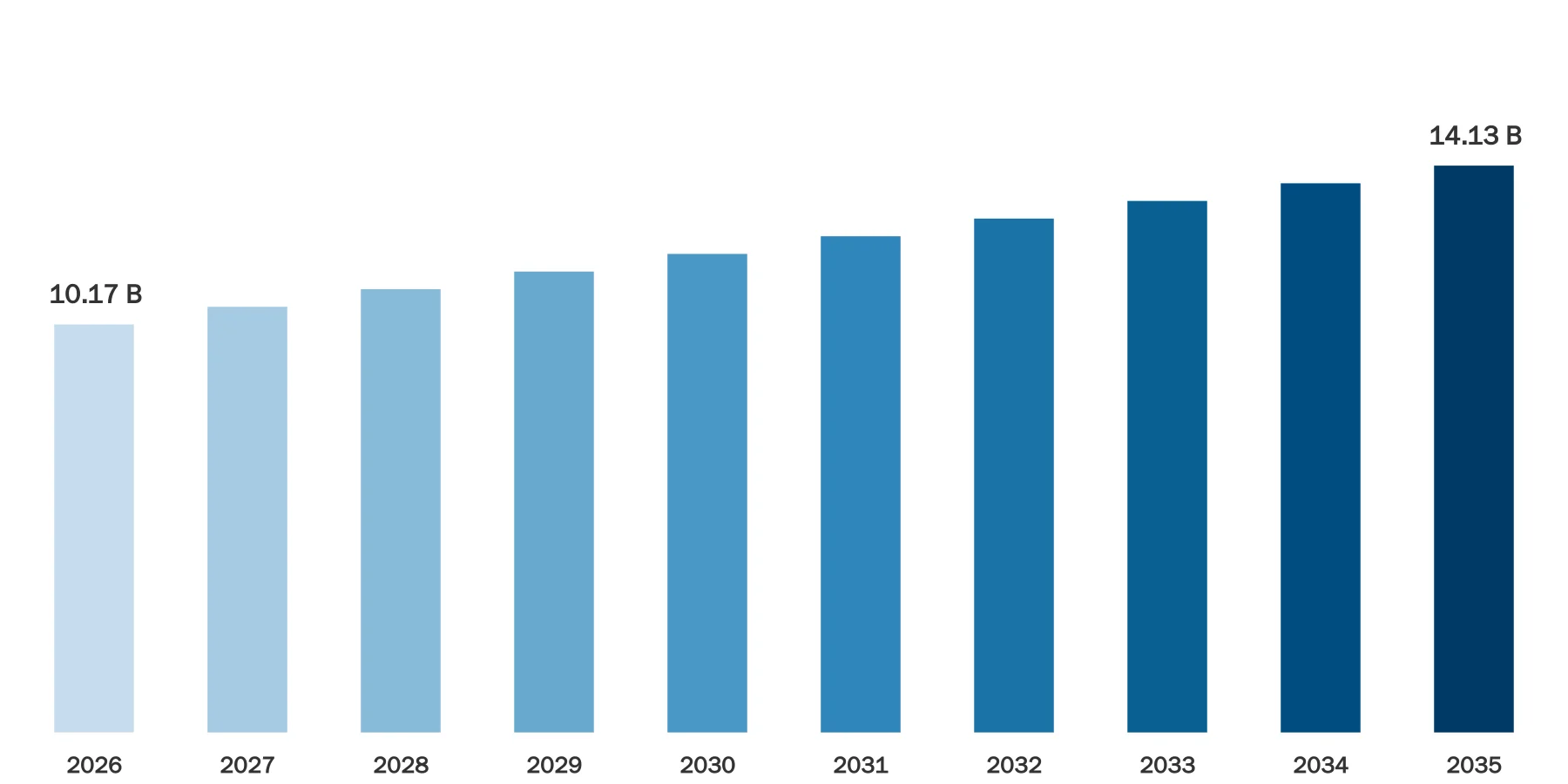
Source: Econ Market Research
The crosslinking agents market plays a pivotal role in numerous industries by providing essential additives that enhance the properties of materials, contributing to improved performance and durability. Crosslinking agents are chemicals or compounds that facilitate the formation of covalent bonds between polymer chains within a material. This process creates a network structure that strengthens the material and imparts desirable characteristics, such as increased mechanical strength, thermal stability, chemical resistance, and overall integrity.
Crosslinking agents are utilized in a wide range of applications, spanning industries such as rubber, plastics, coatings, adhesives, textiles, and more. They contribute to the development of products that can withstand harsh environmental conditions, wear and tear, and exposure to chemicals, making them indispensable in modern manufacturing and technology.
Crosslinking Agent Market Dynamics
The crosslinking agents market is driven by the technological advancements that fuel continuous R&,D, yielding novel agents and innovative applications. Industries across sectors such as automotive, construction, electronics, packaging, and healthcare are continuously seeking materials with improved properties, including mechanical strength, thermal stability, chemical resistance, and durability. This demand fuels the need for effective crosslinking agents that can enhance material performance. Increasing awareness of environmental issues and the need for sustainable practices drive the exploration of eco-friendly and bio-based crosslinking agents. The market',s dynamics are influenced by global economic factors, trade policies, and shifts in manufacturing and consumption patterns. Market players need to adapt to changing global dynamics to remain competitive.
Crosslinking Agent Market Drivers
Growing Demand for High-Performance Materials
The increasing demand for high-performance materials with enhanced mechanical, thermal, and chemical properties is a major driver for the crosslinking agent market. Industries such as automotive, aerospace, and construction require materials that can withstand harsh conditions and deliver superior performance. Crosslinking agents play a key role in enhancing the properties of polymers, rubber, coatings, and adhesives, allowing manufacturers to meet the stringent requirements of these industries. As technology advances and applications become more demanding, the need for effective crosslinking agents continues to rise. The growing demand for high-performance materials across a range of industries drives the need for crosslinking agents that can enhance the properties of base materials.
Advancements in Manufacturing and Technology
Technological advancements and innovative manufacturing processes are driving the adoption of crosslinking agents across various industries. As new materials and products are developed, manufacturers are seeking ways to improve their performance and durability. Crosslinking agents enable the customization of material properties, allowing manufacturers to create products that meet specific requirements. Whether it',s improving the lifespan of electronic components, enhancing the strength of Medical Devices, or increasing the durability of construction materials, crosslinking agents play a vital role in enabling these advancements.
Restraints
Environmental and Health Concerns
The use of certain crosslinking agents can raise environmental and health concerns. Some traditional crosslinking agents may release harmful byproducts during the curing process or end up as pollutants in the environment. Additionally, exposure to certain crosslinking agents in manufacturing or processing environments can pose health risks to workers. Regulatory authorities are increasingly focused on controlling and regulating the use of hazardous chemicals, which can lead to restrictions on certain crosslinking agents, affecting their market viability.
Certain agents may release hazardous byproducts, including volatile organic compounds (VOCs) or hazardous gases, during the crosslinking process. These pollutants can harm air quality and human health while also adding to air pollution. Environmental and health concerns surrounding certain crosslinking agents create challenges for manufacturers and users.
Crosslinking agents, especially those with advanced properties, can sometimes be expensive to produce or procure. Their addition to materials can lead to higher material costs, which might be a deterrent for some industries, particularly those with price-sensitive markets. Manufacturers must carefully balance the benefits of enhanced material properties against the additional costs associated with using crosslinking agents. Price competition and cost-conscious consumers can influence market dynamics and limit the adoption of certain crosslinking agents.
Opportunities
Advancements in Nanotechnology Applications
The opportunity arising from advancements in nanotechnology applications lies in the ability to harness the unique properties of nanomaterials through the strategic use of crosslinking agents. Nanotechnology involves manipulating and utilizing materials at the nanoscale, where properties can significantly differ from their bulk counterparts. Crosslinking agents play a pivotal role in tailoring these properties, thereby expanding the scope of nanomaterial applications.
The synergy between nanotechnology and crosslinking agents promises groundbreaking advancements, enabling the development of novel materials and technologies that can revolutionize industries ranging from electronics and healthcare to energy and beyond. As nanotechnology continues to evolve, the strategic application of crosslinking agents will play a central role in shaping the next generation of high-performance materials and devices.
Growth in Healthcare and Medical Devices
The opportunity presented by the growth in healthcare and medical devices stems from the pivotal role crosslinking agents play in enhancing the performance and safety of materials used in the medical field. As the healthcare industry experiences rapid expansion driven by advancements in medical technology and an aging global population, the demand for specialized materials that meet stringent regulatory standards and offer improved biocompatibility and durability is on the rise. Furthermore, crosslinking agents play a role in the development of wound dressings, surgical sutures, and other medical textiles. By enhancing the mechanical properties and biocompatibility of these materials, crosslinking agents contribute to the creation of products that promote faster healing and reduce the risk of infection.
Segment Overview
By Chemistry
Based on chemistry, the global crosslinking agent market is categorized into amino, amine, isocyanate, amide, aziridine, carbodiimide, and others. The amino category dominates the crosslinking agent market with the largest revenue share. Amino crosslinking agents contain amino (NH2) functional groups, which react with other molecules to form covalent bonds. These agents are used to crosslink polymers and improve properties like mechanical strength, chemical resistance, and adhesion.
Amino resins are commonly used in wood coatings and textiles. Amine crosslinking agents also contain amine functional groups. They are utilized in various applications, including adhesives, coatings, and epoxy systems. Isocyanate crosslinking agents are commonly used in the production of polyurethane materials. Whereas, aziridine crosslinking agents contain aziridine rings, which readily react with functional groups on polymers to form crosslinks. They are used in radiation-curable coatings, adhesives, and inks.
By Application
Based on the Application, the global crosslinking agent market is segmented into decorative coatings, industrial coatings, transportation coatings, projective coatings, and marine coatings. The industrial coatings segment leads the global crosslinking agent market with the largest revenue share. Industrial coatings are designed to protect surfaces from various environmental and operational stresses. They are used in machinery, equipment, infrastructure, and other industrial applications. Crosslinking agents play a crucial role in industrial coatings by imparting properties like chemical resistance, corrosion protection, and abrasion resistance, ensuring the longevity and reliability of coated surfaces. Where, transportation coatings are applied to vehicles, aircraft, ships, and other modes of transportation. These coatings require high performance to withstand weathering, UV radiation, and mechanical stress.
Crosslinking Agent Market Overview by Region
The global crosslinking agent market is categorized into North America, Europe, Asia-Pacific, and the Rest of the World. Asia Pacific emerged as the leading region, capturing the highest market share. The construction industry in Asia Pacific is booming, driven by urbanization, population growth, and infrastructure development. Crosslinking agents are essential for enhancing the durability, weather resistance, and performance of coatings, adhesives, and materials used in construction, contributing to the region',s dominant market share.
Asia Pacific is experiencing rapid industrialization and robust economic growth, leading to increased demand for a wide range of products and materials that utilize crosslinking agents. Governments in the Asia Pacific are emphasizing environmental regulations and sustainability, driving the adoption of crosslinking agents that offer greener and more eco-friendly solutions.
Crosslinking Agent Market Competitive Landscape
In the global crosslinking agent market, a few major players exert significant market dominance and have established a strong regional presence. These leading companies remain committed to continuous research and development endeavors and actively engage in strategic growth initiatives, including product development, launches, joint ventures, and partnerships. By pursuing these strategies, these companies aim to strengthen their market position, expand their customer base, and capture a substantial share of the market.
Key Players
Evonik Industries AG
Allnex Netherlands B.V.
Huntsman International LLC
Covestro AG
BASF SE
DuPont de Nemours, Inc.
INEOS Group
Shanghai Sisheng Polymer Materials Co., Ltd.
Stahl Holdings B.V.
ANGUS Chemical Company
Pergan Marshall, Inc.
Momentive Performance Materials Inc.
Incorez Limited
Arkema S.A.
Wanhua Chemical Group Co., Ltd.
Crosslinking Agent Market Recent Developments
In February 2022, Hexion Holdings Completes Sale of Epoxy Businesses to Westlake Chemical. Hexion Holdings Corp. completed the sale of its epoxy-based Coatings and Composite businesses, which include the product lines for base epoxy resins, specialty epoxy resins, and intermediates (collectively, the Epoxy Business), to Westlake Chemical Corp. for roughly $1.2 billion. After the deal is complete, the Company',s current Adhesives and VersaticTM Acids and Derivatives product lines make up Hexion.
Crosslinking Agent Market Report Scope & Segmentation
| Attributes | Details |
|---|---|
Market Size (Current) | US$ 10.17 Billion in 2026 |
Market Size (Forecast) | US$ 14.13 Billion in 2035 |
Growth Rate | CAGR of 3.71% from 2026 to 2035 |
Forecast Period | 2026 – 2035 |
Base Year | 2025 |
Historical Data Available | Yes |
Regional Scope | Global |
Segments Covered | By Chemistry
By Application
|
Frequently Asked Questions
Common questions about this report
The study period covers historical insights and forecast projections for the period 2026-2035.
About the Author
Market research expert with years of industry experience

Dipali Bhingare serves as the Market Research Director at Econ Market Research. With a focus on translating complex global economic shifts into actionable business intelligence, she oversees the strategic direction of comprehensive market studies. Her work empowers organizations to navigate volatile industries through data-driven forecasting and deep-dive competitive analysis.
Related Reports
Explore more market insights from the same category