

Automatic Book Scanner Market
Automatic Book Scanner Market Size, Share, Trends, Growth, and Industry Analysis, By Technology (Cradle Scanners, Robotic Scanners, Overhead Scanners), By Application (Library andamp; Archive Digitization, Publishing andamp; Printing, Education andamp; Research), By End-User (Libraries, Archives andamp; Museums, Publishing Houses, Universities), Regional Analysis and Forecast Period 2026-2035
Automatic Book Scanner Market Overview
As per Econ Market Research analysis, the Global Automatic Book Scanner Market reached a valuation of US$ 0.94 Billion in 2026 and is anticipated to grow to US$ 1.5 Billion by 2035, at a CAGR of 5.3% during the forecast timeline 2026–2035. The base year considered is 2025.
Automatic Book Scanner Market Size 2025-2035 (USD Billion)

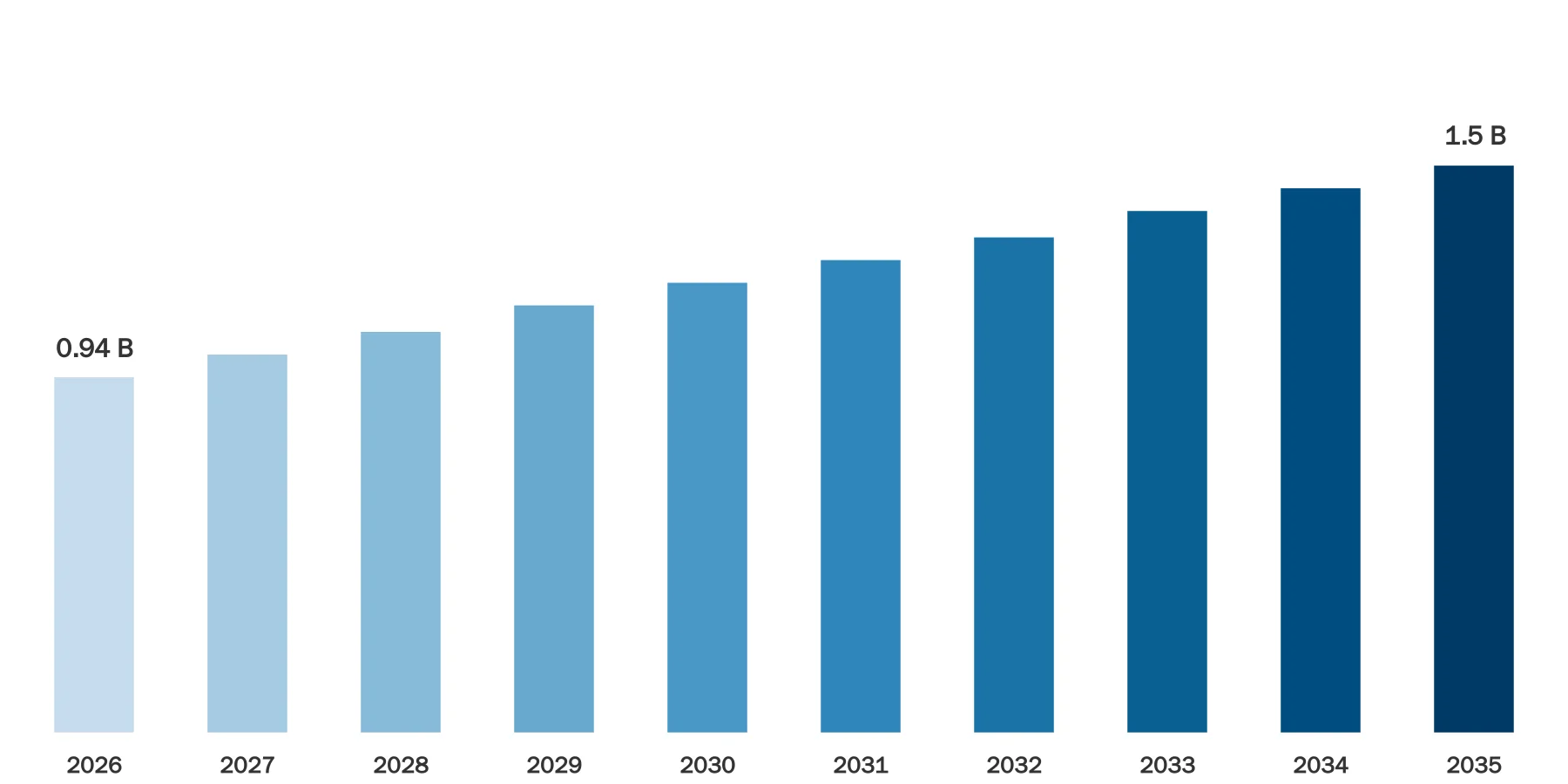
Source: Econ Market Research
Over the past ten years, the market for automatic book scanners has had a rapid evolution driven by both increased demand for effective digitization solutions and technological advancements. These scanners, which are used by libraries, educational institutions, and corporations worldwide, have completely changed the process of turning printed information into digital versions. These devices, which can scan documents quickly and with great quality, are currently essential for maintaining and disseminating knowledge in a variety of industries.
The emergence of digital libraries and the necessity for effective archiving have made automatic book scanners an indispensable tool. The digitization process has been greatly improved by their capacity to handle rare or delicate manuscripts with care, as well as capabilities like advanced image processing and automatic page turning. To further increase their usefulness, Optical character recognition (OCR) technology can be integrated to transform scanned content into editable and searchable text.
A number of manufacturers have released new, cutting-edge models into the market for automatic book scanners, which has boosted competitiveness and expanded the range of available products. Because of this, these scanners are now available in a range of sizes, speeds, and features to meet the unique needs of individual users. The functionality of these scanners has also been increased by the development of cloud-based storage systems, which provide seamless Digital Content storage and accessibility. The market for automatic book scanners is expected to rise further as businesses look for effective, high-quality ways to digitize large volumes of printed materials. This will encourage innovation and accessibility in the field of information preservation and distribution.
Market Dynamics
The dynamics of the automatic book scanner market are influenced by the combination of quickly expanding digital landscape, changing customer needs, and technological innovation. The market has advanced thanks to technological developments in imaging sensors, robotics, and software. These advancements have produced more effective and adaptable scanners that can handle a wide range of book sizes, formats, and paper kinds while producing outputs with improved quality.
The evolution of the market has been largely driven by consumer demands for higher scanning rates, superior image quality, and seamless integration with digital systems. Furthermore, the move to digital repositories and remote access has increased demand for scanners that are compatible with cloud-based storage systems and have strong connectivity choices. The heightened competition among manufacturers has stimulated an ongoing cycle of invention and product improvement. This has led to a wide range of functions, pricing ranges, and user interfaces being offered, satisfying a variety of user needs, from individual users looking for small, easy-to-use solutions to big libraries needing massive volumes of scanning.
Additionally, the market dynamics have been impacted by the growing emphasis on sustainability and energy efficiency, which has resulted in the development of eco-friendly scanning solutions. The market for automatic book scanners is driven by a number of factors, including advancements in technology, shifting customer tastes, competitive dynamics, and the growing demand for effective and long-lasting digitization solutions in an increasingly digital environment.
Market Drivers
Technological Advancements
These scanners have undergone a revolution thanks to advancements in imaging sensors, robotics, and software, which have improved their capacity to satisfy users', ever-higher demands. Higher-resolution scanning made possible by improved sensor technologies captures printed materials', finer details with remarkable clarity. Automation and robotics have revolutionized scanning by providing features like automated page-turning mechanisms that improve productivity and decrease manual labor in digitization workflows.
Additionally, software advancements have been crucial, especially in the areas of image processing and optical character recognition (OCR). Sophisticated OCR features make it easier to transform scanned content into formats that can be edited and searched, greatly improving the usability of digital resources. Furthermore, ongoing software improvements have strengthened image enhancing and correction capabilities, guaranteeing better results. The performance and efficiency of automatic book scanners are fueled by technical improvements, which also make it possible to handle a variety of book sizes, styles, and paper kinds with ease.
Increasing Shift Towards Digital Libraries, Online Archives, and E-Books
There is an urgent need for effective digitization tools to protect and access massive volumes of knowledge as organizations and individuals move from traditional printed materials to digital formats. Libraries, academic institutions, and corporations are proactively adopting digital platforms in order to provide people across the globe with more accessibility and convenience. Digital repositories', intrinsic benefits such as improved content searchability, remote availability, and ease of accessibility are what are driving this trend. An essential part of this shift is the digitization of actual books and manuscripts, which is made possible by automatic book scanners. This process also helps to build digital libraries and online archives.
Additionally, the proliferation of e-books and digital publications demands that print materials be converted into digitally compatible forms, which increases the need for effective scanning solutions. Additionally, digital content',s portability and accessibility meet modern demands for collaborative learning and on-the-go access. Automated book scanners facilitate the creation of extensive digital collections for both individuals and institutions, all the while guaranteeing the preservation and greater distribution of knowledge in forms that are compatible with the modern digital environment.
Restraints:
Modern automatic book scanners are frequently very expensive up front. This includes not only the scanner itself but also extra costs for required software, peripherals, upkeep, and can be specialist employee training. This cost barrier can be a significant obstacle, particularly for organizations with tighter resources or smaller collections where the large expense would not be immediately justified. It can be challenging for smaller libraries or educational institutions to justify the initial cost of a high-end scanner, particularly when weighing it against other operating costs or conflicting resource requirements.
The total cost of ownership is further increased by continuing expenses for upkeep, repairs, and upgrades, which can discourage some prospective customers or reduce the frequency of improvements. Some institutions can be forced to rely on outdated, ineffective scanning techniques or outsource digitization services, which could prove to be prohibitively expensive in the long run, as a result of the high initial expenditure delaying the adoption of contemporary digitization procedures.
Compatibility and Integration Challenges
For these scanners to provide effective workflows and simple access to digital content, they frequently need to be seamlessly integrated with databases, preservation platforms, and other software systems. But accomplishing this integration can be challenging, particularly when working with proprietary formats, legacy software, or disparate systems. One significant obstacle is the variety of formats and methods that different institutions use. It is possible that not all of these systems are compatible with automatic book scanners, in such cases, further software development or adjustments can be required to enable compatibility.
The integration procedure is further complicated by the requirement for interoperability across scanners and different databases or preservation platforms. The need for personnel training and experience to properly operate and integrate these scanners presents another difficulty. Organizations can have trouble recruiting staff members with the necessary technical expertise, which could cause delays or inefficiencies in the integration process. Compatibility and integration issues can cause delays in implementation, greater implementation costs, and disturbances to current workflows.
Opportunities:
Expanding Digital Archives
Globally, libraries, institutions, and organizations are embracing digital transformation more and more to save, arrange, and make a great amount of historical, educational, and cultural content universally accessible. Automatic book scanners have a great deal of potential in this shift to complete digital archives since they are essential instruments for scanning and archiving printed documents. Automated book scanners facilitate the effective conversion of hard copy books, manuscripts, and other documents into digital formats. This feature makes it easier to access and preserve priceless content for future generations, which is in line with the growing demand to digitize collections.
The chance presents itself as organizations look for methods to add a variety of content, from contemporary periodicals to historical records, to their digital archives. Furthermore, there is a growing need for scanners that can handle a variety of material formats, sizes, and circumstances while maintaining high-quality digitalization as the landscape of digital archives grows. With their versatility and high-quality scanning resolutions, automatic book scanners are well-positioned to meet this need.
Remote Learning and Work
The increasing prevalence of remote work and Online Education has led to a greater demand for easily navigable solutions that facilitate the digitalization of physical resources from home or other remote locations. By enabling individuals, educators, and remote workers to produce digital copies of printed documents, automatic book scanners present a promising prospect. This allows for smooth integration into virtual learning environments or remote work arrangements. If these scanners are made with small form factors and easy-to-use interfaces, they can be used for personal or home office use, allowing users to digitize books, notes, or papers for study, collaboration, or personal reference. Furthermore, instructors can use automatic book scanners in the field of remote education to digitize textbooks, course materials, and other resources so that students have simple access to content for studying from a distance. The need for easy-to-use digitizing technologies is growing as the trend toward distant study and work continues to flourish.
Segment Overview
By Technology
Based on technology, the global automatic book scanner market is divided into cradle scanners, robotic, scanners, overhead scanners. The cradle scanners category dominates the market with the largest revenue share in 2023. Cradle scanners are designed with a flatbed or cradle-like structure where the book or document rests during the scanning process. These scanners typically have a glass plate where the material is placed face-down for scanning. They are ideal for delicate or fragile books and can accommodate larger books or bound materials without damaging them.
Cradle scanners often offer high-resolution scanning capabilities, capturing detailed images of pages. Robotic scanners utilize robotic arms or mechanisms to automatically turn pages and scan books without manual intervention. These scanners are efficient for high-volume scanning as they automate the page-turning process, reducing the need for constant human supervision. They often include features like integrated cameras and sensors to ensure precise scanning and page alignment. Overhead scanners, also known as book-edge scanners, have a design where the book is placed facing upwards, and a camera or imaging system captures the pages from above. These scanners are efficient for scanning bound materials, and their design allows for quick and accurate digitization. Overhead scanners often have features to correct distortion and ensure uniform lighting for high-quality scans.
By Application
Based on the application, the global automatic book scanner market is categorized into library and archive digitization, publishing and printing, education and research. Library and archive digitization, this segment primarily caters to libraries, archives, Museums, and cultural institutions seeking to digitize and preserve historical documents, manuscripts, rare books, and other valuable materials. Automatic book scanners play a crucial role in this sector by offering high-resolution scanning capabilities, gentle handling of delicate materials, and efficient digitization workflows. Institutions aim to create comprehensive digital archives for preservation, research, and broader accessibility purposes. In the publishing and printing industry, automatic book scanners are utilized for the digitization of content for various purposes.
Publishers use these scanners to convert printed books, manuscripts, or documents into digital formats for e-book production, digital publishing, or archiving. Printing companies can employ automatic book scanners to create digital backups of their printed materials or to offer additional digital versions of publications. Within the education sector, automatic book scanners find application in educational institutions, universities, and research facilities. These scanners aid educators in creating digital resources for their courses, digitizing textbooks, lecture notes, or supplementary materials for online learning platforms. Researchers utilize automatic book scanners to digitize reference materials, journals, or rare manuscripts for academic studies and scholarly research.
By End-User
Based on end-user, the global automatic book scanner market is segmented into libraries, archives and museums, publishing houses. Libraries are one of the primary segments driving the demand for automatic book scanners. They require efficient tools to digitize their collections of books, manuscripts, periodicals, and historical documents. These scanners play a crucial role in libraries by preserving rare or fragile materials, ensuring long-term accessibility, and enabling the creation of comprehensive digital archives.
Similar to libraries, archives and museums also rely on automatic book scanners to preserve and digitize valuable historical records, artifacts, and artworks. These institutions aim to create digital archives of their collections for archival purposes, academic research, and public access. Automatic book scanners equipped with features to handle delicate materials, capture high-quality images, and ensure accurate digitization are essential for these sectors. Publishing houses utilize automatic book scanners for digitizing printed content for various purposes. They digitize manuscripts, books, or historical documents to create digital backups, facilitate e-book production, or convert printed materials into digital formats for online publishing.
By Scanning Speed
Based on scanning speed, the global automatic book scanner market is divided into high-speed scanners, medium-speed scanners, low-speed scanners. The medium-speed scanners category dominates the market with the largest revenue share in 2023. Medium-speed scanners offer a balance between speed and precision. They cater to users with moderate scanning requirements, providing a reasonable scanning rate while ensuring quality digitization. These scanners are versatile and suitable for various environments, including educational institutions, smaller libraries, or businesses with moderate volumes of materials to be digitized.
High-speed scanners are designed to rapidly digitize large volumes of books or documents within a short period. These scanners typically offer exceptional scanning speeds, allowing them to process numerous pages per minute. High-speed scanners are ideal for institutions or businesses requiring efficient workflows and handling substantial quantities of materials. Low-speed scanners operate at a slower pace compared to high and medium-speed scanners. They are suitable for users with lower volumes of materials to be digitized or those emphasizing accuracy over speed. While their scanning rates are slower, these scanners often provide meticulous scanning and high-resolution outputs. Low-speed scanners can find application in specialized environments such as archives dealing with delicate or rare materials, where meticulous digitization is paramount.
By Connectivity
Based on the connectivity, the global automatic book scanner market is categorized into wired scanners, wireless scanners. The wireless scanners category leads the global automatic book scanner market with the largest revenue share in 2023. Wireless automatic book scanners operate without physical cables, relying on wireless technology, such as Wi-Fi or Bluetooth, for connectivity. These scanners offer the advantage of mobility and flexibility as they can be used in various locations without the constraints of cables.
Wireless scanners enable users to move the scanner freely within the range of the wireless network, facilitating versatile usage scenarios. Wired automatic book scanners are designed to connect to a computer or a network using physical cables, such as USB or Ethernet. These scanners rely on direct physical connections for data transfer and power supply. Wired connections ensure stable and consistent data transmission, reducing the chances of interference or connectivity issues. They are often preferred for high-speed and reliable data transfer, especially in environments where a secure and continuous connection is crucial.
By Book Size Compatibility
Based on book size compatibility, the global automatic book scanner market is segmented into large format scanners, standard format scanners. Large format automatic book scanners are designed to handle oversized or larger-than-standard materials. These scanners have larger scanning beds or platforms that can accommodate books, documents, or materials with dimensions beyond the standard sizes. They are suitable for digitizing large books, maps, newspapers, posters, architectural drawings, or other oversized materials that can not fit into standard-sized scanners. Standard format automatic book scanners are designed for typical or regular-sized materials, such as standard books, documents, or manuscripts. These scanners are equipped to handle materials within standard dimensions commonly found in libraries, educational institutions, and businesses.
By Price Range
Based on price range, the global automatic book scanner market is divided into low-cost scanners, mid-range scanners, high-end scanners. The mid-range scanners leads the global automatic book scanner market. Mid-range automatic book scanners offer a balance between price and performance. They provide a wider range of features, better scanning speeds, and improved functionalities compared to low-cost scanners. These scanners cater to users with moderate digitization requirements who seek a more comprehensive set of features without opting for the highest-end, expensive models.
Low-cost automatic book scanners are designed to be affordable and budget-friendly options for users with basic digitization needs or limited budgets. These scanners offer essential scanning functionalities at a lower price point, making them accessible to smaller libraries, educational institutions, or individual users. High-end automatic book scanners represent top-tier models that offer advanced features, exceptional scanning speeds, superior image quality, and comprehensive functionalities. These scanners are designed for users or institutions with extensive digitization needs, requiring high-performance devices capable of handling large volumes of materials efficiently. High-end scanners often come with cutting-edge technology, robust software integrations, multiple scanning modes, and superior image processing capabilities.
Market Overview by Region
The global automatic book scanner market is categorized into North America, Europe, Asia-Pacific, and the Rest of the World. Asia-Pacific emerged as the leading region, capturing the largest market share in 2026. The region',s large university, school, and research institution education sector has increased demand for effective academic resource digitalization.
The need for high-quality automatic book scanners has increased as these institutions prioritize digitizing their libraries and archives in order to improve accessibility and preserve historical items. Furthermore, the development of cutting-edge scanning technologies has been aided by the quickening pace of technical breakthroughs and the presence of innovation hubs in nations like South Korea, China, Japan, and India. As a result, complex scanners with fast scanning speeds, excellent image quality, and cutting-edge features have been produced to meet the various requirements of publishing firms, libraries, and archives.
Furthermore, government programs and funding for digitization projects that preserve historical records and cultural artifacts have increased demand for automatic book scanners throughout the Asia-Pacific region. These programs promote the uptake of contemporary scanning technology and the expansion of businesses that offer these services. The Asia-Pacific region has emerged as a leader in the automatic book scanner market, exhibiting strong growth and considerable potential for future expansion. This can be attributed to a number of factors including a booming educational sector, technical innovation, and encouragement from government efforts.
Competitive Landscape
In the global automatic book scanner market, a few major players exert significant market dominance and have established a strong regional presence. These leading companies remain committed to continuous research and development endeavors and actively engage in strategic growth initiatives, including product development, launches, joint ventures, and partnerships. By pursuing these strategies, these companies aim to strengthen their market position, expand their customer base, and capture a substantial share of the market.
Key Players:
Treventus Mechatronics GmbH
Qidenus Technologies GmbH
Vikmans Multimedia (India) Pvt. Ltd.
Ishikawa Group Laboratory Co., Ltd.
igus GmbH
Kairee Systems Private Limited
iGuana BV
Overnight Scanning
Image Access GmbH
Crats Infotech Private Limited
Atiz Innovation Co., Ltd.
Czur Tech Co., Ltd.
Plustek Inc.
Microbox GmbH
SMA Scan Master GmbH
Automatic Book Scanner Market Report Scope & Segmentation
| Attributes | Details |
|---|---|
Market Size (Current) | US$ 0.94 Billion in 2026 |
Market Size (Forecast) | US$ 1.5 Billion in 2035 |
Growth Rate | CAGR of 5.3% from 2026 to 2035 |
Forecast Period | 2026 – 2035 |
Base Year | 2025 |
Historical Data Available | Yes |
Regional Scope | Global |
Segments Covered | By Technology
By Application
By End-User
|
Frequently Asked Questions
Common questions about this report
The study period covers historical insights and forecast projections for the period 2026-2035.
About the Author
Market research expert with years of industry experience

Related Reports
Explore more market insights from the same category