

Air Compressor Market
Air Compressor Market Size, Share, Trends, Growth, and Industry Analysis, By Type (Rotary Screw, Reciprocating, Centrifugal), By Technology (Oil-Free, Oil-Filled), By Application (Manufacturing, Oil and Gas, Energy and Power, Electronics and Semiconductors, Healthcare, Food and Beverage), Regional Analysis and Forecast Period 2026-2035
Air Compressor Market Overview
As per Econ Market Research analysis, the Global Air Compressor Market generated revenue of US$ 32.03 Billion in 2026 and is forecast to achieve US$ 51.45 Billion by 2035, at a CAGR of 5.5% during the study period 2026–2035. The base year considered is 2025.
Air Compressor Market Size 2025-2035 (USD Billion)

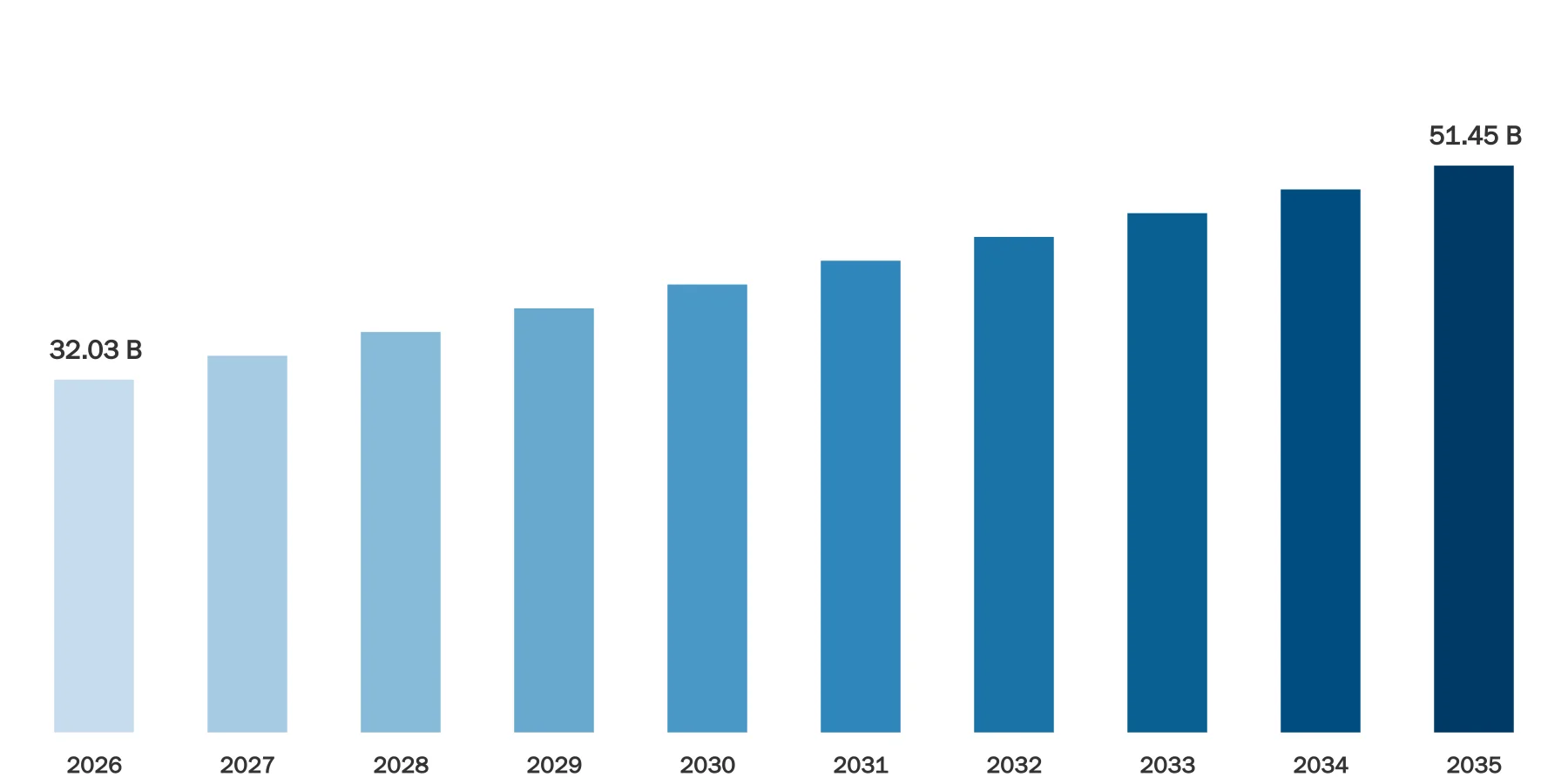
Source: Econ Market Research
Air compressors are essential in powering pneumatic tools, facilitating industrial processes such as manufacturing, construction, and automation, and are increasingly utilized in sectors like healthcare and transportation. The market encompasses a wide array of compressor types, including reciprocating, rotary screw, and centrifugal compressors, each offering distinct features tailored to specific operational requirements. With the rising demand for energy-efficient solutions and the integration of advanced technologies like IoT and AI for predictive maintenance and performance optimization, the global air compressor market is witnessing significant growth and innovation.
The adoption of sustainable manufacturing practices, infrastructure development, and Industrial Automation have all contributed to the recent strong growth of the global air compressor market. Because of their rapid industrialization and urbanisation, emerging economies in the Asia-Pacific region&mdash,especially China and India&mdash,have become major growth drivers, while developed regions like North America and Europe continue to see steady demand because of replacement cycles and technological advancements. Additionally, the growing focus on cutting carbon emissions and improving energy efficiency has accelerated the development of environmentally friendly compressor options, such as electric and hybrid models, which is driving the market',s expansion.
Air Compressor Dynamics
Market growth is primarily driven by the burgeoning industrial sector, where air compressors play a vital role in powering a wide range of pneumatic tools and equipment used in manufacturing, construction, and automotive applications. Moreover, increasing investments in infrastructure development projects worldwide, coupled with the growing adoption of automation technologies, continue to fuel demand for air compressors across various end-user industries. Additionally, changing environmental regulations and standards have an impact on market dynamics, which drives manufacturers to create environmentally friendly and energy-efficient compressor solutions.
The industry is experiencing a transformation in terms of competition and innovation due to the adoption of sustainable manufacturing practices and the incorporation of cutting-edge technologies like Artificial Intelligence and the Internet of Things (AI) for predictive maintenance and performance optimisation. Furthermore, Industry 4.0 initiatives and the development of smart manufacturing concepts are propelling the adoption of connected air compressor systems that can perform remote diagnostics and real-time monitoring, improving operational efficiency and decreasing downtime for end users.
Air Compressor Drivers
Industrial Automation and Manufacturing Growth
One major factor propelling the air compressor market is the growing use of automation technologies in sectors like electronics, aerospace, and automotive. Pneumatic systems driven by air compressors play a major role in automation, especially in the areas of machine operation, material handling, and assembly. Dependability and high performance air compressors are in high demand as industries pursue greater efficiency, precision, and productivity. Additionally, the efficiency and flexibility of pneumatic systems are improved by the integration of cutting-edge sensors and control systems, which propels market expansion.
Infrastructure Development and Urbanization
Rapid urbanization and infrastructure development projects worldwide contribute to the demand for air compressors in construction, mining, and oil &, gas industries. As urban populations grow, there is a need for new infrastructure, including residential buildings, transportation networks, and utility facilities. Air compressors power a variety of tools and machinery used in construction projects, such as pneumatic drills, jackhammers, and concrete pumps. Additionally, the expansion of transportation networks, including roads, railways, and airports, requires air compressors for tasks like pneumatic braking systems and tire inflation, further boosting market demand.
Restraints:
Fluctuating Raw Material Prices
Prices for raw materials, especially metals like copper, aluminium, and steel, which are necessary for compressor parts like cylinders, pistons, and valves, can change, which can affect the air compressor market. Commodity market volatility can impact air compressor manufacturers', manufacturing costs and profit margins, creating obstacles to their pricing strategies and overall profitability. Furthermore, price fluctuations can be made worse by supply chain disruptions and trade tensions, which will further affect market dynamics and competitiveness.
Stringent Regulatory Standards
Compliance with stringent environmental and safety regulations represents a significant restraint for the air compressor market. Regulatory requirements related to emissions, noise levels, and energy efficiency compel manufacturers to invest in R&,D to develop eco-friendly and compliant compressor solutions. Meeting regulatory standards adds complexity to product development and manufacturing processes, potentially increasing production costs and time-to-market. Additionally, non-compliance can result in fines, penalties, and reputational damage, driving companies to prioritize regulatory compliance as a key business imperative.
Opportunities:
Rise of Renewable Energy and Green Technologies
The market for air compressors is expected to benefit from the increased emphasis on sustainability and renewable energy sources. Air compressors are needed for a number of purposes, such as energy storage, power generation, and pneumatic system maintenance and operation, when using renewable energy sources like solar and wind power. Furthermore, developments in green technologies allow for the creation of environmentally friendly and energy-efficient air compressor solutions, meeting the changing demands of consumers and businesses who care about the environment.
Segment Overview
By Type
The air compressor market is categorized into stationary and portable types. Stationary compressors are typically larger and designed for fixed installations in industrial settings, providing continuous compressed air supply for manufacturing processes and pneumatic tools. On the other hand, portable compressors offer mobility and flexibility, making them suitable for construction sites, automotive repair shops, and other applications where portability is essential.
By Product
Air compressors are further classified into reciprocating, rotary/screw, and centrifugal types. Reciprocating compressors utilize pistons to compress air and are commonly used in small to medium-sized applications such as automotive workshops and DIY projects. Rotary/screw compressors operate by rotating screws to compress air and are preferred for larger industrial applications due to their high efficiency and reliability. Centrifugal compressors use centrifugal force to compress air and are ideal for large-scale industrial processes requiring high volumes of compressed air.
By Lubrication
Air compressors can be categorized based on lubrication type as oil-free or oil-filled. Oil-free compressors are designed to minimize contamination risks and are suitable for applications requiring clean, oil-free compressed air, such as pharmaceutical manufacturing and food processing. Oil-filled compressors use lubricating oil to reduce friction and enhance performance, making them suitable for heavy-duty industrial applications where reliability and durability are paramount.
By Application
The air compressor market serves a diverse range of industries and applications, including healthcare &, medical, manufacturing, oil &, gas, home appliances, food &, beverage, energy, Semiconductor &, electronics, and others. Each application segment has unique requirements for compressed air, ranging from precision instruments in healthcare to heavy machinery in manufacturing and exploration equipment in the oil &, gas sector. The versatility of air compressors allows them to adapt to various operating conditions and industry-specific demands, driving their widespread adoption across different sectors worldwide.
Air Compressor Overview by Region
North America and Europe represent mature markets for air compressors, characterized by established industrial sectors, stringent regulatory standards, and a strong focus on energy efficiency and sustainability. These regions witness steady demand for air compressors across various industries such as manufacturing, automotive, and healthcare, driven by technological advancements and infrastructure development initiatives.
On the other hand, the air compressor market is experiencing significant growth in the Asia Pacific region due to the region',s fast industrialization, urbanisation, and infrastructure investments. Air compressors are in high demand in nations like China, India, and Southeast Asia, especially in the manufacturing, construction, and energy sectors. The area gains from the growing automobile industry, rising building activity, and government programmes that support innovation and industrial growth.
Air Compressor Market Competitive Landscape
Key players in the market include Atlas Copco AB, Ingersoll Rand Inc., Gardner Denver Holdings Inc., Sullair LLC, and Kaeser Kompressoren SE, among others. These companies engage in strategic initiatives such as mergers and acquisitions, partnerships, product innovations, and geographic expansions to strengthen their market presence and gain a competitive edge.
Furthermore, the market is witnessing increasing competition from emerging players and new entrants, particularly in regions experiencing rapid industrialization and infrastructure development. These players often focus on niche segments, offering specialized air compressor solutions tailored to specific applications and customer requirements. Additionally, technological advancements, including the integration of IoT, AI, and automation technologies, are reshaping the competitive dynamics of the market, with companies investing in R&,D to develop innovative products with enhanced performance, energy efficiency, and reliability.
Air Compressor Market Leading Companies:
Atlas Copco AB
Ingersoll Rand Inc.
Hitachi Ltd.
Gardner Denver Holdings, Inc.
Kaeser Kompressoren SE
Sullair, LLC
Kobe Steel, Ltd. (Kobelco)
Bauer Kompressoren GmbH
Doosan Portable Power
Siemens Energy AG
Air Compressor Recent Developments
June 2023, Power Equipment Direct has collaborated with ABAC Air Compressors to spearhead the introduction of its revolutionary rotary screw machines across the United States. The AS Series of rotary screw air compressors incorporates cutting-edge integrated block technology designed to minimize downtime, optimize efficiency, and streamline maintenance processes, rendering it ideal for automotive, industrial, and various other applications that demand a dependable and efficient air source.
Feb 2022, Gov. John Bel Edwards and Alliance Compressors LLC have revealed plans for a $45 million investment over the next two years to expand its compressor assembly facility, aligning with the heightened global demand for energy-efficient air conditioning.
Global Air Compressor Report Segmentation
Air Compressor Market Report Scope & Segmentation
| Attributes | Details |
|---|---|
Market Size (Current) | US$ 32.03 Billion in 2026 |
Market Size (Forecast) | US$ 51.45 Billion in 2035 |
Growth Rate | CAGR of 5.5% from 2026 to 2035 |
Forecast Period | 2026 – 2035 |
Base Year | 2025 |
Historical Data Available | Yes |
Regional Scope | Global |
Segments Covered | By Type
By Technology
By Application
|
Frequently Asked Questions
Common questions about this report
The study period covers historical insights and forecast projections for the period 2026-2035.
About the Author
Market research expert with years of industry experience

Dipali Bhingare serves as the Market Research Director at Econ Market Research. With a focus on translating complex global economic shifts into actionable business intelligence, she oversees the strategic direction of comprehensive market studies. Her work empowers organizations to navigate volatile industries through data-driven forecasting and deep-dive competitive analysis.
Related Reports
Explore more market insights from the same category