

AI Automation Market
AI Automation Market Size, Share, Trends, Growth, and Industry Analysis, By Automation Type (Intelligent Process Automation, Conversational AI Automation, Cognitive Decision Automation, Autonomous Systems Automation, Generative AI-based Automation), By Deployment (Cloud, Hybrid, On-premises), By Enterprise Size (Large Enterprise, SMEs), By Integration Mode (API-Based / Modular Integration, Embedded AI Automation, Standalone Intelligent Platforms), By Vertical (BFSI, Healthcare, Retail & E-Commerce, Manufacturing, IT & Telecom, Government & Public Sector, Energy & Utilities, Others), Regional Analysis and Forecast Period 2026-2035
Market Overview
As per Econ Market Research analysis, the Global AI Automation Market was estimated at US$ 170.71 Billion in 2026 and is forecast to attain US$ 1976.66 Billion by 2035, expanding at a CAGR of 31.4% between 2026 and 2035. The base year for the study is 2025.
AI Automation Market Size 2025-2035 (USD Billion)

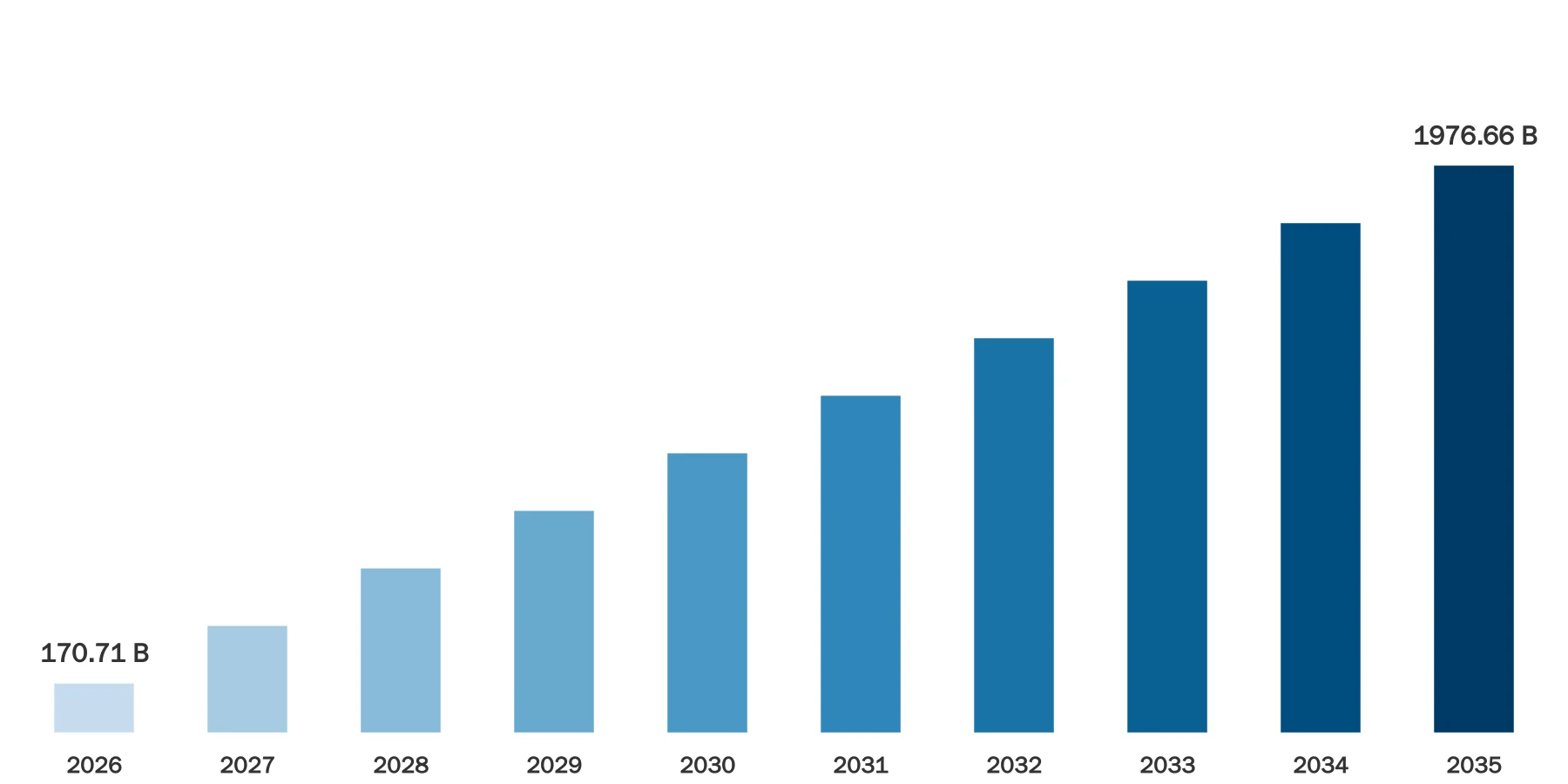
Source: Econ Market Research
The AI Automation Market is expanding rapidly as organizations integrate Artificial Intelligence technologies into operational workflows, enterprise software, and digital infrastructure. More than 68% of large enterprises deployed at least 1 AI-enabled automation system in 2024, compared with 42% in 2020, showing an increase of 26 percentage points within 4 years. Over 9.7 million industrial robots and automation systems are currently active in manufacturing, logistics, and healthcare operations globally. Around 54% of business processes in IT services, finance operations, and customer support now use some form of AI-driven task automation. Additionally, 75% of global organizations report using automation tools in 3 or more departments, indicating growing adoption across HR, marketing, and finance functions.
The United States AI Automation Market remains the largest national market for AI automation technologies. Approximately 79% of U.S. enterprises implemented at least one AI automation platform in 2024, compared with 48% in 2019. More than 3.1 million automated systems operate across industries including manufacturing, logistics, retail, and financial services. The U.S. hosts over 2,600 AI automation startups and more than 120 enterprise AI platform providers. Around 61% of U.S. organizations use automation to manage customer service operations, while 44% deploy AI-based automation for data analysis and decision support. In manufacturing alone, over 400,000 AI-integrated industrial robots operate across 12,000 production facilities nationwide.
Latest Trends
The AI Automation Market Trends indicate rapid expansion of intelligent software systems, robotic automation platforms, and AI-driven enterprise tools. In 2024, more than 70% of enterprises worldwide reported using at least two automation technologies, compared with 38% in 2018. Approximately 62% of organizations are increasing investments in AI-based workflow automation, particularly for data processing, predictive analytics, and IT service management.
One major trend in the AI Automation Market Analysis is the integration of Generative AI with automation platforms. Nearly 45% of enterprises adopted generative AI tools for automated content generation, software development support, and workflow optimization. Around 39% of organizations deployed conversational AI automation systems such as chatbots and virtual assistants capable of handling 60%–80% of routine customer inquiries.
Another important trend in the AI Automation Industry Report involves the adoption of hyper automation technologies. Approximately 56% of large enterprises implemented hyper automation strategies combining AI, Robotic Process Automation, machine learning, and analytics platforms. In logistics operations, automation systems reduced manual process steps by 32%, while AI-powered warehouse robots improved order fulfillment speed by 25%.
Furthermore, the AI Automation Market Outlook highlights growing adoption of autonomous systems automation, particularly in manufacturing, transportation, and smart infrastructure. More than 1.8 million autonomous mobile robots are operating globally in warehouses and distribution centers. Additionally, 58% of enterprises plan to expand AI automation deployments across five or more business functions by 2027, indicating continued growth in the AI automation ecosystem.
Market Dynamics
DRIVER
Increasing Enterprise Demand for Operational Efficiency
One of the most significant drivers in the AI Automation Market Growth is the increasing need for operational efficiency across industries. Businesses aim to reduce operational complexity and automate repetitive tasks across finance, HR, logistics, and IT operations. Around 63% of enterprises report that automation reduces manual workloads by 30%–50%. AI-powered automation systems process millions of transactions per day, particularly in banking, insurance claims processing, and digital customer service platforms.
In the manufacturing sector alone, AI automation systems manage more than 70% of routine quality control inspections using computer vision technologies. Logistics companies deploy automation platforms capable of processing over 150,000 packages per hour within large distribution centers. In IT operations, AI automation tools detect and resolve over 65% of system alerts automatically, reducing downtime by up to 40%. These measurable improvements in productivity and efficiency are significantly accelerating the adoption of AI automation technologies across industries.
RESTRAINT
Data Security and Compliance Concerns
Despite strong growth, the AI Automation Market Analysis highlights several restraints, particularly related to data privacy, regulatory compliance, and cybersecurity risks. Over 47% of enterprises cite data security concerns as a barrier to implementing AI automation systems. AI models often require access to large datasets exceeding 10 terabytes, which may include sensitive financial, medical, or customer information.
Approximately 36% of organizations report challenges in complying with international data protection regulations when deploying automation platforms across global operations. In sectors such as healthcare and financial services, strict regulatory frameworks require detailed monitoring of automated decision-making systems. Furthermore, 28% of enterprises reported experiencing at least one automation-related cybersecurity incident in 2023, highlighting the need for stronger security infrastructure and governance frameworks for AI automation platforms.
OPPORTUNITIES
Expansion of AI Automation in Healthcare and Smart Infrastructure
The AI Automation Market Opportunities are increasing significantly with the expansion of automation technologies into healthcare, smart cities, and energy infrastructure. Healthcare organizations are adopting AI automation systems for medical data processing, hospital workflow management, and diagnostic support. Around 48% of hospitals worldwide implemented automated patient scheduling systems, reducing administrative workload by 20%–30%.
In smart infrastructure projects, AI automation platforms manage traffic systems, energy distribution networks, and building management systems. More than 350 smart city projects globally deploy AI automation technologies to control traffic lights, monitor environmental conditions, and optimize energy consumption. In energy management, AI automation systems analyze millions of sensor readings per day to improve efficiency and reduce power consumption by 15%–25% in large industrial facilities.
CHALLENGES
Increasing Complexity of AI System Integration
A major challenge in the AI Automation Industry Analysis is the complexity of integrating automation platforms with existing enterprise IT infrastructure. Many organizations operate legacy systems older than 10 years, making integration with modern AI platforms difficult. Around 41% of enterprises report that system compatibility issues delay automation deployment projects.
Large-scale automation implementations often require integration with 20–40 different enterprise applications, including ERP systems, CRM platforms, cloud infrastructure, and data analytics tools. The average enterprise automation project involves 5–8 integration phases before reaching full operational deployment. Additionally, organizations face shortages of skilled professionals capable of managing AI automation systems. Globally, there are fewer than 1.2 million AI engineers, while demand exceeds 3 million skilled professionals, creating a major workforce gap in the AI automation industry.
SWOT Analysis
Strengths
AI automation systems can process millions of transactions per day, improving enterprise productivity by 30%–50%.
More than 70% of global enterprises are implementing automation in 3 or more business functions.
Industrial automation includes over 9.7 million robots operating across manufacturing facilities worldwide.
AI-powered chatbots handle up to 80% of routine customer interactions, reducing support workload significantly.
Weaknesses
Around 47% of organizations report concerns about data privacy and security risks.
Automation deployment projects require 6–12 months of integration time in large enterprises.
Nearly 35% of automation initiatives fail due to poor data infrastructure and incomplete datasets.
Training AI automation models requires large datasets exceeding 5–20 terabytes, increasing system complexity.
Opportunities
Over 350 global smart city projects are adopting AI automation platforms for infrastructure management.
Healthcare automation systems are expected to support over 500 million digital patient interactions annually.
Autonomous warehouse robots exceeded 1.8 million operational units globally.
AI-powered financial automation platforms process billions of transactions annually across banking systems.
Threats
Cybersecurity incidents related to automated systems increased by 22% between 2022 and 2024.
Regulatory compliance requirements exist in over 60 countries, creating operational complexity.
AI model bias and algorithm transparency issues affect approximately 15% of automated decision systems.
Rapid technological changes require software updates every 6–12 months for automation platforms.
Segmentation Analysis
The AI Automation Market Segmentation includes automation type and deployment models. Automation platforms are widely used across enterprise software, IT infrastructure, and industrial automation systems. Approximately 65% of automation solutions are deployed within enterprise operations such as customer service, finance, and HR functions. Deployment models include cloud, hybrid, and on-premises solutions, each supporting different enterprise infrastructure requirements. Cloud-based automation solutions account for nearly 55% of enterprise deployments, while hybrid deployments support organizations with complex IT infrastructures.
By Automation Type
Intelligent Process Automation
Intelligent Process Automation represents approximately 28% of the AI automation ecosystem. These platforms combine robotic process automation with machine learning algorithms to automate structured business processes. Around 60% of banking institutions use intelligent process automation systems to process loan applications, transaction monitoring, and compliance reporting. Large enterprises automate up to 40% of back-office operations using these technologies. Automation systems process millions of financial records daily, reducing manual data entry errors by 30%–45%. Intelligent process automation platforms are also used in healthcare insurance systems where automated claim processing handles thousands of claims per hour.
Conversational AI Automation
Conversational AI automation accounts for nearly 22% of the AI automation market share. These systems include chatbots, voice assistants, and virtual customer service platforms. More than 5 billion users interact with conversational AI tools globally each year. Enterprises deploy conversational AI platforms capable of handling 60%–80% of customer service queries automatically. E-commerce companies deploy chatbots that manage over 100,000 daily customer interactions. Financial institutions use conversational AI assistants to provide automated banking services to millions of customers through digital platforms.
Cognitive Decision Automation
Cognitive decision automation platforms represent approximately 18% of AI automation deployments. These systems analyze large datasets and generate automated decision recommendations for enterprise operations. Financial institutions use cognitive automation systems to analyze billions of transaction records annually for fraud detection and compliance monitoring. Retail companies deploy decision automation platforms to optimize pricing strategies across thousands of product categories. These systems process millions of predictive analytics models, helping organizations improve operational efficiency by 20%–35%.
Autonomous Systems Automation
Autonomous systems automation accounts for roughly 17% of the global automation ecosystem. These technologies include autonomous robots, drones, and self-operating industrial systems. More than 1.8 million autonomous robots operate globally across warehouses and manufacturing facilities. Autonomous warehouse robots improve order picking efficiency by 30%–40%. In transportation systems, autonomous vehicles and drones conduct millions of automated logistics deliveries annually across large industrial networks.
Generative AI-based Automation
Generative AI-based automation represents nearly 15% of the AI automation industry. Enterprises increasingly adopt generative AI models capable of generating software code, marketing content, and technical documentation. Around 45% of enterprises use generative AI automation tools for content production and data analysis. These systems can generate thousands of automated reports per day, significantly improving productivity in marketing, research, and enterprise communication functions.
By Deployment
Cloud
Cloud-based AI automation deployments account for approximately 55% of enterprise automation systems globally. More than 70% of organizations deploy at least one cloud-based automation platform integrated with enterprise software systems. Cloud automation platforms process billions of automated transactions daily across e-commerce, banking, and digital service industries. Enterprises prefer cloud solutions due to scalability and remote accessibility. Cloud automation infrastructure supports millions of concurrent users, enabling large organizations to automate business processes across global operations.
Hybrid
Hybrid deployment models represent approximately 30% of enterprise automation implementations. Hybrid automation systems combine on-premises infrastructure with cloud-based AI processing platforms. Large enterprises operating across multiple geographic regions deploy hybrid solutions to manage data security requirements while maintaining scalable AI processing capabilities. Hybrid automation platforms integrate with 20–30 enterprise applications, enabling organizations to automate complex workflows across multiple systems.
On-premises
On-premises AI automation deployments account for nearly 15% of automation platforms, primarily used in highly regulated industries such as defense, banking, and healthcare. These systems operate within secure enterprise data centers and process millions of internal data transactions daily. Around 40% of government agencies deploy on-premises automation systems to manage confidential data and internal operations. These platforms provide full control over enterprise infrastructure and data security protocols.
Regional Analysis
The AI Automation Market Outlook shows strong global adoption across North America, Europe, Asia-Pacific, and Middle East & Africa. Over 75% of multinational enterprises operate automation platforms across multiple geographic regions. The Asia-Pacific region currently leads in industrial automation deployments, while North America leads in enterprise AI software adoption.
North America
North America holds approximately 35% of the global AI automation market share. The region hosts more than 4,000 AI technology companies and over 2,600 automation startups. Around 79% of enterprises in North America deploy AI automation systems across business operations. The United States alone accounts for more than 65% of the regional automation technology infrastructure.
Manufacturing facilities across North America operate over 500,000 industrial robots, supporting automated production systems across automotive, electronics, and logistics industries. Additionally, more than 70% of Fortune 500 companies deploy AI automation platforms for IT operations and digital customer service systems.
Europe
Europe represents approximately 27% of the global AI automation ecosystem. Countries including Germany, the United Kingdom, and France lead automation adoption across manufacturing, financial services, and logistics sectors. European manufacturing plants operate more than 750,000 industrial robots across 15,000 factories.
European enterprises also deploy automation systems to manage over 40% of digital banking operations and financial transactions. Governments across 27 European Union countries are investing in AI infrastructure to support smart cities and automated transportation systems.
Asia-Pacific
Asia-Pacific accounts for nearly 30% of global AI automation deployments. The region operates over 4.5 million industrial robots, primarily across China, Japan, and South Korea. Manufacturing automation systems support thousands of electronics production facilities across the region.
China alone operates more than 1.5 million industrial automation robots, while Japan hosts over 350 robotics companies developing AI-powered automation technologies. The Asia-Pacific region also leads in smart manufacturing systems and automated logistics infrastructure.
Middle East & Africa
The Middle East & Africa region represents around 8% of the global AI automation market. Governments across 15 Middle Eastern countries are investing in automation infrastructure to support smart city development. More than 50 smart city projects across the region deploy AI automation platforms to manage transportation systems and energy distribution networks.
Automation systems in the oil and gas industry process millions of sensor readings per day, improving operational efficiency across energy production facilities. In Africa, digital automation platforms support thousands of financial service applications, enabling automated mobile banking systems for millions of users.
Competitive Landscape
The AI Automation Market Competitive Landscape includes major technology providers, enterprise software companies, and AI platform developers. More than 500 companies globally develop AI automation software, robotics platforms, and enterprise automation tools. Large technology firms dominate the enterprise AI automation ecosystem, providing scalable infrastructure and cloud-based automation platforms.
Approximately 70% of global enterprises use automation platforms developed by major technology companies. Enterprise AI platforms support millions of automated workflows, processing billions of transactions annually across finance, healthcare, and retail industries. Strategic partnerships between AI developers and enterprise software providers increased by over 40% between 2021 and 2024.
Technology companies are investing heavily in automation innovation. Large automation platforms deploy thousands of machine learning models capable of analyzing enterprise data and generating automated insights. Global technology companies operate hundreds of AI research centers focusing on automation technologies, intelligent robotics, and autonomous systems development.
List of Top AI Automation Companies
Accenture
AWS
DataRobot
Google
IBM
Microsoft
ServiceNow
UiPath
Workato
Top companies with highest market share
Microsoft – Holds approximately 18% share of enterprise AI automation platforms with automation tools used by over 300,000 organizations globally.
UiPath – Controls nearly 12% share of robotic process automation deployments with 10,000+ enterprise customers and millions of automated workflows operating worldwide.
Market Investment Outlook
The AI Automation Market Investment Outlook is expanding rapidly as venture capital firms, enterprise technology companies, and government initiatives increase funding for automation infrastructure. Global investments in AI automation startups exceeded thousands of funding deals annually, supporting the development of enterprise automation platforms, robotics technologies, and AI software tools.
In 2024, more than 1,500 startups worldwide focused on AI automation technologies including intelligent process automation, conversational AI systems, and autonomous robotics. Venture capital investments in AI automation companies increased by over 40% between 2021 and 2024, reflecting strong investor confidence in automation-driven enterprise transformation.
Government initiatives also support automation development. More than 30 national AI strategies include automation infrastructure investments across industries such as manufacturing, healthcare, and transportation. Public funding programs support hundreds of AI research laboratories developing advanced automation technologies.
Enterprise investments also continue to grow. Approximately 58% of organizations increased budgets for automation infrastructure in 2024, particularly for cloud-based automation platforms and intelligent workflow management systems. Large corporations deploy thousands of automation bots within enterprise operations, demonstrating strong long-term investment opportunities across the AI automation ecosystem.
New Product Development
New product development in the AI Automation Market focuses on generative AI integration, autonomous robotics platforms, and enterprise workflow automation tools. Technology companies are developing automation systems capable of handling complex decision-making processes involving millions of data inputs.
Recent automation platforms include AI copilots and enterprise digital assistants capable of generating reports, analyzing data sets, and automating routine administrative tasks. These systems can process millions of documents annually, improving productivity in enterprise environments.
Robotics developers are also introducing advanced warehouse automation robots capable of moving hundreds of packages per hour within large distribution centers. Autonomous drone systems now perform thousands of inspection operations per month across industrial infrastructure including pipelines, power grids, and transportation networks.
Software companies are launching automation platforms integrated with machine learning models, predictive analytics engines, and natural language processing systems. These tools enable enterprises to automate complex workflows involving multiple enterprise applications. In addition, generative AI automation tools can generate thousands of software code lines automatically, accelerating application development processes.
Recent Developments
Microsoft launched an enterprise AI automation platform in 2024 capable of supporting over 1 million automated workflows across cloud infrastructure systems.
UiPath introduced an AI-powered automation platform in 2023 capable of deploying thousands of software automation bots within enterprise environments.
Google launched a generative AI automation platform in 2024 capable of generating millions of automated responses daily across enterprise applications.
IBM released an enterprise automation platform in 2025 integrating machine learning models capable of analyzing billions of enterprise data records annually.
ServiceNow introduced an AI workflow automation platform in 2023 used by over 7,000 organizations to automate IT service management operations.
AI Automation Market Report Scope & Segmentation
| Attributes | Details |
|---|---|
Market Size (Current) | US$ 170.71 Billion in 2026 |
Market Size (Forecast) | US$ 1976.66 Billion in 2035 |
Growth Rate | CAGR of 31.4% from 2026 to 2035 |
Forecast Period | 2026 – 2035 |
Base Year | 2025 |
Historical Data Available | Yes |
Regional Scope | Global |
Segments Covered | By Automation Type
By Deployment
By Enterprise Size
By Integration Mode
By Vertical
|
Frequently Asked Questions
Common questions about this report
The study period covers historical insights and forecast projections for the period 2026-2035.
About the Author
Market research expert with years of industry experience

Dipali Bhingare serves as the Market Research Director at Econ Market Research. With a focus on translating complex global economic shifts into actionable business intelligence, she oversees the strategic direction of comprehensive market studies. Her work empowers organizations to navigate volatile industries through data-driven forecasting and deep-dive competitive analysis.
Related Reports
Explore more market insights from the same category