

AI as a Service Market
AI as a Service Market Size, Share, Trends, Growth, and Industry Analysis, By Offering (Infrastructure as a Service, Platform as a Service, Software as a Service), By Technology (Machine Learning, Natural Language Processing, Context Awareness, Computer Vision), By Deployment (Public Cloud, Private Cloud, Hybrid Cloud), By Enterprise Type (Large Enterprises, SMEs), By End User (BFSI, Government, Healthcare, Manufacturing, Retail, Others (Energy & Utilities, etc.)), Regional Analysis and Forecast Period 2026-2035
Market Overview
As per Econ Market Research analysis, Global AI as a Service Market size stood at US$ 28.81 Billion in 2026 and is projected to reach US$ 313.51 Billion by 2035, growing at a CAGR of 30.37% over the forecast period 2026–2035. 2025 is taken as the base year.
AI as a Service Market Size 2025-2035 (USD Billion)

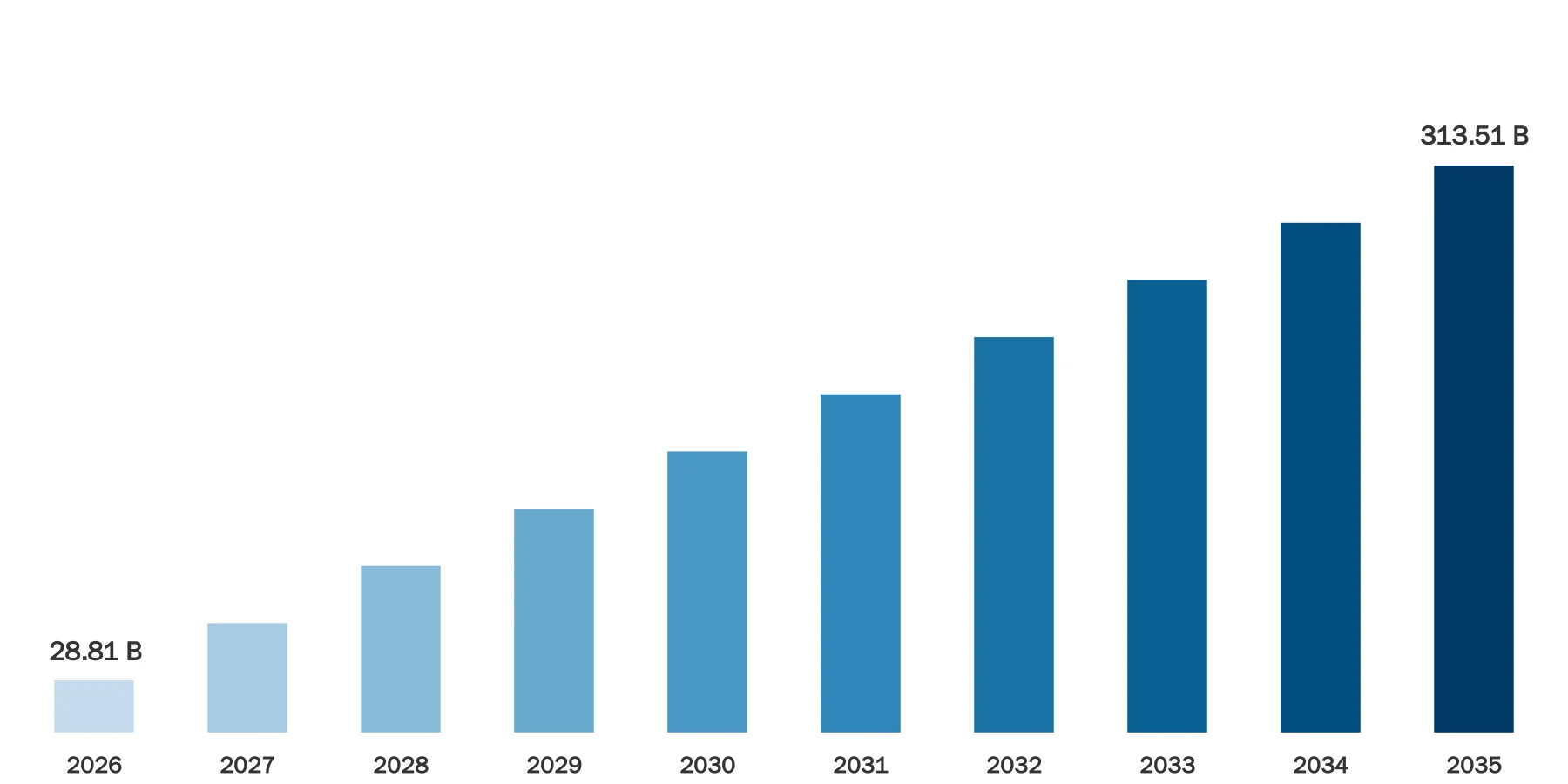
Source: Econ Market Research
The AI as a Service Market is rapidly expanding as organizations across more than 30 industry verticals adopt cloud-based Artificial Intelligence tools for automation, predictive analytics, and data management. Over 85% of global enterprises use at least 1 AI-enabled cloud platform, while approximately 62% of organizations deploy more than 2 AI services simultaneously for operations such as fraud detection, marketing analytics, and supply chain optimization. Global data generation surpassed 120 zettabytes annually, and enterprises process datasets exceeding 15 terabytes per project through AI-powered analytics platforms. More than 700 hyperscale cloud data centers worldwide support AI model training environments capable of processing billions of transactions daily, accelerating enterprise digital transformation.
The USA AI as a Service Market remains the largest regional contributor to the global AI as a Service Market Size, supported by more than 9,500 AI startups, approximately 1.4 million AI professionals, and over 350 operational cloud data centers across the country. Around 72% of Fortune 500 companies use AI cloud services in at least 3 operational departments, including finance, logistics, and customer support. Financial institutions process more than 500 million AI-powered transactions daily using machine learning platforms. Additionally, over 400 AI research laboratories operate within U.S. universities and private research centers, developing advanced AI algorithms used in enterprise software systems and digital service platforms.
Market Latest Trends
The AI as a Service Market Trends highlight the rapid expansion of generative AI technologies, automated machine learning platforms, and real-time AI analytics systems. By 2024, more than 67% of enterprises worldwide deployed AI-driven automation tools, while around 52% implemented AI analytics solutions capable of analyzing datasets containing over 5 million records per application. The number of cloud-based AI APIs increased from approximately 500 in 2018 to more than 2,200 by 2024, enabling businesses to integrate advanced AI capabilities into digital platforms without building in-house infrastructure.
Another important trend in the AI as a Service Market Analysis is the rapid expansion of conversational AI tools used across customer service and digital commerce. AI chatbots now handle nearly 65% of customer interactions globally, processing more than 1 billion queries per day across messaging platforms, websites, and mobile applications. Natural language processing systems are capable of supporting more than 70 languages, allowing companies to operate globally with automated support systems.
The integration of AI services with Internet of Things ecosystems also continues to expand. More than 30 billion IoT devices globally generate continuous datasets analyzed by AI platforms. Enterprises deploy AI systems capable of processing more than 100 terabytes of IoT data daily, enabling predictive maintenance, smart logistics, and real-time environmental monitoring across industries such as manufacturing, transportation, and energy.
Market Dynamics
DRIVER
Increasing Enterprise Adoption of Cloud-Based Artificial Intelligence Platforms
The primary driver of the AI as a Service Market Growth is the increasing adoption of cloud-based AI platforms by enterprises seeking scalable and cost-efficient analytics solutions. More than 90% of global enterprises rely on cloud infrastructure for at least one artificial intelligence workload, and approximately 55% of small and medium enterprises now deploy AI-powered analytics platforms for operational decision-making.
Modern enterprises generate massive volumes of digital data, exceeding 120 zettabytes annually worldwide, which must be analyzed using automated machine learning algorithms. AI cloud services enable companies to process datasets exceeding 10 terabytes per enterprise project, delivering insights for marketing analytics, fraud detection, and operational forecasting.
Financial institutions use machine learning systems to analyze more than 1 trillion digital transactions annually, improving fraud detection accuracy by over 30%. Additionally, more than 700 hyperscale cloud data centers globally provide computing environments capable of training AI models with over 100 billion parameters, enabling faster innovation across industries such as healthcare, finance, and manufacturing.
RESTRAINT
Data Privacy and Regulatory Compliance Challenges
One of the major restraints in the AI as a Service Market Analysis is the growing concern regarding data privacy, regulatory compliance, and cybersecurity risks. Approximately 65% of enterprises report concerns about storing sensitive corporate or customer data on external cloud platforms. Between 2021 and 2024, more than 400 million user accounts were affected by cyber incidents involving cloud-based systems.
Organizations deploying AI services often process highly sensitive information including healthcare records, financial transactions, and biometric authentication data. Healthcare organizations alone generate more than 3 petabytes of patient data annually, requiring strict regulatory compliance across over 45 global data protection frameworks.
In addition, multinational enterprises frequently operate across more than 20 geographic markets, creating challenges related to cross-border data transfer regulations. To mitigate security risks, companies implement more than 15 cybersecurity protection layers in AI cloud environments, increasing operational complexity and infrastructure management requirements.
OPPORTUNITY
Rising AI Adoption Among Small and Medium Enterprises
A major opportunity identified in the AI as a Service Market Forecast is the rapid adoption of AI tools by small and medium enterprises. Globally, more than 350 million SMEs operate across sectors such as retail, logistics, healthcare, and financial services, yet only about 28% of these businesses currently utilize AI-powered software tools.
Cloud-based AI platforms provide affordable subscription models enabling SMEs to access advanced analytics capabilities without building internal AI infrastructure. More than 120 AI platforms now offer automated machine learning tools allowing businesses to train models using datasets containing up to 5 million data points.
Retail companies deploy AI recommendation engines capable of analyzing over 500 customer behavior variables per transaction, enabling targeted marketing campaigns and improved inventory forecasting. Additionally, AI-powered chatbots enable SMEs to automate up to 80% of customer inquiries, significantly improving operational efficiency for companies managing high volumes of digital customer interactions.
CHALLENGE
Complexity of AI Model Integration with Legacy Systems
A significant challenge for the AI as a Service Industry Analysis is integrating AI technologies with legacy enterprise IT infrastructure. Many organizations operate digital systems developed more than 10 to 15 years ago, which are not optimized for modern AI computing architectures.
Integrating AI platforms with enterprise databases often requires processing datasets exceeding 20 terabytes, creating compatibility and performance issues. Approximately 42% of companies report implementation delays exceeding 6 months when integrating AI platforms into existing digital environments.
Advanced AI models also require significant computational resources during training processes. Deep learning models often require more than 10,000 GPU processing hours, while large enterprise AI models may require computing clusters containing thousands of GPU processors.
Furthermore, the shortage of AI specialists remains a major issue. Global demand for AI professionals exceeds supply by more than 2 million skilled workers, creating workforce challenges for organizations deploying AI as a Service platforms.
Segmentation Analysis
The AI as a Service Market Segmentation Analysis shows that organizations adopt AI solutions based on service offerings and technology deployment models. AI cloud platforms provide infrastructure resources, development frameworks, and ready-to-use AI applications for enterprise operations. The AI as a Service Market Size continues to expand as organizations deploy machine learning, natural language processing, context awareness, and computer vision technologies across industries including healthcare, finance, retail, and manufacturing. Each service model provides unique capabilities enabling companies to deploy AI systems capable of processing billions of data points and supporting automated decision-making across enterprise operations.
By Offering
Infrastructure as a Service
Infrastructure as a Service accounts for approximately 36% of the AI as a Service Market Share, providing scalable computing resources required for AI model training and large-scale data processing. Cloud providers operate more than 700 hyperscale data centers globally, supporting AI workloads that process datasets exceeding 50 terabytes per training cycle. AI infrastructure platforms enable organizations to train deep learning models containing more than 100 billion parameters, requiring distributed GPU clusters with thousands of processing units. Financial institutions and healthcare organizations frequently deploy infrastructure-based AI systems capable of processing millions of analytics queries per hour.
Platform as a Service
Platform as a Service represents nearly 30% of the AI as a Service Market Share, enabling developers to build, test, and deploy machine learning models using cloud-based development frameworks. More than 120 AI development platforms currently support automated machine learning tools capable of training models using datasets containing up to 10 million records. Developers worldwide create more than 300,000 machine learning models annually through cloud platforms. These platforms allow deployment across more than 15 digital environments, including enterprise applications, mobile platforms, and web services.
Software as a Service
Software as a Service contributes around 34% of the AI as a Service Market Share, providing ready-to-use AI solutions for analytics, marketing automation, customer engagement, and business intelligence. Enterprises deploy more than 600 AI-powered SaaS applications globally. These applications process approximately 5 billion business transactions daily, generating predictive insights and automated recommendations for enterprise operations. AI-based customer service platforms currently handle approximately 65% of customer interactions, reducing support response time by up to 40%.
By Technology
Machine Learning
Machine learning dominates the AI as a Service Market Share with approximately 40% adoption, enabling predictive analytics and automated decision-making systems. Enterprises deploy more than 300 machine learning frameworks for analyzing datasets containing billions of data points. Financial institutions process over 1 trillion digital transactions annually using machine learning fraud detection algorithms. Manufacturing companies deploy machine learning models monitoring more than 120 million industrial machines worldwide for predictive maintenance and operational optimization.
Natural Language Processing
Natural language processing accounts for approximately 25% of AI service deployments, supporting conversational AI systems and automated text analytics. NLP platforms process more than 1 billion text and voice interactions daily across digital communication channels. Enterprises deploy AI chatbots capable of supporting over 70 languages, enabling global customer engagement. More than 60% of large organizations analyze customer feedback datasets containing millions of textual data records using NLP analytics tools.
Context Awareness
Context awareness technologies represent nearly 18% of the AI as a Service Market Share, enabling AI systems to analyze environmental, behavioral, and location-based data. Smart city infrastructure uses context-aware AI platforms connected to more than 500 million sensors worldwide. Retail companies deploy context-aware recommendation engines analyzing over 1,000 behavioral data points per customer, enabling highly targeted digital advertising and product recommendations.
Computer Vision
Computer vision contributes approximately 17% of the AI as a Service Market Share, supporting image recognition, facial recognition, and automated visual inspection systems. Computer vision platforms analyze more than 10 billion digital images daily. Healthcare institutions deploy AI imaging platforms analyzing more than 50 million medical scans annually, assisting medical professionals in diagnosing complex diseases such as cancer and cardiovascular conditions.
Regional Analysis
The AI as a Service Market Outlook by region indicates strong adoption across North America, Europe, Asia-Pacific, and the Middle East & Africa. Governments across more than 80 countries have launched national artificial intelligence strategies supporting research, infrastructure development, and enterprise adoption. Cloud computing expansion, digital transformation programs, and increasing investment in AI research laboratories continue to drive regional AI adoption across industries including finance, healthcare, logistics, and manufacturing.
North America
North America holds approximately 40% of the global AI as a Service Market Share, supported by strong technology infrastructure and enterprise adoption. The region hosts more than 6,000 AI startups, over 300 cloud data centers, and approximately 1.3 million AI professionals working in research and technology sectors.
More than 72% of large enterprises in North America deploy AI-driven analytics platforms across operational departments. Financial institutions process over 400 million AI-powered transactions daily, supporting fraud detection and digital payment verification.
Healthcare organizations deploy AI imaging platforms analyzing more than 35 million medical scans annually, while retail companies analyze more than 5 billion customer interactions per month using AI-powered recommendation engines.
Government agencies operate over 200 AI research programs, while technology companies continue expanding cloud infrastructure by building more than 50 Hyperscale Computing facilities capable of supporting large-scale AI training environments.
Europe
Europe represents approximately 25% of the global AI as a Service Market Share, supported by strong digital innovation policies and advanced industrial infrastructure. The region hosts more than 3,500 AI startups operating across healthcare, finance, manufacturing, and logistics industries.
Manufacturing companies deploy AI predictive maintenance systems monitoring more than 8 million industrial machines. Retail businesses process over 2 billion customer transactions annually using AI recommendation systems and predictive analytics platforms.
European research programs involve more than 150 collaborative AI research projects, supported by universities and technology companies. AI-powered smart city systems operate across more than 120 major European cities, managing transportation systems and environmental monitoring using millions of connected sensors.
Logistics companies deploy AI routing algorithms capable of optimizing more than 10 million deliveries per day, improving efficiency across cross-border transportation networks.
Asia-Pacific
Asia-Pacific accounts for approximately 28% of the AI as a Service Market Share, driven by strong digital infrastructure development and large-scale technology adoption. The region hosts more than 4,500 AI startups and over 200 cloud data centers supporting enterprise AI workloads.
China operates more than 70 national AI research laboratories, while universities produce over 50,000 AI engineering graduates annually. AI platforms process more than 8 billion digital payments each month across regional fintech platforms.
India hosts more than 2,000 AI startups developing solutions for healthcare diagnostics, financial analytics, and agricultural technology. AI healthcare platforms analyze more than 25 million diagnostic images annually across hospitals and diagnostic laboratories.
Smart city projects across the region deploy AI platforms connected to more than 300 million IoT sensors, enabling intelligent traffic management and environmental monitoring.
Middle East & Africa
The Middle East & Africa region accounts for approximately 7% of the global AI as a Service Market Share, supported by government-led digital transformation initiatives. Countries in the region operate more than 40 AI research centers focused on artificial intelligence innovation.
Smart city initiatives deploy AI platforms connected to more than 50 million IoT devices, supporting urban infrastructure management and traffic optimization. Financial institutions process more than 150 million digital financial transactions daily using AI fraud detection algorithms.
Healthcare systems deploy AI diagnostic platforms analyzing more than 5 million medical imaging scans annually, improving disease detection and patient care. Universities across the region offer more than 60 AI-focused academic programs, training thousands of AI professionals annually.
Competitive Landscape
The AI as a Service Market Competitive Landscape includes more than 120 technology providers offering AI cloud platforms, analytics tools, and machine learning frameworks. These companies provide more than 2,000 AI-based APIs supporting applications across industries such as healthcare, banking, retail, and manufacturing.
Leading providers operate global infrastructure networks consisting of more than 700 hyperscale cloud data centers, enabling enterprises to train AI models capable of processing billions of data points daily. AI platforms offered by major technology companies currently support more than 10 million enterprise customers globally.
Technology companies continuously invest in AI research laboratories employing thousands of engineers and data scientists. More than 500 strategic technology partnerships exist between cloud providers, universities, and enterprise software developers focused on developing industry-specific AI applications.
Competition within the AI as a Service Market also involves the development of specialized AI tools designed for healthcare diagnostics, financial risk assessment, autonomous systems, and intelligent manufacturing solutions.
List of Top AI as a Service Companies
Amazon Web Services, Inc. (U.S.)
Salesforce, Inc. (U.S.)
Microsoft Corporation (U.S.)
IBM Corporation (U.S.)
Intel Corporation (U.S.)
Fair Isaac Corporation (U.S.)
Siemens (Germany)
Alphabet Inc. (Google LLC) (U.S.)
SAP SE (Germany)
BigML, Inc. (U.S.)
Top Companies with Highest Market Share
Amazon Web Services, Inc. holds approximately 32% share of global AI cloud infrastructure, operating more than 100 availability zones across 30 geographic regions and supporting millions of machine learning workloads.
Microsoft Corporation controls nearly 23% share of enterprise AI cloud services, operating more than 60 global data center regions and providing AI tools used by over 95% of Fortune 500 companies.
Market Investment Outlook
The AI as a Service Market Investment Outlook highlights strong global investment in artificial intelligence infrastructure, research programs, and startup ecosystems. Venture capital investment in AI startups exceeded $60 billion between 2022 and 2024, supporting more than 1,200 emerging AI technology companies.
Technology companies are expanding AI infrastructure by developing more than 150 new hyperscale data centers globally, each capable of supporting computing clusters containing over 50,000 GPUs used for large-scale machine learning workloads.
More than 400 multinational corporations now operate internal AI research laboratories employing thousands of data scientists and engineers. Governments across more than 80 countries have launched national AI initiatives supporting technology development and workforce training programs.
Educational institutions worldwide now offer more than 1,000 artificial intelligence academic programs, producing tens of thousands of AI specialists annually to support enterprise technology adoption.
New Product Development
New product development in the AI as a Service Market focuses on generative AI platforms, automated machine learning tools, and real-time analytics engines capable of processing extremely large datasets. Technology companies launched more than 250 new AI cloud services between 2023 and 2025, supporting industries including healthcare, finance, and manufacturing.
Generative AI models now contain more than 100 billion parameters, enabling advanced natural language generation and automated content creation. These models process millions of user requests daily through cloud APIs.
Automated machine learning platforms allow enterprises to train predictive models using datasets containing up to 10 million records, reducing development time by more than 50% compared with traditional AI development methods.
Computer vision platforms now support automated object recognition across more than 1,000 image categories, enabling industrial inspection systems capable of analyzing millions of images daily.
Edge AI platforms are also expanding rapidly, enabling AI systems to process data generated by billions of IoT devices worldwide.
Recent Developments
In 2024, a cloud provider launched a generative AI service capable of processing over 1 trillion tokens per day for enterprise applications.
In 2023, a technology company deployed more than 20,000 GPUs across multiple data centers to support large-scale machine learning training workloads.
In 2025, an AI platform introduced automated machine learning tools capable of training models using datasets containing more than 5 million records without manual coding.
In 2024, an enterprise software provider launched a natural language processing system supporting over 70 languages and processing millions of customer queries daily.
In 2023, a computer vision AI service was developed capable of analyzing more than 10 billion digital images annually for healthcare diagnostics and industrial inspection.
AI as a Service Market Report Scope & Segmentation
| Attributes | Details |
|---|---|
Market Size (Current) | US$ 28.81 Billion in 2026 |
Market Size (Forecast) | US$ 313.51 Billion in 2035 |
Growth Rate | CAGR of 30.37% from 2026 to 2035 |
Forecast Period | 2026 – 2035 |
Base Year | 2025 |
Historical Data Available | Yes |
Regional Scope | Global |
Segments Covered | By Offering
By Technology
By Deployment
By Enterprise Type
By End User
|
Frequently Asked Questions
Common questions about this report
The study period covers historical insights and forecast projections for the period 2026-2035.
About the Author
Market research expert with years of industry experience

Dipali Bhingare serves as the Market Research Director at Econ Market Research. With a focus on translating complex global economic shifts into actionable business intelligence, she oversees the strategic direction of comprehensive market studies. Her work empowers organizations to navigate volatile industries through data-driven forecasting and deep-dive competitive analysis.
Related Reports
Explore more market insights from the same category