

AI API Market
AI API Market Size, Share, Trends, Growth, and Industry Analysis, By Functionality (Generative AI APIs, Computer Vision APIs, Speech/Voice APIs, Recommendation APIs), By Deployment (Cloud-based APIs, Edge APIs, Hybrid APIs), By End-user (BFSI, IT & Telecommunication, Healthcare & Life Sciences, Retail & E-commerce, Manufacturing, Media & Entertainment, Others), Regional Analysis and Forecast Period 2026-2035
Market Overview
As per Econ Market Research analysis, the Global AI API Market accounted for US$ 85.43 Billion in 2026 and is expected to surpass US$ 1033.02 Billion by 2035, witnessing a CAGR of 31.91% throughout 2026–2035. The analysis is based on 2025 as the base year.
AI API Market Size 2025-2035 (USD Billion)

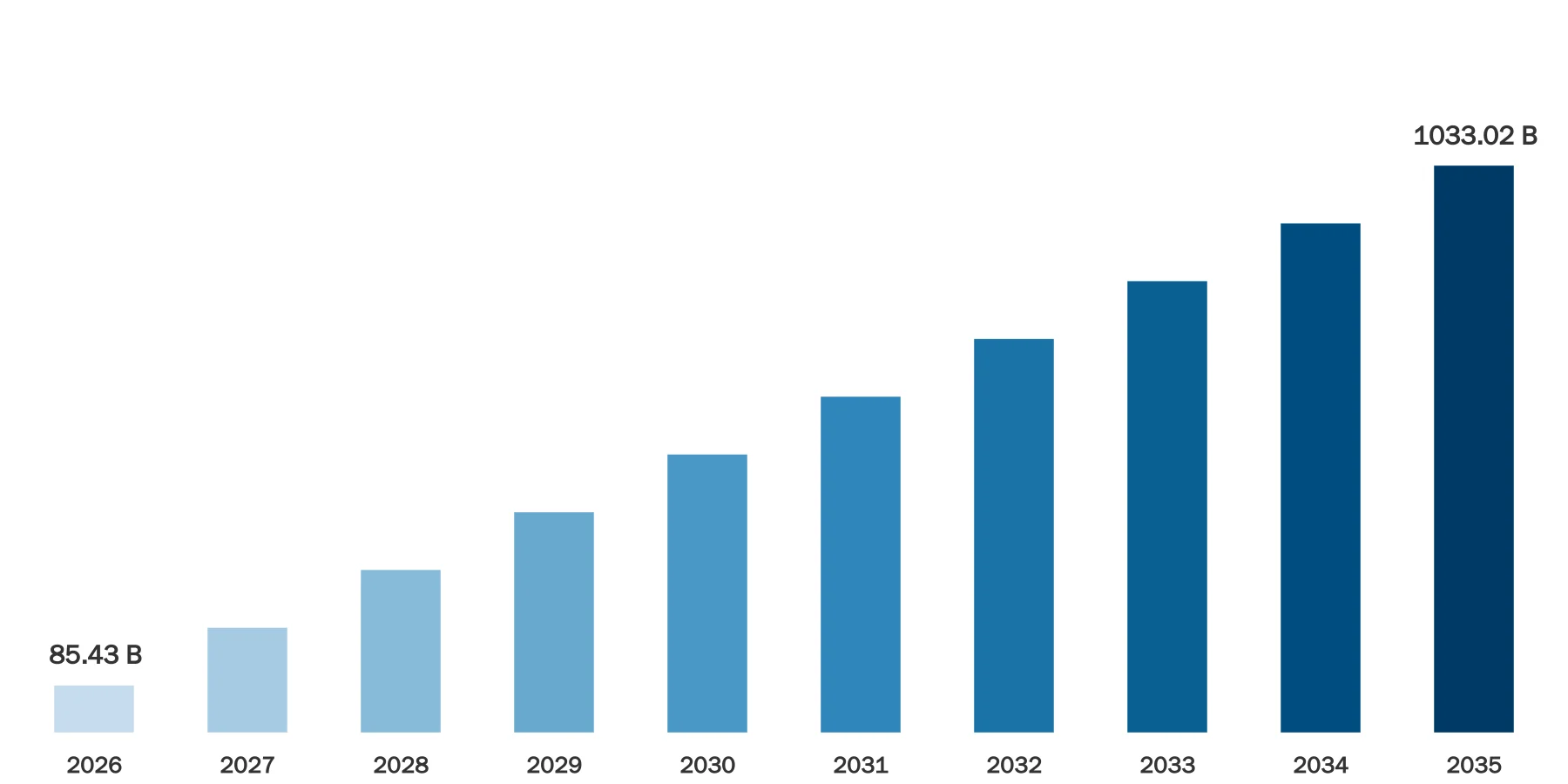
Source: Econ Market Research
The AI API Market is expanding rapidly as enterprises integrate Artificial Intelligence services directly into applications using APIs for natural language processing, image recognition, speech synthesis, and predictive analytics. Around 78% of organizations globally use AI in at least one business function, while 84% of developers actively use AI tools during software development workflows. AI APIs enable developers to integrate machine learning capabilities into software without building models from scratch, reducing deployment time by 40%–60% in many enterprise development cycles. Additionally, 89% of developers use AI-powered technologies, yet only 24% design APIs specifically optimized for AI agents, highlighting a growing demand for specialized AI API infrastructure across industries including healthcare, finance, retail, and logistics.
The USA AI API Market represents one of the largest ecosystems for AI infrastructure, supported by more than 4.4 million professional software developers and over 20,000 AI startups operating within the country. Approximately 61% of adults in the United States used AI tools within the last 6 months, demonstrating widespread digital interaction with AI-driven platforms. AI-assisted programming has significantly increased productivity, with over 51% of developers using AI tools daily during coding tasks. Additionally, 30% of Python code produced by U.S. developers is now generated using AI-based tools, reflecting a strong dependency on AI APIs for coding automation, chatbots, recommendation engines, and automated analytics across enterprise and SaaS platforms.
Key Insights
Emerging Trends: More than 78% of organizations utilize AI technologies in at least 1 operational function, while 84% of developers integrate AI tools in development workflows, and 51% of developers rely on AI daily, indicating strong demand for AI API integration in enterprise software environments.
Key Market Driver: Approximately 90% of employees report using AI tools at work, while 80% indicate productivity improvements, and 44% of developers learn programming using AI-based tools, demonstrating strong demand for scalable AI APIs that support enterprise automation and AI-driven application development.
Major Market Challenges: About 46% of developers express distrust in AI-generated outputs, while 38% report difficulty verifying AI-generated code, and 51% worry about unauthorized API calls by AI agents, highlighting operational challenges related to AI API reliability, governance, and security management.
Regional Outlook: North America accounts for approximately 35%–40% of global AI technology adoption, while Asia-Pacific represents nearly 30% of AI developer communities, Europe contributes about 25% of enterprise AI adoption, and emerging economies represent nearly **15% of new AI deployments.
Competitive Landscape: Large technology providers collectively control nearly 60% of AI API deployments, while AI startups contribute about 35% of innovation-driven platforms, and open-source communities influence approximately **20% of new AI model integrations across enterprise software ecosystems.
Market Segmentation: Generative AI APIs represent nearly 35% of AI API usage, computer vision APIs account for around 25%, speech and voice APIs represent nearly 20%, while recommendation and personalization APIs contribute approximately 20% across enterprise and consumer applications.
Recent Development: Around 70% of developers now experiment with AI-generated code, 36% of programmers are learning AI programming techniques, and 24% of developers actively design APIs for AI agents, highlighting rapid technological advancements in AI API frameworks and developer ecosystems.
Market Latest Trends
The AI API Market Trends highlight rapid adoption of generative AI, machine learning, and automated decision-making services across enterprise software ecosystems. Approximately 78% of organizations globally use AI in at least one business function, indicating strong integration of AI APIs into enterprise platforms for chatbots, analytics automation, and predictive decision-making systems. In addition, 84% of developers now use AI tools during software development, demonstrating a growing reliance on AI APIs to simplify coding, debugging, and application development.
Generative AI APIs represent one of the fastest-expanding segments, with 91% of developers using AI to generate code, enabling software teams to accelerate development cycles and improve productivity. AI APIs for natural language processing and conversational interfaces are widely deployed across customer service systems, with enterprises deploying chatbots that handle 40%–70% of routine support queries in many digital service environments.
Another major AI API Market Trend involves AI-driven data analytics platforms. Approximately 26.4% of businesses use AI for advanced data analytics, while 24.8% deploy AI-powered virtual agents or chatbots for operational automation. These trends demonstrate how organizations increasingly integrate AI APIs into CRM systems, enterprise resource planning software, marketing automation tools, and recommendation engines.
Cloud-based AI APIs dominate deployment strategies due to scalability and lower infrastructure costs. However, edge-based AI APIs are gaining popularity in IoT devices and real-time processing applications such as autonomous vehicles and smart surveillance systems. The developer ecosystem continues to expand, with more than 30% of application code being generated or assisted by AI-powered tools, reinforcing the role of AI APIs as the backbone of modern software development.
Market Dynamics
DRIVER
Rapid Adoption of Artificial Intelligence Across Enterprises
The increasing adoption of artificial intelligence across enterprise operations is the primary driver of the AI API Market Growth. Around 78% of organizations globally now use AI in at least one operational function, demonstrating widespread adoption across industries including finance, retail, healthcare, and manufacturing. Additionally, 99% of Fortune 500 companies utilize AI technologies in their operational workflows, highlighting the growing enterprise demand for scalable AI services.
AI APIs simplify the deployment of machine learning models by providing pre-trained services such as natural language processing, speech recognition, and computer vision. These APIs allow organizations to integrate advanced AI capabilities into applications without building complex models internally. Developers increasingly rely on AI APIs for automation and analytics, with 51% of developers using AI tools daily in development processes.
In addition, generative AI technologies are accelerating software development workflows. Research indicates that over 30% of programming functions created by developers are generated using AI tools, which significantly reduces coding time and improves productivity. AI APIs enable companies to deploy AI services within weeks instead of months, supporting faster innovation and application development.
RESTRAINT
Security Risks and Trust Issues in AI-Generated Outputs
Security concerns and trust issues related to AI-generated outputs represent a significant restraint for the AI API Market Analysis. Surveys indicate that 46% of developers do not fully trust AI-generated code, highlighting concerns about accuracy, reliability, and potential errors in AI-produced outputs.
Another challenge involves verifying AI-generated outputs. Around 38% of developers report that reviewing AI-generated code takes longer than reviewing human-written code, which can reduce productivity gains associated with AI development tools. Additionally, 51% of developers express concerns about unauthorized or excessive API calls from AI agents, creating potential cybersecurity risks for organizations integrating AI APIs into critical systems.
Data privacy regulations also affect AI API deployment. Organizations must ensure compliance with strict data protection standards while integrating AI services into applications. Industries such as healthcare and finance face additional regulatory constraints related to data security and AI transparency. These challenges can slow the adoption of AI APIs, particularly in highly regulated sectors where trust and security are critical requirements.
OPPORTUNITY
Expansion of AI-Powered Applications and Developer Ecosystems
The rapid expansion of AI-powered applications presents major opportunities for the AI API Market Outlook. Global developer communities are growing significantly, with more than 25 million active software developers worldwide building applications using APIs and cloud platforms. The increasing number of developers creates strong demand for accessible AI services delivered through APIs.
Generative AI platforms are opening new opportunities in industries such as content creation, digital marketing, cybersecurity, and financial services. For example, AI-powered chatbots can automate 40%–60% of customer service interactions, while recommendation systems improve product discovery in e-commerce platforms used by millions of consumers globally.
Another opportunity lies in AI-driven automation for enterprise workflows. Surveys indicate that 83% of businesses report new product or service opportunities after implementing AI technologies, demonstrating the innovation potential of AI APIs in software ecosystems.
The increasing adoption of AI APIs in Internet-of-Things environments also creates significant opportunities. Smart devices, connected vehicles, and industrial automation systems increasingly rely on AI APIs for predictive analytics, anomaly detection, and automated decision-making.
CHALLENGE
High Infrastructure Requirements and Model Optimization Complexity
Despite strong growth prospects, the AI API Industry faces challenges related to infrastructure requirements and model optimization complexity. AI models require large datasets, advanced computing power, and high-performance GPUs to operate efficiently. Training large language models can involve billions of parameters, which increases computational demand and operational complexity.
Another challenge involves managing large volumes of API requests generated by AI applications. AI agents can generate thousands of API calls per minute in automated systems, requiring robust infrastructure to prevent service interruptions or system overload.
Developer skills also present a challenge. Surveys indicate that 36% of developers are still learning AI programming techniques, which highlights a skill gap in advanced machine learning and AI architecture design.
In addition, organizations must continuously optimize AI models to ensure accuracy and performance across different datasets and languages. AI systems deployed globally must support multiple languages, regional datasets, and domain-specific knowledge, which increases the complexity of maintaining high-quality AI API services.
Segmentation Analysis
The AI API Market Segmentation is primarily categorized by functionality and deployment architecture. AI APIs enable developers to access machine learning capabilities such as language processing, image recognition, speech synthesis, and recommendation systems through cloud or hybrid infrastructure. Generative AI APIs currently represent one of the fastest growing segments due to widespread adoption in chatbots, coding assistants, and automated content generation. Computer vision APIs are widely used in security systems, retail analytics, and healthcare imaging applications. Speech and voice APIs support voice assistants and call center automation systems used by millions of businesses globally. Deployment models include cloud-based APIs, edge APIs for real-time processing, and hybrid architectures combining both infrastructures.
By Functionality
Generative AI APIs
Generative AI APIs represent approximately 35% of AI API deployments, making them the largest functionality segment in the AI API Market. These APIs enable applications to generate text, code, images, and synthetic data through advanced machine learning models. Around 91% of developers now use generative AI tools for coding assistance, demonstrating strong demand for generative AI APIs in software development environments.
Generative AI APIs are widely used in chatbots, content generation tools, marketing automation platforms, and automated documentation systems. Enterprises use generative AI APIs to process millions of queries daily across customer support and digital services platforms.
Computer Vision APIs
Computer vision APIs account for nearly 25% of AI API deployments, supporting applications such as facial recognition, object detection, and automated visual inspection systems. These APIs process millions of images and video streams daily in industries including manufacturing, healthcare, and retail.
Computer vision technologies are widely used in smart surveillance systems that analyze 30–60 frames per second in real-time video monitoring applications. Retail companies deploy computer vision APIs to track store traffic patterns and inventory levels through camera-based analytics systems.
Speech and Voice APIs
Speech and voice APIs represent approximately 20% of AI API deployments, enabling applications to convert speech into text and generate human-like voice responses. Voice assistants integrated into smartphones and smart speakers process billions of voice commands annually, highlighting the large scale of speech API usage.
Speech APIs are widely deployed in customer service call centers where automated voice assistants handle 30%–50% of routine customer queries, reducing operational workload for human agents.
Recommendation APIs
Recommendation APIs account for roughly 20% of AI API usage, enabling personalized recommendations in e-commerce, streaming platforms, and social media services. Recommendation algorithms analyze user behavior, browsing history, and interaction patterns across millions of users to generate personalized suggestions.
Streaming platforms and e-commerce websites rely heavily on recommendation APIs to influence over 70% of user engagement and content discovery, demonstrating the strong impact of AI recommendation engines on digital platforms.
By Deployment
Cloud-Based APIs
Cloud-based APIs dominate the AI API Market with approximately 65% deployment share, due to scalability, cost efficiency, and global accessibility. Cloud infrastructure allows developers to access AI services without investing in high-performance computing hardware.
Cloud-based AI APIs can process millions of requests per minute across distributed data centers. Many enterprise applications deploy AI APIs through cloud environments that support automated scaling and high availability.
Edge APIs
Edge AI APIs represent nearly 20% of deployments, primarily used in Internet-of-Things devices, smart cameras, and autonomous systems requiring real-time decision-making. Edge APIs enable data processing directly on local devices rather than sending data to centralized cloud servers.
Edge AI processing reduces latency to less than 10 milliseconds, which is essential for applications such as autonomous vehicles, industrial robotics, and smart manufacturing systems.
Hybrid APIs
Hybrid AI APIs account for approximately 15% of deployments, combining cloud and edge processing architectures to optimize performance and data security. Hybrid deployments enable organizations to process sensitive data locally while leveraging cloud infrastructure for large-scale analytics.
Enterprises deploy hybrid AI architectures in industries such as healthcare and finance where regulatory compliance requires strict control over sensitive data.
Regional Analysis
The AI API Market Regional Analysis shows strong adoption across major global technology ecosystems. North America leads AI API development due to strong AI infrastructure and developer ecosystems. Europe focuses on enterprise AI adoption and regulatory frameworks. Asia-Pacific experiences rapid expansion in AI startups and developer communities. Middle East & Africa show growing adoption through digital transformation initiatives and government AI strategies.
North America
North America accounts for approximately 35%–40% of global AI API adoption, making it the largest regional market. The region hosts more than 5,000 AI startups and over 4 million software developers, creating a strong ecosystem for AI innovation.
The United States dominates the regional AI API market due to strong investments in artificial intelligence infrastructure and cloud computing platforms. More than 61% of American adults have used AI tools within the past six months, demonstrating widespread exposure to AI-powered applications.
Major industries driving AI API adoption include financial services, healthcare, e-commerce, and technology sectors. AI APIs support automated fraud detection systems that analyze thousands of financial transactions per second. Healthcare organizations also use AI APIs to analyze medical imaging data and Electronic Health Records for diagnostic assistance.
Additionally, the region has a strong developer community where over 50% of developers use AI tools daily for coding, debugging, and automation. This high developer adoption rate significantly contributes to the growth of AI APIs across enterprise software ecosystems.
Europe
Europe accounts for approximately 25% of global AI API deployments, supported by strong research institutions and digital transformation programs across multiple countries. The region hosts more than 3 million professional developers and a rapidly growing number of AI startups focusing on enterprise automation and data analytics.
European enterprises are increasingly adopting AI APIs for financial technology platforms, cybersecurity solutions, and advanced manufacturing systems. Smart manufacturing facilities deploy AI APIs to monitor production equipment and detect anomalies across thousands of sensor inputs per second.
Governments across the region are also investing heavily in AI innovation programs. European companies deploy AI APIs to enhance predictive maintenance systems, automate supply chain operations, and improve logistics planning across international trade networks.
Additionally, e-commerce companies rely heavily on recommendation APIs to personalize product suggestions for millions of customers, increasing digital engagement and customer retention rates.
Asia-Pacific
Asia-Pacific represents approximately 30% of the global AI API Market, driven by rapid growth in technology startups and digital services platforms. The region has one of the largest developer populations, with countries such as India, China, and Japan collectively hosting more than 8 million software developers.
AI adoption is accelerating across multiple industries including fintech, telecommunications, and online retail. E-commerce platforms in the region use AI APIs to analyze millions of consumer interactions daily, enabling personalized recommendations and dynamic pricing strategies.
China has also emerged as a major AI technology hub with strong adoption of AI platforms and developer frameworks. AI APIs are widely used in facial recognition systems deployed across smart city infrastructure and digital payment platforms processing billions of transactions annually.
India represents one of the fastest-growing developer ecosystems where AI APIs support mobile applications, digital payment services, and cloud-based enterprise platforms serving hundreds of millions of users.
Middle East & Africa
The Middle East & Africa region accounts for approximately 5%–8% of global AI API adoption, but adoption is increasing rapidly due to digital transformation initiatives and government investments in artificial intelligence infrastructure.
Countries such as the United Arab Emirates and Saudi Arabia have launched national AI strategies to accelerate the adoption of advanced technologies across government services, healthcare systems, and financial sectors. AI APIs are widely used in smart city projects involving automated traffic management, public safety monitoring, and energy optimization systems.
Telecommunications companies across the region deploy AI APIs to analyze network performance and optimize bandwidth usage across millions of connected devices. AI-powered analytics platforms also support financial institutions in fraud detection and customer behavior analysis.
Additionally, startups across Africa are leveraging AI APIs to develop mobile-based financial services, agricultural analytics platforms, and healthcare diagnostics tools serving rural communities.
List of Top AI API Companies
Google LLC (U.S.)
Microsoft Corporation (U.S.)
IBM Corporation (U.S.)
OpenAI (U.S.)
AssemblyAI (U.S.)
Hugging Face (U.S.)
DeepSeek (China)
Cohere (Canada)
Eden AI (U.S.)
Imagga (Bulgaria)
SymphonyAI (U.S.)
CrowdStrike (U.S.)
ScaleAI (U.S.)
Veritone (U.S.)
Flow AI (Netherlands)
SentiSight.ai (U.S.)
Top Two Companies with Highest Market Share
Google provides one of the largest AI API ecosystems through cloud AI services including natural language processing, computer vision, and speech recognition APIs. Google processes billions of AI API requests daily across its cloud infrastructure and supports millions of developers globally building AI-powered applications.
Microsoft offers a comprehensive AI API portfolio through Azure AI services including language models, vision APIs, and speech APIs. Azure AI infrastructure supports over 95% of Fortune 500 companies, enabling large-scale AI deployments across enterprise software systems.
Market Investment Outlook
The AI API Market Investment Outlook highlights strong investment activity from venture capital firms, technology companies, and government innovation programs. Artificial intelligence has become a strategic priority for organizations globally, with 92% of business leaders identifying AI as a major investment focus for product development and operational automation.
Technology startups developing AI infrastructure platforms are receiving significant funding to expand AI model capabilities, developer platforms, and cloud infrastructure. AI APIs are becoming the core layer of the digital economy because they enable companies to deploy advanced machine learning models without investing in expensive research and development teams.
Investments are particularly focused on generative AI platforms capable of processing large datasets and supporting millions of API requests per day. Cloud providers are expanding AI infrastructure by building high-performance data centers equipped with specialized GPUs designed for machine learning workloads.
In addition, governments worldwide are launching AI innovation initiatives to support research institutions and startups developing AI technologies. These programs encourage collaboration between universities, private enterprises, and technology incubators to accelerate AI innovation and application development.
The rapid expansion of developer communities further strengthens investment opportunities in the AI API ecosystem, as millions of developers continue building AI-powered applications across cloud platforms, mobile devices, and IoT ecosystems.
New Product Development
The AI API Market Innovation Landscape is characterized by rapid product development across generative AI models, multimodal AI systems, and specialized enterprise APIs. Technology companies are continuously launching new AI APIs capable of processing text, images, audio, and video simultaneously through multimodal AI models.
Recent advancements in generative AI APIs allow developers to generate complex outputs such as code, synthetic images, and detailed analytics reports using natural language prompts. Many modern AI APIs support models containing billions of parameters, enabling highly sophisticated language understanding and contextual reasoning.
Another major innovation involves AI APIs optimized for edge computing environments. These APIs allow machine learning models to run directly on devices such as smartphones, surveillance cameras, and industrial sensors. Edge AI processing reduces latency and enables real-time analytics in applications such as autonomous vehicles and smart manufacturing systems.
Security features are also improving in AI APIs. Developers are implementing authentication protocols and encryption mechanisms to prevent unauthorized API usage and protect sensitive data. Modern AI APIs include built-in monitoring tools that analyze thousands of API calls per minute to detect suspicious activity and ensure system reliability.
These technological innovations continue to expand the capabilities of AI APIs, enabling organizations to build advanced intelligent applications across industries including healthcare, logistics, retail, cybersecurity, and financial services.
Recent Developments
In 2025, developer surveys indicated that 84% of developers actively use AI tools in development workflows, highlighting rapid adoption of AI APIs in software development environments.
In 2025, research showed that 91% of developers used AI tools to generate code, accelerating demand for generative AI APIs across enterprise development platforms.
In 2025, studies revealed that 30% of Python programming functions were generated using AI tools, demonstrating significant influence of AI APIs on software development productivity.
In 2025, reports showed that 78% of organizations globally adopted AI technologies in at least one business function, increasing enterprise demand for AI APIs supporting automation and analytics.
In 2025, surveys revealed that 24% of developers actively design APIs specifically for AI agents, highlighting the emergence of new AI-optimized API architectures in modern software ecosystems.
AI API Market Report Scope & Segmentation
| Attributes | Details |
|---|---|
Market Size (Current) | US$ 85.43 Billion in 2026 |
Market Size (Forecast) | US$ 1033.02 Billion in 2035 |
Growth Rate | CAGR of 31.91% from 2026 to 2035 |
Forecast Period | 2026 – 2035 |
Base Year | 2025 |
Historical Data Available | Yes |
Regional Scope | Global |
Segments Covered | By Functionality
By Deployment
By End-user
|
Frequently Asked Questions
Common questions about this report
The study period covers historical insights and forecast projections for the period 2026-2035.
About the Author
Market research expert with years of industry experience

Related Reports
Explore more market insights from the same category