

Agriculture Equipment Market
Agriculture Equipment Market Size, Share, Trends, Growth, and Industry Analysis, By Type (Tractors, Harvesters, Soil Preparation and Cultivation Equipment, Irrigation and Crop Processing Equipment, Agricultural Spraying Equipment, Hay and Forage Machines, Others), By Automation (Automatic, Semi-automatic, Manual), By Business (Original Equipment Manufacturers (OEMs), Aftermarket), Regional Analysis and Forecast Period 2026-2035
Market Overview
As per Econ Market Research analysis, Global Agriculture Equipment Market size stood at US$ 183.73 Billion in 2026 and is projected to reach US$ 325.83 Billion by 2035, growing at a CAGR of 6.5% over the forecast period 2026–2035. 2025 is taken as the base year.
Agriculture Equipment Market Size 2025-2035 (USD Billion)

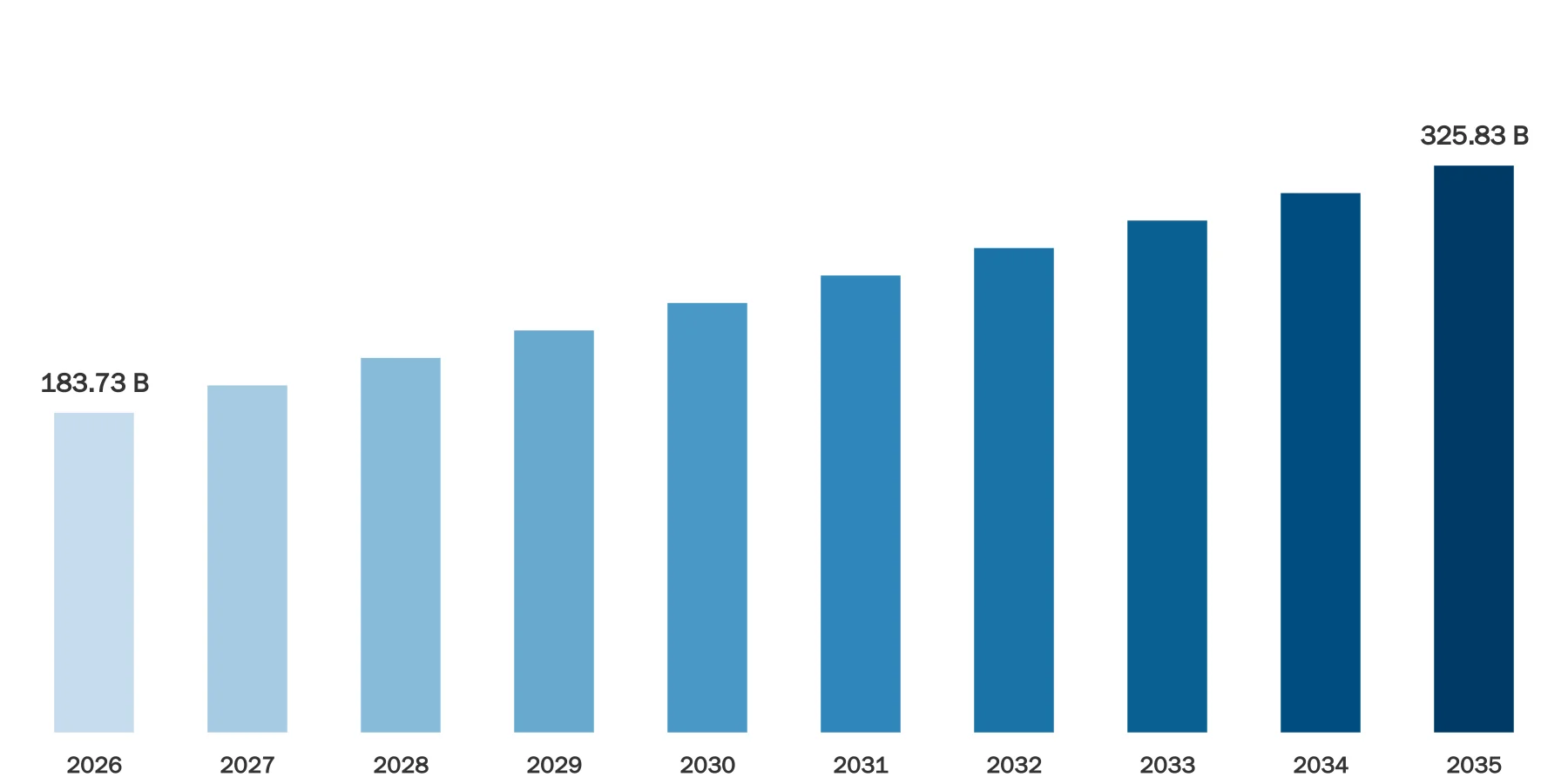
Source: Econ Market Research
Agriculture equipment includes the use of tractors, harvesters, plows, and cultivators to assist in various farming activities. The utilization of agriculture equipment assists in obtaining a high crop yield in comparatively less time and with minimum efforts. In addition, the use of automatic and semiautomatic agriculture equipment reduces the necessity of human labor on farms, which in turn reduces the costs incurred on manpower. These further increases crop production by reducing downtime and allowing highly precise operations.
An increase in mechanisation of various farming activities such as plowing, harrowing, planting, harvesting, and tilling is expected to boost demand for agriculture equipment, which drives the growth of the global agriculture equipment industry. The recognition of benefits owing to the implementation of mechanical equipment such as tractors, harvesters, and various attachments increases the dependency of farmers on the agriculture equipment. In addition, the implementation of precision farming enables sustainability in farming activities, increases profitability, and protects land resources, which results in improved agricultural production. Various products offered by major players in the agriculture equipment industry assist farmers in different farming activities such as sowing and harvesting, which further promotes the implementation of agriculture equipment. This significantly contributes to the growth of the global agriculture equipment market.
Market Growth Factors
In the recent years, the number of technologies that are adopted in order to provide better machinery for farming purposes has increased to a great extent. Increased use of the internet of things, Artificial Intelligence, and equipment that is enabled with GPS will lead to the growth of the market during the forecast period. All of these factors will play an instrumental role and provide better opportunities for the growth of this market during the forecast period. The availability and usage of flying drones will also provide great opportunities for this market. The increased use of these modern equipments and their benefits have created more need for such equipments, and the manufacturers in the industry are constantly engaged in coming up with better products and developing the existing products to meet the demand of the end users.
Market Key Drivers
Regardless of the size of their operation, farmers need credit facilities to buy expensive Farm Equipment on a financial market that has seen significant development. So, large farmers that can afford the high expense of installing and maintaining the farm equipment are more likely to use it. Users place a high value on accessibility and ease of availability of agriculture equipment, which also draws potential customers. As a result of these rules, the range of machines and tools that are eligible for subsidies has been greatly increased. Farmers are entitled for support in other agricultural operations in addition to the specific subsidies on agricultural instruments, boosting the demand for specialist machinery and equipment.
Market Key Restraint
Agriculture production is negatively impacted by both climatic changes and agricultural cycles. A region',s weather influences crop yield, which has an impact on purchasing selections for farming equipment. Due to the food insecurity experienced by emerging nations during erratic weather patterns, many nations adopt farm machinery slowly. By product and region, agricultural tool demand varies. Tractors and planting, seeding, and application tools are frequently in demand from March to June in the Northern Hemisphere and from September to December in the Southern Hemisphere. Dealers from the Northern Hemisphere place orders for harvesting equipment between August and October to keep inventory on hand for the peak selling season, which runs from March to June. Conversely, dealers from the Southern Hemisphere place orders for the same equipment between August and October to keep inventory on hand for the peak season, which runs from November to February.
Market Key Opportunities
Farmers who employ precision farming concentrate on producing more with fewer resources. With the use of this technology, farmers may monitor crop variability both within and between fields and take appropriate action to achieve their farming objectives. In addition, the growing demand puts ongoing pressure on the agriculture sector to deliver higher yields. Precision farming is anticipated to boost productivity and operational effectiveness, closing the supply-demand gap. Over the projected period, the farming method is anticipated to successfully address the issue of a high demand for agricultural products in all types of geographies.
Regional Insights
The Asia-Pacific region will have a top position during the forecast period. In the recent years, this region has shown strong growth in the economy, due to which the demand for this agriculture equipment will also increase during the forecast period. The growth of a few nations like Taiwan, India, and China is considerable. In the coming years, India will prove to be a nation that will provide maximum opportunities for the growth of this market. The need for agricultural tractors has grown drastically in India, and this will continue to grow well during the forecast period. As the farmers in this region seek ways to increase their productivity, the need for this equipment will grow. The mechanisation process will also help in the growth of the market during the forecast period.
The agricultural equipment market in North America is anticipated to increase as a result of rising investments in the sector. Also, during the study period, the market for agricultural equipment is anticipated to benefit greatly from the growing demand for contemporary agricultural equipment. Throughout the projected period, it is also anticipated that a rise in agricultural activity throughout the region will have a substantial impact on the expansion of the local market. The US Department of Agriculture reports that the government wants to boost agricultural output by 40% by the year 2050.
Competition Analysis
The key market players profiled in the report include:
Mahindra &, Mahindra Ltd.
Escorts Limited
CNH Industrial N.V.
Deere &, Company
AGCO Corporation
SDF S.p.A.
China National Machinery Industry Corporation Ltd. (Sinomach),
J C Bamford Excavators Ltd.
Kubota Corporation.
Agriculture Equipment Market Report Scope & Segmentation
| Attributes | Details |
|---|---|
Market Size (Current) | US$ 183.73 Billion in 2026 |
Market Size (Forecast) | US$ 325.83 Billion in 2035 |
Growth Rate | CAGR of 6.5% from 2026 to 2035 |
Forecast Period | 2026 – 2035 |
Base Year | 2025 |
Historical Data Available | Yes |
Regional Scope | Global |
Segments Covered | By Type
By Automation
By Business
|
Frequently Asked Questions
Common questions about this report
The study period covers historical insights and forecast projections for the period 2026-2035.
About the Author
Market research expert with years of industry experience

Dipali Bhingare serves as the Market Research Director at Econ Market Research. With a focus on translating complex global economic shifts into actionable business intelligence, she oversees the strategic direction of comprehensive market studies. Her work empowers organizations to navigate volatile industries through data-driven forecasting and deep-dive competitive analysis.
Related Reports
Explore more market insights from the same category