

Agriculture Supply Chain Management Market
Agriculture Supply Chain Management Market Size, Share, Trends, Growth, and Industry Analysis, By Component (Hardware, Solutions, Services), By Solution Type (Manufacturing Execution System (MES), Transportation Management System (TMS), Warehouse Management System (WMS), Supply Chain Planning, Procurement and Sourcing), By Deployment Model (On-premise, On-Demand / Cloud-Based), By User Type (Small and Medium-Sized Enterprises (SMEs), Large Enterprises), Regional Analysis and Forecast Period 2026-2035
Market Overview
As per Econ Market Research analysis, the Global Agriculture Supply Chain Management Market was estimated at US$ 26 Billion in 2026 and is forecast to attain US$ 76 Billion by 2035, expanding at a CAGR of 12.65% between 2026 and 2035. The base year for the study is 2025.
Agriculture Supply Chain Management Market Size 2025-2035 (USD Billion)

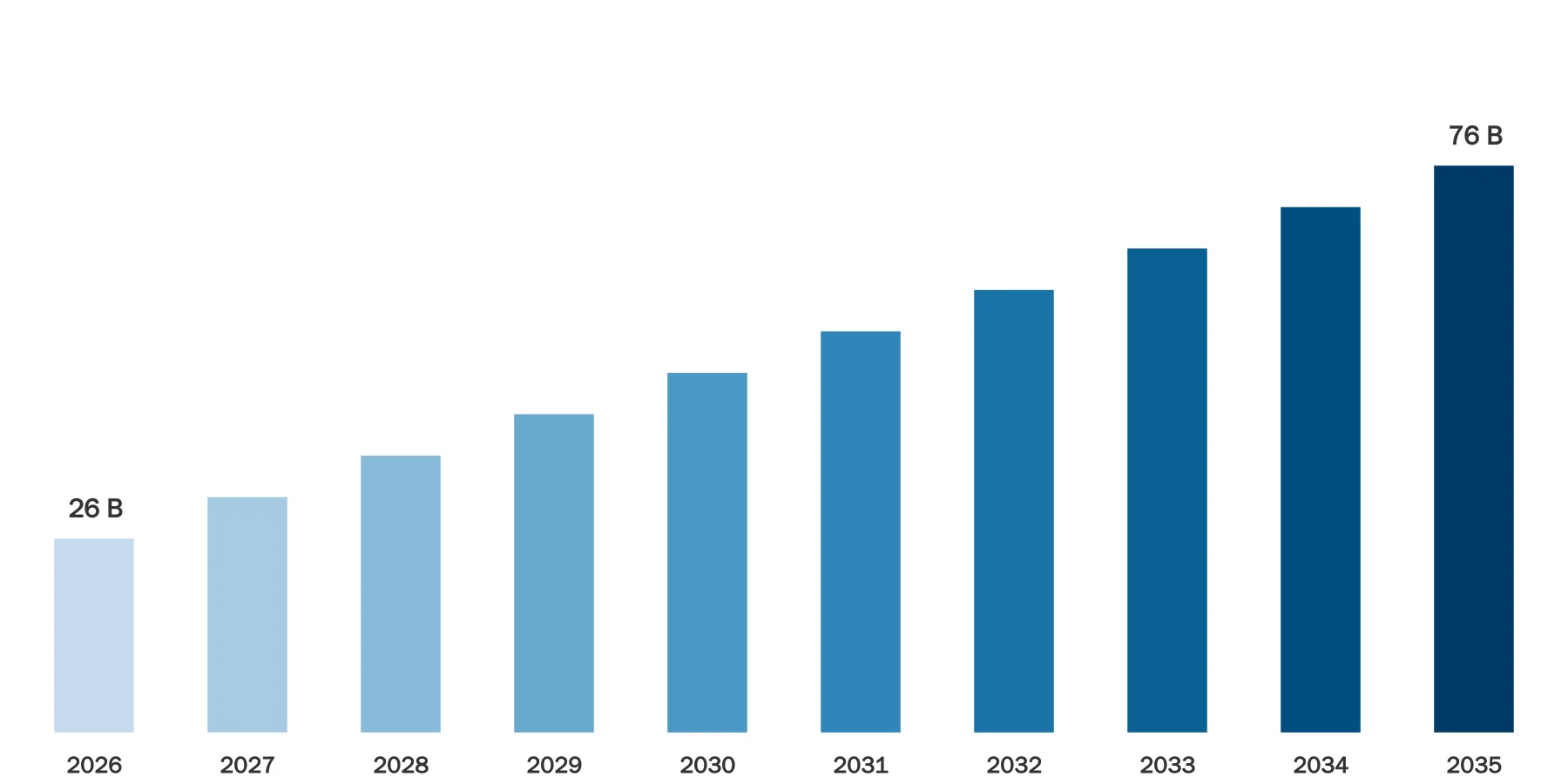
Source: Econ Market Research
Supply chain management manages the flow of goods and services and includes all processes that transform raw materials into final products. Similar to this, agriculture supply chain management entails controlling interactions between businesses in charge of efficiently producing and delivering goods from farms to consumers in order to consistently meet their demands for quantity, quality, and price. This typically entails overseeing procedures, partnerships, and horizontal and vertical alliances. Hence, to ensure that production and delivery commitments are met on time, agricultural supply chains implement internal controls and provide chain-wide incentives. Although the rise of supply chains from the farm gate to the retail level has been facilitated by improved efficiency, timely distribution, cost-effective transportation, and product differentiation. For instance, in May 2022, Intellync announced a cooperation with supply chain management solution provider Star Index in order to combine Star Index',s extensive knowledge of supply chain insights with Intellync',s expertise in agricultural supply chains. It creates software that will help agri-food companies enhance their supply chains by reducing resource needs, assessing risk, and capturing and reporting data.
COVID-19 Impact on Agriculture Supply Chain Management Market
The COVID-19 epidemic has a negative influence on the global market for supply chain management in agriculture. Due to a lack of supplies from other states, problems with the arrangement of the transport vehicles, transportation restrictions, labour shortages, ineffective cold chain facilities, panic buying, price fluctuations, and a lack of collectors/aggregators in the market, it has caused disruptions in the agricultural supply chain. Also, due to constraints on international trade, the pandemic has impacted the export and import of agricultural products globally. The management of the global agriculture supply chain has been harmed by all of these operations.
The market's stakeholders are, however, making the necessary preparations to make up for the loss brought on by the pandemic. Also, it is expected that businesses will put more of an emphasis on post-pandemic solutions that will help advanced preparation and lessen the effects of such crises in the future. In the coming years, the organizations will place a greater emphasis on end-to-end stock visibility, intricate supplier monitoring, and process automation, which will increase demand for SCM software in the agriculture supply chain management sector.
Market Drivers
The worldwide agriculture supply chain industry will develop due to cloud-based software - Agricultural demand and supply chain operations have recently seen a continuous increase in the use of cloud-based applications. A supply chain that is located in the cloud benefits consumers in many ways. When several cloud vendors enhance their portfolios, the overall cost of solutions is significantly reduced. Organizations headquartered in agriculture can benefit from a variety of factors, including reduced risk, more visibility, quicker deployment, and greater flexibility.
Market Restraints
High cost to restraint the growth of the global agriculture supply chain market- The price of using an agricultural supply chain management system adds to the cost of the finished commodity that is supplied. Small-scale industries frequently lack the budget since processing information and coordinating transactions between businesses is significantly more expensive.
Extended time for installation - The delivery procedure is hampered by the receiver',s uncertainty caused by the lengthy software installation and implementation times. The lengthening of these processes adds overhead expenses as well, which has a negative effect on the final cost of agricultural products.
Market Opportunities
Increasing demand for enhanced supply chain visibility - The status of numerous operations carried out by agricultural supply chain management systems is tracked in real-time by supply chain managers. Supply chain managers can be ready and handle little issues that develop because of this ongoing monitoring. The ongoing observation ensures sufficient production and supply of goods from the producer to the consumer. The system aids in maintaining the quantity, quality, and price requirements for the items.
Regional Analysis
On the basis of regional analysis, the Global Agriculture Supply Chain Management Market is classified into four regions: North America, Europe, Asia Pacific, and the Rest of the World. North America accounted for the largest market share, and Europe was the second largest in 2022. Market consolidation with larger companies acquiring smaller competitors to attain economies of scale and vertical integration, the trend of precision farming, and increased investments in Agritech start-ups are some of the important factors driving the growth of the North American market. Agri inputs, precision agriculture, farm management software, supply chain technology, quality management, and traceability are among the major advancement areas in the North American agriculture sector that are driving technology adoption.
Competitive Landscape
The key market players profiled in the report include:
FCE Group AG
Agri Value Chain
Bext360
Ambrosus
ChainPoint
AgriDigital
eHarvestHub
Eka
GrainChain, Inc.
Geora Ltd.
IBM
Trellis Ltd.
Intellync
SAP SE
Proagrica
The companies have adopted organic as well as inorganic growth strategies, such as new service and product developments and investments and expansions, to expand their product portfolios and increase their respective market shares across different regions. Expansion and investments involve investments in R&D, new manufacturing facilities, and supply chain optimization.
Agriculture Supply Chain Management Market Report Scope & Segmentation
| Attributes | Details |
|---|---|
Market Size (Current) | US$ 26 Billion in 2026 |
Market Size (Forecast) | US$ 76 Billion in 2035 |
Growth Rate | CAGR of 12.65% from 2026 to 2035 |
Forecast Period | 2026 – 2035 |
Base Year | 2025 |
Historical Data Available | Yes |
Regional Scope | Global |
Segments Covered | By Component
By Solution Type
By Deployment Model
By User Type
|
Frequently Asked Questions
Common questions about this report
The study period covers historical insights and forecast projections for the period 2026-2035.
About the Author
Market research expert with years of industry experience

Dipali Bhingare serves as the Market Research Director at Econ Market Research. With a focus on translating complex global economic shifts into actionable business intelligence, she oversees the strategic direction of comprehensive market studies. Her work empowers organizations to navigate volatile industries through data-driven forecasting and deep-dive competitive analysis.
Related Reports
Explore more market insights from the same category