Ablation Technology Market Overview
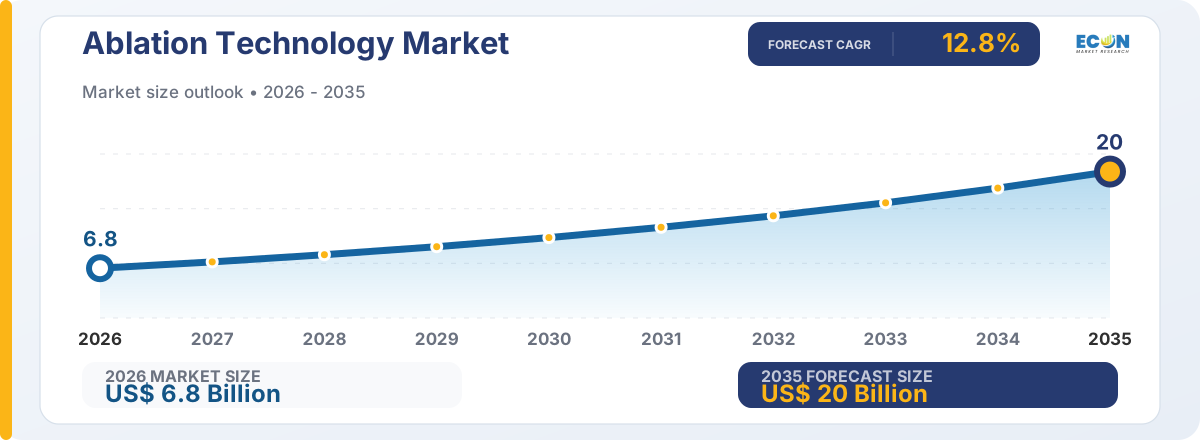
As per Econ Market Research analysis, the Global Ablation Technology Market was valued at approximately US$ 6.8 Billion in 2026 and is predicted to reach US$ 20 Billion by 2035, expanding at a CAGR of 12.8% over the forecast duration. The base year is 2025.
Ablation technology refers to medical operations that remove or destroy tissue utilizing lasers, radiofrequency, or cryotherapy. This technology is commonly used to treat cancer, cardiovascular disorders, and chronic pain. The global ablation technology market is expanding rapidly as the prevalence of chronic diseases rises, technology advances, and people demand less intrusive procedures.
Factors driving the market include an older population that is increasingly susceptible to chronic health disorders, as well as continual improvements in ablation devices that improve safety and effectiveness. Key market players are working on creating new and enhanced technologies to serve different medical needs, adding to the overall market growth. The increasing adoption of outpatient procedures and the rising demand for effective and less invasive treatment options further fuel the market growth.
Dynamic Insights
The rising prevalence of chronic diseases such as cancer, cardiovascular disorders, and chronic pain is a major driver, increasing the demand for better treatment options. Technological improvements, such as the development of more accurate and minimally invasive ablation technologies, contribute to market expansion by improving treatment outcomes and patient safety. Patients and healthcare providers prefer minimally invasive procedures, which offer faster recovery times and a lower chance of problems.
However, the market confronts some constraints, including as the high prices involved with sophisticated ablation technologies and the complexities of regulatory approvals. These limitations may limit market accessibility, especially in emerging nations with less developed healthcare infrastructure. Despite these challenges, opportunities abound, including the potential for growth in developing markets where healthcare access is expanding. Innovations in ablation technology, such as improved imaging techniques and hybrid devices, offer new avenues for market growth. The continuous focus on research and development by key industry players aims to overcome current limitations and meet evolving medical needs, positioning the market for sustained growth.
Drivers Insights
Rising Prevalence of Chronic Diseases
The rising prevalence of chronic diseases such as cancer, cardiovascular ailments, and chronic pain issues is driving the demand for ablation technology. Chronic disorders frequently necessitate long-term management and therapy, and ablation techniques offer an efficient option by identifying, removing, or destroying troublesome tissue. As the world',s population ages, the prevalence of these illnesses grows, raising the demand for better ablation therapies. This tendency is particularly noticeable in affluent countries with greater healthcare access, as well as in emerging regions where healthcare infrastructure is increasing. The increased number of patients looking for minimally invasive treatment choices further strengthens the market.
Technological Advancements
Continuous innovation in ablation technologies improves their effectiveness and safety, which drives market development. Advancements such as more precise laser systems, improved radiofrequency devices, and advanced cryotherapy equipment all help to improve treatment outcomes and minimize recovery times. Innovations such as hybrid ablation devices, which combine multiple procedures, are also broadening the range of treatable illnesses. These technological advancements not only make procedures safer and more efficient, but they also enhance their adoption by both healthcare providers and patients. The continual research and development activities of leading industry players ensure that the market continues to evolve with cutting-edge solutions.
Restraints Insights
High Costs of Advanced Technologies
The high cost of advanced ablation devices and procedures can be a significant barrier to market growth. The development and production of cutting-edge ablation technologies involve substantial investment in research, manufacturing, and regulatory compliance. These high costs are often passed on to healthcare providers and patients, potentially limiting access to advanced treatments, especially in low- and middle-income regions. Additionally, the high cost of maintaining and upgrading medical equipment can be a financial burden for hospitals and clinics, further constraining market growth.
Regulatory Challenges
The ablation technology market has hurdles due to complicated and strict regulatory constraints. Obtaining permission for new ablation devices requires rigorous clinical research, adherence to multiple international standards, and lengthy approval processes. These regulatory impediments can slow the market launch of innovative technology and raise the cost of bringing items to market. In other regions, regulatory processes may be less clear or inconsistent, providing additional uncertainty and impediments for businesses wanting to extend their market presence.
Opportunities Insights
Emerging Technologies and Innovations
The development of novel ablation technologies and techniques opens up numerous prospects for market expansion. Innovations such as minimally invasive procedures, advanced imaging techniques, and the use of Artificial Intelligence for precision ablation provide new opportunities to improve patient outcomes and increase the range of treatable illnesses. Companies that spend in R&,D to create next-generation ablation devices are well positioned to gain market share. These technical breakthroughs not only address the increased demand for effective therapies, but they also offer up new applications and markets.
Segment Analysis
By Technology
In the global ablation technology market, the technology sector includes numerous ways for performing ablation treatments. Key methods include radiofrequency ablation, which uses electrical currents to create heat and destroy tissue, laser/light ablation, which employs concentrated light beams for precise tissue removal, and ultrasonic ablation, which uses high-intensity sound waves to target and treat tissue. Other procedures include electrical ablation, which utilizes electrical impulses to disrupt tissue, and cryoablation, which employs severe cold to freeze and destroy tissue.
Microwave ablation uses microwave energy to vaporize tissue, whereas pulsed field ablation uses electrical pulses to induce reversible changes in cell membranes. Hydrothermal/hydromechanical ablation treats tissues by combining high-temperature steam with mechanical force. Each technology provides distinct advantages and is selected based on the individual medical application and desired outcomes.
By Product
The product segment in the ablation technology market is divided into systems and consumables. Systems refer to the complete ablation equipment, including the main device, control units, and associated accessories necessary for performing ablation procedures. These systems are often sophisticated and require significant investment, but they are essential for conducting various ablation treatments.
Consumables, on the other hand, include single-use items such as catheters, probes, and electrodes that are used during the ablation process. Consumables are crucial for ensuring the effectiveness and safety of procedures, as they are designed to interact directly with the patient&rsquo,s tissue. Both systems and consumables are integral to the functioning of ablation technologies, with systems providing the core functionality and consumables enabling the precise application of these technologies.
By Application
The application segment of the ablation technology market includes a wide range of medical sectors that use ablation technologies. Ablation procedures are used to treat arrhythmias and other heart problems in patients with cardiovascular disease. Ablation is a cancer treatment method that destroys tumors or aberrant tissues in numerous organs. Ablation is used in ophthalmology to treat eye problems, and in pain management to relieve chronic pain. Ablation is used in gynecology and urology to treat operations involving the reproductive and urinary systems. Orthopedic treatment uses ablation technologies for musculoskeletal disorders, whereas cosmetic/aesthetic surgery uses them for skin treatments and body reshaping.
Regional Analysis
North America, notably the United States, dominates the market because to advanced healthcare systems, large investment in medical technology, and a high prevalence of chronic conditions necessitating ablation therapies. The region',s significant emphasis on research and development helps to speed the deployment of novel ablation technologies. Europe is also a significant market, with well-established healthcare infrastructure and an increasing use of minimally invasive procedures.
The region benefits from high healthcare spending and an emphasis on improving patient outcomes using sophisticated technologies. In Asia-Pacific, the market is experiencing rapid growth fuelled by improving healthcare infrastructure, rising healthcare expenditure, and a large patient population with chronic conditions. Countries like China and India are investing heavily in healthcare modernization and are witnessing increased demand for ablation technologies. The growing middle-class population and increasing access to healthcare services in these countries further drive market expansion.
Latin America and the Middle East &, Africa are emerging markets with significant growth potential. In these regions, increasing healthcare investments, expanding healthcare infrastructure, and rising awareness about advanced treatment options contribute to the growing adoption of ablation technologies. However, challenges such as varying levels of healthcare access and affordability remain.
Competitive Landscape
Medtronic, Boston Scientific, Johnson &, Johnson, and Abbott Laboratories are among the industry',s top players. These large businesses have developed themselves by a combination of substantial R&,D, diverse product portfolios, and savvy acquisitions. They constantly innovate and improve their ablation technologies in order to keep their competitive advantage. For example, Medtronic and Boston Scientific are well-known for their innovative radiofrequency and cryoablation systems, whereas Johnson &, Johnson and Abbott Laboratories provide a wide range of devices for a variety of medical purposes.
Furthermore, some specialist enterprises contribute to the competitive dynamics by focusing on niche technology or unique ablation techniques. For example, companies like AngioDynamics and AtriCure are prominent players in microwave and pulsed field ablation technologies, respectively. The competitive landscape is also shaped by emerging players and new entrants that bring innovative technologies to the market. These smaller firms often focus on developing cutting-edge solutions or addressing unmet needs in specific therapeutic areas.
The market',s competitive nature is further intensified by ongoing investments in research and development, which drive technological advancements and enhance product offerings. Companies are also increasingly pursuing strategic partnerships, collaborations, and mergers and acquisitions to expand their market presence and leverage complementary technologies.
List of Key Players:
Medtronic
Olympus Corporation
AngioDynamics
Boston Scientific Corporation
ATRICURE
Johnson &, Johnson Private Limited
Abbott
CONMED Corporation
Smith+Nephew
Recent Developments:
Dec 2023, Ajax Health has announced the launch and funding of Cortex, a medical technology company focused on creating a comprehensive mapping and ablation solution suite for treating atrial fibrillation (AFib), a prevalent heart rhythm disorder impacting over 30 million patients globally. Cortex has secured $90 million in funding, with KKR and Hellman &, Friedman (H&,F) leading the investment round, alongside contributions from other investors such as AI Life Sciences, an Affiliate of Access Industries.
Global Ablation Technology Report Segmentation:
Ablation Technology Market Report Scope & Segmentation
| Attributes | Details |
|---|---|
| Market Size (Current)Current market valuation | US$ 6.8 Billion in 2026 |
| Market Size (Forecast)Projected market valuation | US$ 20 Billion in 2035 |
| Growth RateCompound Annual Growth Rate | CAGR of 12.8% from 2026 to 2035 |
| Forecast PeriodAnalysis timeline | 2026 – 2035 |
| Base YearReference year for analysis | 2025 |
| Historical Data AvailablePast market data availability | Yes |
| Regional ScopeGeographical coverage | Global |
| Segments CoveredMarket segments analyzed | By Technology
By Application
By End-User
|
Leading companies covered in this report
- Medtronic
- Johnson and Johnson (Ethicon)
- Boston Scientific
- Abbott
- AngioDynamics
- Stryker
- Hologic
- Olympus Corporation
Frequently Asked Questions
Common questions about this report
The study period covers historical insights and forecast projections for the period 2026-2035.
About the Author
Market research expert with years of industry experience

Dipali Bhingare serves as the Market Research Director at Econ Market Research. With a focus on translating complex global economic shifts into actionable business intelligence, she oversees the strategic direction of comprehensive market studies. Her work empowers organizations to navigate volatile industries through data-driven forecasting and deep-dive competitive analysis.