


Top Companies in the Sovereign Cloud: Leaders, Trends, and Regional Outlook
The top Sovereign Cloud companies are shaping secure, compliant infrastructure through data sovereignty, local control, AI, and regional cloud services.
1. Introduction
Overview of the Global Sovereign Cloud Industry
In 2026, the global Sovereign Cloud industry has become a strategic part of government modernization, regulated-sector digitization, and national cybersecurity planning. A Sovereign Cloud environment typically addresses at least 4 control areas: data location, legal jurisdiction, operational access, and technological independence. Demand is particularly visible across the European Union’s 27 member states, the United States federal ecosystem with 527 certified cloud services, and Asia-Pacific markets implementing national privacy frameworks. Unlike conventional public cloud deployments, Sovereign Cloud platforms enable governments, banks, healthcare providers, defense organizations, and infrastructure operators to determine where information is stored, who administers systems, and which laws govern access.
Market Evolution and Growth Drivers
The Sovereign Cloud market has evolved through 3 major stages: basic data residency, local operational control, and complete digital sovereignty. Before 2020, many organizations considered in-country storage sufficient, but regulations introduced between 2021 and 2025 expanded requirements for encryption ownership, administrator nationality, supply-chain transparency, cloud portability, and incident reporting. By 2026, leading platforms support public, private, dedicated, partner-operated, and fully disconnected deployment models. The strongest growth drivers include expanding artificial intelligence workloads, stricter rules across 18 critical European sectors, increasing government cloud procurement, rising geopolitical risk, and the need to protect sensitive information for periods extending beyond 10 or 20 years.
2. Top 5 Latest Trends in the Sovereign Cloud
1. Expansion from Data Residency to Operational Sovereignty
Operational sovereignty is becoming one of the most important Sovereign Cloud trends in 2026 because storing data within 1 country does not automatically prevent foreign administrators, external control planes, or extraterritorial legal demands from affecting it. Newer Sovereign Cloud architectures isolate customer content, metadata, permissions, resource labels, and system configurations within an approved jurisdiction. One European sovereign region launched in January 2026 was designed to remain physically and logically separate from other global regions while retaining familiar cloud architecture and application programming interfaces. It subsequently achieved SOC 2, C5, and 7 ISO-related compliance milestones. Organizations are consequently evaluating at least 5 factors during procurement: data location, operator citizenship, support access, cryptographic ownership, and service continuity during geopolitical disruption.
This trend is especially relevant for public administration, defense, energy, telecommunications, financial services, and healthcare institutions that cannot treat infrastructure location as the only sovereignty requirement. A modern Sovereign Cloud contract increasingly defines which personnel can access systems, how emergency administration is approved, where operational logs remain, and whether the platform can continue functioning during a cross-border network interruption. In 2026, procurement teams are also separating 3 concepts that were previously combined: data sovereignty, operational sovereignty, and software sovereignty. This more precise approach allows buyers to determine whether their workloads need simple regional hosting, locally supervised operations, or a fully independent control plane with jurisdiction-specific governance.
2. Sovereign Artificial Intelligence Infrastructure
Sovereign artificial intelligence is accelerating the development of Sovereign Cloud platforms as governments seek to train, fine-tune, and operate large AI models without transferring sensitive datasets outside national or regional boundaries. By 2026, one major provider organized its Sovereign Cloud portfolio into 3 levels: Data Boundary, Dedicated, and Air-Gapped. Another provider combined 3 private-cloud components covering infrastructure, workplace applications, and locally operated AI models. These approaches allow agencies to run generative AI for public services, healthcare analysis, defense intelligence, legal document processing, and national-language applications while retaining control over training data, prompts, model outputs, identities, and encryption keys.
Sovereign AI deployments require more than locally installed graphics processors because a complete environment may contain at least 6 layers: computing hardware, model storage, data pipelines, identity systems, security monitoring, and model governance. Governments are therefore requesting platforms that support local model inference, private retrieval-augmented generation, confidential computing, controlled software updates, and jurisdiction-specific audit records. The opportunity is particularly significant for countries supporting 2 or more official languages, regulated healthcare systems processing millions of records, and national agencies operating classified or restricted datasets. Sovereign Cloud companies that combine AI functionality with local control are likely to gain an advantage over providers offering only basic virtual machines and storage.
3. Growth of Disconnected and Air-Gapped Cloud Deployments
Disconnected Sovereign Cloud infrastructure is expanding because certain defense, intelligence, industrial, and critical-infrastructure workloads cannot maintain continuous internet connectivity. In 2026, modern private Sovereign Cloud offerings can operate in connected or completely disconnected environments while supporting productivity applications, infrastructure management, and large AI models. Air-gapped platforms separate customer workloads from public control planes and can be installed inside government facilities, military locations, research laboratories, and industrial sites. One dedicated cloud architecture can begin with an infrastructure footprint as small as 3 racks, while isolated-region systems provide computing, networking, storage, and security without an internet connection.
The demand for disconnected cloud is being driven by at least 4 operational concerns: cyberattack containment, unstable international connectivity, classified-data handling, and continuity during political or military disruption. Unlike a traditional on-premises data center, a disconnected Sovereign Cloud can provide cloud-style automation, application orchestration, policy enforcement, infrastructure APIs, and controlled update packages. Organizations must nevertheless evaluate how frequently software updates are imported, how vulnerabilities are remediated, and how audit evidence is exported. A platform that remains disconnected for 30, 60, or 90 days requires carefully designed patching, key rotation, backup, and incident-response processes to prevent operational sovereignty from creating outdated or vulnerable infrastructure.
4. Customer-Controlled Encryption and Post-Quantum Readiness
Customer-controlled encryption is becoming a standard expectation because physical data residency alone cannot protect information when a provider controls all cryptographic keys. In 2026, leading Sovereign Cloud services increasingly support customer-managed keys, external key managers, hardware security modules, confidential computing, and approval-based privileged access. Post-quantum readiness is also entering procurement discussions after 3 finalized post-quantum cryptography standards were released on August 13, 2024. These standards include FIPS 203, FIPS 204, and FIPS 205, while an additional FIPS 206 standard remains under development. Organizations managing information with a sensitivity period of 10 years or longer are beginning migration planning before large-scale quantum systems become commercially available.
A mature encryption strategy typically covers at least 5 states: data at rest, data in transit, data in use, backup copies, and archived information. Sovereign Cloud buyers are increasingly asking whether keys can be generated and stored inside their jurisdiction, whether provider personnel can access plaintext data, and whether emergency access requires 2 or more independent approvals. Confidential computing adds another protection layer by isolating data while applications process it. Over the next several years, providers that support cryptographic agility will be better positioned because customers may need to replace vulnerable algorithms across thousands of applications without redesigning their entire Sovereign Cloud architecture.
5. Multi-Cloud Portability and Sovereign Exit Planning
Cloud portability has become a major Sovereign Cloud trend as governments and enterprises seek protection from vendor lock-in, geopolitical interruption, and unilateral service changes. The European Data Act entered into force on January 11, 2024, became applicable on September 12, 2025, and includes measures supporting switching between cloud providers and parallel use of multiple platforms. By late 2025, policymakers had also proposed 3 standard contractual clause areas covering switching and exit, termination, and security or business continuity. These developments are encouraging organizations to treat data export, workload migration, identity portability, and application compatibility as essential sovereignty requirements rather than optional technical features.
A practical Sovereign Cloud exit plan should identify at least 6 elements: export formats, transfer timelines, migration costs, encryption-key portability, application dependencies, and deletion verification. Open-source technologies, containerized applications, Kubernetes-based orchestration, and standardized interfaces can reduce dependence on proprietary services, although complete portability remains difficult for advanced databases and artificial intelligence platforms. Public-sector buyers are increasingly testing whether a provider can transfer 100% of required datasets and configurations without operational disruption. As a result, Sovereign Cloud companies are competing not only on security and compliance but also on reversibility, interoperability, contractual transparency, and the ability to support hybrid or multi-cloud architectures.
3. Top 5 Companies in the Sovereign Cloud
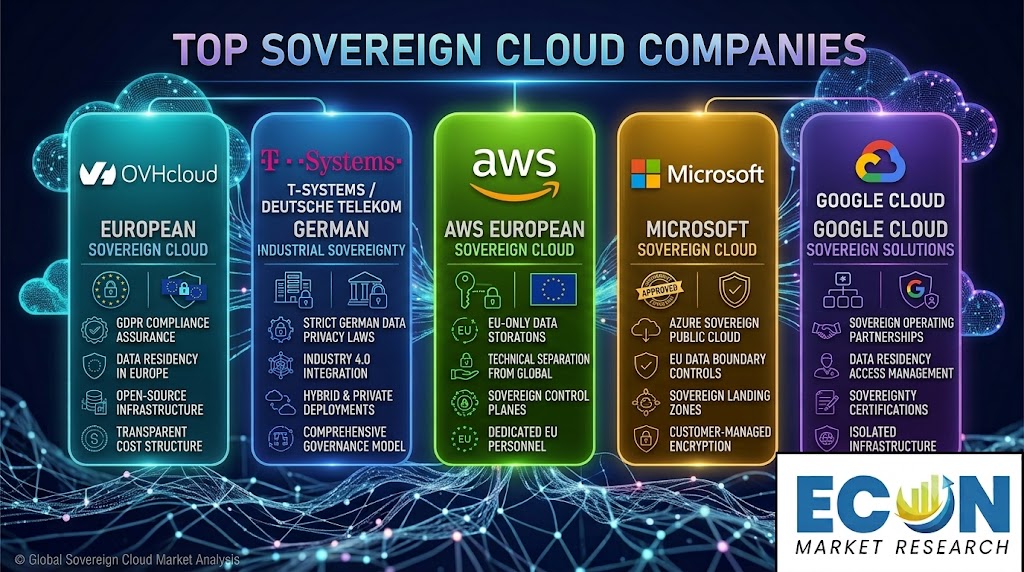
1. Amazon Web Services
Company overview and headquarters: Amazon Web Services was introduced in 2006 and is headquartered in Seattle, Washington, United States. The company provides infrastructure, storage, databases, networking, cybersecurity, analytics, and artificial intelligence services for commercial and public-sector customers. Its Sovereign Cloud strategy expanded significantly in January 2026 with the opening of a new European environment located entirely within the European Union and designed to operate independently from its other global regions.
Core Sovereign Cloud expertise: Its expertise includes independent control-plane architecture, regional data residency, local operational governance, customer-controlled encryption, and resilience for regulated workloads. Customer-created metadata, including roles, permissions, configurations, and resource labels, can remain within the selected sovereign environment. This design targets organizations with at least 4 major requirements: EU-only data storage, EU-controlled operations, technical separation, and continued access to established cloud development tools.
Major products and services: The company’s Sovereign Cloud portfolio includes its European Sovereign Cloud, government-focused regions, dedicated infrastructure, Outposts, identity and access management, key management, security monitoring, object storage, virtual computing, databases, and cloud-governance tools. Control Tower became available in the European sovereign environment during 2026, enabling organizations to establish multi-account governance and automated controls. The platform is suitable for public administration, healthcare, financial services, defense suppliers, and operators working across the 18 sectors addressed by Europe’s expanded cybersecurity framework.
2. Microsoft
Company overview and headquarters: Microsoft was founded in 1975 and is headquartered in Redmond, Washington, United States. The organization has developed one of the broadest Sovereign Cloud portfolios by integrating cloud infrastructure, workplace productivity, security, identity management, artificial intelligence, and on-premises deployment. Its 2026 strategy is based on 3 principal approaches: Sovereign Public Cloud, Sovereign Private Cloud, and partner-supported national cloud environments.
Core Sovereign Cloud expertise: Microsoft focuses on data residency, regulated-environment management, customer-controlled encryption, local operational oversight, and hybrid infrastructure. Sovereign Public Cloud capabilities are designed to operate across existing European regions without forcing customers to migrate into a completely separate data center. Sovereign Private Cloud brings infrastructure, productivity, and AI workloads inside customer-controlled locations and supports both connected and completely disconnected operations.
Major products and services: Its portfolio includes Azure, Azure Local, Microsoft 365 Local, Foundry Local, EU Data Boundary capabilities, Data Guardian, confidential computing, external key management, security operations, identity services, and government cloud regions. The EU Data Boundary covers major enterprise services including Azure, Microsoft 365, Dynamics 365, and Power Platform. These 4 service families allow regulated organizations to combine infrastructure, business applications, collaboration, and application development under a broader regional data-control model.
3. Google Cloud
Company overview and headquarters: Google was founded in 1998 and is headquartered in Mountain View, California, United States, while its cloud division provides infrastructure, data analytics, cybersecurity, application development, and artificial intelligence services. In 2026, its Sovereign Cloud portfolio was organized into 3 deployment categories: Google Cloud Data Boundary, Google Cloud Dedicated, and Google Cloud Air-Gapped. The portfolio is designed to provide different levels of location, access, software, and operational control.
Core Sovereign Cloud expertise: Google Cloud specializes in sovereign data boundaries, partner-operated controls, isolated infrastructure, confidential computing, external key management, and distributed cloud deployments. Its partnership model allows locally approved operators to contribute additional oversight and security measures. This architecture addresses at least 4 sovereignty dimensions: data location, administrative access, encryption control, and workload isolation.
Major products and services: Major offerings include Google Distributed Cloud, Sovereign Controls by Partners, Confidential External Key Management, air-gapped infrastructure, Kubernetes-based application management, security analytics, cloud storage, data platforms, and locally deployable AI capabilities. Innovations announced in 2026 expanded support for bringing AI services to locations where customer data already resides. This approach enables organizations to operate models and applications inside national, regional, dedicated, or disconnected environments instead of transferring sensitive information to a conventional public region.
4. Oracle
Company overview and headquarters: Oracle was founded in 1977 and is headquartered in Austin, Texas, United States. The company differentiates its Sovereign Cloud strategy through dedicated regions, government regions, isolated regions, partner-operated cloud infrastructure, and separate sovereign realms. Its EU Sovereign Cloud uses 2 regions located in Frankfurt and Madrid, separated by approximately 1,500 kilometers to support geographic redundancy and disaster recovery.
Core Sovereign Cloud expertise: Oracle specializes in physically separated cloud environments, local operational control, full-stack infrastructure deployment, database sovereignty, and internet-disconnected operations. Each EU sovereign region contains at least 3 fault domains for local resilience. Its Dedicated Region offering can begin with a footprint of 3 racks, enabling governments and regulated enterprises to operate a complete cloud region within an approved location.
Major products and services: The company’s portfolio includes EU Sovereign Cloud, UK Sovereign Cloud, Government Cloud, Dedicated Region, Cloud Isolated Region, Oracle Alloy, database services, virtual computing, Kubernetes, storage, artificial intelligence, analytics, identity management, and key management. Its sovereign environments can provide more than 200 cloud services, while its UK offering uses a dedicated dual-region model for eligible government and defense organizations handling sensitive workloads.
5. OVHcloud
Company overview and headquarters: OVHcloud was founded in 1999 and is headquartered in Roubaix, France. The company has developed a strong position among European organizations prioritizing local jurisdiction, open technologies, infrastructure reversibility, and protection from extraterritorial access. Its infrastructure includes approximately 450,000 servers across 43 data centers on 4 continents, serving about 1.6 million customers in more than 140 countries.
Core Sovereign Cloud expertise: OVHcloud focuses on European data sovereignty, SecNumCloud-qualified services, locally governed infrastructure, open-source technologies, transparent operations, and reduced vendor lock-in. The company obtained a SecNumCloud Security Visa for qualifying services in 2021 and expanded its qualified infrastructure with a Bare Metal Pod platform in 2025. Its public-sector services also support GDPR-related requirements and are designed to avoid exposure to non-European extraterritorial laws.
Major products and services: Its portfolio includes Hosted Private Cloud, SecNumCloud-qualified private cloud, Bare Metal servers, Public Cloud, Kubernetes, object storage, backup, disaster recovery, identity management, key management, logging, monitoring, and artificial intelligence tools. More than 80 open and reversible services are available across its broader cloud environment. The company’s emphasis on reversibility, regional operations, and European legal control makes it a significant provider for governments, healthcare institutions, financial organizations, and businesses seeking an alternative to non-European hyperscale platforms.
4. Regional Outlook
North America
North America represents a mature Sovereign Cloud environment led by United States federal procurement, defense requirements, regulated healthcare, financial services, and state-level privacy initiatives. As of 2026, the federal cloud marketplace contained 527 certified services, including 28 services approved through the newer FedRAMP 20x approach. These numbers show that government cloud adoption is moving from isolated infrastructure contracts toward a repeatable authorization ecosystem. One major government cloud platform alone recorded 68 authorizations and 486 documented reuses, demonstrating how reusable security assessments can reduce duplicate agency reviews. Sovereign Cloud providers in the region compete through government-only regions, dedicated hardware, classified-environment support, customer-managed encryption, and compliance automation.
The North American Sovereign Cloud market can be divided into at least 3 customer groups: federal organizations, state or provincial institutions, and highly regulated private enterprises. Federal agencies prioritize authorization reuse, supply-chain security, and continuous monitoring, while state organizations focus on citizen-data protection and regional disaster recovery. Canadian buyers frequently balance national control with operations distributed across 10 provinces and 3 territories, creating demand for region-specific hosting and contractual transparency. Future development will center on artificial intelligence for defense, healthcare, taxation, public safety, and administrative automation. Providers will also need to support post-quantum migration after the publication of 3 principal cryptographic standards in 2024, particularly for government information that must remain confidential for more than 10 years.
Europe
Europe remains the most regulation-driven Sovereign Cloud region because the European Union includes 27 member states with shared digital rules but distinct national security, healthcare, defense, and public-sector requirements. NIS2 establishes cybersecurity obligations across 18 critical sectors, including energy, transport, health, digital infrastructure, manufacturing, and public administration. The region also combines GDPR requirements, financial-sector operational resilience rules, cybersecurity certification programs, and national qualification schemes. These overlapping frameworks have made Europe a testing ground for independent cloud control planes, EU-only administrator models, locally controlled encryption, and legally separated cloud operations.
The European Data Act added another market driver after entering into force on January 11, 2024 and becoming applicable on September 12, 2025. Its cloud-switching provisions encourage customers to transfer workloads between providers or use several providers in parallel, strengthening demand for interoperability and exit planning. Europe is also seeing competition among 3 provider groups: international hyperscalers offering sovereign environments, European infrastructure providers emphasizing legal independence, and national operators delivering partner-managed clouds. The region already supports dual-region and multi-region sovereign architectures, including 2-region deployments separated by approximately 1,500 kilometers. Over the next several years, European customers will increasingly compare providers through operational autonomy, software portability, local staffing, encryption ownership, and resilience during cross-border service disruption.
Asia-Pacific
Asia-Pacific is developing through 3 distinct Sovereign Cloud models: national data-control laws, public-sector cloud certification, and locally operated hyperscale infrastructure. India enacted the Digital Personal Data Protection Act in 2023, finalized Digital Personal Data Protection Rules in 2025, and established the Data Protection Board of India through a notification dated November 13, 2025. China introduced 2 major laws addressing data security and personal information during 2021, while other markets apply financial, healthcare, telecommunications, or government-specific localization requirements. These regulatory differences prevent providers from using 1 standardized regional architecture for every Asia-Pacific country.
Japan’s government cloud assessment program was officially announced on May 26, 2020 and uses pre-assessment and registration to determine whether cloud services meet government security requirements. The program is jointly supported by 4 major public bodies responsible for cybersecurity, digital strategy, communications, and economic policy. Across Asia-Pacific, Sovereign Cloud demand is strongest in national government, banking, telecommunications, healthcare, smart cities, manufacturing, and defense. Countries with populations exceeding 100 million people require platforms capable of supporting large citizen databases, multilingual services, digital identity, and domestic AI training. Providers that combine in-country infrastructure, regional disaster recovery, local support personnel, and portable application platforms are likely to secure a larger share of regulated workloads.
Middle East & Africa
The Middle East Sovereign Cloud market is expanding through government digitization, national AI strategies, smart-city programs, energy-sector modernization, and personal-data regulation. The Gulf Cooperation Council consists of 6 states, while the United Arab Emirates operates through 7 emirates, creating several national and subnational procurement opportunities. Saudi Arabia’s Personal Data Protection Law applies in at least 2 principal territorial scenarios: processing conducted within the Kingdom and processing of residents’ data by parties outside the Kingdom. Official guidance also identifies 4 broad resident categories, including citizens, permanent or temporary workers, visitors, and other individuals residing in the country.
African Sovereign Cloud development is shaped by a 54-country landscape with different levels of data-protection maturity, connectivity, public-sector digitization, and domestic data-center capacity. South Africa, Kenya, Nigeria, Egypt, Morocco, and several other markets are developing stronger local hosting and cybersecurity requirements for government, banking, telecommunications, healthcare, and digital identity. Regional buyers commonly evaluate 3 deployment options: local public cloud regions, dedicated national infrastructure, and hybrid systems connected to government data centers. The largest opportunity involves platforms that can operate under limited connectivity while providing local backup, disaster recovery, identity services, and security monitoring. Across the Middle East and Africa, providers must also support Arabic, English, French, and numerous local languages, making sovereign AI and multilingual public-service automation increasingly important.
5. Future Opportunities in the Sovereign Cloud
Future Sovereign Cloud opportunities will extend beyond conventional infrastructure into sovereign AI, confidential computing, national digital identity, defense modernization, healthcare data exchange, and critical-infrastructure management. A typical government may operate hundreds of legacy applications across 10 or more ministries, making application modernization and secure migration significant service opportunities. Providers can develop automated sovereignty dashboards that continuously verify data location, administrator access, encryption status, configuration compliance, and cross-border transfers. Instead of completing a compliance review only 1 time each year, organizations will increasingly demand continuous evidence collection across 24-hour operations. Platforms capable of generating machine-readable audit evidence can shorten approval cycles and improve visibility into changing risk.
Sovereign AI may become the largest technical opportunity because governments need national-language models, domestic training datasets, controlled inference, and protection for sensitive prompts. A complete sovereign AI platform may integrate at least 7 components: accelerated computing, data storage, model management, identity, encryption, safety controls, and audit logging. Additional opportunities will emerge from post-quantum migration, as organizations replace cryptographic technologies with the 3 principal standards introduced in 2024 and future standards still under development. Cloud providers can offer cryptographic discovery, automated key rotation, hybrid encryption, and long-term archive protection for information retained for 10, 20, or 30 years.
Interoperability and sovereign cloud federation will create another major opportunity. The European Data Act’s application from September 12, 2025 has strengthened expectations for easier cloud switching, parallel multi-cloud use, and protection against vendor lock-in. Providers that support open APIs, Kubernetes, standardized identity, portable databases, and documented exit procedures can serve customers operating across 2 or more jurisdictions. Future Sovereign Cloud ecosystems may connect national providers, telecommunications operators, regional data centers, and global cloud platforms through federated governance. This structure would allow each organization to place workloads according to 4 classifications: public, internal, sensitive, and classified.
Small and mid-sized governments also represent an important opportunity because many cannot build a complete national cloud independently. Modular infrastructure starting with 3 racks, partner-operated sovereign platforms, and managed private-cloud services can lower the technical barrier to entry. Providers can package compliance templates for healthcare, banking, education, taxation, energy, and public safety. Success will depend on transparent contracts, local workforce development, 2-region disaster recovery, independent security assessment, and a clear plan for service continuity. Sovereign Cloud companies that provide measurable control rather than broad sovereignty claims will be best positioned for long-term adoption.
6. Conclusion
The Sovereign Cloud industry has entered a new phase in 2026 as governments and regulated enterprises move beyond simple data localization. Buyers now evaluate at least 5 interconnected requirements: geographic residency, legal authority, operational control, cryptographic ownership, and technological portability. The top companies in the Sovereign Cloud are responding with independent regions, EU-controlled operations, customer-managed encryption, partner-operated environments, air-gapped infrastructure, and disconnected AI services. The introduction of 3 finalized post-quantum standards, expanding cybersecurity obligations across 18 European sectors, and a federal marketplace containing 527 certified services demonstrate how sovereignty is becoming measurable through technical controls and regulatory evidence.
Amazon Web Services, Microsoft, Google Cloud, Oracle, and OVHcloud each address Sovereign Cloud requirements through a different architecture. Some emphasize independent hyperscale regions, while others focus on hybrid deployment, air-gapped systems, dedicated cloud regions, local partnerships, or European legal autonomy. No single model is suitable for all 195 countries or every regulated industry. Organizations should therefore classify their information, determine acceptable jurisdictions, define administrator-access rules, retain control of encryption keys, and test exit procedures before selecting a platform. Over the next 5 to 10 years, Sovereign Cloud adoption will increasingly support national AI, public digital services, healthcare transformation, defense resilience, financial stability, and critical infrastructure. The providers that combine innovation with verifiable local control will shape the next generation of trusted cloud computing.