


Top Companies in Physical AI Transforming Intelligent Robotics
The top Physical AI companies are advancing humanoid robots, autonomous systems, industrial automation, world models, and intelligent machines worldwide.
Introduction
Overview of the Global Physical AI Industry
The global Physical AI industry represents the convergence of artificial intelligence, robotics, computer vision, sensors, edge computing and autonomous control systems. Unlike conventional software-based AI, Physical AI enables machines to perceive real-world environments, understand human instructions and perform physical actions through robots, vehicles, drones and intelligent industrial equipment. In 2024, manufacturers installed 542,076 industrial robots worldwide, marking the 4th consecutive year in which annual installations remained above 500,000 units. Asia accounted for 74% of new installations, Europe represented 16% and the Americas contributed 9%. These figures demonstrate the expanding physical infrastructure available for deploying AI-powered machines across factories, warehouses, hospitals and transportation networks.\
Market Evolution and Growth Drivers
Physical AI has evolved from rule-based industrial automation developed during the 1960s into adaptable machines powered by multimodal foundation models in 2026. Earlier robots repeated pre-programmed movements inside restricted work cells, while modern Physical AI systems combine visual perception, language understanding, spatial reasoning and real-time action planning. In 2025, vision-language-action models demonstrated that robots could learn new short-duration tasks from as few as 100 demonstrations. By 2026, advanced world models could process language, images, video, audio and action sequences within 1 unified architecture. Growth is being driven by labor shortages, expanding robot fleets, improved simulation platforms, faster edge processors and rising demand for flexible automation across at least 5 major industries.
Top 5 Latest Trends in the Physical AI
1. Vision-Language-Action Models for General-Purpose Robots
Vision-language-action models are becoming a central Physical AI trend because they connect visual observations and natural-language commands directly with robotic movement. A robot using a VLA system can identify an object, interpret a spoken instruction, calculate an appropriate grasp and execute the required action without relying on 1 rigid program for every task. Models introduced in 2025 demonstrated smooth and reactive manipulation, open-vocabulary instruction following and adaptation to unfamiliar objects, positions and environments. Researchers also showed that the technology could transfer across multiple robot configurations after additional fine-tuning. This development is important because industrial users can potentially train 1 robot for dozens of tasks rather than purchasing separate machines for every production operation.
The latest VLA systems are also improving robotic dexterity, spatial awareness and human-machine communication. Robots have demonstrated activities such as folding paper, removing bottle caps, placing items inside containers and selecting safe trajectories around people. Some embodied-reasoning models have improved capabilities including 3D object detection, pointing, trajectory prediction, grasp planning and multi-view correspondence. An on-device robotics model introduced in June 2025 moved part of this intelligence directly onto local robotic hardware, reducing dependence on continuous cloud connectivity. This architecture is particularly valuable in factories, hospitals and warehouses where even 1 second of network delay can affect operational safety, task accuracy or production continuity.
2. World Models and Synthetic Training Environments
World models are transforming how Physical AI systems learn because developers can train machines in simulated environments before allowing them to operate around real equipment or human workers. A world model predicts how an environment may change after a robot performs 1 specific action. It can estimate whether a container will fall, whether an object will collide with another object or whether a robotic arm can reach a target safely. The latest platforms combine a digital twin of the robot, a digital twin of the environment and a policy model responsible for selecting actions. This approach reduces dependence on expensive physical demonstrations and enables millions of virtual training scenarios to be generated without damaging real machinery.
Simulation platforms are also becoming more realistic through GPU-accelerated physics, synthetic data generation and parallel training. In 2026, simulation research documented applications across 5 major robotics domains, including manipulation, navigation, autonomous systems, industrial automation and human-robot interaction. Developers can test variations in lighting, object positions, floor conditions, sensor noise and human behavior before deploying a robot. Synthetic datasets help address the shortage of labeled physical-world data, particularly for rare or dangerous events. For example, an autonomous machine can experience 10,000 simulated collision scenarios without creating 1 real accident. This capability is accelerating Physical AI development in autonomous vehicles, construction machinery, warehouse robots and humanoid systems.
3. Humanoid Robots Moving into Industrial Work
Humanoid robots are progressing from laboratory demonstrations into structured industrial trials. Their human-like shape allows them to use stairs, tools, shelves, containers and workstations originally designed for people. Companies are focusing initial deployments on repetitive material handling, parts sequencing, tote movement and production-line support rather than completely unstructured household work. Commercial humanoid programs have already targeted automotive plants, logistics centers and electronics facilities, where tasks can be measured through cycle time, successful picks, distance traveled and safety interventions. At least 12 major humanoid developers have been assessed across 8 operational criteria, illustrating the rapid increase in competition and technical maturity within this segment.
Industrial deployments are also creating new workforce and safety discussions. One major automotive manufacturer plans to introduce an enterprise humanoid robot into a Georgia production facility in 2028 for parts-sequencing operations, followed by component-assembly tasks in 2030. Another commercial humanoid has been tested in distribution operations and offered through a usage model measured at $30 per operating hour, although broader deployments remain limited. These examples show that humanoid Physical AI is shifting toward measurable workplace productivity rather than controlled demonstrations. However, companies must still evaluate emergency stopping, worker separation, payload limits, battery duration and failure recovery before scaling from 10 pilot robots to fleets of 1,000 machines.
4. Edge AI and On-Device Robotic Intelligence
Edge AI is enabling robots to process sensor data and make decisions directly on the machine. A modern Physical AI platform may receive information from 6 or more sources, including RGB cameras, depth cameras, microphones, force sensors, joint encoders and lidar. Processing this information locally allows a robot to respond immediately to a moving person, unstable object or blocked route. On-device models introduced in 2025 demonstrated general-purpose dexterity and rapid adaptation while operating on local robotic hardware. This reduces bandwidth requirements, protects sensitive operational data and improves reliability in environments where wireless coverage is inconsistent.
The expansion of edge computing is particularly important for mobile robots, drones and autonomous vehicles that cannot depend on a remote data center for every decision. A robot moving at 2 meters per second can travel 20 centimeters during a delay of only 100 milliseconds, creating a potential safety concern in crowded environments. Local inference allows the machine to detect hazards, stop movement or modify its trajectory before a cloud response arrives. New robotic processors are therefore being designed to perform perception, planning and control workloads simultaneously. Physical AI companies are also combining edge processors with cloud-based fleet management, creating a 2-level system in which safety-critical actions remain local while large-scale training and analytics occur centrally.
5. Human-Robot Collaboration and Safety Governance
Human-robot collaboration is becoming a defining Physical AI trend as autonomous machines leave isolated cages and begin sharing workspaces with employees. Collaborative deployment requires systems that can identify people, predict movement, limit force and stop safely when unexpected contact occurs. Modern Physical AI safety involves at least 4 layers: mechanical design, sensor-based detection, software restrictions and operational procedures. Foundation models introduce additional requirements because their behavior may vary across objects, instructions and environments. Developers must therefore test both predictable mechanical failures and uncertain AI-generated actions before authorizing real-world deployment.
Regulation is also influencing product design. The European AI framework established Regulation 2024/1689 as the region’s first comprehensive legal structure for artificial intelligence. Physical AI systems used in areas such as employment, transportation, medical care or safety-critical machinery may face stricter documentation, risk-management, cybersecurity and human-oversight obligations. Research published in 2025 specifically highlighted robustness and cybersecurity requirements for high-risk systems under Article 15. For manufacturers, compliance will increasingly involve maintaining data records, documenting model limitations, measuring failure rates and providing at least 1 reliable method for human intervention.
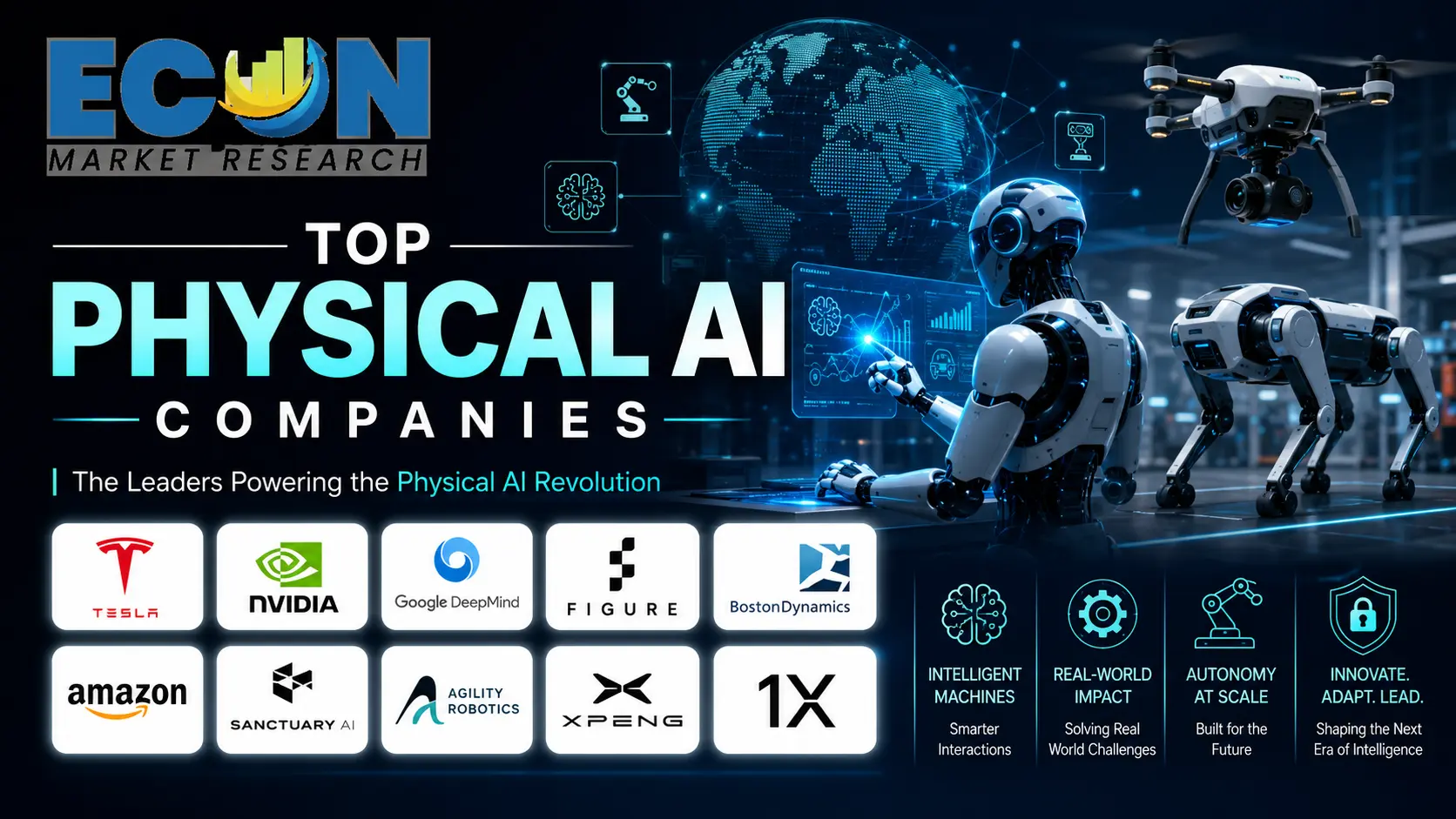
Top 5 Companies in the Physical AI
1. NVIDIA
Company overview: NVIDIA is one of the most influential Physical AI companies because it provides the computing architecture, simulation tools, foundation models and development frameworks used by robot manufacturers. Founded in 1993, the company expanded from graphics processing into data-center AI, autonomous vehicles, industrial digital twins and robotics. Its Physical AI strategy connects training infrastructure, simulation environments and edge computing through 1 integrated technology stack.
Headquarters: Santa Clara, California, United States.
Core Physical AI expertise: NVIDIA specializes in GPU-accelerated simulation, robotic foundation models, synthetic data generation, autonomous-machine computing and digital-twin technology. Its robotics platform supports humanoids, mobile manipulators, industrial robots, autonomous construction equipment and self-driving vehicles. The company’s technology is used across at least 5 robotics categories, helping developers train machines in simulation and deploy trained models onto edge hardware.
Major products and services: Major offerings include Isaac Sim, Isaac Lab, Isaac GR00T, Jetson robotic computers, Cosmos world models, Omniverse digital twins and DRIVE autonomous-vehicle platforms. In 2026, the company released additional open Cosmos and GR00T models, evaluation tools and robot-learning datasets. Its newer Cosmos architecture can jointly process 5 information types: language, image, video, audio and action sequences.
2. Google DeepMind
Company overview: Google DeepMind is a major developer of embodied AI and general-purpose robotic intelligence. The organization was formed through the 2023 combination of 2 major AI research groups and has expanded its work from digital reasoning systems into Physical AI. Its objective is to create models that can understand real-world environments, reason about objects and control multiple types of robots.
Headquarters: London, United Kingdom, with additional research operations in several international technology centers.
Core Physical AI expertise: The company specializes in multimodal reasoning, vision-language-action models, spatial understanding, robotic manipulation and cross-embodiment learning. Its research addresses 3 essential robotic capabilities: generalization, interactivity and dexterity. The models are designed to understand natural-language instructions, respond to environmental changes and manipulate objects that were not included in the original training process.
Major products and services: Gemini Robotics, Gemini Robotics-ER and Gemini Robotics On-Device are among its principal Physical AI technologies. Gemini Robotics was introduced in March 2025 and built on Gemini 2.0. Research showed that the system could learn certain new tasks from 100 demonstrations and transfer capabilities to unfamiliar robot forms. Trusted testing involved several robotics developers working on humanoids, mobile systems and industrial platforms.
3. Tesla
Company overview: Tesla is developing Physical AI through autonomous vehicles, factory automation and the Optimus general-purpose humanoid robot. Founded in 2003, the company has accumulated large-scale experience in batteries, electric motors, camera-based perception, custom AI processors and high-volume manufacturing. These capabilities provide 5 important components required for humanoid robotics: energy storage, actuation, sensing, computing and production engineering.
Headquarters: Austin, Texas, United States.
Core Physical AI expertise: Tesla’s core Physical AI expertise includes computer vision, neural-network training, autonomous navigation, motion planning, custom inference hardware and electromechanical integration. The Optimus program applies technology developed for vehicles to a 2-legged robotic platform. The robot is intended to perform repetitive, physically demanding or potentially hazardous tasks inside industrial and eventually commercial environments.
Major products and services: Tesla’s principal Physical AI platforms include Optimus, autonomous driving software, robotaxi technology and custom AI training infrastructure. The company began limited robotaxi operations in Austin in June 2025, while Optimus development continued through factory testing and production-line preparation. Reports in July 2026 indicated that parts of the Fremont facility were being repurposed for robot manufacturing, although large-scale commercial availability remained under development.
4. Boston Dynamics
Company overview: Boston Dynamics is one of the most experienced robotics companies in dynamic mobility, balance and whole-body control. The organization originated in 1992 and has spent over 30 years developing robots capable of operating in challenging physical environments. Its machines are known for combining advanced mechanical design with real-time perception and control.
Headquarters: Waltham, Massachusetts, United States.
Core Physical AI expertise: Boston Dynamics specializes in humanoid robotics, quadruped mobility, industrial inspection, manipulation, balance control and intelligent automation. Its Physical AI systems combine cameras, force sensing, motion planning and learned behavior. The company’s research has covered difficult locomotion tasks such as walking on small footholds, maintaining balance after disturbances and coordinating multiple joints during dynamic movement.
Major products and services: Its main platforms include Atlas, Spot and Stretch. Atlas is an enterprise humanoid robot designed for material handling and industrial automation, Spot is a 4-legged inspection robot and Stretch is a warehouse-focused mobile manipulation system. Atlas is scheduled to enter parts-sequencing work at a United States automotive facility in 2028, with expansion toward component assembly planned for 2030.
5. Figure AI
Company overview: Figure AI is a United States robotics company focused on developing general-purpose humanoid machines for industrial and household environments. Established in 2022, the company has advanced through multiple robot generations within approximately 4 years. Its strategy combines vertically integrated robot hardware with proprietary embodied-intelligence software.
Headquarters: San Jose, California, United States.
Core Physical AI expertise: Figure AI specializes in humanoid manipulation, visual perception, whole-body coordination, natural-language interaction and end-to-end robot learning. Its Helix intelligence platform connects visual inputs and language commands with continuous robotic actions. This design is intended to help 1 robot perform multiple activities across changing environments instead of being limited to a single programmed operation.
Major products and services: The company’s major technologies include Figure 02, Figure 03 and Helix. Figure 03 is positioned as a general-purpose humanoid for everyday environments, while Helix provides the intelligence required to navigate unpredictable surroundings and handle household or workplace tasks. Figure AI has also tested earlier humanoid systems in automotive manufacturing, giving the company practical experience with repetitive material movement and production operations.
Regional Outlook
North America
North America is a leading Physical AI region because it combines advanced AI laboratories, semiconductor companies, robotics startups, automotive manufacturers and large logistics operators. The region recorded 204 industrial robots per 10,000 manufacturing employees in the latest international comparison. The United States remains the largest regional development center, supported by robotics clusters in California, Massachusetts, Texas, Oregon and Pennsylvania. Companies in these locations are developing humanoids, autonomous vehicles, warehouse robots, drones, medical systems and AI processors.
The North American Physical AI ecosystem benefits from extensive access to cloud infrastructure, venture funding, university laboratories and large industrial testing environments. Automotive manufacturers are conducting humanoid trials for parts handling, while logistics companies are evaluating robots for tote movement, unloading and order fulfillment. At least 3 major categories—manufacturing, transportation and warehousing—are moving from isolated automation toward AI-enabled machines capable of adapting to variable conditions. The region also contains several leading developers of robotic foundation models, simulation platforms and edge processors.
Labor availability is another important driver. The United States has reported over 1 million unfilled roles associated with physical tasks across relevant industrial and logistics activities, creating demand for machines that can support employees rather than simply replace fixed automation. Companies are exploring robotics-as-a-service models, per-hour usage contracts and phased deployments beginning with 1 production cell. However, North American adoption will depend on workplace safety, legal liability, cybersecurity and demonstrated productivity. Enterprises increasingly require pilot programs to document successful task completion, human interventions and downtime before expanding to fleets of 100 or more robots.
Europe
Europe has a mature industrial automation base and one of the world’s highest regional concentrations of robots. The European Union recorded 231 industrial robots per 10,000 manufacturing employees, compared with a global average of 132. Germany ranked among the leading automated economies with 449 robots per 10,000 workers. Other countries represented in the global top 20 included Switzerland, the Netherlands, Austria, Italy, Belgium, Luxembourg, France and Spain.
European Physical AI development is centered on automotive manufacturing, machinery, logistics, healthcare and precision engineering. Germany has strong industrial robotics capabilities, France hosts growing humanoid and AI startups, Switzerland supports advanced robotic research and the Nordic countries are developing autonomous logistics and maritime systems. European manufacturers are particularly interested in flexible robots that can support production environments facing aging workforces and shortages of skilled technicians. These applications include machine tending, inspection, assembly and intra-factory transportation.
Regulation will strongly influence Europe’s competitive position. Regulation 2024/1689 creates a risk-based framework that may classify certain Physical AI applications as high-risk when they affect safety, employment, medical treatment or essential services. Companies may need to maintain technical documentation, testing records, human-oversight procedures and cybersecurity controls before deploying 1 system commercially. Although these obligations increase development requirements, they may also strengthen customer confidence in certified European robotics. The region’s opportunity lies in combining its 231-unit robot density with trustworthy AI engineering, premium industrial equipment and internationally recognized safety practices.
Asia-Pacific
Asia-Pacific is the largest operational center for industrial robotics and accounted for 74% of new global installations in 2024. The region’s average robot density reached 131 units per 10,000 manufacturing workers, while South Korea recorded approximately 1,220 units. China represented 54% of new global robot installations and maintained an operational stock approaching 2 million industrial units. Japan, Singapore and Taiwan also ranked among the leading automation economies.
China has become a major Physical AI manufacturing ecosystem through its combination of component suppliers, battery producers, electric-motor manufacturers, electronics factories and humanoid startups. Chinese companies are developing quadrupeds, industrial humanoids, service robots and autonomous delivery systems at increasingly competitive production costs. In 2024, entities associated with China reportedly represented 2 out of every 3 global robotics patent filings, demonstrating substantial activity across hardware, sensing, control and artificial intelligence.
Japan continues to prioritize robots for manufacturing, nursing, healthcare and agriculture. Its Moonshot Research and Development Program was launched in 2020, includes 10 goals and is scheduled to continue until 2050. Japan’s aging population creates urgent demand for machines capable of patient transfer, mobility support, food preparation and household assistance. The nursing sector has reported only 1 applicant for every 4.25 available positions, illustrating the workforce pressure behind care-robot development. However, advanced humanoid caregiving applications are not expected to achieve broad implementation before 2030 because safe physical interaction remains technically demanding.
Middle East & Africa
The Middle East and Africa Physical AI landscape is at an earlier stage than North America, Europe and Asia-Pacific, but several countries are accelerating investment in autonomous mobility, smart cities, drones and robotic research. The United Arab Emirates has emerged as a regional hub through government-led AI programs, university laboratories and autonomous-transport initiatives. Abu Dhabi hosted a 1-week autonomous technology program in 2025 that brought together policymakers, researchers, investors and technology companies focused on multi-sector deployment.
Physical AI opportunities in the Middle East are concentrated in logistics, energy, construction, aviation, security and urban transportation. Robots can inspect pipelines, monitor industrial facilities, clean solar panels and operate in environments where temperatures may exceed 45°C. Autonomous systems can also support ports and airports that operate 24 hours per day. The region’s large infrastructure projects provide controlled environments in which companies can test drones, delivery robots and automated construction equipment before expanding into more complex public settings.
Africa presents different but equally important applications. Physical AI can support agriculture, mining, healthcare delivery, infrastructure inspection and disaster response across large geographic areas. Autonomous drones can survey 100 hectares faster than ground-based teams, while robotic systems can enter mines or damaged structures without placing workers at immediate risk. Adoption remains constrained by connectivity, equipment cost, maintenance capacity and workforce training. Regional progress will therefore depend on modular machines, local service networks and edge AI systems that can function without uninterrupted cloud access. Partnerships involving 2 or more governments, universities and technology providers may help convert research demonstrations into sustainable deployments.
Future Opportunities in the Physical AI
Future Physical AI opportunities will extend beyond humanoid robots into autonomous vehicles, agricultural machines, medical systems, construction equipment and intelligent consumer devices. One of the largest opportunities is developing general-purpose robot intelligence that can operate across multiple hardware platforms. A manufacturer could train 1 foundation model and adapt it to a humanoid, mobile manipulator and robotic arm rather than building 3 unrelated software systems. Research has already demonstrated transfer across unfamiliar robot embodiments and learning from as few as 100 demonstrations.
Industrial digital twins will create another significant opportunity by allowing companies to model complete factories before installing physical machines. A digital environment can simulate 1,000 production layouts, identify collision risks and estimate workflow bottlenecks without interrupting an operating facility. Synthetic data will become particularly valuable for training machines on rare events, such as equipment failures, dropped objects or emergency evacuations. New world models that process 5 modalities—language, images, video, audio and actions—may enable robots to predict environmental changes with greater accuracy.
Healthcare and elderly assistance also represent long-term Physical AI opportunities. Robots may support patient lifting, medicine delivery, rehabilitation exercises and hospital logistics. The global shortage of healthcare workers is expected to intensify as populations age, while the United States alone could face a physician shortage reaching 86,000 by 2036. Physical AI will not eliminate the need for qualified professionals, but it can reduce repetitive physical work and expand access in remote locations. Safety validation, clinical evidence and human supervision will remain mandatory for high-risk applications.
Connectivity will further expand Physical AI capabilities. Research into 6G robotics maps future communication performance across sensing, perception, cognition, actuation and self-learning. Low-latency networks may allow multiple robots to coordinate inside smart factories, ports and transportation systems. However, essential functions such as emergency stopping must remain available locally even when 1 network connection fails. The strongest future platforms will therefore combine edge intelligence, cloud training and secure fleet-level coordination.
Conclusion
The leading companies in the Physical AI industry are building the technological foundation for machines that can perceive, reason and act in real environments. NVIDIA provides simulation, computing and world-model infrastructure; Google DeepMind develops multimodal robotic intelligence; Tesla combines autonomous systems with large-scale manufacturing; Boston Dynamics contributes over 30 years of advanced mobility research; and Figure AI focuses on integrated general-purpose humanoids. Together, these 5 companies illustrate how Physical AI requires coordinated progress in software, processors, sensors, batteries, actuators and production engineering.
The industry is advancing rapidly, but widespread deployment will require more than impressive demonstrations. Companies must prove that robots can complete 1,000s of task cycles safely, recover from unexpected failures and deliver consistent performance beside human workers. Regional adoption will also vary according to robot density, labor availability, regulation and industrial structure. Asia accounted for 74% of new robot installations in 2024, while Europe recorded 231 robots per 10,000 manufacturing employees and North America reached 204. These established automation bases provide strong foundations for intelligent machines.
Physical AI is therefore moving from fixed automation toward adaptable systems capable of learning new operations and understanding changing surroundings. The next phase will be defined by measurable reliability, responsible governance and productive human-robot collaboration. Organizations that begin with controlled 1-task pilots, validated safety procedures and high-quality operational data will be better positioned to scale. As foundation models, simulations and edge processors improve through 2026 and beyond, Physical AI will become an increasingly important part of manufacturing, logistics, transportation, healthcare, agriculture and everyday service environments.