


Top Photonic Computing Companies and Their Key Capabilities
The top photonic computing companies are profiled by core technologies, major products, technical capabilities, regional presence, and competitive influence.
Introduction
Overview of the Global Photonic Computing Industry
The photonic computing industry entered a more commercial phase by 2026 as optical processors, photonic interconnects and photon-based quantum systems moved beyond isolated laboratory demonstrations. Lightelligence’s PACE 2 integrates over 40,000 photonic devices for a 128 × 128 matrix operation, while Lightmatter’s current interconnect portfolio ranges from 800 Gbps per fibre to a 114 Tbps rack-level photonic interposer. Q.ANT has placed photonic processing systems at 2 European supercomputing centres, and ORCA Computing had delivered 10 on-premises photonic quantum systems by early 2025. Commercial activity now covers AI training, inference, high-performance computing, encrypted processing, scientific simulation, optimisation and quantum application development. Competition remains fragmented between classical optical-acceleration companies and photonic quantum-computing specialists, with fewer than 20 companies operating deployable systems at meaningful commercial or institutional scale.
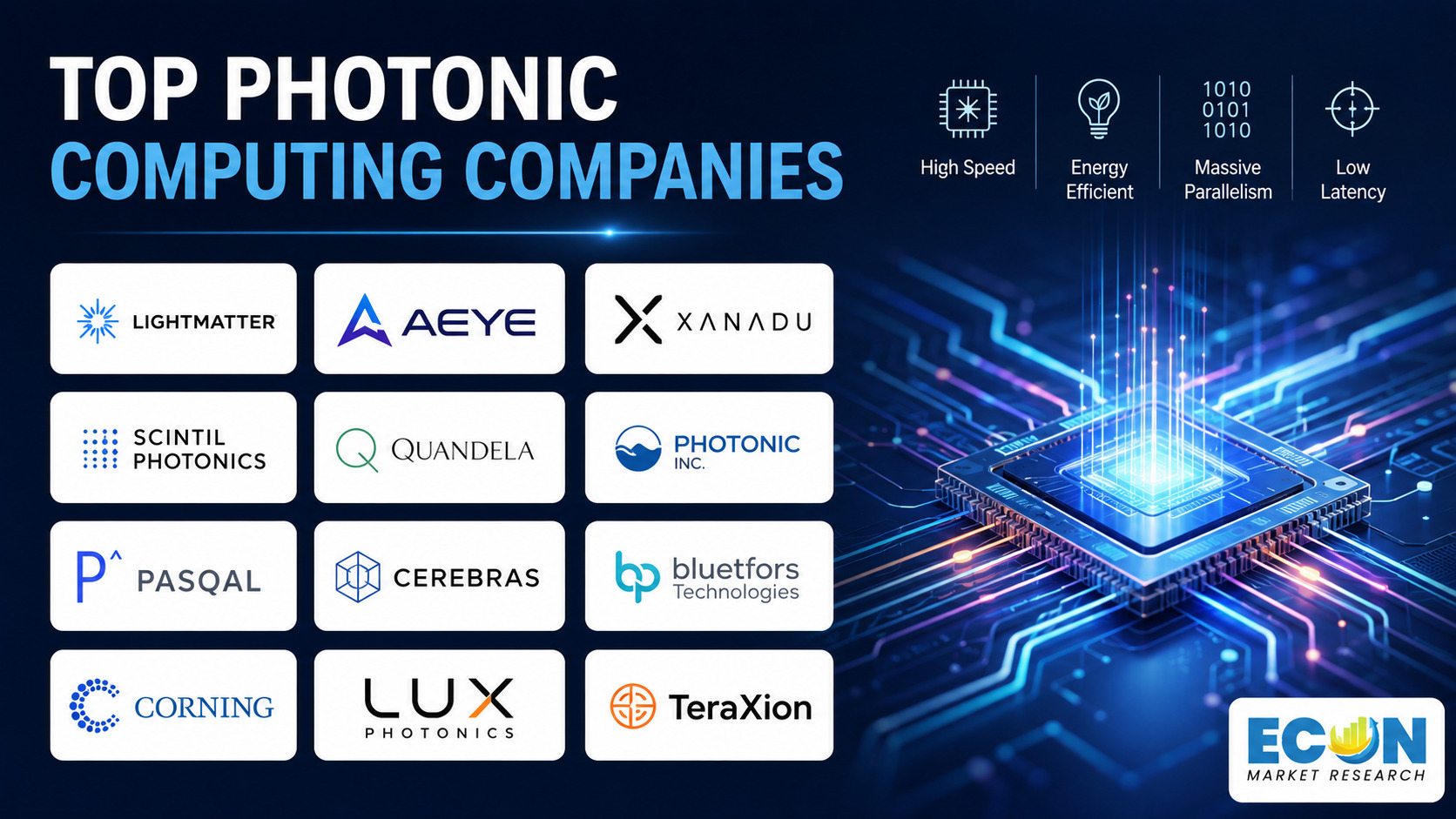
Product penetration remains concentrated in hyperscale data centres, national laboratories, cloud platforms, universities and early-access enterprise environments. QuiX Quantum reports over 15 field-deployed devices, Quandela has deployed 5 quantum computers across Europe and North America, and its cloud environment has supported over 1,200 researchers and partner organisations in 30 countries. Lightelligence maintains 250-plus employees, including 170-plus research and development personnel, and has accumulated 428 patents. These indicators show that photonic computing has progressed from academic prototypes into a specialised hardware ecosystem containing processors, optical memory links, control electronics, software development kits, rack-mounted servers and cloud-accessible systems. However, most deployments still function as accelerators or hybrid components alongside CPUs, GPUs and conventional high-performance infrastructure rather than as complete replacements for electronic computing.
Market Evolution and Growth Drivers
Photonic computing has developed through 3 overlapping stages: optical research platforms, integrated photonic processors and commercially deployable hybrid systems. Lightmatter was founded in 2017 after its founders demonstrated silicon-photonic matrix operations, and it introduced the Envise accelerator in 2020 and Passage interconnect technology in 2021. Lightelligence launched its first PACE platform in 2021, followed by PACE 2 in 2025. Q.ANT progressed from its 2018 founding to production deployment and its first commercial cloud customer in 2026. Photonic quantum computing has followed a parallel path, with Xanadu demonstrating the 216-qubit Borealis system in 2022 and introducing a modular 12-qubit Aurora architecture in 2025. The transition has been driven by better fabrication, packaging, optical modulation, photon generation, control software and integration with standard server environments.
The strongest adoption driver is the growing energy and communication burden created by AI infrastructure. Data-centre electricity consumption reached 485 TWh in 2025 and is projected to reach 950 TWh in 2030, while electricity use by AI-focused data centres is expected to triple during that period. Photonic systems address 2 bottlenecks within this infrastructure: mathematical processing and movement of data between processors, memory and switches. Optical devices can transmit several wavelengths simultaneously, reduce conversion stages and execute selected matrix or nonlinear operations directly through physical light behaviour. Q.ANT’s second-generation processor sustains 8 GOPS on nonlinear functions, while Lightmatter’s Passage L200 supports 32–64 Tbps of aggregate optical bandwidth. These measurable improvements are increasing interest among cloud providers, supercomputing centres, defence organisations, pharmaceutical researchers and industrial users that require greater throughput without proportionate increases in power and cooling.
Top 5 Latest Trends in the Photonic Computing Industry
Co-packaged optical interconnects for AI infrastructure
Commercial photonic AI processors and hybrid servers
Modular photonic quantum computing systems
Integrated photonics manufacturing and advanced packaging
Software-defined and cloud-accessible photonic computing
Trend 1: Co-Packaged Optical Interconnects for AI Infrastructure
Optical interconnects became one of the most commercially important trends among the top companies in the photonic computing industry during 2025 and 2026. AI clusters containing 100,000-plus GPUs require processors to exchange model parameters, activations and memory data across racks at speeds that electrical links cannot efficiently sustain. Lightmatter’s Passage L20 provides 12.8 Tbps of aggregate bandwidth, while the Passage L200 supports 32–64 Tbps through co-packaged optics. Its M1000 reference platform reaches 114 Tbps across a 4,000 mm² footprint. Marvell strengthened this segment by completing its acquisition of Celestial AI in February 2026, adding Photonic Fabric technology designed for package-, system- and rack-level connectivity. This trend matters because computing capacity can remain unused when processors wait for data, making optical I/O a system-level performance requirement rather than a peripheral networking upgrade.
Trend 2: Commercial Photonic AI Processors and Hybrid Servers
Photonic arithmetic is advancing from fixed demonstrations into programmable cards and standard server formats. Lightelligence’s first PACE processor used a 64 × 64 optical matrix multiplier, over 12,000 photonic devices, a 1 GHz system clock and a 150-picosecond optical-computation delay. Its 2025 PACE 2 card expanded the architecture to 40,000-plus devices and a 128 × 128 matrix operation. Q.ANT’s second-generation Native Processing Unit performs nonlinear mathematical functions directly in light, sustains 8 GOPS for those operations and is supplied in a 19-inch, 4U rack server with PCIe Gen4 x8 connectivity. In May 2026, a cloud provider serving 6.8 million customers across 17 markets became Q.ANT’s first commercial customer. These deployments indicate that optical acceleration is becoming accessible through familiar data-centre interfaces rather than specialist laboratory benches.
Trend 3: Modular Photonic Quantum Computing Systems
Photonic quantum companies are increasingly designing systems as modular, networked data-centre equipment. ORCA Computing’s PT-1 and PT-2 platforms use rack-mounted, air-cooled hardware and telecom-grade optical fibre, allowing operation without the specialised facility conditions required by several competing quantum architectures. The company had delivered 10 on-premises systems by early 2025 and deployed another PT Series system to a Japanese enterprise in June 2026. Xanadu’s Aurora demonstrated a networked 12-qubit photonic architecture with real-time error-correction capabilities, while Quandela’s Belenos increased from the previous 6-qubit generation to 12 photonic qubits. QuiX Quantum’s Carina architecture combines photon generation, multiplexing, cluster-state creation and fast feed-forward control for future commercial deployment. Modularity is strategically important because systems can be upgraded node by node as photon sources, detectors, control electronics and error-correction methods improve.
Trend 4: Integrated Photonics Manufacturing and Advanced Packaging
Manufacturing scale has become a decisive competitive factor because useful photonic computers may require thousands or millions of precisely aligned optical components. PsiQuantum manufactures thousands of wafers through a tier-1 semiconductor foundry and operates facilities for barium-titanate processing, fibre attachment, cryogenic testing and advanced system assembly. Its demonstrated platform achieved 99.98% state-preparation and measurement fidelity, 99.22% 2-qubit fusion fidelity and 99.72% chip-to-chip interconnect fidelity before accounting for loss. Xanadu opened an ultra-low-loss photonic packaging facility in Toronto in 2025, while Quandela launched a semiconductor pilot line in 2026 and employed over 100 people from 20 nationalities. Q.ANT operates a thin-film lithium-niobate pilot line with IMS CHIPS. These investments reduce dependence on manually assembled optical benches and support repeatable production, field maintenance and component standardisation.
Trend 5: Software-Defined and Cloud-Accessible Photonic Computing
Software compatibility is becoming as important as optical hardware performance. Q.ANT provides C, C++ and Python interfaces, Linux drivers and a photonic algorithms library for its 19-inch Native Processing Server. ORCA systems support Python, PyTorch workflows and integration with NVIDIA CUDA-Q, enabling hybrid quantum-classical development without requiring users to redesign complete software environments. Xanadu’s PennyLane framework connects photonic quantum hardware with machine learning and other quantum platforms, and industry disclosures indicate it is used by 47% of surveyed quantum programmers. Quandela provides cloud access through its Perceval software environment and had users in 30 countries by 2025. Software abstraction reduces the specialised physics knowledge required for application testing, broadens access to SMEs and universities, and helps photonic technology providers convert hardware demonstrations into repeatable workflows for chemistry, optimisation, AI and encrypted computing.
Top 10 Companies in the Photonic Computing Industry
The following 10 companies are presented according to product capability, technical maturity, deployment activity, geographic presence, manufacturing progress and relevance to classical or quantum photonic computing. The sequence is not a strict financial or market-share ranking.
1. Lightmatter
Company Overview: Lightmatter was founded in 2017 by 3 researchers connected to the Massachusetts Institute of Technology and is headquartered in Mountain View, California. Its personnel have contributed to over 100 patents across photonics, semiconductor design and computing. Core Photonic Computing Expertise: The company focuses on silicon-photonic interconnects, co-packaged optics, light sources and 3D photonic integration for AI supercomputers. Major Products and Services: Passage L20 delivers 12.8 Tbps, Passage L200 supports 32–64 Tbps, and the M1000 evaluation platform provides 114 Tbps across a 4,000 mm² active photonic interposer. The EVK50 supports 800 Gbps per fibre, while EVK100 reaches 3.2 Tbps per fibre at 1.9 picojoules per bit. Lightmatter also develops Guide light engines containing hundreds of lasers and optical components on a single chip, giving the company coverage across optical transmission, packaging, switching and rack-level integration.
2. Lightelligence
Company Overview: Founded in 2017, Lightelligence operates offices in the Boston area, San Jose and Singapore. The company employs over 250 people, including more than 170 research and development personnel, and reports 428 cumulative patents. Headquarters: Its principal United States location is in Waltham, Massachusetts. Core Photonic Computing Expertise: Lightelligence develops optical multiply-accumulate engines, optical networks on chip, data-centre optical fabrics and optoelectronic accelerator cards. Major Products and Services: Its first PACE platform incorporated a 64 × 64 optical matrix core, over 12,000 photonic devices and a 1 GHz clock. PACE 2, released in 2025, contains more than 40,000 photonic devices and supports 128 × 128 matrix operations. Photowave products support PCIe 5.0/6.0 and CXL 2.0/3.0 for disaggregated memory, while Gazelle provides an 8 × 2 optical matrix-computing research platform.
3. Q.ANT
Company Overview: Q.ANT was founded in 2018 as a TRUMPF spin-off and is headquartered in Stuttgart, Germany, with a United States headquarters opened in Austin in 2026. Core Photonic Computing Expertise: The company uses thin-film lithium niobate and its Light Empowered Native Arithmetic architecture to execute nonlinear mathematical functions directly in light. Major Products and Services: Its Native Processing Server is a 19-inch, 4U system containing a PCIe Gen4 x8 photonic accelerator, x86 host processor, Linux operating system, 2 × 10 Gbit Ethernet interfaces and Python, C and C++ APIs. Its second-generation processor sustains 8 GOPS for nonlinear functions, and 1 optical element can replace 100–1,000 transistors for selected operations. Systems operate at the LRZ and Jülich supercomputing centres, while the 2026 IONOS agreement introduced the platform to a commercial cloud environment serving 6.8 million customers.
4. Marvell Technology
Company Overview: Marvell has operated in data-infrastructure semiconductors for over 30 years and maintains major operations in Santa Clara, California. In February 2026, it completed the acquisition of Celestial AI and integrated the acquired team into its Data Center Group. Core Photonic Computing Expertise: Marvell combines optical digital-signal processors, switching silicon, custom accelerators and Celestial AI’s Photonic Fabric for scale-up AI connectivity. Major Products and Services: The Photonic Fabric platform is designed for optical I/O across packages, servers and racks. A proposed Photonic Fabric Appliance combines HBM3E, DDR5 and an on-module photonic switch to provide up to 32 TB of shared memory and 115 Tbps of all-to-all digital switching. Modelling of the architecture reported throughput gains of 3.66 times for 405-billion-parameter inference and 7.04 times for 1-trillion-parameter workloads, although these figures remain simulation results rather than broad production benchmarks.
5. Optalysys
Company Overview: Optalysys was founded in Leeds, United Kingdom, in 2013 and maintains operations in Leeds, Bristol and Santa Clara. Headquarters: Its registered head office is located in Leeds. Core Photonic Computing Expertise: The company develops silicon-photonic compute-in-transit technology that performs mathematical processing within the optical data path. Its work targets AI inference, confidential computing, post-quantum security, cloud infrastructure and high-performance scientific applications. Major Products and Services: Earlier systems included the FT:X 2000 optical coprocessor, while current development focuses on integrated silicon-photonic processors for Fourier transforms, convolutions and encrypted-data operations. The architecture combines optical transport and arithmetic rather than repeatedly converting information between optical and electronic domains. Optalysys expanded its United States commercial activity in 2026 and appointed a semiconductor executive with over 30 years of industry experience to lead product commercialisation and international deployment.
6. ORCA Computing
Company Overview: ORCA Computing was founded in 2019 as a University of Oxford spin-out and is headquartered in London, with offices in Toronto and Austin. Its technology draws on more than 30 years of photonics research. Core Photonic Computing Expertise: ORCA develops full-stack, room-temperature photonic quantum computers using fibre-connected modules, quantum memories and telecom-grade optical components. Major Products and Services: The PT Series includes the PT-1 exploration platform and PT-2 utility system, both designed as rack-mounted and air-cooled machines for existing data-centre environments. By early 2025, ORCA had delivered 10 on-premises systems to customers including the United Kingdom Ministry of Defence, the National Quantum Computing Centre, the Poznań Supercomputing and Networking Center and Montana State University. A 2026 Japanese deployment was completed in less than 1 week and integrated with enterprise cloud and high-performance computing infrastructure.
7. Xanadu
Company Overview: Xanadu was founded in Toronto in 2016 and became a publicly listed photonic quantum-computing company in March 2026. Headquarters: The company’s headquarters and advanced packaging operations are located in Toronto, Canada. Core Photonic Computing Expertise: Xanadu develops continuous-variable photonic quantum processors, networked quantum architectures, error-correction methods and the hardware-independent PennyLane programming framework. Major Products and Services: Borealis demonstrated 216 squeezed-state qubits in 2022, while Aurora introduced a modular 12-qubit networked system in 2025. The company also demonstrated 12 logical Gottesman–Kitaev–Preskill qubits with real-time error correction. Xanadu opened an ultra-low-loss photonic packaging facility in Ontario in 2025 and announced 10 strategic partnerships covering manufacturing, hardware, research and industrial applications. Its software supports quantum machine learning, chemistry, optimisation and hybrid classical-quantum workflows.
8. PsiQuantum
Company Overview: PsiQuantum was founded in 2016 and is headquartered in Palo Alto, California. It operates facilities in Palo Alto, Milpitas, Chicago, Brisbane and Moreton Bay. Core Photonic Computing Expertise: The company is developing fault-tolerant quantum computers based on silicon-photonic qubits, semiconductor manufacturing, optical switching, photon detection and modular cryogenic infrastructure. Major Products and Services: PsiQuantum manufactures thousands of quantum-chip wafers through a tier-1 foundry and is constructing a utility-scale system in Queensland designed to contain tens of thousands of photonic quantum chips. Demonstrated component results include 99.98% state-preparation and measurement fidelity, 99.50% interference visibility and 99.22% 2-qubit fusion fidelity. Its Moreton Bay project broke ground in June 2026, while its Milpitas facility supports barium-titanate processing, edge coupling, fibre attachment and intermediate-scale system assembly.
9. Quandela
Company Overview: Quandela was founded in 2017 and is headquartered in Massy, France. It employs over 100 people from 20 nationalities and has established an industrial photonic-chip manufacturing operation. Core Photonic Computing Expertise: The company develops deterministic semiconductor single-photon sources, optical quantum processors, cloud platforms, system middleware and hybrid HPC-quantum integration. Major Products and Services: Belenos expanded Quandela’s architecture from 6 to 12 photonic qubits and was made available to over 1,200 researchers and partner companies across 30 countries. Quandela had deployed 5 quantum computers across Europe and North America by early 2026. In April 2026, its Lucy system was coupled to the Joliot-Curie supercomputer in France for logistics, machine learning, materials research and molecular-discovery workloads. The company also develops the Perceval programming environment and eDelight single-photon-source technology.
10. QuiX Quantum
Company Overview: QuiX Quantum was founded in Enschede, Netherlands, in 2019 and expanded into Amsterdam, Stuttgart and Ulm in 2022. Core Photonic Computing Expertise: The company develops silicon-nitride photonic integrated circuits, reconfigurable quantum processors, control hardware and universal photonic quantum-computing architectures. Major Products and Services: QuiX reports over 15 devices operating in the field and photonic system clock speeds ranging from 100 MHz to 1 GHz. Its portfolio includes special-purpose quantum computers, universal systems and standalone photonic processors. Carina, introduced in July 2026, integrates photon generation, multiplexing, cluster-state generation and fast feed-forward controls for commercial deployment. The Dedalo roadmap addresses logical qubits and loss-tolerant fault correction, while the PACU control unit supports scalable photonic assembly. The company’s fabless model uses CMOS-compatible silicon-nitride manufacturing for lower-loss optical circuits.
Regional Outlook
North America
North America contains the highest concentration of photonic-computing headquarters, AI infrastructure customers and semiconductor partnerships. Lightmatter and PsiQuantum are headquartered in California, Lightelligence operates in Massachusetts and California, Optalysys maintains a Santa Clara office, Q.ANT opened an Austin operation in 2026, and ORCA Computing also has an Austin presence. United States data centres consumed 180 TWh of electricity in 2024, and their demand is projected to increase by 240 TWh by 2030. This pressure is accelerating interest in optical I/O, co-packaged optics and lower-energy acceleration. PsiQuantum’s United States footprint includes Palo Alto research, Milpitas manufacturing and a planned Chicago quantum-computing facility, while Lightmatter works with at least 5 major manufacturing and packaging partners across silicon fabrication and assembly.
Canada has developed a distinct photonic quantum cluster centred on Toronto, where Xanadu operates its headquarters and advanced packaging facility. The company’s Aurora platform contains 12 networked photonic qubits, and PennyLane provides a software bridge between quantum hardware and machine-learning environments. Canada also hosts ORCA Computing’s Toronto office and participates in research partnerships involving universities, photonics specialists and international quantum companies. Across North America, the main opportunities involve AI scale-up interconnects, quantum software, advanced packaging and secure computing. Challenges include optical loss, semiconductor capacity, power availability, component qualification and the requirement to integrate new devices with clusters containing tens of thousands of GPUs. As of 2026, most commercial adoption remains concentrated in pilot deployments, evaluation systems and strategic hyperscale partnerships rather than standard enterprise server purchases.
Europe
Europe has produced at least 5 major photonic-computing companies represented in this analysis: Q.ANT, Optalysys, ORCA Computing, Quandela and QuiX Quantum. The European Quantum Technologies Flagship began in 2018, has involved over 5,000 researchers and supports quantum computing, simulation, communication and sensing. By June 2026, EuroHPC had inaugurated its 6th quantum computer, and a new photonic-computing call established technical targets of at least 100 photonic qubits by 2028 and a modular full-stack system by 2030. Germany contributes thin-film lithium-niobate processing, supercomputing deployments and silicon-nitride research; France provides photon-source manufacturing and HPC integration; the Netherlands supports low-loss photonic circuits; and the United Kingdom supplies optical processors, quantum systems and secure-computing research.
Commercial validation is increasingly connected to public supercomputing infrastructure. Q.ANT operates processors at LRZ and Jülich, ORCA has delivered systems to the United Kingdom and Poland, and Quandela’s Lucy computer is connected to the Joliot-Curie supercomputer in France. QuiX Quantum has delivered the Carina core platform to the German Aerospace Center, while Optalysys develops secure and AI-oriented silicon photonics in the United Kingdom. Europe’s strengths include specialist research institutes, at least 27 participating EU countries in the EuroQCI initiative, semiconductor pilot lines and strong public procurement. Constraints include fragmented national standards, limited large-scale chip fabrication, shortages of photonic-packaging expertise and competition from North American hyperscalers. The region’s clearest opportunity is sovereign hybrid infrastructure that combines European supercomputers with locally designed optical accelerators and quantum systems.
Asia-Pacific
Asia-Pacific combines semiconductor manufacturing depth with expanding AI and quantum-computing programmes. Lightelligence maintains a Singapore office and develops products compatible with PCIe 6.0 and CXL 3.0, while ORCA Computing deployed a PT Series system to a Japanese enterprise in 2026. Japan’s NTT, University of Tokyo and NICT demonstrated a programmable optical quantum platform in 2025 that incorporated non-Gaussian optical pulses for nonlinear operations. Australia has designated Brisbane as PsiQuantum’s Asia-Pacific base and began construction of its Moreton Bay utility-scale computer in June 2026. The project is expected to create 400 local jobs and operate alongside a growing advanced-manufacturing and quantum-research precinct.
Australia’s quantum ecosystem included 26 research organisations, 53 laboratories and facilities, 38 quantum businesses and 24 universities teaching quantum subjects in 2024. China, Japan, South Korea, Taiwan and Singapore provide mature foundry, optical-component and electronic-packaging supply chains that can support photonic integration, although export controls and geopolitical restrictions create sourcing risks. Data-centre electricity consumption in China is projected to rise by 175 TWh between 2024 and 2030, while Japanese demand is projected to increase by 15 TWh. Southeast Asian data-centre electricity use is expected to more than double by 2030, driven partly by Singapore and southern Malaysia. These conditions create opportunities for optical memory fabrics, co-packaged interconnects, energy-efficient accelerators and hybrid quantum systems across manufacturing, logistics, telecommunications and scientific research.
Middle East & Africa
The Middle East and Africa remain early-stage markets for photonic computing, but activity is expanding through national AI, quantum and data-centre programmes. Saudi Arabia inaugurated its first quantum computer and a commercial quantum-computing-as-a-service platform in May 2026. The installed system controls 200 qubits and supports industrial research in energy, materials and optimisation, although it uses neutral-atom rather than photonic hardware. Israel launched a 2026 programme for an integrated-photonics research infrastructure and separately proposed a national quantum facility supporting at least 3 processing technologies. A diamond-semiconductor consortium unites 12 companies and 11 academic research groups to develop components relevant to quantum computing, optical communication and sensing. These programmes can create future customers and manufacturing partners for global photonic-computing technology providers.
South Africa established the Centre for Quantum Computing and Technology in June 2025 as 1 node within a national initiative that also operates through 4 other universities. Its work covers computing, communication and sensing for healthcare, logistics, cybersecurity and finance. Africa’s data-centre electricity consumption remained below 1 kWh per person in 2024 and is projected to remain below 2 kWh by 2030, indicating a smaller digital infrastructure base than North America, Europe or Asia-Pacific. South Africa is expected to exceed 25 kWh per person by 2030, making it a potential regional entry point for photonic accelerators and quantum cloud access. Regional barriers include specialist-workforce shortages, dependence on imported optical components, limited fabrication capacity, grid constraints and the need to establish procurement and cybersecurity standards for emerging computing systems.
Future Opportunities in the Photonic Computing Industry
Future opportunities will be concentrated in architectures that combine optical data movement, specialised computation and standard electronic control. Global data-centre electricity use is projected to reach 950 TWh in 2030, creating measurable demand for components that increase bandwidth per watt. Co-packaged optical switches, photonic chiplets, optical memory fabrics and compute-in-transit processors can reduce the frequency with which data must be converted between electrical and optical formats. Commercial targets already illustrate this direction: Lightmatter supports 64 Tbps on its L200 roadmap, Marvell’s proposed appliance provides 32 TB of shared memory, and the European photonic quantum programme targets at least 100 photonic qubits by 2028. Verified engineering progress, rather than unsupported performance projections, will determine which architectures progress from early-access evaluation to volume data-centre deployment.
SMEs can participate through chip design, packaging, control electronics, lasers, detectors, simulation software and industry-specific algorithms without building complete systems. Cloud access will also expand the addressable user base because a company can test a 12-qubit photonic processor or optical accelerator without operating its own laboratory. Workforce development represents another major opportunity: Australia already has 24 universities teaching quantum subjects, and Europe’s flagship has involved over 5,000 researchers. Partnerships between foundries, startups, supercomputing centres and hyperscalers can shorten qualification cycles and support common interfaces. By 2030, the strongest opportunities are expected in AI interconnects, confidential computing, pharmaceutical modelling, materials simulation, industrial optimisation, telecommunications and hybrid HPC-quantum services, provided vendors demonstrate repeatable accuracy, maintainability, software compatibility and measurable energy savings under production workloads.
Conclusion
The top companies in the photonic computing industry operate across 2 connected technology domains: classical optical acceleration and photonic quantum processing. Lightmatter, Lightelligence, Q.ANT, Marvell and Optalysys focus primarily on AI processing, interconnects, memory movement or secure computation, while ORCA Computing, Xanadu, PsiQuantum, Quandela and QuiX Quantum develop photon-based quantum systems. Their products range from a 150-picosecond optical multiplication engine to 114 Tbps photonic interposers and modular 12-qubit quantum platforms. The 5 major trends—co-packaged optics, commercial optical processors, modular quantum systems, advanced manufacturing and software accessibility—show that industry competition is shifting from isolated component performance toward complete, deployable and programmable computing platforms.
Regional strengths remain distinct in 2026. North America leads in AI infrastructure, venture-backed hardware and advanced packaging; Europe has at least 5 specialised companies and 6 EuroHPC quantum systems; Asia-Pacific combines photonics research with large semiconductor and data-centre supply chains; and the Middle East and Africa are building foundational quantum and integrated-photonics capabilities. The strongest future opportunity lies in hybrid systems that preserve electronic computing for control and general workloads while assigning communication, matrix operations, nonlinear processing or quantum algorithms to optical hardware. Success will depend on reducing optical loss, standardising packaging, increasing manufacturing yield, supporting familiar software environments and proving performance under real customer workloads. These requirements will shape which global photonic computing companies progress from pilot projects to repeatable industrial deployment before 2030.