


Top Industrial Computer Vision Companies Shaping the Industry in 2026
The industrial computer vision industry features 10 major companies advancing AI inspection, 3D vision, smart cameras, edge imaging, and factory automation.
Introduction
Overview of the Global Industrial Computer Vision Industry
Industrial computer vision has become a core layer of automated manufacturing, combining cameras, optics, illumination, image sensors, processing hardware, artificial intelligence, and inspection software to perform tasks that previously depended on manual visual checks. The scale of the surrounding automation infrastructure illustrates the operating environment for the technology: factories installed 542,000 industrial robots in 2024, while the global operational robot stock reached 4.664 million units. Asia represented 74% of new robot deployments, Europe accounted for 16%, and the Americas represented 9%, creating a broad installed base for vision-guided robotics, automated inspection, identification, metrology, assembly verification, and defect detection.
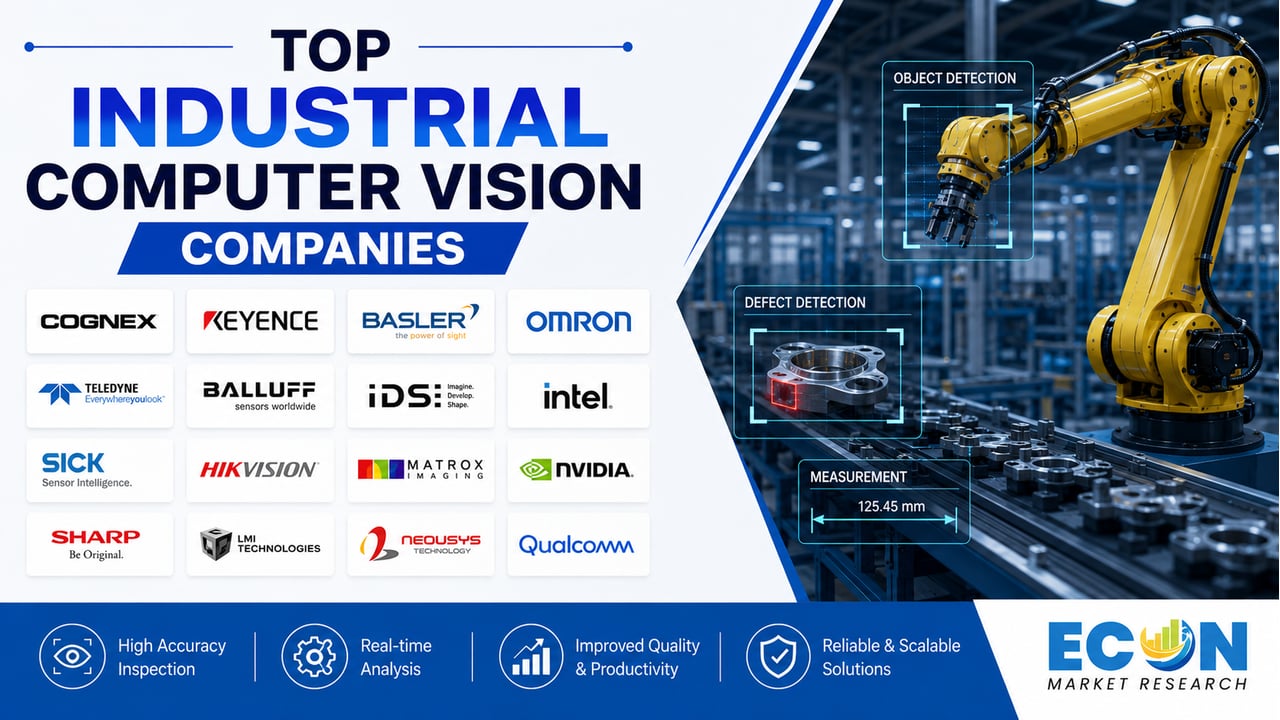
The Industrial Computer Vision industry serves automotive production, electronics, semiconductors, food processing, pharmaceuticals, packaging, logistics, battery manufacturing, metals, textiles, printing, medical technology, and general factory automation. Product architectures now range from compact smart cameras to distributed systems using multiple high-resolution cameras and industrial PCs. Current systems span visible light, near-infrared, short-wave infrared, 3D imaging, and line-scan technologies; commercial examples include 8k line-scan cameras operating at 25 kHz, 5GigE area-scan cameras delivering 8.1 MP at 67 fps, and industrial portfolios covering thousands of hardware and software configurations.
Market Evolution and Growth Drivers
Industrial computer vision has progressed from deterministic 2D pattern matching toward AI-assisted inspection, 3D measurement, multispectral imaging, and edge-based decision-making. Factory automation provides a measurable indication of this transition: the 542,000 robots installed during 2024 were more than twice the annual volume recorded 10 years earlier, and yearly installations remained above 500,000 units for a fourth consecutive year. Computer vision increasingly complements this automation by verifying component position, surface quality, dimensions, labels, welds, assembly completeness, and robot guidance without slowing production lines.
Artificial intelligence is another major driver. In the European Union, 19.95% of enterprises used AI technologies in 2025, while adoption among large enterprises reached 55.03%. Industrial vision suppliers are responding with trainable inspection tools that require fewer defect samples, edge inference that limits data movement, and hybrid systems combining rule-based algorithms with learned models. Regulatory requirements are also influencing system design: enforcement of major EU AI Act provisions began on 2 August 2026, increasing attention to documentation, traceability, risk management, and reliable AI operation in industrial applications.
Top 5 Latest Trends in the Industrial Computer Vision Industry
AI-Assisted and Self-Learning Quality Inspection
3D Vision for Robotics and Precision Metrology
Edge Processing and Smart Cameras
High-Speed, Multispectral and Event-Based Imaging
High-Bandwidth Standardized Vision Architectures
Trend 1: AI-Assisted and Self-Learning Quality Inspection
AI-assisted quality inspection has moved from experimental deployments into commercial factory platforms capable of learning visual variation that conventional fixed thresholds struggle to classify. Industrial computer vision systems increasingly combine traditional geometry, measurement, OCR, and pattern-matching tools with neural-network models for scratches, contamination, assembly errors, irregular surface defects, and anomalous components. A recent technical review examined over 1,200 research papers on generative AI in industrial machine vision and identified data augmentation for classification and object detection as a primary application. The ability to synthetically expand limited defect datasets is particularly important because actual manufacturing defects can occur too infrequently to generate balanced training sets.
Commercial adoption is visible across the Top Companies in the Industrial Computer Vision Industry. OMRON introduced AI-supported FH inspection capabilities in 2020, while Cognex and KEYENCE now offer production-oriented vision platforms incorporating AI tools alongside conventional inspection functions. This hybrid approach matters because factories can retain deterministic measurement where tolerances are explicitly defined while using AI where appearance varies naturally. By 2026, the direction of development had expanded toward digital-twin-supported inspection and AI models designed to connect visual perception with broader manufacturing intelligence.
Trend 2: 3D Vision for Robotics and Precision Metrology
Three-dimensional industrial computer vision is gaining importance as factories automate operations that require depth, shape, volume, orientation, and surface-profile information rather than only color or contrast. The global stock of operational industrial robots reached 4.664 million units in 2024, expanding the potential deployment base for 3D bin picking, robotic guidance, weld inspection, adhesive-bead measurement, battery inspection, pallet measurement, and dimensional verification. Unlike conventional 2D imaging, structured light, laser triangulation, stereo vision, and line-confocal techniques generate geometric data that can remain useful even when color or printed texture provides limited information.
Current equipment demonstrates the precision being commercialized. KEYENCE 3D pattern-projection systems can complete selected stopped-workpiece inspections in 0.6 seconds, while newer 3D laser profilers can exceed 6,500 measurement points per profile with profile intervals down to 2.1 microns and full-frame scan rates reaching 1.8 kHz. These specifications support inspection of connectors, electronics, machined components, batteries, packaging, and reflective assemblies where height differences or surface geometry determine whether a component passes quality requirements.
Trend 3: Edge Processing and Smart Cameras
Industrial computer vision is shifting processing closer to the camera because factories increasingly require deterministic response times without continuously transmitting raw images to centralized servers. IDS introduced its IDS NXT intelligent camera platform in 2018, illustrating an early transition toward on-camera AI inference, while current smart-camera platforms integrate image acquisition, processing, communications, and inspection logic within a single industrial device. Edge architectures reduce network loads and simplify installations in machinery where space, wiring, latency, cybersecurity, or continuous cloud connectivity can constrain conventional PC-based vision systems.
The scale of deployed imaging hardware makes this architecture commercially relevant. By 2025, more than 2 million IDS cameras were operating worldwide, supported by a portfolio of about 5,000 products and customers in over 70 countries. Smart processing also extends into 3D systems, where measurement and pass/fail tools can execute inside the sensor before results are transferred to PLCs or robot controllers. This architecture allows industrial computer vision technology providers to sell complete inspection functionality rather than requiring customers to integrate a camera, frame grabber, industrial PC, software stack, and separate inference hardware.
Trend 4: High-Speed, Multispectral and Event-Based Imaging
Factories are demanding imaging systems that reveal defects invisible to conventional RGB cameras while keeping pace with faster production equipment. Commercial line-scan platforms now operate at resolutions up to 16k, while Teledyne DALSA configurations reach 300 kHz at 16k resolution and multispectral versions capture visible and near-infrared information during a single scan. SWIR products extend detection into wavelengths such as 950–1700 nm, enabling inspection of moisture, materials beneath selected surfaces, silicon structures, food characteristics, and other properties that ordinary visible-light cameras cannot reliably distinguish.
Event-based imaging is creating another technical route for high-speed applications. IDS introduced a uEye EVS industrial camera in 2025 using an event-based sensor architecture that records changes in a scene rather than repeatedly transmitting complete conventional image frames. Meanwhile, industrial-camera portfolios have extended toward extremely high frame rates and resolutions; Allied Vision's current selection tools cover models reaching 245.8 MP and frame-rate ranges extending to 3,674 fps. These technologies expand industrial computer vision beyond standard frame-based inspection into vibration analysis, rapid motion, high-speed manufacturing, scientific processes, and difficult exposure conditions.
Trend 5: High-Bandwidth Standardized Vision Architectures
Industrial computer vision systems are becoming easier to scale because cameras increasingly support standardized interfaces rather than proprietary connectivity. Current commercial platforms use GigE Vision, 5GigE, USB3 Vision, CoaXPress, and Camera Link HS to balance cable length, bandwidth, latency, synchronization, and processing requirements. A Basler ace 2 configuration, for example, transmits 8.1 MP images at 67 fps through 5GigE, while Teledyne's Linea Lite family provides GigE Vision line-scan configurations spanning 2k, 4k, and 8k resolution.
Standardized image-quality characterization is advancing alongside connectivity. EMVA 1288 establishes a unified method for measuring and reporting machine-vision camera and sensor performance, and current Basler characterization material states that its cameras are measured in 100% compliance with the EMVA 1288 methodology. Standardization matters commercially because system integrators can compare sensitivity, noise, dynamic range, interface compatibility, and throughput before committing engineering resources. As factories deploy larger multi-camera cells, interoperability becomes increasingly important for reducing integration time and keeping replacement components available throughout long machine lifecycles.
Top 10 Companies in the Industrial Computer Vision Industry
The following 10 companies are not presented as a strict numerical ranking. Selection is based on direct industrial computer vision participation, product breadth, imaging expertise, deployment scale, geographic presence, industrial applicability, software capability, and recent technology development.
1. Cognex Corporation
Company Overview: Cognex was founded in 1981 and is headquartered in Natick, Massachusetts, United States. By 2025, the company reported that it had shipped over 5 million image-based products since its establishment, giving it a substantial installed base across manufacturing and logistics. Core Industrial Computer Vision Expertise: Cognex concentrates on machine vision, deep-learning inspection, barcode reading, presence verification, measurement, OCR, and guidance applications. Major Products and Services: Its portfolio includes In-Sight smart vision systems, VisionPro software, DataMan identification systems, and AI-enabled inspection platforms. Recent In-Sight generations combine conventional vision tools with AI so manufacturers can address both deterministic measurements and visually variable defects within the same inspection architecture.
2. KEYENCE Corporation
Company Overview: KEYENCE was founded in May 1974, employs 12,784 people, and operates from its global headquarters in Osaka, Japan. Its international network extends to 250 offices in 46 countries, serving about 400,000 customers across 110 countries. Core Industrial Computer Vision Expertise: The company develops factory-automation vision systems, vision sensors, measurement platforms, code readers, microscopes, and related sensing technology. Major Products and Services: Current machine-vision offerings include modular controllers, smart cameras, AI-assisted VS-series systems, and 2D and 3D inspection technology. KEYENCE's broad customer footprint is important because a common vision architecture can be supported across multinational automotive, electronics, pharmaceutical, food, and packaging production locations.
3. Basler AG
Company Overview: Basler was founded in 1988 and is headquartered in Ahrensburg, Germany. In 2025, the company reported about 820 employees, 13 locations, and approximately 5,000 vision hardware and software products. Core Industrial Computer Vision Expertise: Basler develops industrial cameras, embedded vision components, frame-grabber solutions, software, optics, lighting, and customized imaging systems. Major Products and Services: Its ace 2 family includes GigE, USB 3.0, and 5GigE models; one current configuration delivers 8.1 MP at 67 fps through 5GigE. Basler also supplies 3D and IP67-oriented products for factory automation, robotics, electronics, battery manufacturing, logistics, medical imaging, and other industrial inspection applications.
4. Teledyne DALSA
Company Overview: Teledyne DALSA was established in 1980, became part of Teledyne Technologies in 2011, employs roughly 1,000 people, and is headquartered in Waterloo, Ontario, Canada. Core Industrial Computer Vision Expertise: Its capabilities cover image sensors, area-scan and line-scan cameras, smart cameras, frame grabbers, 3D imaging, software, and specialized spectral imaging. Major Products and Services: The Linea Lite 8k Super Resolution model entered production in 2024, delivering 8k imaging at 25 kHz with a reconstructed 3.5 μm effective pixel structure. Other platforms extend into SWIR, multispectral, high-speed line scanning, semiconductor inspection, battery inspection, electronics, materials grading, printing, and automated optical inspection.
5. Zebra Technologies Corporation
Company Overview: Zebra Technologies was founded in 1969 and is headquartered in Lincolnshire, Illinois, United States. The company has about 10,700 employees in 57 countries, over 10,000 channel partners, and roughly 8,000 patents and patent applications worldwide. Core Industrial Computer Vision Expertise: Zebra expanded directly into machine vision through product development and acquisitions, including the completed acquisition of Matrox Imaging in 2022. Major Products and Services: The resulting portfolio includes fixed industrial scanners, smart cameras, Aurora Vision Studio, Aurora Vision Library, Aurora Design Assistant, 2D inspection, and 3D imaging capabilities. This combination connects industrial visual inspection with Zebra's established identification and frontline automation technology.
6. SICK AG
Company Overview: SICK was founded in 1946 and is headquartered in Waldkirch, Germany. Current company information identifies over 10,000 employees and 63 subsidiaries and affiliated operations worldwide. Core Industrial Computer Vision Expertise: SICK combines industrial vision with a broad sensor-automation portfolio, enabling manufacturers to integrate cameras, distance sensing, identification, safety, and measurement into coordinated factory systems. Major Products and Services: Its Inspector family provides 2D inspection with AI and rule-based tools, while Visionary products address 3D applications. Industrial 3D models are available with IP65/IP67 environmental protection, supporting automated logistics, robotics, manufacturing, positioning, battery inspection, and mobile-machine applications exposed to demanding operating conditions.
7. OMRON Corporation
Company Overview: OMRON was established in 1933, is headquartered in Kyoto, Japan, and employed 26,050 people as of March 31, 2026. Its products and services reach over 130 countries. Core Industrial Computer Vision Expertise: OMRON integrates cameras and image processing with PLCs, robotics, motion control, sensing, safety, and production automation. Major Products and Services: The FH inspection platform introduced AI-assisted functionality in 2020, supporting applications such as appearance inspection, positioning, OCR, and defect recognition. In July 2026, OMRON also announced work combining inspection technology with advanced simulation and AI infrastructure, reinforcing the convergence of computer vision, digital twins, synthetic data, and intelligent factory automation.
8. IDS Imaging Development Systems GmbH
Company Overview: IDS was founded in 1997 and remains headquartered in Obersulm, Germany. The company employs over 320 people from 21 countries, has supplied over 2 million cameras, serves roughly 11,000 customers, and makes products available in over 70 countries. Core Industrial Computer Vision Expertise: IDS develops 2D cameras, 3D stereo systems, AI-enabled cameras, monitoring systems, and event-based imaging. Major Products and Services: Important milestones include the first uEye USB camera in 2004, Ensenso 3D technology in 2013, IDS NXT AI cameras in 2018, and event-based uEye EVS technology in 2025. Its portfolio is used in machinery, robotics, research, medical technology, logistics, and automated inspection.
9. Baumer Group
Company Overview: Baumer traces its history to 1952, when Herbert Baumer established the company in Frauenfeld, Switzerland, which remains its headquarters. The group currently employs about 2,800 people through 39 subsidiaries in 19 countries. Core Industrial Computer Vision Expertise: Baumer combines industrial cameras and automated image-processing components with sensors, encoders, and measurement technology. Major Products and Services: Its industrial imaging portfolio includes high-resolution, high-frame-rate, UV, visible, and SWIR cameras, supporting machine building, electronics, packaging, robotics, and quality assurance. The company's manufacturing expansion has included a 7,000 m² research-and-development facility and over 6,000 m² of production space at its Lake Constance technology center.
10. Allied Vision Technologies GmbH
Company Overview: Allied Vision was founded in 1989 and operates from Stadtroda, Germany, with locations across Germany, Italy, Canada, the United States, Singapore, Japan, and China and sales representation in over 30 countries. Core Industrial Computer Vision Expertise: Its focus is 2D industrial imaging, embedded vision, SWIR imaging, high-speed cameras, and customized machine-vision solutions. Major Products and Services: Its current portfolio includes Alvium, Goldeye, and high-speed industrial camera families. In July 2026, Allied Vision announced 100GigE machine-vision cameras, while its camera-selection range spans resolutions up to 245.8 MP and frame rates reaching 3,674 fps, demonstrating the industry's movement toward substantially higher image-data throughput.
Regional Outlook
North America
North America has a mature industrial automation base that supports substantial industrial computer vision deployment in automotive manufacturing, logistics, electronics, aerospace, food processing, pharmaceuticals, and general manufacturing. The United States installed 34,200 industrial robots in 2024, representing 68% of installations across the Americas. U.S. manufacturing robot density stood at 295 units per 10,000 manufacturing employees in 2023, reinforcing demand for cameras used in robot guidance, part identification, assembly verification, metrology, and inline quality inspection. The region also contains major industrial vision headquarters and engineering operations belonging to Cognex, Zebra, Teledyne DALSA, and other imaging technology providers.
Canada and Mexico show different industrial computer vision demand patterns. Canada installed about 3,800 industrial robots during 2024, with automotive applications accounting for 47% of installations. Mexico installed approximately 5,600 units, and automotive manufacturing represented 63% of its robot deployments. These production structures favor vision systems for weld verification, component presence, dimensional checks, traceability, paint and surface inspection, and robotic positioning. The North American opportunity increasingly involves upgrading existing cells with AI-enabled cameras rather than automating only greenfield facilities, particularly where manufacturers already have robot, PLC, and industrial-network infrastructure.
Research and standards development are additional regional strengths. A 2026 U.S. smart-manufacturing roadmap identified advanced sensing and perception, AI, autonomous systems, digital twins, and robotics as important technology areas while highlighting data integration, trustworthiness, explainability, and reliability as continuing barriers. U.S. manufacturing policy also added 2 AI-focused centers in 2025, strengthening technical work relevant to industrial AI deployment. The practical challenge for computer vision suppliers is therefore shifting from proving that AI can detect visual defects toward demonstrating stable performance, cybersecurity, maintainability, traceability, and integration across long industrial equipment lifecycles.
Europe
Europe remains one of the world's most concentrated environments for advanced industrial automation and machine vision. European factories installed approximately 85,000 industrial robots in 2024, while the European Union accounted for 67,800 installations, or 80% of the regional total. Germany installed 26,982 units, representing 32% of European deployments, followed by Italy with 8,783, Spain with 5,100, France with 4,900, and the United Kingdom with 2,500. These manufacturing bases create direct applications for high-speed imaging, 3D measurement, electronics inspection, automotive quality control, food grading, pharmaceutical packaging, and robot guidance.
Europe also contains a dense network of Industrial Computer Vision manufacturers including Basler, SICK, IDS, and Allied Vision in Germany, alongside camera, optics, illumination, integration, and software specialists across other countries. Germany's manufacturing robot density reached 429 robots per 10,000 employees in 2023, compared with 219 across the European Union, illustrating the region's advanced automation intensity. Computer vision adoption increasingly extends beyond automotive plants toward batteries, semiconductors, intralogistics, packaging, recycling, medical manufacturing, and smaller flexible production cells where rapid product changeovers favor configurable vision software rather than fixed-purpose inspection equipment.
Regulation is becoming a stronger product-design consideration. In 2025, 19.95% of EU enterprises used AI, increasing to 55.03% among large enterprises. Enforcement of major AI Act provisions began on 2 August 2026, while updated implementation timelines set 2 December 2027 for specified Annex III high-risk systems and 2 August 2028 for high-risk AI embedded in regulated physical products. Not every industrial vision inspection system falls into these high-risk classifications, but the framework is increasing attention to risk assessment, transparency, data governance, validation, and traceability when AI-based vision influences safety-critical or regulated processes.
Asia-Pacific
Asia-Pacific is the largest operational concentration of factory robotics and therefore a critical deployment region for industrial computer vision. Asia accounted for 74% of global industrial robot installations in 2024. China alone installed 295,000 robots, representing 54% of worldwide installations, and its operational stock passed 2 million units. Domestic Chinese robot suppliers captured 57% of their home market in 2024, compared with a share near 28% roughly a decade earlier. This manufacturing ecosystem supports large-scale demand for vision in electronics, automotive manufacturing, EV batteries, solar equipment, semiconductors, packaging, logistics, and consumer-product assembly.
Japan and South Korea provide another technology-intensive cluster. Japan installed 44,500 robots in 2024 and maintained an operational stock of about 450,500 units, while South Korea installed 30,600 robots. South Korea's manufacturing robot density reached 1,012 robots per 10,000 employees in 2023, the highest among the major industrial economies measured, while Japan recorded 419. Japan also produced 38% of global robot production, strengthening the regional supply chain for automation systems that frequently incorporate industrial cameras, sensors, controllers, optics, and inspection software.
India represents a smaller but expanding automation base, installing 9,100 industrial robots in 2024, with automotive applications accounting for 45% of deployments. Singapore, meanwhile, recorded 770 robots per 10,000 manufacturing employees in 2023, reflecting the high automation intensity possible in compact electronics, semiconductor, pharmaceutical, and precision-manufacturing clusters. Taiwan's semiconductor ecosystem and Southeast Asia's electronics and assembly networks add further demand for high-resolution inspection. The regional opportunity is increasingly differentiated: China emphasizes scale, Japan and Korea emphasize automation depth, India emphasizes new capacity, while Singapore and Taiwan favor highly precise, data-rich inspection environments.
Middle East & Africa
Industrial computer vision adoption in the Middle East and Africa remains less mature than in Asia, Europe, or North America, but industrial diversification is creating targeted opportunities. The 6 Gulf Cooperation Council countries are expanding automated manufacturing, logistics, food production, chemicals, metals, and infrastructure operations. Saudi Arabia provides a measurable example: its number of factories increased from 7,206 in 2016 to over 11,500 by the end of 2023, a 60% expansion. As new plants adopt Industry 4.0 architectures, inspection cameras, machine-learning quality systems, robotic guidance, traceability, and automated measurement can be designed into production lines rather than retrofitted later.
Saudi Arabia's advanced-manufacturing strategy has also discussed a 2035 industrial horizon that includes substantially greater factory automation, creating potential applications for computer vision in metals, automotive components, food, pharmaceuticals, and downstream industrial manufacturing. The UAE is developing Industry 4.0 capabilities as part of its national industrial transformation agenda, where computer vision can support automated inspection and predictive manufacturing. High temperatures, dust, and demanding operating conditions make rugged housings, industrial illumination, thermal management, and IP-rated equipment particularly important when cameras are deployed outside controlled production environments.
Elsewhere, Israel's national AI program builds on government action initiated in 2021, creating an R&D environment for AI, computer vision, robotics, and related deep technologies. South Africa, Egypt, Kenya, and Nigeria form 4 important African industrial and technology nodes, although adoption remains constrained by uneven automation investment, specialist skills, imported equipment dependence, and infrastructure availability. This creates an opportunity for modular vision systems that can operate locally without continuous cloud connectivity, while regional system integrators can reduce support barriers by combining cameras, lighting, software, PLC integration, commissioning, and maintenance into a single deployment model.
Future Opportunities in the Industrial Computer Vision Industry
Future opportunities in the Industrial Computer Vision industry will increasingly center on reducing the engineering required to deploy reliable inspection rather than simply increasing camera resolution. With 4.664 million industrial robots already operating worldwide in 2024, a substantial installed automation base can potentially be upgraded with 2D inspection, 3D guidance, AI classification, and improved visual traceability. Analytical expectations therefore favor configurable smart cameras, no-code training environments, synthetic-data generation, automatic model validation, and edge inference that allow manufacturers to adapt inspection recipes without rebuilding complete automation cells. These opportunities are particularly relevant to SMEs that lack dedicated teams of machine-vision programmers and data scientists.
Image acquisition will also continue expanding beyond conventional RGB. Current commercial technology already reaches 16k line-scan resolution, 300 kHz line rates, SWIR coverage extending to 1,700 nm, and 3D profile intervals measured in low single-digit microns. The next opportunity is to combine these sensing modalities with AI so factories can classify material composition, subsurface defects, geometry, surface appearance, and assembly correctness within a coordinated inspection sequence. Such multimodal systems could be particularly valuable in semiconductor production, battery cells, recycling, food sorting, medical devices, composites, electronics, and high-value precision components.
Regulatory and governance capabilities will become product differentiators as AI-based inspection moves into safety-sensitive and regulated production. In Europe, key high-risk AI deadlines now extend to 2 December 2027 and 2 August 2028, giving manufacturers and suppliers defined timelines for relevant regulated applications. Verified targets such as these should be distinguished from analytical expectations: the legislation does not mean every industrial camera becomes a high-risk AI system, but it does strengthen the commercial case for auditable models, version-controlled datasets, documented validation, cybersecurity, human oversight, and traceable inspection decisions when computer vision forms part of regulated machinery or quality systems.
Another opportunity lies in interoperability and lifecycle economics. Industrial machines can remain operational for 10 years or longer, while camera interfaces and AI processors evolve much faster, making replaceable components and standardized communications strategically important. 5GigE, GigE Vision, USB3 Vision, CoaXPress, and Camera Link HS allow manufacturers to select bandwidth according to application requirements rather than locking every system to one architecture. Computer vision technology providers that combine standardized hardware, long-term software support, remote diagnostics, regional application engineering, and reusable AI models will be better positioned to serve multinational factories seeking common inspection standards across geographically distributed production lines.
Conclusion
The Industrial Computer Vision industry has developed into a critical enabling technology for automated manufacturing, operating alongside a global installed base of 4.664 million industrial robots and 542,000 new robot installations recorded in 2024. Its current direction is defined by 5 interconnected trends: AI-assisted inspection, 3D measurement, edge intelligence, advanced spectral and high-speed imaging, and standardized high-bandwidth architectures. Together, these developments are moving vision systems beyond basic presence detection toward autonomous quality decisions, micron-scale measurement, robotic perception, material analysis, and continuous traceability.
The 10 Top Companies in the Industrial Computer Vision Industry examined here demonstrate the sector's diverse competitive structure. Cognex and KEYENCE provide broad inspection ecosystems; Basler, Teledyne DALSA, IDS, Baumer, and Allied Vision contribute specialized imaging technologies; SICK and OMRON connect vision deeply with factory automation; and Zebra combines machine vision with industrial identification and workflow systems. Current capabilities range from 2 million-plus deployed cameras at IDS to over 5 million image-based products shipped by Cognex, showing that industrial vision has already progressed far beyond niche deployment.
Regional conditions will continue shaping adoption. Asia accounted for 74% of robot installations in 2024, Europe for 16%, and the Americas for 9%, while emerging industrial programs in the Middle East and Africa are creating newer deployment environments. The strongest future opportunities will come from making sophisticated vision easier to configure, validate, integrate, and maintain while preserving measurable accuracy and regulatory traceability. As AI, 3D sensing, spectral imaging, edge computing, and industrial networking converge, computer vision is positioned to become an increasingly integrated perception layer for automated factories rather than a standalone inspection component.