

Top Generative AI in Manufacturing Companies Driving Industrial Innovation in 2026
The generative AI in manufacturing industry features 10 key companies advancing industrial copilots, digital twins, AI agents, automation, and smart factories.
Introduction
Overview of the Global Generative AI in Manufacturing Industry
Generative AI in manufacturing has moved beyond general-purpose chatbots into engineering, production, maintenance, quality control, industrial knowledge management, digital twins, automation programming, and supply-chain workflows. The technology is increasingly connected with factory data, product lifecycle management systems, industrial control software, cloud platforms, edge computers, and simulation environments. One measurable example of commercial penetration is Siemens Industrial Copilot: by October 2024, more than 100 companies in Europe and the United States were already using the system, while approximately 120,000 engineering-software users could access its generative AI capabilities. These deployments show that industrial GenAI is progressing from proof-of-concept testing toward operational engineering environments where accuracy, security, traceability, and manufacturing context matter.
The industry's competitive structure includes industrial automation specialists, cloud providers, AI computing companies, enterprise software developers, engineering-platform vendors, and digital-twin technology providers. Manufacturing use cases now span automotive, aerospace, electronics, machinery, batteries, chemicals, pharmaceuticals, food processing, energy equipment, semiconductors, and consumer products. In 2025, 19.95% of EU enterprises with at least 10 employees used AI technologies, rising to 55.03% among large enterprises, providing an indicator of the wider digital environment into which manufacturing GenAI is being deployed. Industrial adoption remains uneven because factory applications must connect AI outputs to engineering rules, machinery, sensor data, maintenance records, and safety-critical operating procedures.
Market Evolution and Growth Drivers
Generative AI entered manufacturing through document summarization, engineering assistance, programming support, and enterprise knowledge retrieval before expanding toward autonomous agents and physical-AI workflows. Siemens and Microsoft introduced their Industrial Copilot collaboration in 2023, commercial engineering availability followed in July 2024, and Siemens expanded the platform into generative AI-assisted maintenance in 2025. By 2026, manufacturers were increasingly connecting copilots with automation engineering, digital twins, real-time industrial data, edge computing, and agentic workflows. This progression reflects an important change: GenAI is no longer limited to generating text but is increasingly being grounded in production data and engineering context so that responses can support physical industrial processes.
Productivity pressure and skill shortages are major adoption drivers. Siemens reported that Industrial Copilot users can generate certain panel visualizations in 30 seconds, while generated automation code in one implementation required only 20% adaptation. Schneider Electric reported in April 2026 that its Azure AI-powered industrial copilot can reduce engineering time by up to 50%, with selected production changes that previously required weeks being completed in hours. At the same time, AWS reported that 70% of manufacturers in a cited 2025 industry outlook identified data-related challenges as a major barrier to AI adoption, highlighting why industrial GenAI increasingly requires structured manufacturing data, governance, and integration with legacy systems rather than standalone language models.
Top 5 Latest Trends in the Generative AI in Manufacturing Industry
Industrial Copilots for Engineering and Automation
Agentic AI for Factory Operations
Generative Design and AI-Enhanced Digital Twins
Edge and Sovereign Generative AI
Industrial Knowledge Assistants and Retrieval-Augmented AI
Trend 1: Industrial Copilots for Engineering and Automation
Industrial copilots are one of the most commercially developed trends among the Top Companies in the Generative AI in Manufacturing Industry. These systems allow engineers to use natural-language instructions for PLC programming, control-system configuration, troubleshooting, documentation, visualization generation, and automation design. Siemens Industrial Copilot became commercially available for engineering in July 2024, and by October that year more than 100 companies were using the technology. Rockwell Automation has also integrated generative AI into FactoryTalk Design Studio, allowing engineers to generate and explain PLC code through natural-language prompts. Schneider Electric's industrial copilot reported engineering-time reductions of up to 50% in 2026, showing how domain-specific GenAI is moving directly into automation-development workflows rather than remaining a general office-productivity tool.
Trend 2: Agentic AI for Factory Operations
Manufacturing GenAI is progressing from assistants that answer questions toward AI agents capable of planning tasks, accessing multiple systems, coordinating workflows, and initiating actions under defined controls. Microsoft introduced its Factory Operations Agent direction in 2025, while Schneider Electric demonstrated next-generation agentic manufacturing capabilities with Microsoft Azure AI at Hannover Messe 2026. The Schneider architecture connects design, engineering, simulation, commissioning, and operations through coordinated specialized agents and EcoStruxure Automation Expert. In one industrial deployment, the associated autonomous platform accumulated more than 6,000 hours of stable operation. Agentic AI matters because factory work involves sequences of decisions rather than isolated prompts, making governed multi-step execution a more useful long-term model for production environments.
Trend 3: Generative Design and AI-Enhanced Digital Twins
Generative AI is increasingly being combined with simulation and digital twins to create, evaluate, and optimize engineering alternatives before physical manufacturing begins. NVIDIA expanded Omniverse with generative AI capabilities in 2023, and by 2026 Siemens and NVIDIA were working on an Industrial AI Operating System linking design, engineering, manufacturing, production, operations, and supply chains. Dassault Systèmes also expanded generative AI across its virtual-twin environment, including 2026 capabilities for prompt-guided manufacturing drawings and AI-enhanced CATIA workflows. This trend reduces the separation between AI-generated ideas and engineering validation because generated designs can be evaluated inside physics-based or virtual manufacturing environments before tooling, materials, or production capacity are committed.
Trend 4: Edge and Sovereign Generative AI
Manufacturers increasingly require GenAI that can operate close to industrial equipment because factories may have latency limits, cybersecurity requirements, intellectual-property concerns, unreliable connectivity, or restrictions on sending production data to external services. Rockwell Automation announced an edge-based generative AI initiative with NVIDIA in November 2025, using the Nemotron Nano 9B model family to support industrial workflows on HMIs, desktop environments, servers, private clouds, and air-gapped systems. AWS expanded the same architectural direction through AI Factories, allowing selected AI infrastructure and services to operate within customer-controlled data-center environments. Edge GenAI can support troubleshooting, code assistance, operator guidance, and maintenance while reducing the need to transmit every industrial interaction to a centralized public-cloud model.
Trend 5: Industrial Knowledge Assistants and Retrieval-Augmented AI
Industrial organizations generate decades of maintenance manuals, engineering drawings, alarm histories, work instructions, quality records, operator notes, specifications, and process documentation. Generative AI is increasingly being grounded in these datasets rather than relying solely on general model knowledge. IBM describes manufacturing GenAI applications that search and summarize technical documents, while AVEVA introduced its Industrial AI Assistant in 2024 to let industrial users query operational information through natural language. Google Cloud and AWS similarly support retrieval-augmented manufacturing applications through their enterprise AI platforms. This trend is strategically important because the manufacturing workforce must often locate precise plant-specific information, and a grounded assistant can make institutional knowledge accessible without requiring employees to manually search across hundreds or thousands of documents.
Top 10 Companies in the Generative AI in Manufacturing Industry
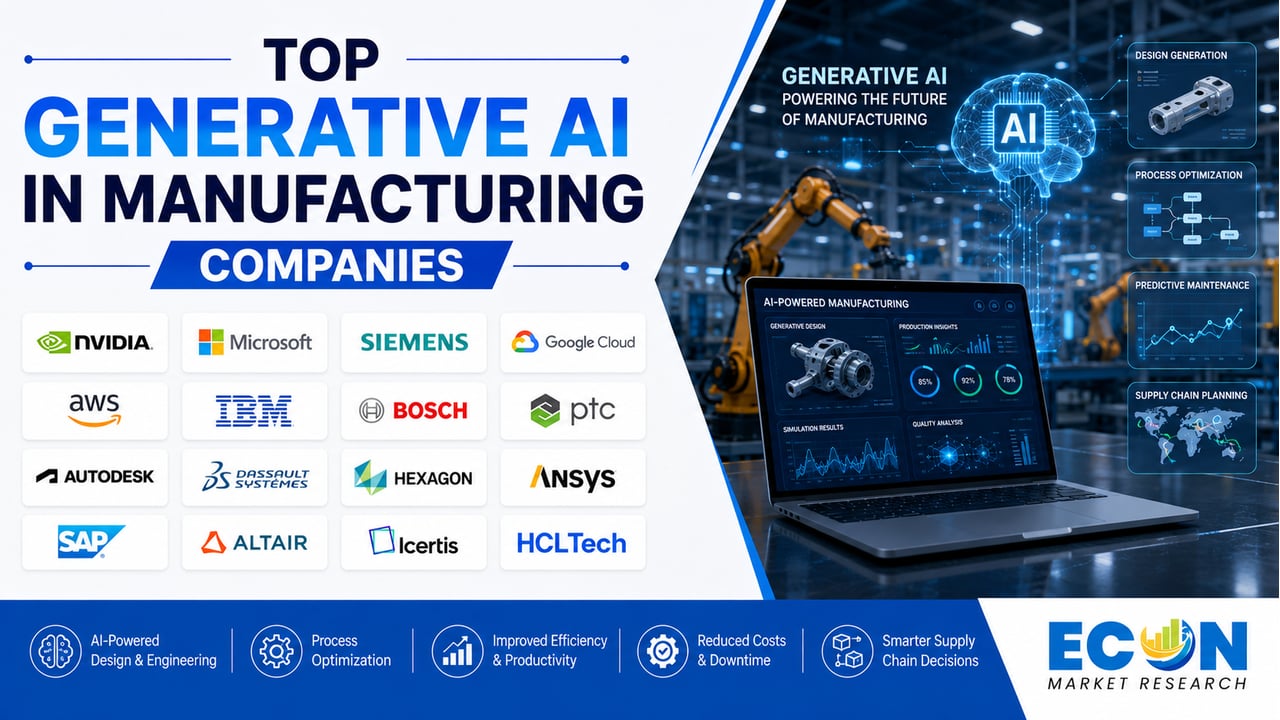
The following 10 companies are not presented as a strict ranking. They are selected based on industrial GenAI product capabilities, engineering expertise, manufacturing relevance, deployment scale, geographic presence, ecosystem strength, and direct participation in factory, automation, design, maintenance, or industrial-data applications.
1. Siemens AG
Company Overview: Siemens traces its history to 1847 and had approximately 318,000 employees as of September 2025, with operations spanning more than 200 countries. Headquarters: Berlin and Munich, Germany. Core Generative AI in Manufacturing Expertise: Siemens combines industrial automation, engineering software, digital twins, PLC systems, manufacturing data, and generative AI. Major Products and Services: Siemens Industrial Copilot supports engineering, automation programming, troubleshooting, and maintenance; more than 100 companies were using the platform by October 2024. Siemens expanded its collaboration with NVIDIA in 2026 around an Industrial AI Operating System and introduced Digital Twin Composer as part of its broader industrial AI strategy.
2. Microsoft Corporation
Company Overview: Microsoft was founded in 1975, employs approximately 228,000 people, and operates in about 190 countries. Headquarters: Redmond, Washington, United States. Core Generative AI in Manufacturing Expertise: Microsoft provides the cloud, foundation-model, data, security, productivity, and agent infrastructure used by multiple industrial copilots. Major Products and Services: Azure OpenAI Service powers Siemens Industrial Copilot and Rockwell Automation's FactoryTalk Design Studio Copilot, while Microsoft Cloud for Manufacturing supports factory data and operational AI use cases. In 2025, Microsoft expanded its industrial AI strategy with Factory Operations Agent concepts designed to allow production personnel to query manufacturing data and operational context more naturally.
3. NVIDIA Corporation
Company Overview: NVIDIA was founded in 1993 and is headquartered in Santa Clara, California, United States. Core Generative AI in Manufacturing Expertise: NVIDIA supplies accelerated computing, foundation models, digital-twin infrastructure, simulation tools, robotics frameworks, and edge AI used to develop industrial GenAI and physical-AI applications. Major Products and Services: NVIDIA Omniverse added generative AI capabilities in 2023, while NVIDIA Nemotron models are being adapted by Rockwell Automation for industrial edge applications. In 2026, NVIDIA expanded its Siemens partnership to create an industrial AI architecture connecting digital twins, simulation, production systems, robotics, and generative intelligence.
4. Amazon Web Services
Company Overview: Amazon Web Services launched in 2006 and has developed into a global cloud and AI infrastructure platform serving manufacturing organizations across multiple geographic regions. Headquarters: Seattle, Washington, United States, as part of Amazon. Core Generative AI in Manufacturing Expertise: AWS combines foundation models, agents, industrial data services, IoT, cloud infrastructure, edge technology, and enterprise AI deployment. Major Products and Services: Amazon Bedrock provides access to 100+ foundation models, while Bedrock Agents supports multi-step automation. At Hannover Messe 2026, AWS highlighted industrial agentic AI, physical AI, intelligent data foundations, and edge-to-cloud connectivity; Volkswagen's AWS-powered Digital Production Platform was being expanded across 40+ facilities worldwide.
5. Google Cloud
Company Overview: Google was founded in 1998 and operates an international technology organization with employees drawn from more than 70 countries. Headquarters: Mountain View, California, United States. Core Generative AI in Manufacturing Expertise: Google Cloud provides Gemini models, enterprise agent infrastructure, manufacturing data services, analytics, edge technology, and AI development environments. Major Products and Services: Vertex AI became a major development environment for generative AI in 2023, while the current Gemini Enterprise Agent Platform supports building, governing, and scaling AI agents. Google Cloud's manufacturing portfolio specifically addresses generative AI, factory operations, worker assistance, asset monitoring, and edge AI applications.
6. IBM
Company Overview: IBM was established in 1911 as the Computing-Tabulating-Recording Company and adopted the IBM name in 1924. Headquarters: Armonk, New York, United States. Core Generative AI in Manufacturing Expertise: IBM applies enterprise AI, hybrid cloud, governance, automation, computer vision, asset management, and generative AI to industrial workflows. Major Products and Services: The watsonx portfolio supports building, validating, tuning, governing, and deploying AI models and agents. Manufacturing applications include technical-document search, maintenance assistance, production knowledge retrieval, video-based verification, supply-chain analysis, and enterprise AI orchestration. By 2026, IBM was also positioning watsonx for agent-based workflows involving delayed orders, inventory shortages, and operational bottlenecks.
7. Rockwell Automation, Inc.
Company Overview: Rockwell Automation has operated for more than 123 years, employs approximately 26,000 people, and serves customers in more than 100 countries. Headquarters: Milwaukee, Wisconsin, United States. Core Generative AI in Manufacturing Expertise: Rockwell focuses specifically on industrial automation, PLC engineering, factory software, production systems, and edge intelligence. Major Products and Services: FactoryTalk Design Studio Copilot uses generative AI for PLC code generation, product guidance, troubleshooting, and code explanation. In 2025, Rockwell announced an industrial edge GenAI initiative using NVIDIA Nemotron Nano, designed to operate on HMIs, desktop systems, private servers, and air-gapped industrial environments.
8. Schneider Electric SE
Company Overview: Schneider Electric has a history extending approximately 190 years, employs about 160,000 people, and works with an ecosystem of roughly 1 million partners in more than 100 countries. Headquarters: Rueil-Malmaison, France, within its global multi-hub operating model. Core Generative AI in Manufacturing Expertise: Schneider combines industrial automation, energy management, software-defined control, factory engineering, AI, and edge systems. Major Products and Services: EcoStruxure Automation Expert provides the automation foundation for its industrial copilot and agentic manufacturing work with Microsoft. In 2026, Schneider reported up to 50% engineering-time savings for selected control configuration and documentation workflows.
9. Dassault Systèmes
Company Overview: Dassault Systèmes employs approximately 25,000 people, operates through 184 sites, and serves more than 370,000 customers across 12 industries, with active customers in 159 countries. Headquarters: Vélizy-Villacoublay, France. Core Generative AI in Manufacturing Expertise: The company integrates generative AI with CAD, product lifecycle management, virtual twins, simulation, manufacturing planning, and engineering collaboration. Major Products and Services: Its 3DEXPERIENCE, CATIA, SOLIDWORKS, and DELMIA environments are incorporating assistive, predictive, generative, and agentic AI. In 2026, SOLIDWORKS introduced prompt-guided generative drawing functionality capable of producing standards-based 2D manufacturing documentation.
10. SAP SE
Company Overview: SAP was founded by 5 people in 1972 and has grown to more than 105,000 employees, with offices in approximately 130 countries. Headquarters: Walldorf, Germany. Core Generative AI in Manufacturing Expertise: SAP connects generative AI with ERP, manufacturing execution, supply chains, procurement, maintenance, business data, and workforce processes. Major Products and Services: Joule provides conversational and agentic AI across SAP applications, while the company's generative AI hub gives enterprises controlled access to multiple foundation-model families. In 2026, Bosch Digital reported a 20% developer-productivity improvement from Joule-based development workflows and a 15–20% reduction in time required for selected unit-testing activities.
Regional Outlook
North America
North America has a strong Generative AI in Manufacturing ecosystem because the region contains major AI computing, cloud, software, and industrial automation providers. Of the 10 companies profiled in this article, 6 have major or global headquarters in the United States, including Microsoft, NVIDIA, AWS, Google, IBM, and Rockwell Automation. U.S. manufacturers are deploying GenAI for engineering assistance, maintenance knowledge, production analytics, code generation, and supply-chain workflows. NIST published its 2026 Roadmap on Artificial Intelligence and Machine Learning for Smart Manufacturing, emphasizing industrial data management, heterogeneous system integration, trustworthy AI, explainability, reliability, advanced sensing, digital twins, and human-AI teaming as core technical priorities.
Standards and measurement science are especially important in North America because factory AI can affect equipment behavior and production decisions. NIST's AI for Manufacturing Workshop was held on May 27–28, 2026 and focused on fitness-for-purpose metrics, reliability, interoperability, resilience, and human-AI teaming. Canada has strong AI research and advanced-manufacturing capabilities, while Mexico provides a major automotive, electronics, machinery, and export-manufacturing base connected to U.S. supply chains. The regional opportunity therefore differs by country: the United States concentrates foundation-model, cloud, automation, and semiconductor capabilities; Canada contributes AI research and industrial engineering; and Mexico offers a large production environment where multilingual copilots, maintenance assistants, and engineering-support tools can help standardize knowledge across plants.
Europe
Europe combines industrial engineering depth with an increasingly formal regulatory framework for AI. In 2025, 19.95% of EU enterprises used at least one AI technology, compared with 13.5% in 2024. Adoption varied widely: Denmark reached 42.0%, while Finland recorded 37.8%, demonstrating how digital readiness differs between European economies. Europe also hosts Siemens, Schneider Electric, Dassault Systèmes, and SAP among the companies profiled here, giving the region strong capabilities in factory automation, engineering software, enterprise applications, digital twins, and industrial AI. Germany and France are especially important for industrial GenAI development, while the Netherlands, Nordic countries, Italy, Spain, and the United Kingdom provide additional manufacturing and software ecosystems.
Regulation will increasingly influence how GenAI is integrated into industrial products. European Commission enforcement of major AI Act rules began on 2 August 2026, while the updated AI Omnibus timeline applies high-risk obligations to specified areas from 2 December 2027 and to relevant AI systems embedded in regulated products such as industrial machinery from 2 August 2028. These rules do not classify every manufacturing copilot as high risk, but they increase the importance of documentation, cybersecurity, accuracy, human oversight, traceability, and risk management where AI becomes part of regulated equipment. The EU's GenAI4EU initiative also covers 14 industrial and public-sector areas, including manufacturing and engineering, virtual worlds, robotics, materials, batteries, and mobility.
Asia-Pacific
Asia-Pacific combines advanced manufacturing scale with expanding AI infrastructure. China reported more than 6,200 AI companies in 2025, while its government has introduced additional measures to integrate artificial intelligence into manufacturing. Shanghai introduced a new industrial AI policy package in July 2026 focused on manufacturing data, core technologies, industrial models, and intelligent factory transformation. Japan, South Korea, Taiwan, and Singapore provide advanced automotive, electronics, semiconductor, machinery, and precision-manufacturing environments that can support GenAI applications in engineering, documentation, quality, maintenance, and digital twins. Singapore also functions as a major regional technology hub, with Google employing more than 3,000 people at its regional headquarters there.
India and Southeast Asia provide a different opportunity built around expanding manufacturing capacity and digital engineering. India's Electronics Component Manufacturing Scheme was approved on March 28, 2025 and notified on April 8, supporting a broader electronics-manufacturing ecosystem where AI-enabled design, simulation, and production software can be deployed. In August 2026, an Indian government technology initiative also specifically referenced AI-enabled Design for Additive Manufacturing tools and simulation platforms. APAC manufacturers face supply-chain and data-sovereignty requirements that may favor private-cloud, edge, and small-language-model architectures. As a result, generative AI adoption in the region is likely to span both globally hosted platforms and factory-local solutions tailored to semiconductor, electronics, automotive, machinery, and high-volume industrial environments.
Middle East & Africa
The Middle East and Africa represent an earlier-stage but strategically relevant environment for industrial GenAI. The 6 Gulf Cooperation Council countries are investing in industrial diversification, digital infrastructure, logistics, energy technology, and advanced manufacturing. The UAE launched its national AI strategy in 2017, and the country's long-term programs connect AI adoption with the UAE Centennial 2071 agenda. Operation 300bn further emphasizes expansion and modernization of the industrial sector, creating potential use cases for GenAI in engineering support, maintenance, energy management, process documentation, workforce training, and industrial knowledge systems. The region's combination of greenfield industrial facilities and international technology partnerships can make new factories suitable for AI-enabled architectures from the design stage.
Israel contributes a mature AI and advanced-technology ecosystem, while South Africa, Egypt, Kenya, and Nigeria provide emerging manufacturing and digital markets with different levels of infrastructure readiness. An Israeli national technology pavilion at Mobile World Congress 2025 included 32 technology companies spanning security, connectivity, AI, IoT, hardware, and related digital capabilities. Across Africa, constraints include access to industrial data, AI engineering skills, computing infrastructure, and integration expertise. These conditions create a practical role for cloud-based assistants and compact edge models that can preserve operational knowledge without requiring every factory to maintain a large internal AI team. Adoption is therefore likely to begin with focused applications such as maintenance, technical search, operator support, and engineering documentation before expanding into autonomous production workflows.
Future Opportunities in the Generative AI in Manufacturing Industry
Future opportunities for the Top Companies in the Generative AI in Manufacturing Industry will increasingly involve connecting generative models directly with validated engineering and production environments. Siemens and Microsoft already provide access to Industrial Copilot capabilities for an engineering user base exceeding 120,000 people, while Schneider Electric has demonstrated engineering-time reductions of up to 50% in selected workflows. The next opportunity is to extend these copilots from code and documentation toward closed-loop engineering assistants that can propose configurations, test them in digital twins, check them against engineering constraints, explain risks, and prepare validated automation packages for human approval. Such systems could reduce repetitive engineering work while retaining expert oversight for safety-critical production changes.
Physical AI and generative simulation create another major opportunity. NVIDIA and Siemens expanded their industrial AI partnership in 2026, while Dassault Systèmes is integrating generative intelligence into virtual twins and engineering environments. These technologies can allow manufacturers to generate synthetic training scenarios, equipment layouts, robot paths, manufacturing drawings, and process alternatives before physical deployment. Analytical expectations favor tighter connections between 3D engineering data and language-based agents because a factory AI system that understands geometry, physics, machine constraints, and production schedules can provide more useful recommendations than a model trained primarily on text. This opportunity is particularly relevant to automotive, aerospace, electronics, machinery, batteries, and semiconductor production.
Edge and regulated manufacturing will also create new product categories. Rockwell Automation's 2025 Nemotron Nano initiative demonstrates that smaller language models can be adapted for local industrial environments, while EU requirements for relevant AI embedded in regulated machinery apply from 2 August 2028 under the updated timeline. This combination creates opportunities for specialized models that operate offline, respect intellectual-property restrictions, maintain audit logs, and provide predictable responses inside factory networks. Small and medium-sized manufacturers could benefit particularly from packaged systems that include an industrial model, domain-specific knowledge base, cybersecurity controls, integration connectors, and preconfigured use cases rather than requiring an internal team to build every GenAI component from the ground up.
Conclusion
The Generative AI in Manufacturing industry has evolved rapidly since industrial copilot initiatives began reaching commercial users in 2023 and 2024. Today, applications extend across PLC programming, engineering documentation, maintenance, digital twins, manufacturing data analysis, product design, troubleshooting, supply-chain workflows, and operator knowledge. The 5 major trends shaping the industry—industrial copilots, agentic manufacturing, generative digital twins, edge AI, and industrial knowledge assistants—show that GenAI is becoming increasingly specialized for physical production environments. Siemens Industrial Copilot's adoption by more than 100 companies and Schneider Electric's reported engineering-time reductions of up to 50% demonstrate that measurable industrial use cases already exist alongside continuing technical challenges.
The 10 Top Companies in the Generative AI in Manufacturing Industry represent complementary parts of the technology stack. Siemens, Rockwell Automation, and Schneider Electric connect AI directly with industrial automation; Microsoft, AWS, Google Cloud, and IBM provide models, agents, cloud services, and enterprise data platforms; NVIDIA supplies AI computing, models, simulation, and physical-AI infrastructure; Dassault Systèmes links generative intelligence with virtual twins and engineering; and SAP connects AI to manufacturing-related enterprise workflows. The competitive environment is therefore unlikely to be dominated by a single technology category because production-grade GenAI requires integration between models, industrial data, engineering software, cybersecurity, edge systems, human expertise, and physical equipment.
Regional development will remain uneven. EU enterprise AI adoption reached 19.95% in 2025, China reported more than 6,200 AI companies, the United States published a dedicated 2026 smart-manufacturing AI roadmap, and the UAE continues to connect AI development with its national 2071 vision. Future opportunities will depend less on generic chatbot functionality and more on whether GenAI systems can deliver traceable, secure, technically valid, context-aware assistance inside real factories. Companies that successfully combine generative intelligence with digital twins, industrial automation, edge computing, validated engineering data, regulatory compliance, and skilled human oversight will define the next phase of manufacturing AI adoption.