


Top Companies in the Enterprise AI Platform Industry
The top enterprise AI platform companies are shaping secure, scalable AI adoption through advanced models, automation, governance, and cloud integration.
Introduction
Overview of the Global Enterprise AI Platform Industry
The global enterprise AI platform industry has entered a production-focused phase in 2026 as organizations move beyond isolated experiments toward secure, integrated, and measurable artificial intelligence deployments. Enterprise AI platforms combine at least 6 essential capabilities: model development, data integration, application building, agent orchestration, governance, security, and performance monitoring. Adoption is strongest among large organizations, where complex data estates and thousands of employees create significant automation opportunities. In the United States, approximately 37% of companies with at least 250 employees reported using AI in business operations during 2026, compared with an overall business adoption range of 17% to 20%.
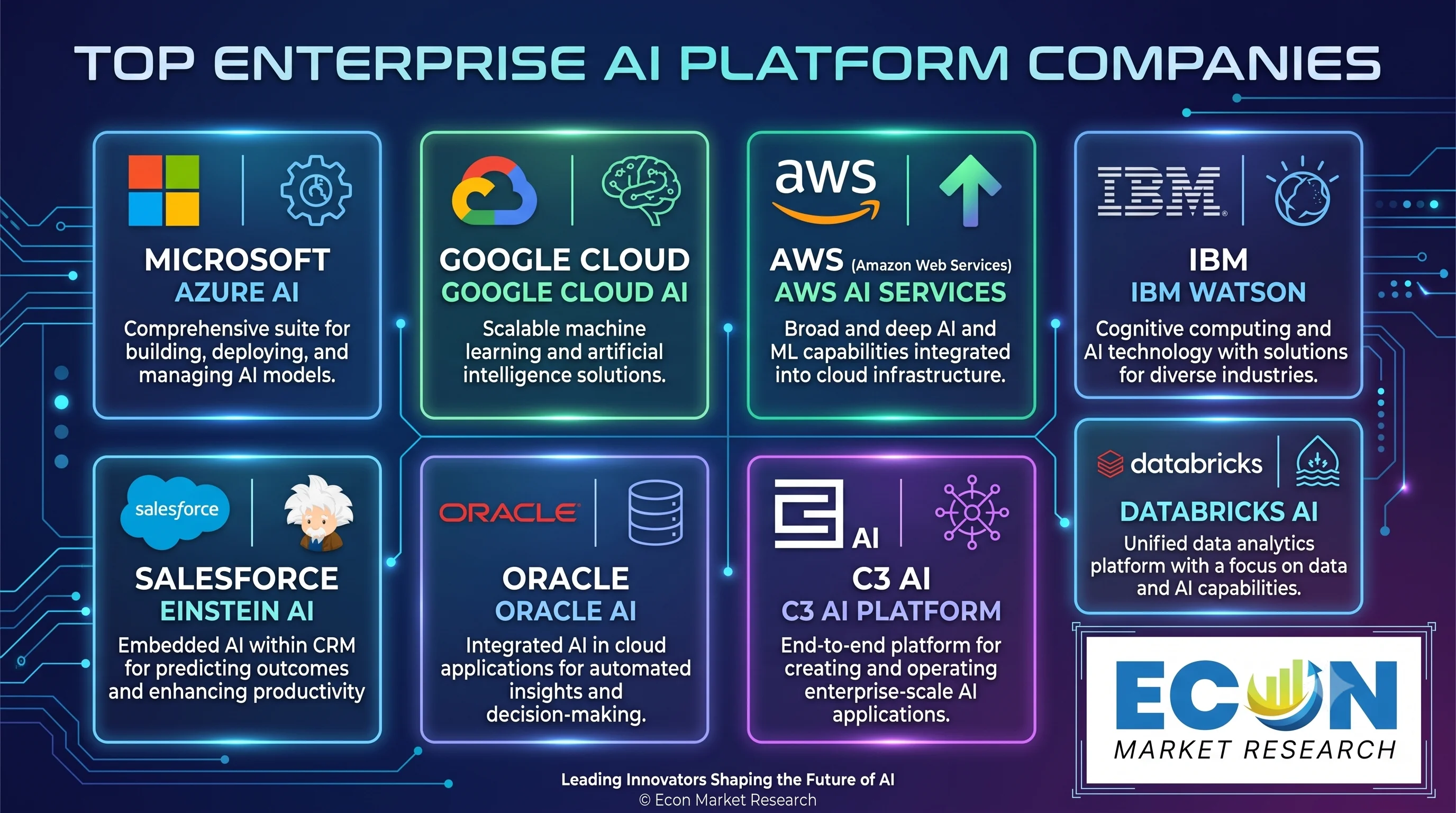
Enterprise AI platforms are increasingly used to support customer service, software development, fraud detection, demand forecasting, document processing, cybersecurity, manufacturing optimization, and employee productivity. A modern enterprise may connect 10 or more business systems, including customer relationship management, enterprise resource planning, supply chain, finance, human resources, and analytics applications, to a single AI environment. The strongest platforms provide controlled access to multiple foundation models rather than requiring customers to depend on 1 model family. This model-neutral strategy allows organizations to select different models according to accuracy, latency, language, privacy, computing, and regulatory requirements.
Market Evolution and Growth Drivers
The enterprise AI platform market has evolved through at least 4 major stages: predictive analytics, machine learning operations, generative AI application development, and agentic AI orchestration. Before 2022, most enterprise platforms concentrated on training structured-data models for classification, forecasting, anomaly detection, and recommendation systems. Between 2023 and 2025, large language models expanded the market to knowledge assistants, content generation, code creation, and retrieval-augmented generation. By 2026, enterprises increasingly expect platforms to support AI agents that can plan tasks, access approved tools, retain contextual memory, call application programming interfaces, and complete multi-step workflows.
Several measurable factors are accelerating enterprise AI platform adoption. Organizations must manage growing volumes of structured and unstructured information across hundreds of repositories, while large employers may process millions of emails, documents, transactions, and customer interactions each month. Businesses also require AI systems that can operate across 24-hour service environments without weakening access controls or regulatory compliance. In a 2026 business survey, approximately 18% of firms reported using AI in at least 1 business function, while adoption reached 32% when results were weighted by employment. In knowledge-intensive sectors and very large companies, usage rates reached approximately 50% to 60%, confirming that organizational scale is a major adoption driver.
Top 5 Latest Trends in the Enterprise AI Platform
1. Agentic AI and Multi-Agent Workflow Automation
Agentic AI represents 1 of the most important enterprise AI platform trends in 2026. Unlike conventional chatbots that primarily respond to individual questions, AI agents can interpret objectives, generate plans, select tools, execute actions, evaluate results, and escalate exceptions to human employees. A multi-agent architecture may assign 5 specialized agents to research, data retrieval, analysis, compliance checking, and final reporting. This approach allows enterprises to automate workflows that previously required movement between 3 or more departments. Platforms are therefore adding identity management, persistent memory, tool permissions, agent registries, simulation environments, and step-level monitoring.
The business value of agentic AI depends on controlled execution rather than unrestricted autonomy. An effective enterprise AI platform can limit an agent to 10 approved applications, require human authorization for transactions above a defined threshold, and record every action in an auditable log. Agent platforms are also becoming framework-neutral, allowing developers to use multiple orchestration technologies and model providers. Production systems increasingly include 4 operational layers: reasoning, knowledge grounding, action execution, and observability. This structure helps enterprises prevent agents from accessing unauthorized information or completing irreversible activities without approval.
2. Model Choice, Routing, and Smaller Specialized Models
Enterprise buyers are moving from single-model strategies toward model portfolios containing dozens or even thousands of options. One major enterprise platform now provides access to more than 11,000 models, while another allows organizations to explore hundreds of specialized models through a unified environment. This expansion reflects an important operational reality: the most powerful model is not automatically the best choice for every enterprise AI platform workload. A lightweight classification task may require a smaller model, while complex legal analysis may need a larger reasoning model with stronger contextual capabilities.
Intelligent model routing is therefore becoming a core enterprise AI platform feature. A routing layer can evaluate at least 5 factors—task complexity, accuracy requirement, response speed, data sensitivity, and computing consumption—before selecting the appropriate model. Organizations may use 1 model for coding, a second for multilingual customer service, a third for document extraction, and a fourth for image analysis. Smaller models are particularly valuable for private-cloud, edge, and on-device deployments because they can reduce processing latency and infrastructure requirements. Model diversity also reduces dependency on 1 supplier and gives procurement teams greater negotiating and operational flexibility.
3. Enterprise Data Grounding and Retrieval-Augmented Generation
Enterprise AI platform performance is increasingly determined by the quality of connected business data. Even an advanced foundation model cannot reliably answer organization-specific questions without access to current policies, product records, customer histories, operational metrics, and approved documents. Retrieval-augmented generation addresses this limitation by searching trusted enterprise sources before producing an answer. A production retrieval system may process 1 user question, retrieve 20 candidate passages, rank the 5 most relevant sections, and provide those sections to the model as verified context.
The latest platforms are extending retrieval beyond basic vector search. They combine semantic retrieval, keyword matching, structured database queries, metadata filters, knowledge graphs, access permissions, and document-level citations. A company with 10 million documents cannot treat every file as equally relevant or accessible. The enterprise AI platform must respect user roles, geographic restrictions, retention policies, and document classifications during each retrieval request. Knowledge graphs are also gaining importance because they represent relationships among customers, products, suppliers, employees, contracts, and business processes. This structured context helps agents understand not only individual facts but also how 2 or more business entities are connected.
4. AI Governance, Evaluation, and Regulatory Compliance
Governance has become a platform-level requirement rather than a final compliance activity. Enterprises now evaluate AI systems across at least 7 dimensions: accuracy, reliability, fairness, safety, privacy, security, and explainability. Platform providers are adding automated evaluation, prompt testing, red-team simulation, model documentation, lineage tracking, policy enforcement, and continuous monitoring. These capabilities help organizations identify whether an application produces unsupported statements, exposes sensitive information, behaves inconsistently, or performs differently across user groups.
Regulatory deadlines are accelerating investment in enterprise AI platform governance. The European AI Act entered into force on August 1, 2024, prohibited AI practices and AI-literacy requirements began applying on February 2, 2025, and general-purpose AI obligations started on August 2, 2025. Most additional requirements are scheduled to apply from August 2, 2026, with selected provisions continuing through 2027 and 2028. Enterprises operating across 27 European Union member states therefore need centralized inventories, risk classifications, technical documentation, monitoring records, and human-oversight controls. The leading enterprise AI platforms are responding by embedding governance into development, deployment, and operational workflows.
5. Hybrid, Sovereign, and Private AI Deployment
Organizations increasingly want the flexibility to deploy enterprise AI platforms across public cloud, private cloud, dedicated infrastructure, and on-premises environments. Highly regulated businesses may need to keep sensitive data within 1 country, 1 legal jurisdiction, or a company-controlled data center. Sovereign AI capabilities address these requirements through regional processing, customer-managed encryption, isolated computing, local operational control, and zero-retention model endpoints. These features are especially important for public-sector, healthcare, defense, telecommunications, and financial-services applications.
Hybrid AI architectures also help companies use existing technology investments. An organization may retain 20 years of operational information in on-premises systems while running modern AI inference in a controlled cloud environment. Rather than moving every dataset, the enterprise AI platform can connect approved agents to relevant records through secure interfaces. Hardware diversity is another part of this trend, with enterprise platforms supporting multiple accelerator families, including A100, H100, H200, and MI300-class infrastructure. The objective is to balance 4 priorities: performance, security, data residency, and operational cost.
Top 5 Companies in the Enterprise AI Platform
1. Microsoft
Company overview: Microsoft was established in 1975 and has developed a broad enterprise technology portfolio spanning productivity software, business applications, cloud infrastructure, security, databases, developer tools, and artificial intelligence. Its enterprise AI strategy connects AI development with workplace applications, identity systems, data services, application hosting, and governance. The company serves organizations ranging from small businesses to employers with more than 100,000 workers.
Headquarters: Microsoft is headquartered in Redmond, Washington, United States, where its main corporate campus includes more than 100 buildings and supports global product development, research, engineering, and enterprise operations.
Core Enterprise AI Platform expertise: Microsoft Foundry is positioned as a unified platform-as-a-service environment for enterprise AI operations, model building, application development, and agent deployment. The platform provides access to more than 11,000 models and supports the complete agent lifecycle, including design, grounding, evaluation, deployment, identity, memory, permissions, monitoring, and governance.
Major products and services: Key offerings include Microsoft Foundry, Foundry Agent Service, Foundry Models, Azure Machine Learning capabilities, Azure AI Search, Azure OpenAI integrations, content-safety tools, managed computing, and enterprise data services. The infrastructure supports at least 4 major accelerator families—A100, H100, H200, and MI300—giving customers multiple deployment choices for training and inference. The platform is particularly strong for enterprises already using Microsoft 365, Dynamics 365, Power Platform, GitHub, Windows, and Azure security services.
2. Amazon Web Services
Company overview: Amazon Web Services began offering cloud infrastructure services in 2006 and now supports startups, public-sector agencies, research institutions, and global enterprises. Its enterprise AI portfolio is designed around scalable computing, storage, databases, machine learning, foundation-model access, and agentic application development. The company’s AI services can support workloads ranging from 1 experimental model endpoint to globally distributed applications serving millions of requests.
Headquarters: Amazon Web Services operates as part of Amazon, which is headquartered in Seattle and Arlington, United States, while its cloud infrastructure is distributed across multiple geographic regions and availability zones.
Core Enterprise AI Platform expertise: Amazon Bedrock is a fully managed enterprise platform that provides access to foundation models through unified interfaces without requiring customers to manage the underlying infrastructure. The platform supports model choice, customization, retrieval, guardrails, agent development, knowledge bases, evaluation, and production monitoring. More than 100,000 organizations worldwide use Amazon Bedrock for generative AI and agent-related applications.
Major products and services: Major offerings include Amazon Bedrock, Bedrock AgentCore, managed knowledge bases, guardrails, model evaluation, prompt management, Amazon SageMaker AI, vector-search integrations, serverless computing, databases, and security services. In 2026, the platform expanded its frontier-model access and enterprise agent capabilities, including managed agent infrastructure, memory, secure tool connections, and production observability. A unified application may combine 5 services for model access, knowledge retrieval, workflow execution, security logging, and performance monitoring.
3. Google
Company overview: Google was founded in 1998 and has more than 20 years of experience developing large-scale search, advertising, cloud computing, machine learning, language, vision, and data infrastructure. Its enterprise AI approach combines foundation models, data analytics, application development, productivity tools, and agent orchestration. The company’s technologies support multilingual, multimodal, predictive, and generative AI workloads across numerous industries.
Headquarters: Google is headquartered in Mountain View, California, United States, while its cloud and AI operations extend across multiple global regions serving organizations in North America, Europe, Asia-Pacific, Latin America, and the Middle East.
Core Enterprise AI Platform expertise: Google’s enterprise AI capabilities include Vertex AI and the Gemini Enterprise agent platform. These environments help organizations develop machine learning workflows, access foundation models, create and share AI agents, connect enterprise data, manage prompts, evaluate applications, and operate production services. Gemini Enterprise provides a single secure environment in which employees can discover, create, share, and run agents across multiple workflows.
Major products and services: Major products include Vertex AI, Gemini Enterprise, Gemini models, Agent Development Kit capabilities, model evaluation, vector search, data warehouses, machine learning pipelines, notebook environments, search grounding, and enterprise productivity integrations. Developers can work with at least 5 commonly used programming languages—Python, JavaScript, Go, Java, and C++—when building AI applications. Google is particularly strong in organizations that need integrated analytics, multimodal AI, large-scale data processing, and search-based knowledge discovery.
4. IBM
Company overview: IBM was established in 1911 and has more than 100 years of experience supporting enterprise computing, regulated industries, scientific research, consulting, data management, and hybrid infrastructure. Its AI history includes decades of work in natural language processing, machine learning, decision support, automation, and responsible AI. The company’s current strategy emphasizes trusted AI, governed data, open model choice, hybrid deployment, and integration with existing enterprise systems.
Headquarters: IBM is headquartered in Armonk, New York, United States, and operates research, consulting, software, and infrastructure organizations across more than 100 countries.
Core Enterprise AI Platform expertise: IBM watsonx provides an integrated environment for building, testing, deploying, governing, and scaling enterprise AI. Watsonx.ai combines foundation models, agent tooling, machine learning, application programming interfaces, and managed runtimes in 1 development studio. The platform’s primary differentiation is its focus on enterprise governance, hybrid deployment, model lifecycle controls, and trusted data context.
Major products and services: Major offerings include watsonx.ai, watsonx.data intelligence, watsonx.governance capabilities, watsonx Orchestrate, foundation models, model evaluation, data lineage, metadata management, agent orchestration, consulting, and hybrid-cloud integration. Watsonx Orchestrate allows organizations to coordinate multiple AI agents across applications and workflows while applying centralized governance. IBM is particularly relevant for enterprises operating mainframes, private clouds, regulated workloads, or complex data environments accumulated over 20 or more years.
5. Oracle
Company overview: Oracle was established in 1977 and has nearly 50 years of experience in enterprise databases, business applications, cloud infrastructure, analytics, integration, and industry software. Its AI strategy is closely connected to structured business data, enterprise resource planning, human capital management, supply chain, healthcare, financial services, and database workloads. This application-and-data foundation allows organizations to embed AI directly into operational processes rather than creating separate experimental tools.
Headquarters: Oracle is headquartered in Austin, Texas, United States, and operates cloud regions, development centers, and business offices across multiple continents.
Core Enterprise AI Platform expertise: OCI Enterprise AI provides an end-to-end environment for building, deploying, operating, and governing production AI agents. The offering became generally available in March 2026 and supports model access, enterprise data connections, vector stores, managed context, memory, agent orchestration, identity controls, guardrails, observability, and auditability.
Major products and services: Major offerings include OCI Enterprise AI Models, OCI Enterprise AI Agents, OCI Generative AI, database-integrated vector search, managed Kubernetes, cloud infrastructure, identity and access management, analytics, business applications, and industry-specific AI services. The platform follows a 4-step development structure: select models, connect enterprise data, define workflows and tool calls, and deploy with production controls. Its model-neutral approach includes options from multiple providers, allowing enterprises to avoid dependence on 1 model ecosystem.
Regional Outlook
North America
North America remains a central enterprise AI platform region because it combines major platform providers, advanced cloud infrastructure, large corporate technology budgets, mature software ecosystems, and a significant concentration of AI researchers. The region includes thousands of large enterprises across financial services, healthcare, retail, manufacturing, telecommunications, energy, logistics, and professional services. These organizations frequently operate hundreds of applications and manage data across multiple clouds, making unified AI orchestration and governance strategically important. In the United States, overall business AI usage ranged between 17% and 20% from December 2025 to May 2026, while 20% to 23% of businesses expected to use AI within the following 6 months.
Enterprise size creates a clear adoption difference in North America. Approximately 37% of American companies with at least 250 employees reported using AI, while 32% of organizations employing between 100 and 249 people used the technology during the collection period ending May 3, 2026. Adoption in information, professional services, and finance reached approximately 50% to 60% among very large companies. These industries are early enterprise AI platform adopters because they process millions of digital records, communications, transactions, and customer interactions.
The North American market is moving toward agent governance, cybersecurity, model evaluation, and measurable operational performance. Companies increasingly require AI platforms to support at least 3 deployment environments: public cloud, private infrastructure, and software-as-a-service applications. Demand is also increasing for model-routing systems that balance response quality, latency, and processing requirements. Future regional growth will depend on resolving 4 operational challenges: fragmented data, shortages of specialized AI talent, unpredictable computing consumption, and inconsistent governance across business units.
Europe
Europe is becoming one of the most governance-driven enterprise AI platform markets because organizations must combine innovation with detailed risk controls. The European Union contains 27 member states, numerous languages, multiple industry regulators, and strict requirements concerning privacy, cybersecurity, competition, consumer protection, and automated decision-making. Enterprise platforms must therefore support multilingual applications, regional data processing, detailed model documentation, role-based access, audit trails, and human oversight. These capabilities are particularly important in banking, insurance, healthcare, manufacturing, public administration, transportation, and critical infrastructure.
The European AI Act has created a structured implementation timeline that directly affects enterprise platform selection. The legislation entered into force on August 1, 2024; prohibited practices and AI-literacy duties began applying on February 2, 2025; and governance provisions and general-purpose AI obligations began applying on August 2, 2025. Most additional rules are scheduled to apply from August 2, 2026, while certain requirements continue into 2027 and 2028. As a result, enterprises need platforms capable of maintaining system inventories, risk classifications, evaluation evidence, usage records, incident information, and model documentation.
European enterprise AI platform demand is also shaped by digital sovereignty. Many organizations want model and data processing to remain within 1 approved jurisdiction, and public-sector buyers may require locally controlled computing environments. Manufacturing-heavy economies are using enterprise AI for quality inspection, predictive maintenance, engineering design, supply planning, and energy optimization. A production manufacturer may connect AI to 5 operational layers: product design, factory equipment, warehouse systems, supplier records, and customer-service data. Europe’s long-term opportunity will favor providers that combine open standards, sovereign infrastructure, energy efficiency, and compliance-by-design.
Asia-Pacific
Asia-Pacific is an expansive enterprise AI platform market covering advanced technology economies, large developing markets, manufacturing centers, financial hubs, and rapidly digitizing public sectors. The region includes countries with populations ranging from fewer than 10 million residents to more than 1 billion, creating substantial differences in language, infrastructure, regulation, and enterprise readiness. Major adoption areas include banking, telecommunications, electronics manufacturing, automotive production, online commerce, logistics, healthcare, education, agriculture, and government services. Multilingual AI is especially important because applications may need to support 10 or more regional languages.
India represents a significant emerging enterprise AI platform opportunity. The IndiaAI Mission was approved with an outlay of ₹10,372 crore across 5 years, including plans to establish computing capacity containing more than 10,000 graphics processing units. The infrastructure is intended to support startups, researchers, academic institutions, industry participants, and other ecosystem stakeholders. This computing expansion can help organizations develop domestic language models, sector-specific applications, public-service tools, and enterprise automation solutions without depending exclusively on overseas infrastructure.
Other Asia-Pacific markets are emphasizing sovereign models, semiconductor capacity, robotics, digital public infrastructure, and industrial AI. Japan announced a national physical-AI infrastructure project involving 13,750 Vera CPUs and 27,500 Rubin GPUs in July 2026, demonstrating the scale of regional investment in AI factories and robotics. Enterprises across the region increasingly require platforms capable of supporting 3 operating locations: centralized cloud regions, private data centers, and edge environments near factories or retail sites. The largest opportunity will emerge where enterprise AI platforms can combine local languages, regional compliance, efficient inference, and integrations with manufacturing and consumer ecosystems.
Middle East & Africa
The Middle East and Africa enterprise AI platform market is developing through government transformation programs, telecommunications modernization, financial-services digitization, cloud-region expansion, and smart-city projects. The region includes more than 50 countries with substantial differences in computing capacity, digital skills, regulations, languages, and data infrastructure. Gulf economies are among the most active adopters, while African markets are creating opportunities in banking, agriculture, healthcare, public administration, education, and mobile services. Enterprise platforms that support Arabic, English, French, and local African languages can address millions of users across diverse service environments.
The United Arab Emirates has established itself as a major regional AI hub through national strategies, cloud investments, research institutions, digital-government services, and sovereign infrastructure. The country consists of 7 emirates, with Abu Dhabi and Dubai serving as major centers for AI deployment, financial services, transportation, aviation, logistics, and public-sector innovation. Organizations in the Gulf frequently prioritize data residency, private model deployment, cybersecurity, and integration with national digital-identity systems. A government AI platform may need to connect more than 10 departments while maintaining separate permissions, records, and approval processes.
African enterprise AI adoption is influenced by mobile-first infrastructure and the need to serve large populations with limited specialist resources. AI platforms can help banks automate document review, telecommunications providers improve network operations, healthcare organizations support triage, and agricultural businesses analyze weather or crop information. However, progress depends on 4 enabling factors: reliable connectivity, affordable computing, high-quality local data, and employee training. Cloud-based and smaller-model architectures can help reduce infrastructure barriers, while regional data centers can improve latency and regulatory alignment.
Future Opportunities in the Enterprise AI Platform
The future of the enterprise AI platform market will be defined by the transition from isolated assistants to coordinated digital workforces. Organizations will deploy hundreds or thousands of specialized agents across customer service, finance, procurement, technology, human resources, supply chain, legal operations, and product development. A large enterprise may manage 1,000 agents with different permissions, tools, knowledge sources, and performance targets. This scale will create demand for agent directories, identity systems, lifecycle controls, simulation environments, activity logs, cost allocation, policy enforcement, and centralized shutdown capabilities.
Industry-specific enterprise AI platforms represent another major opportunity. A general-purpose platform can provide the technical foundation, but healthcare, banking, manufacturing, retail, and public-sector organizations require specialized data models, terminology, workflows, and regulatory controls. A healthcare agent may need to follow 20 clinical and privacy rules, while a banking agent may require transaction limits, customer verification, fraud controls, and detailed audit trails. Providers that package models, connectors, evaluations, workflows, and governance into industry-ready solutions can reduce deployment time from several months to a smaller number of controlled implementation phases.
Smaller and more efficient models will expand enterprise AI beyond centralized data centers. Businesses will deploy models in factories, vehicles, retail stores, medical devices, mobile applications, and remote locations where connectivity may be limited. Edge AI can reduce response times from seconds to milliseconds for selected operational decisions. Hybrid platforms will coordinate these edge systems with centralized models, enterprise databases, and cloud-based governance. The result will be a distributed AI architecture operating across 3 layers: device, local infrastructure, and cloud.
AI evaluation and assurance services will become equally important. Enterprises will need continuous testing rather than 1-time model approval because models, data, prompts, tools, and regulations change regularly. Platforms will measure factuality, task completion, security, fairness, latency, user satisfaction, and operational impact. Organizations may establish at least 5 approval gates before allowing an agent to execute production actions. The strongest providers will make these controls visible to technical teams, compliance officers, auditors, and business leaders through shared dashboards.
Conclusion
The top companies in the enterprise AI platform market are competing to provide far more than access to large language models. In 2026, enterprise customers expect an integrated environment covering data connections, model selection, application development, AI agents, security, governance, evaluation, deployment, and performance monitoring. Microsoft, Amazon Web Services, Google, IBM, and Oracle each bring a distinct combination of infrastructure, models, databases, business applications, development tools, and industry experience. Their strongest opportunities lie in helping organizations move from 1 experimental assistant to hundreds of secure production workflows.
Successful enterprise AI platform adoption will depend on strategy as much as technology. Organizations must identify high-value use cases, prepare trusted data, establish measurable objectives, define human-oversight rules, and create governance before scaling deployment. A practical implementation may begin with 3 focused use cases, expand to 10 departmental applications, and later support enterprise-wide agent orchestration. Companies that attempt to deploy AI without access controls, testing, monitoring, or employee training may increase operational risk rather than productivity.
Over the next 3 to 5 years, enterprise AI platforms will become a foundational layer of corporate technology architecture. The market will increasingly reward platforms that support multiple models, hybrid environments, sovereign deployment, industry-specific workflows, and transparent governance. Enterprises will not select providers solely according to model intelligence; they will evaluate reliability, interoperability, security, regulatory alignment, computing efficiency, and measurable business performance. As adoption rises beyond the current 17% to 20% range among businesses, enterprise AI platforms will play an expanding role in how organizations analyze information, serve customers, develop products, coordinate employees, and automate complex decisions.