


Top Digital Thread Companies Driving Connected Manufacturing
the top Digital Thread companies connecting PLM, digital twins, manufacturing, AI, lifecycle data, and product traceability across global industries.
1. Introduction
Overview of the Global Digital Thread Industry
The global Digital Thread industry has evolved into a core layer of modern manufacturing, connecting product requirements, CAD models, simulation results, bills of materials, production instructions, quality records, supply-chain data, equipment information, and service histories through a continuous and traceable information structure. The concept entered formal manufacturing research during the 2010s, and NIST's Digital Thread for Smart Manufacturing project operated from 2013 to 2018 to improve reuse, traceability, and information exchange between engineering, manufacturing, and quality functions. By 2025, the World Economic Forum's Global Lighthouse Network had expanded to 189 digitally advanced industrial sites across more than 30 countries and 35 subsectors, illustrating the operational scale of connected manufacturing practices that depend on consistent lifecycle information.
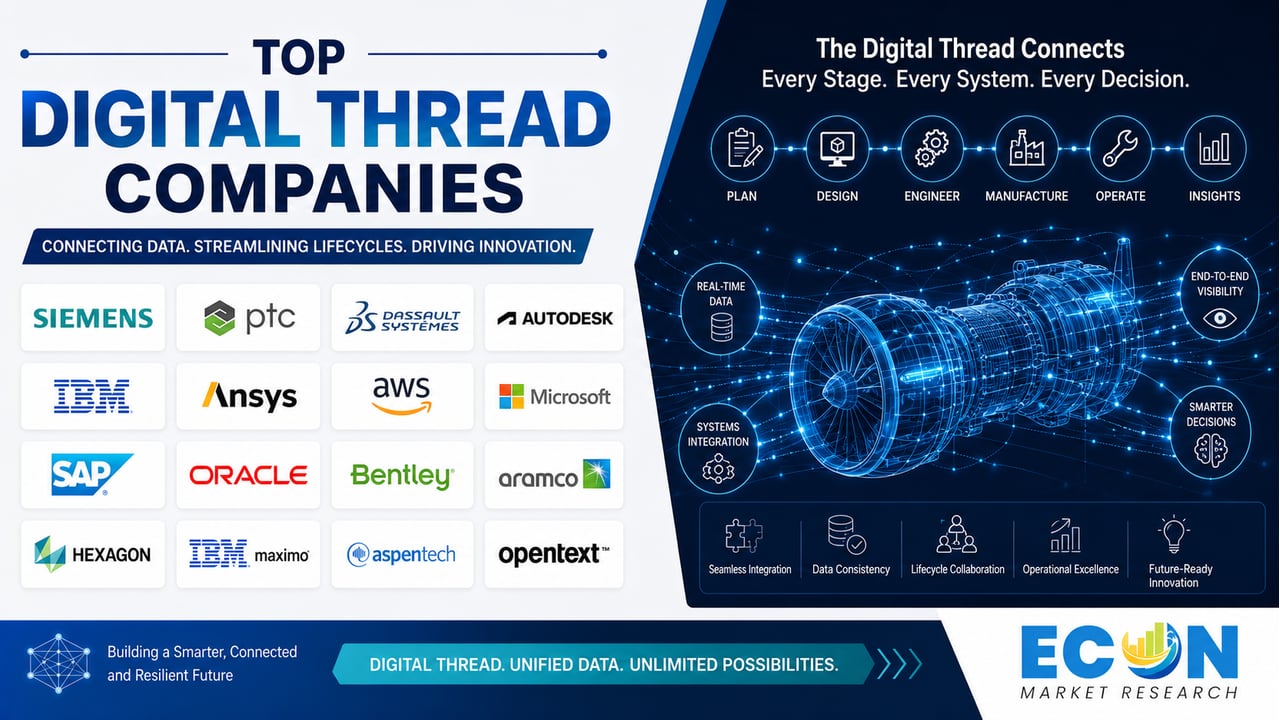
The Top Companies in the Digital Thread Industry now support automotive, aerospace and defense, industrial machinery, electronics, semiconductors, medical devices, pharmaceuticals, energy, shipbuilding, consumer products, and process manufacturing. Digital-thread architectures typically integrate at least 4 major enterprise domains—engineering, manufacturing, quality, and service—while advanced implementations also connect ERP, supply chain, industrial IoT, simulation, and asset-management systems. NIST's 2024 supply-chain roadmap specifically evaluated digital-thread capabilities across 4 strategic sectors: aerospace and defense, energy, agriculture and food, and pharmaceutical, biopharmaceutical, and medical devices. The competitive landscape therefore includes PLM specialists, industrial automation providers, engineering-software vendors, cloud enterprise platforms, simulation companies, and manufacturing-data specialists.
Market Evolution and Growth Drivers
Digital Thread adoption has advanced as manufacturing products have become combinations of mechanical hardware, electronics, embedded software, cloud services, and field data rather than isolated physical assemblies. In 2013, the term gained formal prominence through U.S. digital-engineering work, while the following decade expanded the idea from linking engineering definitions to manufacturing into a lifecycle architecture covering product development, production, operation, maintenance, and end-of-life information. Aras identifies 2013 as an important starting point for the modern Digital Thread concept, while NIST continues developing standards, protocols, and interoperability methods to improve information continuity among heterogeneous manufacturing systems.
Regulation, sustainability, AI, and automation are now accelerating the next stage. The European Union adopted Regulation (EU) 2024/1781 in 2024, establishing the Digital Product Passport framework, and the EU's DPP Registry went live on 20 July 2026. Product-specific implementation planning covers iron and steel in 2026, textiles, tyres, and aluminium in 2027, furniture in 2028, and ICT products in 2029. These requirements increase the value of product genealogy, material traceability, configuration control, and lifecycle records. At the same time, manufacturers are incorporating generative AI and intelligent agents into PLM, engineering, and automation software, making a governed Digital Thread increasingly important because AI systems require accurate contextual product data rather than disconnected documents.
2. Top 5 Latest Trends in the Digital Thread Industry
AI-Enabled Digital Threads and Engineering Agents
Digital Thread and Digital Twin Convergence
Model-Based Systems Engineering and Configuration Traceability
Cloud PLM, MES, and Enterprise Data Integration
Digital Product Passports and Lifecycle Compliance
Trend 1: AI-Enabled Digital Threads and Engineering Agents
Artificial intelligence is turning the Digital Thread from a passive information backbone into an active engineering environment. By 2026, Rockwell Automation's FactoryTalk Design Studio included AI plan-and-build agents that can interpret specifications, I/O lists, standards documents, and existing project files, while Autodesk was expanding APIs and Model Context Protocol capabilities so AI agents could interact with engineering software and connected lifecycle data. Siemens was similarly combining simulation, industrial AI, automation, and Digital Thread technologies across its Xcelerator portfolio. For the Top Companies in the Digital Thread Industry, this trend makes data structure strategically important: an AI agent can only generate reliable engineering actions when requirements, revisions, configurations, production information, and approval states remain connected and contextually accurate.
Trend 2: Digital Thread and Digital Twin Convergence
Digital twins increasingly depend on Digital Threads for lifecycle context. A Digital Thread records how an asset was specified, designed, simulated, manufactured, modified, and serviced, while the twin applies that information to a virtual representation of the operating product or process. By 2026, Dassault Systèmes supported virtual-twin workflows across a customer base exceeding 390,000 enterprises, while Synopsys' Ansys portfolio connected materials, simulation, model-based systems engineering, and data-management assets through its simulation Digital Thread. Hexagon also combines real-world metrology feedback with simulation, analytics, and AI so digital representations can be updated using physical measurements. This convergence creates closed-loop engineering in which field and factory data can inform the next design revision rather than remaining isolated after production.
Trend 3: Model-Based Systems Engineering and Configuration Traceability
Model-Based Systems Engineering is expanding the Digital Thread beyond CAD and PLM into requirements, software, electronics, functional architectures, verification, validation, and simulation. Synopsys' Ansys Connect links systems architecture models to engineering analyses and provides access to more than 250,000 advanced materials records, while PTC has concentrated its portfolio around CAD, PLM, ALM, and service lifecycle management following portfolio changes completed during fiscal 2025. This matters for aircraft, vehicles, industrial equipment, medical devices, and semiconductor-enabled systems because a single product can contain thousands of hardware and software dependencies. Configuration-controlled Digital Threads allow engineering teams to understand which requirement, simulation, component, software release, manufacturing instruction, and test result applies to a particular product version rather than relying on disconnected files.
Trend 4: Cloud PLM, MES, and Enterprise Data Integration
Cloud platforms are reducing the technical separation among engineering, manufacturing, supply chain, and enterprise systems. Autodesk's 2026 roadmap specifically emphasized strengthening a Digital Thread across disciplines, roles, and lifecycle stages, while SAP's Integrated Product Development platform supports closed-loop processes from design to operation and consumption. Oracle Fusion Cloud PLM similarly connects engineering, supply chain, manufacturing, quality, and partners through a unified product record. This trend became more commercially important as companies moved from departmental cloud applications toward end-to-end lifecycle architectures. The World Economic Forum's manufacturing network reached 189 Lighthouse sites by 2025, providing evidence that advanced manufacturers increasingly treat connected data, automation, analytics, and operational systems as enterprise capabilities rather than isolated digital projects.
Trend 5: Digital Product Passports and Lifecycle Compliance
Digital Product Passports are creating a regulatory reason to extend Digital Threads into materials, sustainability, repairability, recycling, and supply-chain records. Regulation (EU) 2024/1781 established the DPP as a digital identity mechanism for products, components, and materials, while the European Commission activated its Digital Product Passport Registry in July 2026. The planned product sequence extends across multiple industrial categories through 2029, creating requirements for structured information that may need to survive years of design changes, production batches, supplier substitutions, servicing, and end-of-life processing. Digital Thread technology providers that already manage configuration, BOMs, quality records, supplier information, and product genealogy are therefore positioned to help manufacturers turn compliance data into an integrated lifecycle process rather than a separate documentation exercise.
3. Top 10 Companies in the Digital Thread Industry
The following companies are not presented as a strict numerical ranking. These 10 organizations were selected based on direct Digital Thread capabilities, PLM and lifecycle technologies, manufacturing connectivity, engineering integration, digital twins, data traceability, enterprise software, and continuing product development.
1. Siemens AG
Company Overview: Siemens' Digital Industries Software organization has a workforce exceeding 24,000 people, supports more than 170,000 customers, operates in 38 countries, and maintains 260 locations. Headquarters: Siemens AG is headquartered through its principal corporate locations in Munich and Berlin, Germany. Core Digital Thread Expertise: Siemens combines product engineering, PLM, simulation, manufacturing planning, MES, industrial IoT, automation, and industrial AI. Major Products and Services: Teamcenter forms a lifecycle-data backbone, while Designcenter, Simcenter, Opcenter, Plant Simulation, Insights Hub, and other Xcelerator technologies extend continuity into design, simulation, manufacturing, and operation. In July 2026, MULTIVAC selected Teamcenter as its Digital Thread backbone, while HD Hyundai's U.S. shipbuilding initiative connected at least 6 Siemens technology areas into an integrated engineering-to-production architecture.
2. PTC Inc.
Company Overview: PTC is headquartered in Boston, Massachusetts, employs more than 7,000 people, and supports over 30,000 customers globally. Its history includes the introduction of internet-based PLM technology in 1998, giving the company more than 25 years of experience in web-connected lifecycle management. Headquarters: Boston, United States. Core Digital Thread Expertise: PTC focuses on CAD, PLM, application lifecycle management, systems engineering, service lifecycle management, and configuration control. Major Products and Services: Windchill provides the PLM foundation for Digital Thread implementations, while Creo, Codebeamer, ServiceMax-related lifecycle capabilities, and Servigistics connect engineering and service domains. PTC describes the Digital Thread as connecting people, processes, and data from concept through service, with PLM providing governance and traceability across product information.
3. Dassault Systèmes
Company Overview: Dassault Systèmes employs 25,000 people, supports more than 390,000 enterprise customers, operates 188 sites, and has active customers in 155 countries. Headquarters: Vélizy-Villacoublay, France, where its global headquarters operates across a 6-building campus covering 7 acres. Core Digital Thread Expertise: The company connects product design, simulation, manufacturing, quality, collaboration, and virtual twins using a shared data model. Major Products and Services: The 3DEXPERIENCE platform integrates CATIA, DELMIA, SIMULIA, ENOVIA, and related applications. Dassault describes digital manufacturing as an end-to-end shared data environment connecting engineering, production, inventory, scheduling, quality, and performance information. Joby Aviation uses 3DEXPERIENCE as a single Digital Thread across development, manufacturing, and certification of its electric aircraft.
4. Rockwell Automation
Company Overview: Rockwell Automation employed approximately 26,000 people serving customers in more than 100 countries at fiscal year-end 2025. Headquarters: Milwaukee, Wisconsin, United States. Core Digital Thread Expertise: Rockwell connects industrial automation with MES, production data, cloud manufacturing, quality management, digital twins, and enterprise lifecycle workflows. Major Products and Services: FactoryTalk, Plex, FactoryTalk ProductionCentre, FactoryTalk Design Studio, and FactoryTalk Orchestration address engineering and production stages of the Digital Thread. FactoryTalk Orchestration launched in June 2026 to coordinate material flow and production processes end-to-end, while Rockwell's medical-device Digital Thread architecture directly connects PLM and MES for lifecycle traceability, manufacturing visibility, and compliance.
5. SAP SE
Company Overview: SAP has more than 110,000 employees representing over 157 countries and maintains more than 100 development locations worldwide. Headquarters: Walldorf, Germany. Core Digital Thread Expertise: SAP connects PLM with ERP, supply chain, procurement, manufacturing, logistics, quality, sustainability, and service processes, giving it a strong position at the enterprise-process layer of the Digital Thread. Major Products and Services: SAP Integrated Product Development, SAP S/4HANA, SAP Digital Manufacturing, PLM system integration, and Business AI support connected lifecycle workflows. SAP Digital Manufacturing uses S88 and S95 production models, while its PLM integration architecture converts engineering data into downstream manufacturing and enterprise processes. In 2026, SAP also expanded AI-assisted approaches for evaluating product changes and governed lifecycle decisions.
6. Hexagon AB
Company Overview: Hexagon had approximately 24,500 employees in 50 countries at the end of 2025, while its broader location network includes more than 300 offices. Headquarters: Stockholm, Sweden. Core Digital Thread Expertise: Hexagon connects engineering design, production, metrology, inspection, reality capture, digital twins, and real-world manufacturing feedback. Major Products and Services: Nexus and Hexagon's Manufacturing Intelligence technologies connect design and engineering information with production and quality data. Its Digital Factory service has supported a track record of 70,000 projects covering 1.2 billion square metres, with 900 specialists including more than 500 laser-scanning experts. This physical-data capability differentiates Hexagon because the Digital Thread can incorporate measured as-built and as-manufactured conditions rather than only design intent.
7. Autodesk, Inc.
Company Overview: Autodesk was founded in 1982 and employed approximately 14,300 people worldwide as of 31 January 2026. Headquarters: San Francisco, California, United States. Core Digital Thread Expertise: Autodesk connects CAD, CAM, CAE, PCB design, PDM, PLM, manufacturing, supplier collaboration, and product-data management through cloud platforms. Major Products and Services: Fusion, Fusion Manage, Vault, and associated manufacturing applications support lifecycle continuity from design through production. Autodesk's 2026 Fusion roadmap explicitly prioritizes strengthening the Digital Thread across disciplines and lifecycle stages. Vault 2027.1 further expands its connector with Fusion Manage so engineering teams can create workflow records, add affected items, review status, and complete lifecycle actions without leaving their engineering data environment.
8. Aras Corporation
Company Overview: Aras was founded in 2000 and reported more than 700 employees with offices in over 6 countries in its 2024 corporate disclosure, giving the company a 25-year operating history by 2025. Headquarters: Andover, Massachusetts, United States. Core Digital Thread Expertise: Aras specializes in adaptable PLM, multidomain traceability, configuration management, requirements, product records, quality, and service information. Major Products and Services: Aras Innovator maintains relationships among product assets and revisions from concept through manufacturing, quality, maintenance, and disposition. Its Digital Thread architecture supports bidirectional traceability rather than merely storing documents in one repository. Customer implementations include shipbuilding, automotive electronics, energy equipment, and regulated products, while Aras' 2026 positioning emphasizes an AI-ready, model-based, multilayer Digital Thread architecture.
9. Oracle Corporation
Company Overview: Oracle's world headquarters is in Austin, Texas, while its current cloud infrastructure spans more than 200 data centres across its multicloud and Oracle Cloud environments. Headquarters: Austin, United States. Core Digital Thread Expertise: Oracle integrates PLM, ERP, manufacturing, supply chain, quality, IoT, analytics, and field-service information through a common enterprise cloud architecture. Major Products and Services: Oracle Fusion Cloud Product Lifecycle Management establishes a unified product record linking engineering, manufacturing, quality, supply chain, and partners. Its Connected Digital Innovation architecture tracks lifecycle information from initial concepts through release, field use, and service. By 2026, Oracle was also embedding AI agents and AI-assisted risk, quality, and compliance capabilities directly into Fusion workflows, extending the Digital Thread from information sharing toward automated lifecycle decision support.
10. Synopsys, Inc.
Company Overview: Synopsys now employs roughly 28,000 people after broadening from semiconductor EDA into engineering solutions spanning silicon to physical systems. Headquarters: Sunnyvale, California, United States. Core Digital Thread Expertise: Through its Ansys portfolio, Synopsys connects simulation, materials intelligence, model-based systems engineering, optimization, process automation, and engineering-data management. Major Products and Services: Ansys Connect creates a simulation Digital Thread, ModelCenter links system architectures with analytical models, and Minerva provides enterprise simulation process and data management with CAD, CAE, and PLM interoperability. Ansys Connect can provide access to more than 250,000 advanced materials records, while the 2026 R1 release added Connected Materials capabilities designed to improve continuity between materials data and engineering simulation.
4. Regional Outlook
North America
North America combines major Digital Thread software suppliers with aerospace, defense, automotive, medical-device, semiconductor, and industrial manufacturing users. NIST began its Digital Thread for Smart Manufacturing project in 2013 and continues to develop standards and interoperability methods for product-definition and manufacturing information. A 2024 U.S. manufacturing roadmap mapped Digital Thread requirements across 4 strategically important supply chains: aerospace and defense, energy, agriculture and food, and pharmaceuticals, biopharmaceuticals, and medical devices. The United States is also home to PTC, Rockwell Automation, Autodesk, Aras, Oracle, and Synopsys, placing a substantial share of the global Digital Thread software ecosystem close to large engineering customers.
Canada's manufacturing adoption is visible in sectors such as shipbuilding, where Seaspan uses Aras technology as part of its modernization strategy across 3 facilities serving Canadian naval and coast-guard programs. Mexico's opportunity is closely linked to manufacturing networks spanning automotive, electronics, industrial machinery, and North American supply chains, where configuration and production data must move between engineering headquarters, component suppliers, and assembly sites. Across the region, the central challenge is brownfield integration: manufacturers may have decades of PLM, ERP, MES, CAD, quality, and automation data created by different vendors. NIST's continuing interoperability work reflects why standards remain essential even after more than 10 years of formal Digital Thread development.
Europe
Europe is becoming one of the most regulation-driven Digital Thread regions. The European Union contains 27 member states, and Regulation (EU) 2024/1781 created the legal foundation for Digital Product Passports in 2024. The European Commission activated the DPP Registry on 20 July 2026, turning product traceability from a future concept into operating digital infrastructure. Implementation planning includes iron and steel in 2026, textiles, tyres, and aluminium in 2027, furniture in 2028, and ICT products in 2029. Manufacturers selling these products will increasingly need structured records linking design, materials, suppliers, sustainability attributes, production data, and product identity across lifecycle stages.
Europe also contains several major Digital Thread technology providers: Siemens in Germany, SAP in Germany, Dassault Systèmes in France, and Hexagon in Sweden. Dassault alone operates 188 sites and serves active customers in 155 countries, while Hexagon employs approximately 24,500 people across 50 countries. Germany remains especially important for connected engineering and manufacturing, while France has a strong aerospace and virtual-twin ecosystem; Nordic countries contribute PLM, metrology, industrial software, and sustainable-manufacturing technologies. European manufacturers therefore face a dual requirement: increase industrial data continuity for productivity while simultaneously preparing Digital Threads to support regulatory evidence, product identity, sustainability information, cybersecurity, and circular-economy obligations.
Asia-Pacific
Asia-Pacific provides the largest physical manufacturing base for many products that can benefit from Digital Thread technologies. China reported more than 30,000 basic-level smart factories by February 2025, alongside 1,200 advanced-level factories and 230 excellence-level smart factories. Earlier national programs had already developed 421 demonstration factories and more than 10,000 provincial-level digital workshops and smart factories. These facilities increasingly depend on industrial software, connected production data, quality systems, automation, and product lifecycle integration. Japan's Connected Industries program similarly promotes data connectivity across manufacturing, while South Korea, Taiwan, and Singapore maintain advanced automotive, electronics, shipbuilding, semiconductor, and precision-engineering ecosystems where traceable engineering-to-production information is strategically important.
India and Southeast Asia create a different opportunity because new manufacturing capacity can implement connected processes without carrying the same level of legacy-system complexity found in 30-year-old Western plants. India's electronics strategy is increasingly oriented toward creating a complete domestic ecosystem covering design, manufacturing, packaging, and high-technology devices, while its technology-startup ecosystem contains more than 30,000 companies. SAP has also been expanding its engineering workforce in Vietnam, where its development hub is planned to reach 500 employees by 2027. For Global Digital Thread companies, Asia-Pacific therefore combines mature high-automation markets such as Japan and South Korea with rapidly digitizing manufacturing environments in India, Southeast Asia, and China.
Middle East & Africa
The Middle East is connecting Digital Thread opportunities with national industrial-diversification strategies. Saudi Arabia operated 40 industrial cities and more than 12,000 factories at the end of 2024, with a national objective of reaching 36,000 factories by 2035. Its Fourth Industrial Revolution program specifically aims to transform 4,000 factories from labor-intensive operations toward smart production, automation, and advanced industrial solutions. This creates opportunities for connected product definitions, manufacturing records, quality genealogy, maintenance information, and industrial data platforms. Energy, chemicals, metals, pharmaceuticals, defense, food processing, and emerging advanced-manufacturing sectors provide the strongest potential applications.
The UAE's Industry 4.0 program provides another measurable framework. Its initial roadmap targeted a 30% improvement in industrial productivity, development of 100 Industry 4.0 Lighthouse organizations by 2031, attraction or establishment of 500 technology companies, and assessment of 200 manufacturers for transformation. The Champions 4.0 Network began with 12 industrial and technology organizations representing automation, industrial software, energy, telecommunications, and manufacturing. In Africa, South Africa has the region's strongest diversified industrial base across automotive, mining equipment, food processing, chemicals, metals, and engineering. Wider adoption remains constrained by digital-skills availability, infrastructure consistency, integration expertise, and the cost of modernizing legacy equipment, creating demand for scalable cloud and modular Digital Thread solutions rather than large single-stage transformations.
5. Future Opportunities in the Digital Thread Industry
Future opportunities for the Top Companies in the Digital Thread Industry will increasingly center on creating trusted machine-readable context for artificial intelligence. Engineering AI agents operating in 2026 can already interpret requirements, assist control-system design, evaluate product changes, and interact with connected product data. The next opportunity is to give these systems governed access to requirements, CAD geometry, simulations, product structures, manufacturing records, quality data, supplier changes, and service histories through a unified lifecycle graph. With the Global Lighthouse Network reaching 189 advanced sites across more than 30 countries by 2025, the industrial sector already has a substantial base of digitally mature operations from which closed-loop AI workflows can expand.
Compliance and sustainability will create another major opportunity through 2029 and beyond. The EU Digital Product Passport framework requires manufacturers to prepare increasingly structured lifecycle information for regulated product categories, while the DPP Registry became operational in July 2026. Digital Thread platforms can connect sustainability attributes with engineering changes, material specifications, supplier records, production batches, repair history, and end-of-life information instead of creating a separate compliance database. Small and medium manufacturers also represent an important expansion path because NIST specifically identifies increasingly capable industrial-data standards as a way to make integrated smart manufacturing more accessible to SMEs. Cloud PLM, configurable integration, modular MES, open APIs, and subscription-based engineering environments can lower the technical threshold for adopting lifecycle connectivity.
Partnerships among software ecosystems will also shape the next stage. SAP and Siemens have already worked to connect enterprise and engineering information, while Digital Thread platforms increasingly expose APIs and open integration models rather than requiring a single-vendor software stack. Autodesk's 2026 roadmap prioritizes reducing file-based handoffs, Synopsys connects multiple CAD and CAE environments through Ansys Minerva, and Aras emphasizes a multilayer architecture that preserves relationships among information stored in heterogeneous systems. The strongest future architectures are therefore likely to resemble connected data networks rather than one monolithic database, with interoperability, identity, semantic context, cybersecurity, and lifecycle governance determining whether information remains usable for 10, 20, or 30 years.
6. Conclusion
The Digital Thread industry has progressed from a manufacturing-data concept formalized during the 2010s into an enterprise architecture linking product definition, engineering, simulation, manufacturing, quality, supply chain, operation, and service. NIST's Digital Thread research dates to 2013, while the Global Lighthouse Network expanded from 16 sites to 189 within 6 years, showing how quickly digitally integrated industrial operations have moved from isolated pilots toward repeatable manufacturing models. The 5 major trends—AI-enabled Digital Threads, digital-twin integration, model-based systems engineering, cloud lifecycle integration, and Digital Product Passports—are reinforcing the importance of traceability and contextual data across every stage of a physical product's life.
The 10 Top Companies in the Digital Thread Industry—Siemens, PTC, Dassault Systèmes, Rockwell Automation, SAP, Hexagon, Autodesk, Aras, Oracle, and Synopsys—approach this challenge from different layers of the industrial technology stack. Siemens Digital Industries Software alone supports more than 170,000 customers, Dassault Systèmes serves over 390,000 enterprise customers, SAP employs more than 110,000 people, and Hexagon operates across 50 countries. Their competitive positions depend increasingly on how effectively they can connect heterogeneous engineering and operational environments rather than simply adding another standalone application.
Regional opportunities will remain distinct through the rest of the decade. China already reports more than 30,000 basic-level smart factories, Saudi Arabia targets 36,000 factories by 2035, and the European Union has activated Digital Product Passport infrastructure with product-specific requirements extending through 2029. These developments show that the future Digital Thread will need to serve productivity, automation, AI, sustainability, regulatory compliance, and supply-chain resilience simultaneously. Companies that maintain trustworthy product context across decades of engineering revisions, manufacturing events, software updates, field service, and material changes will define the next phase of connected industrial operations.