


Top Companies in the Data Center Networking Industry and Their Key Capabilities
The top data center networking companies are profiled by core capabilities, major products, technology focus, regional presence, and global industry impact.
Introduction
Overview of the Global Data Center Networking Industry
The global data center networking industry forms the communication foundation connecting servers, storage systems, accelerators, security appliances, cloud platforms, and external networks. At the end of 2025, operators managed 1,360 hyperscale data centers worldwide, and hyperscale facilities accounted for 48% of global data center capacity. Enterprise on-premises facilities retained 32% of installed capacity, while colocation infrastructure represented the remaining portion. These environments increasingly use leaf-spine architectures, Ethernet switching, optical interconnects, network interface cards, data processing units, routing systems, telemetry platforms, and automated fabric-management software. Major end users include cloud service providers, telecommunications operators, financial institutions, healthcare organizations, government agencies, universities, manufacturers, retailers, and artificial intelligence developers.
The technical profile of data center networking has shifted from conventional 10 GbE and 40 GbE connections toward 100 GbE, 400 GbE, 800 GbE, and emerging 1.6 TbE systems. The IEEE 802.3df-2024 standard, published on March 15, 2024, introduced specifications supporting 400 Gb/s and 800 Gb/s Ethernet operation. Commercial switch platforms now provide 51.2 Tbps of throughput through configurations such as 64 ports of 800G, while newer silicon supports 102.4 Tbps and 64 ports of 1.6T connectivity. This transition reflects the bandwidth requirements of distributed databases, cloud-native applications, high-performance computing, and GPU clusters in which thousands of processors must exchange data with predictable latency.
Networking efficiency has also become an energy-management issue. Global data center electricity consumption is projected to reach 945 TWh in 2030 and 1,200 TWh in 2035, increasing pressure on operators to reduce switch power, transceiver power, cooling loads, and data movement overhead. Network architecture affects processor utilization because congestion, packet loss, or underperforming interconnects can leave expensive computing resources idle. Consequently, Top Companies in the Data Center Networking Industry are competing across switching silicon, optics, congestion control, network automation, telemetry, security, and multi-site connectivity rather than concentrating exclusively on port density.
Market Evolution and Growth Drivers
Data center networking evolved from hierarchical 3-tier designs toward flatter leaf-spine fabrics as east-west traffic became dominant. Virtualization, container platforms, distributed storage, and microservices increased the number of machine-to-machine connections inside facilities, while artificial intelligence introduced synchronized traffic patterns involving hundreds or thousands of accelerators. A 51.2 Tbps switch can support 128 ports of 400 GbE or 64 ports of 800 GbE, enabling operators to increase fabric capacity without multiplying the number of switching layers. Modern platforms also use Ethernet VPN, Virtual Extensible LAN, Border Gateway Protocol, RDMA over Converged Ethernet, adaptive routing, priority flow control, and explicit congestion notification to maintain performance under intensive workloads.
Standardization and open software are accelerating adoption. The Ultra Ethernet Consortium released Specification 1.0 on June 11, 2025, followed by version 1.0.3 in July 2026, establishing an interoperable Ethernet communication stack for artificial intelligence and high-performance computing. The Software for Open Networking in the Cloud project provides a Linux-based network operating environment supported by switch manufacturers, semiconductor suppliers, cloud operators, and system integrators. These initiatives give customers alternatives to vertically integrated networking systems and support disaggregated combinations of switching hardware, network operating systems, optics, and automation tools.
Artificial intelligence remains a central adoption driver because network performance determines how efficiently accelerators complete training and inference tasks. NVIDIA states that its Spectrum-X architecture improves AI networking performance by 1.6 times compared with conventional Ethernet and can scale to 128,000 GPUs within a 2-tier topology. At the infrastructure level, operators are also introducing 400 Gb/s data processing units that offload networking, storage, security, and management workloads from host processors. These developments are transforming the network from a passive transport layer into a programmable computing subsystem that manages traffic placement, data movement, isolation, and workload acceleration.
Top 5 Latest Trends in the Data Center Networking Industry
Migration to 800G and 1.6T Ethernet
Purpose-built Ethernet fabrics for artificial intelligence
Co-packaged optics and power-efficient optical connectivity
AI-assisted automation and open network operating systems
Multi-site scale-across networking and high-capacity data center interconnects
Trend 1: Migration to 800G and 1.6T Ethernet
The transition to 800G Ethernet became commercially important after the publication of IEEE 802.3df-2024 and the availability of 51.2 Tbps switching silicon. An operator can configure a single switch with 64 ports of 800G, 128 ports of 400G, or 256 ports of 200G, allowing the same silicon generation to support different leaf, spine, and interconnect roles. Cisco, Arista, NVIDIA, Broadcom, Dell, HPE, Huawei, and Nokia now offer or enable systems operating at 800G speeds. These products are primarily adopted by hyperscale cloud operators, AI infrastructure providers, telecommunications carriers, scientific computing centers, and enterprises building large GPU environments.
The next phase is moving toward 1.6T interfaces and 102.4 Tbps switch capacity. Arista lists a 64-port 1.6T platform with 102.4 Tbps of throughput, while Nokia’s data center switching portfolio supports platforms reaching 460.8 Tbps of system capacity. Higher-speed interfaces reduce the number of physical links required to carry a specified traffic volume, but they also increase signal-integrity, thermal-management, cabling, and optical-design requirements. As a result, the migration is influencing semiconductor design, connector formats, forward-error correction, transceiver testing, liquid-cooled rack layouts, and network troubleshooting practices across the Top Companies in the Data Center Networking Industry.
Trend 2: Purpose-Built Ethernet Fabrics for Artificial Intelligence
Traditional Ethernet was developed for diverse workloads, whereas AI clusters create synchronized data exchanges in which congestion at 1 point can delay thousands of processors. Vendors are therefore adding adaptive routing, packet spraying, dynamic load balancing, lossless transport, advanced telemetry, and workload-aware congestion control. The Ultra Ethernet Consortium’s 1.0 specification established a framework covering application programming interfaces, transport, link behavior, switches, network interface cards, optics, and cables. The organization had advanced to version 1.0.3 by July 2026, demonstrating continued work on interoperability and implementation guidance.
NVIDIA’s Spectrum-X combines Ethernet switches, SuperNICs, software, telemetry, and congestion-management capabilities. The platform reports 1.6-times higher AI network performance than off-the-shelf Ethernet and 95% fabric efficiency in deployments exceeding 100,000 GPUs. Its multiplane design can connect 128,000 GPUs through a 2-tier topology, while rack-scale configurations can link 256 GPUs within 1 rack. Cisco’s Nexus Hyperfabric, HPE Juniper’s QFX systems, Arista’s Etherlink platforms, and Broadcom-based white-box designs illustrate how other participants are developing competing AI-oriented Ethernet architectures.
Trend 3: Co-Packaged Optics and Power-Efficient Optical Connectivity
Optical modules have become a major power and thermal constraint as switch bandwidth advances beyond 51.2 Tbps. Broadcom’s Bailly co-packaged-optics platform integrates 8 optical engines, each providing 6.4 Tbps, with a 51.2 Tbps Ethernet switch. The company reports a 70% reduction in optical-interconnect power compared with conventional pluggable implementations. By positioning optics closer to the switch silicon, co-packaged systems shorten electrical signal paths and reduce the need for high-power electrical interfaces between the application-specific integrated circuit and front-panel modules.
NVIDIA has introduced silicon-photonics platforms supporting 200G-per-lane signaling and Spectrum-X Ethernet Photonics systems with capacity reaching 409.6 Tbps. Ciena expanded its intra-data-center optical capabilities through its 2025 acquisition of Nubis Communications and announced 1600ZR and 1600ZR+ technology based on a 2-nanometer design in March 2026. These developments show that optical technology is moving from long-distance data center interconnection into rack, row, cluster, and campus-scale networks. Product designers must nevertheless address repairability, manufacturing yield, connector reliability, thermal coupling, and operational workflows before co-packaged optics becomes standard across all deployment classes.
Trend 4: AI-Assisted Automation and Open Network Operating Systems
Large facilities can contain thousands of switches and millions of physical or virtual endpoints, making manual configuration unsustainable. Network automation platforms increasingly manage fabric design, provisioning, compliance, telemetry, root-cause analysis, capacity planning, and remediation. Arista’s Extensible Operating System supports environments ranging from 100 to over 100,000 compute and storage nodes, while HPE Juniper’s Apstra Data Center Director provides Day 0 through Day 2 automation for IP and Ethernet VPN fabrics. Huawei’s CloudEngine management environment analyzes over 72 fault types and reports automated fault-location capabilities covering 90% of supported scenarios.
Open operating systems are also changing procurement models. SONiC enables customers to run a common software environment across compatible switches from different manufacturers, reducing dependence on 1 hardware supplier. Vendors differentiate their offerings through application programming interfaces, telemetry databases, digital twins, validation tools, security integrations, and AI assistants rather than through proprietary command-line interfaces alone. Automation is especially valuable for AI clusters because a failed 800G link, incorrect congestion setting, or inconsistent firmware image can affect hundreds of accelerators. Continuous validation and predictive analytics therefore become operational requirements rather than optional management features.
Trend 5: Multi-Site Scale-Across Networking and High-Capacity Interconnects
AI infrastructure is expanding beyond individual buildings because power, land, cooling, and permitting limitations prevent every workload from occupying 1 campus. NVIDIA’s Spectrum-XGS technology is designed to connect AI fabrics across racks, buildings, and campuses, while Ciena develops coherent optical, routing, and automation systems for data center interconnection. This scale-across model requires deterministic performance, encryption, precise timing, traffic engineering, high-capacity optics, and coordinated control across multiple sites. It differs from traditional disaster-recovery networking because distributed accelerator clusters may exchange data continuously rather than only during backup or failover events.
The geographic distribution of hyperscale capacity reinforces this trend. The world contained 1,360 hyperscale facilities at the end of 2025, while 20 metropolitan markets held 62% of hyperscale capacity. Northern Virginia and Greater Beijing together accounted for 20%, demonstrating both concentration and the need for high-capacity regional connections. Multi-site networking allows operators to use power and computing resources across different locations, but latency, optical reach, data-sovereignty rules, failure domains, and operating complexity remain constraints. Vendors capable of combining packet switching, coherent optics, security, telemetry, and orchestration are therefore gaining strategic importance.
Top 10 Companies in the Data Center Networking Industry
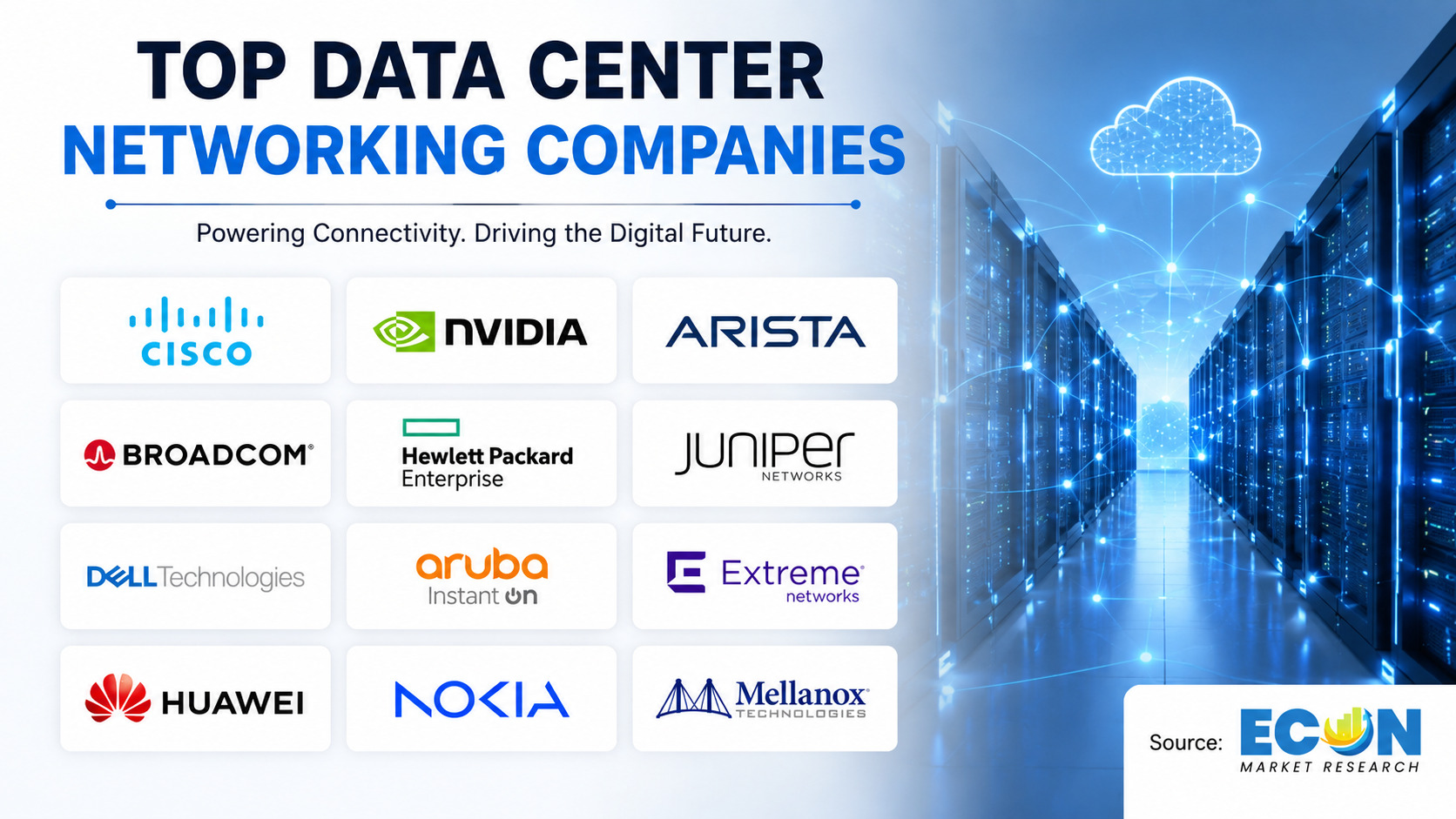
The following companies are not presented as a strict financial or market-share ranking. They were selected according to 6 factors: data center product depth, switching or optical capability, software expertise, geographic availability, technical innovation, and relevance to cloud, enterprise, telecommunications, or AI infrastructure. The list includes semiconductor suppliers, system vendors, network operating-system developers, optical specialists, and integrated infrastructure providers because modern data center networking depends on each of these functions.
1. Cisco Systems, Inc.
Company Overview: Cisco was founded on December 10, 1984, by Len Bosack and Sandy Lerner and shipped its first product in 1986. Headquarters: The company’s corporate headquarters is in San Jose, California, United States. Core Data Center Networking Expertise: Cisco develops switching, routing, security, observability, automation, optical, and cloud-management technologies for enterprise and service-provider environments. Its Nexus architecture supports interfaces from 1G through 800G and is used in leaf-spine, Ethernet VPN, storage, multi-cloud, and AI networks. Major Products and Services: The modular Nexus 9808 can deliver 230.4 Tbps of capacity and as many as 288 line-rate 800G ports. The Nexus 9232E provides 32 ports of 800G in a fixed form factor, while Nexus Hyperfabric combines an 800 GbE backend fabric with NVIDIA accelerators and BlueField-3 infrastructure processing. Cisco also offers Nexus Dashboard, application-centric infrastructure, telemetry, security, support, design, implementation, and lifecycle services.
2. Arista Networks, Inc.
Company Overview: Arista traces its roots to Arastra, established in 2004, and launched its Arista product identity in 2008. The company reports 10,000 cloud customers and 100 million deployed ports. Headquarters: Arista is headquartered in Santa Clara, California, United States. Core Data Center Networking Expertise: Its specialization includes high-speed Ethernet switching, routing, extensible software, telemetry, network detection, automation, and cloud-scale fabric design. The Extensible Operating System uses a consistent software image across multiple hardware families and supports networks ranging from 100 to over 100,000 compute and storage nodes. Major Products and Services: The 7060X6 delivers 51.2 Tbps, 64 ports of 800G, 165 MB of buffering, and latency measured at 700 nanoseconds. Its newer 7060XE7 platform supports 64 ports of 1.6T and 102.4 Tbps. Arista also provides CloudVision, Etherlink AI networking, routing platforms, optical integration, professional services, validation, monitoring, and automation tools.
3. NVIDIA Corporation
Company Overview: NVIDIA was founded on April 5, 1993, by Jensen Huang, Chris Malachowsky, and Curtis Priem. Its technology ecosystem includes 3.8 million developers, 35,000 companies using NVIDIA AI technologies, and 13,000 startups participating in NVIDIA Inception. Headquarters: The company is headquartered in Santa Clara, California, United States, and maintains over 50 offices worldwide. Core Data Center Networking Expertise: NVIDIA integrates GPUs, switches, SuperNICs, data processing units, optics, cables, telemetry, simulation, and software into purpose-built AI fabrics. Major Products and Services: Spectrum-4 switch systems deliver 51.2 Tbps and support 64 ports of 800G, while Spectrum-X reports 1.6-times higher performance than off-the-shelf Ethernet. The multiplane design scales to 128,000 GPUs in a 2-tier fabric. BlueField-3 supplies 400 Gb/s connectivity and accelerates networking, storage, cybersecurity, and management services. NVIDIA also offers Cumulus Linux, SONiC support, NetQ, DOCA, ConnectX adapters, LinkX interconnects, InfiniBand, and silicon-photonics systems.
4. Broadcom Inc.
Company Overview: Broadcom’s corporate lineage spans over 60 years and incorporates technology originating from Hewlett-Packard, Agilent, LSI, Brocade, Broadcom Corporation, and other infrastructure businesses. Headquarters: Broadcom is headquartered in Palo Alto, California, United States. Core Data Center Networking Expertise: The company supplies merchant switching silicon, physical-layer devices, digital signal processors, network interface components, optical engines, storage connectivity, and infrastructure software used by switch manufacturers and cloud operators. Major Products and Services: Tomahawk 5 provides 51.2 Tbps and supports 64 ports of 800G, 128 ports of 400G, or 256 ports of 200G. Broadcom began production shipments in March 2023, 7 months after initial sampling. Its Bailly co-packaged-optics system integrates 8 optical engines delivering 6.4 Tbps each and reports a 70% reduction in optical-interconnect power. In 2026, Broadcom added production-volume 102.4 Tbps switching and a 400G-per-lane optical digital signal processor to its technology roadmap.
5. Hewlett Packard Enterprise Company
Company Overview: Hewlett Packard Enterprise was formed in 2015 when Hewlett-Packard separated into 2 companies. HPE completed its acquisition of Juniper Networks on July 2, 2025, combining HPE Aruba Networking with Juniper’s routing, switching, automation, security, and AI-native management portfolio. Headquarters: HPE is headquartered in Spring, Texas, United States. Core Data Center Networking Expertise: The combined organization addresses enterprise, cloud, service-provider, and AI data center fabrics through switching hardware, routing systems, intent-based automation, observability, security, and infrastructure integration. Major Products and Services: The Juniper QFX5240 supplies 64 ports of 800GbE in a 2U platform and supports RoCEv2, BGP Additional Paths, telemetry, zero-touch provisioning, Terraform, Python, Ansible, and Puppet. Apstra Data Center Director manages fabric design and closed-loop assurance from Day 0 through Day 2. HPE also offers Aruba CX switching, Mist AI operations, data center services, financing, support, deployment, training, and integrated compute-storage-networking solutions.
6. Huawei Technologies Co., Ltd.
Company Overview: Huawei was founded in 1987 and reports 208,000 employees serving operations across over 170 countries and regions. Headquarters: The company is headquartered in Shenzhen, China. Core Data Center Networking Expertise: Huawei develops Ethernet switches, routers, optical systems, network controllers, automation software, telemetry, AI-assisted operations, and integrated cloud infrastructure. Its CloudEngine portfolio addresses enterprise, carrier, financial, government, and cloud-provider networks. Major Products and Services: Huawei introduced the CloudEngine 16800 in January 2019 with a 48-port 400GE line card and capacity for 768 ports of 400GE in a fully configured chassis. Product configurations provide switching capacities of 45 Tbps, 89 Tbps, and 178 Tbps, depending on the chassis model. Its management environment analyzes over 72 fault categories and reports automated fault location for 90% of supported incidents. Huawei also supplies iMaster NCE, 800GE systems, data center interconnects, optical modules, security, implementation, maintenance, and lifecycle-management services.
7. Nokia Corporation
Company Overview: Nokia’s history began in 1865, giving the company over 160 years of industrial and communications experience. Its research organization includes Bell Labs, whose scientists have received 10 Nobel Prizes. Headquarters: Nokia is headquartered in Espoo, Finland. Core Data Center Networking Expertise: The company develops routing silicon, Ethernet switching, optical transport, network operating systems, automation, security, and data center interconnection technologies for cloud operators, telecommunications carriers, enterprises, and sovereign infrastructure programs. Major Products and Services: Nokia’s data center platforms support 10G, 25G, 100G, 200G, 400G, 800G, and 1.6T interfaces, with system capacity reaching 460.8 Tbps. Its SR Linux operating system uses an open architecture, while Event-Driven Automation supports intent-based operations and continuous validation. Nokia expanded its optical capabilities through the completion of its Infinera acquisition in 2025 and introduced additional 800G pluggable optics. The portfolio also includes data center gateways, service routers, coherent optics, SONiC options, design services, managed operations, and technical support.
8. Dell Technologies Inc.
Company Overview: Dell Technologies was founded in 1984 and is headquartered in Round Rock, Texas, United States. Headquarters: Its global base remains in Round Rock, supported by product, engineering, sales, and service operations across multiple regions. Core Data Center Networking Expertise: Dell supplies open-networking switches, servers, storage, integrated racks, AI infrastructure, network operating-system options, deployment services, and validated architectures. It was an early commercial supporter of disaggregated networking, allowing customers to select compatible hardware and software independently. Major Products and Services: The PowerSwitch Z9864F-ON provides 51.2 Tbps of switching capacity, processing at 20.3 billion packets per second, 165 MB of buffering, latency below 700 nanoseconds, and 64 ports of 800G. Dell platforms span connectivity from 10G through 800G and support Enterprise SONiC, SmartFabric OS10, third-party software, Ethernet VPN, and AI-fabric configurations. Services include design, installation, validation, support, residency, lifecycle management, and integration with PowerEdge servers and storage platforms.
9. Extreme Networks, Inc.
Company Overview: Extreme Networks was founded in Silicon Valley in 1996 and reports 2,800 employees, 11,000 channel partners, and tens of thousands of customers. Headquarters: Its principal corporate operations are based in Morrisville, North Carolina, United States. Core Data Center Networking Expertise: Extreme develops Ethernet switching, fabric automation, cloud management, network access control, analytics, security, and AI-assisted operations for enterprises, universities, healthcare systems, government organizations, manufacturers, and service providers. Major Products and Services: The Extreme 8730 provides 32 ports of 400G or 128 ports of 100G, 12.8 Tbps of switching capacity, 80 MB of packet buffering, a 24-core processor, and 32 GB of system memory. The 5120 family supports 24-port and 48-port access configurations, 10 GbE connections, 25G or 100G uplinks, and 256-bit MACsec encryption. Extreme also offers Fabric Connect, Cloud IQ, Platform ONE, network assurance, professional services, implementation, education, and support.
10. Ciena Corporation
Company Overview: Ciena was incorporated in November 1992 and introduced its first commercial product on March 28, 1996. That system transported 16 optical channels and 40 Gb/s across a distance of 600 kilometers, establishing the company’s early specialization in high-capacity optical networking. Headquarters: Ciena is headquartered in Hanover, Maryland, United States, with offices across the Americas, Europe, the Middle East, Africa, and Asia-Pacific. Core Data Center Networking Expertise: The company focuses on coherent optics, data center interconnects, packet-optical platforms, routing, automation, network assurance, intra-data-center optics, and multi-layer orchestration. Major Products and Services: In March 2026, Ciena announced 1600ZR and 1600ZR+ technology using a 2-nanometer design, hyper-rail photonic systems, full-spectrum transponders, and a 6.4T optical engine developed through Nubis. Its portfolio includes WaveLogic coherent technology, Navigator Network Control Suite, routing systems, optical line systems, managed services, professional services, maintenance, and network transformation consulting.
Regional Outlook
North America
North America remains a central development and deployment region for data center networking because the United States hosts 14 of the world’s 20 largest hyperscale metropolitan markets. Northern Virginia and Greater Beijing together represent 20% of global hyperscale capacity, with Northern Virginia serving as the primary US concentration. However, geographic expansion is changing the domestic network map. Texas and Midwestern states accounted for 33% of operating US hyperscale capacity at the end of 2025 but represented 53% of the future development pipeline. This shift creates demand for long-distance optical links, regional data center interconnects, distributed cloud routing, and scale-across AI fabrics.
Electricity availability is a defining US constraint. Data centers consumed 176 TWh in 2023, representing 4.4% of national electricity use, and could require 325–580 TWh in 2028. Networking suppliers are responding through higher-radix switches, power-efficient silicon, co-packaged optics, improved telemetry, and congestion control that increases accelerator utilization. The region also benefits from the headquarters, research operations, or major engineering facilities of Cisco, Arista, NVIDIA, Broadcom, Dell, HPE, Extreme Networks, and Ciena. This concentration supports semiconductor development, software engineering, optical research, system validation, partner integration, and direct access to hyperscale customers.
Canada’s federal infrastructure includes 4 enterprise data centers designed to meet LEED Silver or equivalent environmental standards, while its cloud-first policy prioritizes public cloud services for information classified as Protected B or below. The Canadian market emphasizes government modernization, data residency, telecommunications, financial services, research computing, and interconnection between Toronto, Montreal, Vancouver, and US hubs. Mexico is developing a broader cloud and colocation ecosystem, including a proposed 6-facility project in Querétaro covering 52 hectares and designed with waterless cooling. The project is associated with 7,200 construction positions and 900 permanent jobs, illustrating Mexico’s potential as a nearshore infrastructure location.
Europe
European data center networking is shaped by cloud adoption, energy reporting, data protection, sovereignty, and environmental policy. In 2023, 45.2% of European Union enterprises used cloud services; adoption reached 77.6% among large enterprises, 59% among medium-sized organizations, and 41.7% among small businesses. The EU’s Digital Decade targets call for 75% of enterprises to use cloud, big-data, or AI technologies and for the deployment of 10,000 climate-neutral, secure edge nodes by 2030. Registered edge nodes increased from 498 in 2022 to 1,836 in 2024, creating requirements for compact switching, remote automation, security, and regional interconnection.
Regulation directly affects network and facility design. Data centers with installed IT power demand of at least 500 kW are subject to EU reporting requirements covering energy performance and sustainability indicators. The European Commission also expects data centers to become climate-neutral and highly energy-efficient by 2030, while its 2026 Cloud and AI Development Act framework aims to expand European capacity by 2035. Network suppliers must therefore provide measurable power consumption, telemetry, lifecycle data, secure management, and architectures that support workload movement between facilities with different energy and cooling profiles.
Germany, France, Italy, Spain, the Netherlands, Ireland, the United Kingdom, and Nordic countries perform different roles in the regional ecosystem. Frankfurt, London, Amsterdam, Paris, and Dublin serve as major interconnection centers, while Nordic markets use lower ambient temperatures and expanding renewable-power systems to attract compute-intensive workloads. The European AI infrastructure program includes 19 AI Factories and 13 antenna sites, with facilities distributed across countries including Germany, France, Italy, Spain, Finland, Sweden, and other member states. Europe nevertheless faces permitting delays, electricity-grid constraints, shortages of advanced ICT professionals, and fragmented national requirements. ICT specialists represented 5% of employment in 2026, compared with a Digital Decade objective of 10%, making workforce development a strategic networking priority.
Asia-Pacific
Asia-Pacific combines hyperscale deployment, semiconductor manufacturing, optical-component production, cloud adoption, and government-led computing programs. China established 8 national computing hubs and 10 data center clusters under its east-data-west-computing initiative. At launch, the program incorporated plans associated with 5 million standard racks and 130 exaflops of computing capability. By August 2022, the designated hubs had initiated over 60 projects representing 1.1 million standard racks. These developments create demand for high-capacity switches, optical transport, network controllers, congestion management, and long-distance interconnects between eastern demand centers and western energy regions.
India’s installed data center capacity increased from 375 MW in 2020 to over 1,500 MW in 2025. Mumbai accounted for 790 MW, followed by Chennai with 305 MW, Bengaluru with 182 MW, Hyderabad with 152 MW, Delhi with 76 MW, and other locations with 15 MW. As of June 2025, India had 130 private data centers and 49 government facilities, while the IndiaAI infrastructure program had approved access to 38,231 graphics processing units through 14 service providers. Four submarine cable systems were being commissioned and 3 additional systems were planned, strengthening the case for high-capacity gateways, regional interconnection, AI fabrics, and domestic network manufacturing.
Japan established its Watt-Bit Collaboration Council in March 2025 to coordinate electricity and telecommunications planning for data centers, addressing the need to align computing locations with grid capacity. Singapore’s Green Data Centre Roadmap provides at least 300 MW of additional near-term capacity and links subsequent growth to access to green energy. South Korea and Taiwan contribute advanced semiconductor, memory, substrate, server, and optical-component capabilities, while Australia supports cloud regions, mining analytics, government services, and regional connectivity. Southeast Asian markets are gaining relevance as operators diversify outside established hubs, but power availability, water use, grid carbon intensity, cross-border data regulation, and technical skills vary substantially between countries.
Middle East & Africa
The Middle East is developing cloud, sovereign data, artificial intelligence, government-platform, and smart-city infrastructure through national transformation programs. The United Arab Emirates operates FEDnet, which provides cloud infrastructure, virtual data centers, disaster recovery, private connectivity, hosted communications, and government-to-government network access. The country’s Go Digital initiative was designed to convert 50% of government service centers into digital platforms within 2 years. These programs create requirements for secure data center fabrics, redundant interconnection, identity-aware access, encryption, telemetry, and regional cloud connectivity.
Qatar’s Internet Exchange Point, established in 2020, reached 19 active participants by May 2025. The country subsequently approved the expansion of the Azure Qatar Data Center through 2 additions providing 4 MW and 6 MW of capacity. A national cloud partnership was serving 56 government entities by May 2025, while a separate national data strategy included 21 initiatives and 128 projects over 3 years. These developments support Qatar’s Digital Agenda 2030 and create opportunities for Ethernet switching, optical links, route servers, cloud gateways, automation, security, and sovereign workload management.
South Africa has the continent’s most developed concentration of large commercial data centers, including a 12 MW facility opened by NTT in Johannesburg. The country licensed over 300 MHz of high-demand spectrum in 2022, supporting wider 4G and 5G deployment and increased traffic into cloud and edge facilities. South Africa also connects to international systems including Equiano, 2Africa, WACS, and Seacom, giving Johannesburg and Cape Town important regional interconnection roles. Power reliability, grid carbon intensity, skills availability, and connectivity costs remain operating challenges despite the country’s infrastructure depth.
Interconnection maturity differs across the rest of Africa. In July 2026, Kenya had 5 active Internet exchange points with 170 members, while 89% of its 215 active networks could exchange traffic through an IXP. Nigeria had 5 active exchanges, 149 members, 18 operating data centers, and IXP access covering 97% of 227 active networks. Egypt had 3 active exchanges with 37 members and IXP coverage reaching 96% of 72 active networks. These figures indicate opportunities for edge switching, route security, local content caching, optical backbones, carrier-neutral interconnection, and modular facilities, but import dependence, limited power availability, regulatory fragmentation, and shortages of certified network engineers continue to constrain expansion.
Future Opportunities in the Data Center Networking Industry
The strongest product opportunity is the transition from 800G to 1.6T and subsequently higher-capacity fabrics. Systems already supporting 102.4 Tbps and 64 ports of 1.6T demonstrate the technical direction, while photonic platforms reaching 409.6 Tbps indicate how optics may support later generations. Development priorities will include 200G-per-lane signaling, improved digital signal processing, lower-loss packaging, co-packaged optics, liquid-cooled switch trays, repairable optical assemblies, and automated link qualification. Verified product roadmaps support these technical targets, but adoption timing will vary according to transceiver availability, power budgets, equipment cost, workload scale, and customer replacement cycles.
Artificial intelligence creates opportunities in traffic engineering, failure prediction, network digital twins, automated root-cause analysis, and workload-aware orchestration. A fabric connecting 128,000 GPUs cannot depend on engineers manually inspecting every interface or congestion event. Future platforms will continuously compare intended and actual network states, predict capacity shortages, recommend topology changes, isolate defective links, and coordinate network behavior with computing schedulers. Data processing units operating at 400 Gb/s can also move security, storage, and infrastructure services away from host CPUs, creating programmable service layers within every server. Vendors that combine hardware telemetry, reliable data models, explainable automation, and controlled remediation will hold an operational advantage.
Open and interoperable networking provides another opportunity. Ultra Ethernet Specification 1.0.3, SONiC, Ethernet VPN, RoCEv2, open telemetry, and standardized 800G interfaces allow enterprises and cloud providers to combine technology from multiple suppliers. This model can benefit small and medium-sized operators that lack the scale to develop proprietary network hardware or software. Partnerships among semiconductor companies, switch manufacturers, optics suppliers, cable producers, automation vendors, integrators, and cloud providers will become increasingly important because no single product category can deliver a complete AI fabric. Interoperability laboratories, certification programs, validated architectures, and subscription-based operations services can reduce deployment risk for customers with limited internal networking expertise.
Geographic opportunities will follow power, connectivity, and regulatory availability. Texas and the US Midwest account for 53% of the American hyperscale development pipeline, Europe plans 10,000 climate-neutral secure edge nodes by 2030, Singapore has allocated at least 300 MW of additional capacity, and India is working from a 2025 base above 1,500 MW. These developments will require metro switching, regional optical networks, secure gateways, edge automation, and multi-site workload orchestration. In Africa and parts of the Middle East, the immediate opportunity is often local interconnection rather than hyperscale switching: Nigeria’s 18 operating data centers and Kenya’s 5 active exchanges show how local hosting and peering can build the traffic base required for subsequent cloud and AI deployments.
Sustainability and regulatory compliance will influence every future opportunity. Data center electricity consumption is projected to reach 945 TWh by 2030, while European facilities above 500 kW already face sustainability-reporting requirements. Network vendors can respond with telemetry that measures power by port and workload, energy-aware routing, fewer switching layers, lower-power optics, reusable hardware, extended software support, and lifecycle reporting. Analytical expectations should not be treated as guaranteed outcomes, but the verified combination of higher bandwidth demand and stricter energy oversight indicates that customers will increasingly evaluate networking products according to throughput per watt, operational lifespan, cooling compatibility, and measurable utilization rather than maximum throughput alone.
Conclusion
The data center networking industry has entered a period in which network design directly affects computing productivity. The world operated 1,360 hyperscale data centers at the end of 2025, while 400G, 800G, and emerging 1.6T systems were redefining fabric capacity. The 5 central trends—higher-speed Ethernet, AI-specific fabrics, co-packaged optics, intelligent automation, and multi-site interconnection—are interconnected. Higher port speeds require improved optics; larger AI clusters require better congestion control; distributed facilities require coherent interconnection; and infrastructure containing thousands of devices requires automated operations.
The 10 selected companies contribute different capabilities. Cisco, Arista, HPE, Huawei, Dell, and Extreme provide switching systems and management platforms; NVIDIA integrates networking with accelerated computing; Broadcom supplies foundational switching and optical silicon; Nokia combines data center switching with routing and automation; and Ciena specializes in optical interconnection. Their platforms range from 12.8 Tbps enterprise systems to 460.8 Tbps modular architectures, demonstrating that the competitive field covers multiple customer classes rather than 1 uniform deployment model.
Regional conditions will continue to shape adoption. North America combines hyperscale concentration with rising power constraints, Europe links capacity expansion to 2030 sustainability objectives, Asia-Pacific integrates infrastructure deployment with manufacturing ecosystems, and the Middle East and Africa emphasize sovereign cloud, government digitization, peering, and local hosting. The strongest future opportunities involve 1.6T interfaces, photonic integration, AI-assisted operations, open Ethernet, secure scale-across fabrics, and energy-aware design. Consequently, the Top Companies in the Data Center Networking Industry will be distinguished by their ability to deliver measurable performance, interoperability, operational reliability, security, automation, and power efficiency across increasingly distributed computing environments.