


Industrial AI Companies Transforming Smart Manufacturing
The industrial AI industry is advancing through agentic AI, digital twins, predictive maintenance, physical AI, edge intelligence, and autonomous robotics.
Introduction
Overview of the Global Industrial AI Industry
The global industrial AI industry has moved from isolated predictive-maintenance pilots into production environments spanning manufacturing, energy, chemicals, automotive, semiconductors, logistics, mining and infrastructure. Rockwell Automation’s 2026 study of 1,560 manufacturing decision-makers across 17 countries found that 59% already use smart-manufacturing technologies and 34% of industrial operations are AI-augmented. The World Economic Forum’s Global Lighthouse Network had expanded to 238 advanced manufacturing and supply-chain sites by June 2026, supported by a library of over 1,200 proven Fourth Industrial Revolution use cases. Analytical AI and machine learning represented 62% of Lighthouse solutions recorded for 2025, while generative AI accounted for 23%.
The physical infrastructure available for industrial AI is also expanding. A total of 4,664,000 industrial robots were operating worldwide in 2024, following 542,000 new installations during that year. Asia accounted for 74% of new robot deployments, Europe held 16% and the Americas represented 9%. Industrial AI now combines machine vision, sensor analytics, digital twins, generative copilots, autonomous mobile robots, physics simulation and AI-supported production scheduling. Unlike enterprise AI applications that can tolerate delayed responses, industrial deployments frequently interact with physical equipment where reliability, latency, deterministic control and worker safety are operational requirements. This distinction has created a competitive field involving automation manufacturers, semiconductor providers, cloud companies and specialist industrial software vendors.
Market Evolution and Growth Drivers
Industrial AI developed from statistical process control, machine condition monitoring and rule-based automation into systems capable of interpreting unstructured data and recommending operational actions. Predictive maintenance dominated early industrial machine-learning applications, but the technology mix has broadened substantially by 2026. Rockwell Automation reports that more than one-third of manufacturing operations are already AI-augmented and expects that share to reach 54% by 2030 based on its surveyed manufacturers. Siemens introduced 9 industrial copilots at CES 2026, while PTC released 12 AI agents, 10 integrations and over 100 portfolio enhancements in June 2026. The progression illustrates a transition from algorithms attached to individual machines toward AI embedded throughout engineering, production and service workflows.
Growth is being driven by operational complexity, workforce constraints, cybersecurity exposure and the need to extract more value from factory data. In Rockwell Automation’s 2026 Asia-Pacific survey, 95% of manufacturers considered digital transformation essential to competitiveness and 71% planned to increase AI and machine-learning use during the next 12 months. At the same time, only 22% reported fully integrated manufacturing execution systems, demonstrating the data-integration gap that industrial AI platforms must address. The World Economic Forum’s 238 Lighthouse sites show that scaled transformation can combine AI with robotics, cloud systems and connected equipment, while regulations such as the European AI Act are increasing requirements for transparency, governance and risk management as intelligent systems move closer to production decisions.
Top 5 Latest Trends in the Industrial AI Industry
Agentic AI and industrial copilots
AI-powered digital twins and physics simulation
Predictive maintenance and closed-loop process optimization
Physical AI and autonomous industrial robotics
Edge AI and IT-OT convergence
Trend 1: Agentic AI and Industrial Copilots
Industrial copilots are developing into agents that can interpret engineering data, generate automation code, diagnose production problems and coordinate multi-step tasks. Siemens announced 9 industrial copilots in January 2026 after its earlier Siemens Industrial Copilot deployment had reached over 100 customers and made generative AI capabilities available to more than 120,000 engineers. Schneider Electric reported in April 2026 that its industrial copilot, developed with Microsoft Azure AI, reduced engineering time by up to 50% for control-configuration and documentation tasks, turning some production changes that previously required weeks into work completed within hours. PTC’s June 2026 portfolio expansion added 12 AI agents across product-development and lifecycle workflows. These systems are shifting industrial AI from information retrieval toward task execution under defined engineering controls.
Trend 2: AI-Powered Digital Twins and Physics Simulation
Digital twins are becoming more computationally powerful as AI replaces parts of traditional simulation with physics-informed surrogate models. Foxconn uses NVIDIA Omniverse technologies to build virtual replicas of manufacturing facilities and reported thermal computational-fluid-dynamics simulations running up to 150 times faster through NVIDIA PhysicsNeMo than conventional workflows. The company uses these virtual factories to validate layouts, simulate robots and duplicate production-line configurations across international sites before physical installation. Siemens introduced Digital Twin Composer in 2026, while Dassault Systèmes and NVIDIA announced a shared industrial AI architecture on February 3, 2026 for science-validated virtual worlds and engineering models. Digital twins therefore increasingly function as continuously updated operational environments rather than static 3D design representations.
Trend 3: Predictive Maintenance and Closed-Loop Process Optimization
Predictive maintenance remains a high-value industrial AI application, but current systems increasingly combine failure prediction with process recommendations and operator action. C3 AI reports manufacturing implementations delivering 20%–50% reductions in downtime and 1%–2% increases in production yield. One electric-utility deployment integrated 10 years of information from 12 data sources to monitor 10,000 transformers and 22,000 circuit breakers; the resulting models reduced transformer failures by 48% and achieved 98% accuracy in detecting future failure events. Honeywell Forge similarly combines production monitoring with generative AI assistance for troubleshooting and KPI investigation. The commercial shift is from identifying that an asset may fail toward determining the likely cause, recommended intervention and impact on production schedules.
Trend 4: Physical AI and Autonomous Industrial Robotics
Physical AI enables robots and autonomous machines to perceive their surroundings, interpret instructions and adapt to changing environments instead of executing only pre-programmed movements. The global industrial robot fleet reached 4,664,000 operational units in 2024, providing a substantial hardware base for intelligent software. ABB and NVIDIA expanded their physical-AI collaboration in 2026 to address the simulation-to-real-world transition, with ABB describing future autonomous versatile robots capable of learning and adapting in real time. ABB Robotics already provides articulated systems with payload ranges extending from 1.5 kilograms to 800 kilograms across different product classes. Physical AI is especially important for variable picking, inspection, logistics and small-batch manufacturing where conventional fixed automation requires frequent manual reprogramming.
Trend 5: Edge AI and IT-OT Convergence
Industrial AI is increasingly moving closer to machines because factories cannot always depend on distant cloud infrastructure for low-latency decisions. Microsoft’s intelligent-factory architecture combines Azure IoT Operations, Azure Arc, Azure Local, AI Foundry and Microsoft Fabric to connect programmable logic controllers, sensors, manufacturing systems and enterprise data. Honeywell Technologies reported 32,000 connected customers, 324,000 connected sites and 6.4 million connected assets through its industrial ecosystem as of March 2026. Edge deployment allows machine-vision inspection, anomaly detection and worker assistance to continue near production equipment while selected workloads synchronize with cloud systems. The trend also increases cybersecurity requirements because AI workloads must operate across historically separated information-technology and operational-technology networks.
Top 10 Companies in the Industrial AI Industry
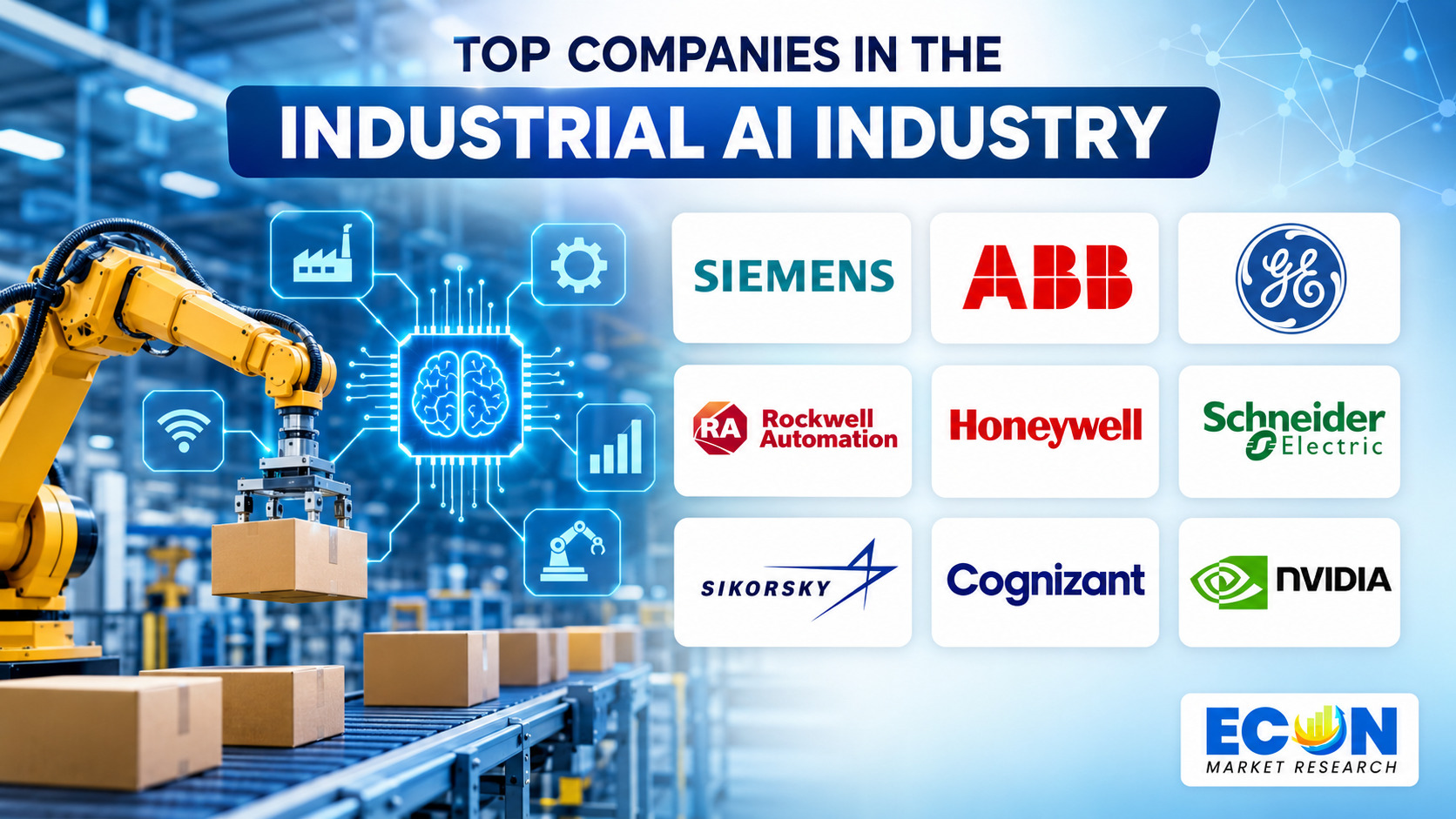
The following 10 companies are presented based on industrial AI product depth, automation expertise, deployment scale, digital-twin capabilities, robotics, AI infrastructure and relevance to production environments. The sequence is not a strict ranking.
1. Siemens
Company Overview: Siemens traces its history to 1847 and employed 318,000 people across more than 190 countries as of fiscal 2025. Headquarters: Munich, Germany. Core Industrial AI Expertise: Siemens combines automation hardware, industrial software, engineering data, digital twins, edge computing and generative AI across manufacturing and infrastructure. Major Products and Services: Its portfolio includes Siemens Xcelerator, Industrial Edge, Industrial Copilot and Digital Twin Composer. At CES 2026, Siemens introduced 9 industrial copilots covering the value chain from engineering through operations and expanded its NVIDIA partnership to develop an Industrial AI Operating System. Earlier Siemens-Microsoft deployments provided Industrial Copilot access to more than 120,000 engineers, demonstrating commercial deployment beyond laboratory experimentation.
2. Schneider Electric
Company Overview: Schneider Electric operates with 160,000 employees and an ecosystem of more than 1 million partners in over 100 countries. Headquarters: Rueil-Malmaison, France. Core Industrial AI Expertise: The company integrates industrial automation, energy intelligence, edge computing, software-defined control and AI into factories, process plants and infrastructure. Major Products and Services: EcoStruxure Automation Expert provides a software-defined industrial control environment, while the company’s Microsoft-powered industrial copilot supports automation engineering. Field deployments reported in April 2026 showed engineering-time savings reaching 50%. Schneider Electric also launched agentic manufacturing capabilities that coordinate specialized AI agents across design, simulation, commissioning and operational workflows, linking AI recommendations to traceable industrial automation logic.
3. ABB
Company Overview: ABB has a history extending beyond 140 years and maintains approximately 110,000 employees, with over 160 manufacturing sites documented for 2025. Headquarters: Zurich, Switzerland. Core Industrial AI Expertise: ABB combines electrification, process automation, robotics, machine vision, predictive analytics and autonomous mobile systems. Major Products and Services: The company reports more than 300 developers dedicated to machine learning and AI, while 55% of its R&D workforce focuses on digital, AI and software activities. ABB Robotics operates through over 100 locations in roughly 53 countries and provides RobotStudio, OptiFact, AI-enhanced robotic vision and autonomous mobile robots. Its 2026 physical-AI partnership with NVIDIA focuses on reducing the gap between virtual simulation and reliable robot performance in factories.
4. Rockwell Automation
Company Overview: Rockwell Automation employed approximately 26,000 people serving customers in more than 100 countries at the end of fiscal 2025. Headquarters: Milwaukee, Wisconsin, United States. Core Industrial AI Expertise: The company specializes in industrial control, manufacturing execution, production analytics, autonomous operations and IT-OT integration. Major Products and Services: Its portfolio includes Allen-Bradley controls, FactoryTalk software and the Plex Smart Manufacturing Platform. Rockwell describes industrial AI as a foundation for the transition from automation to autonomy, where production systems can adapt to changing conditions rather than only execute predefined logic. Its 2026 global study of 1,560 manufacturers found that 34% of operations were already AI-augmented, giving the company extensive benchmarking data for industrial transformation strategies.
5. Honeywell Technologies
Company Overview: Honeywell Technologies became an independent pure-play automation company on June 29, 2026 following the separation of Honeywell Aerospace. Headquarters: Charlotte, North Carolina, United States. Core Industrial AI Expertise: The company focuses on building automation, process automation, industrial control, autonomous operations and industrial software. Major Products and Services: Honeywell Forge connects more than 32,000 customers, 324,000 sites and 6.4 million assets. The company maintains over 25,000 patents and employs more than 7,000 domain-focused engineers. Forge Production Intelligence incorporates a generative AI assistant that allows plant engineers and managers to investigate KPI deviations, equipment relationships and production problems through natural-language interaction. The 2026 corporate restructuring concentrates Honeywell Technologies directly on industrial autonomy rather than aerospace operations.
6. NVIDIA
Company Overview: NVIDIA was founded in 1993 and has expanded from accelerated graphics into AI infrastructure, robotics and industrial simulation. Headquarters: Santa Clara, California, United States. Core Industrial AI Expertise: NVIDIA supplies GPU computing, digital-twin libraries, robotics simulation, machine vision and physical-AI software used by manufacturers and industrial software providers. Major Products and Services: Omniverse, Isaac, Metropolis, PhysicsNeMo and cuOpt support factory simulation, autonomous robots, inspection and optimization. Foxconn has used NVIDIA PhysicsNeMo to accelerate selected thermal simulations by 150 times, while NVIDIA’s March 2026 industrial program included deployments or collaborations involving FANUC, Honda, Mercedes-Benz, Samsung, SK hynix and TSMC. NVIDIA therefore provides the computational layer underneath industrial AI applications rather than conventional PLC-based factory control.
7. Microsoft
Company Overview: Microsoft was founded in 1975 and has developed a dedicated manufacturing technology stack spanning cloud, edge, data and AI. Headquarters: Redmond, Washington, United States. Core Industrial AI Expertise: Microsoft connects enterprise information systems with factory operational data through Azure, Fabric, AI Foundry and Copilot technologies. Major Products and Services: Microsoft Cloud for Manufacturing includes Factory Operations Agent, Factory Safety Agent and manufacturing data solutions within Fabric. Its Siemens collaboration had deployed Industrial Copilot technology to over 100 customers by 2024 and made the system accessible to more than 120,000 engineers. Microsoft’s 2026 industrial strategy extends from copilots toward agents capable of monitoring production KPIs, assisting root-cause analysis and coordinating tasks across cloud and factory-edge environments.
8. PTC
Company Overview: PTC has operated for nearly 40 years in product-development and manufacturing software and marked 40 years of innovation in its 2025 impact reporting. Headquarters: Boston, Massachusetts, United States. Core Industrial AI Expertise: PTC connects engineering, product lifecycle management, industrial IoT, augmented reality and service information into digital threads used by manufacturers. Major Products and Services: Its portfolio includes Creo, Windchill, ThingWorx and ServiceMax. In June 2026, PTC introduced the Jetstream AI platform alongside 12 AI agents, 10 integrations and over 100 product enhancements. The company’s industrial IoT tools support real-time monitoring, bottleneck analysis, predictive maintenance and energy optimization, giving manufacturers an AI layer that can use product and equipment information across engineering, manufacturing and service stages.
9. Dassault Systèmes
Company Overview: Dassault Systèmes was founded in 1981 and has spent more than 4 decades developing 3D engineering, simulation and virtual-environment technologies. Headquarters: Vélizy-Villacoublay, France. Core Industrial AI Expertise: The company specializes in virtual twins, simulation, product engineering, scientific modeling and industrial lifecycle platforms. Major Products and Services: Its 3DEXPERIENCE platform integrates design, manufacturing planning and simulation data, while a strategic partnership announced with NVIDIA on February 3, 2026 aims to establish an industrial AI architecture combining Virtual Twins with accelerated computing and science-validated world models. The approach allows engineers to train AI systems within physically grounded virtual environments before applying recommendations to factories, equipment or materials development.
10. C3 AI
Company Overview: C3 AI was founded in 2009 and maintains its headquarters in Redwood City, California, with offices across North America, Europe, Mexico and India. Headquarters: Redwood City, California, United States. Core Industrial AI Expertise: The company develops enterprise AI applications for predictive maintenance, process optimization, demand planning, inventory management and supply-network risk. Major Products and Services: C3 AI Reliability predicts equipment failures, while Process Optimization combines AI with physics-based models for near-real-time recommendations. The company reports manufacturing deployments delivering 20%–50% reductions in downtime and 1%–2% yield improvements. C3 AI applications can typically be configured for manufacturing use cases within 1–2 quarters, while selected maintenance products are designed for production deployment within 12–24 weeks.
Regional Outlook
North America
North America combines advanced AI infrastructure with a substantial industrial automation base. The Americas installed 50,100 industrial robots during 2024, with the United States accounting for 34,200 units and 68% of regional installations. The United States maintained an operational fleet of 393,700 industrial robots, creating a broad installed base for AI-enhanced machine vision, maintenance and robot control. NIST strengthened the research environment in December 2025 by establishing 2 centers focused on AI in manufacturing and critical infrastructure and published a dedicated AI and machine-learning roadmap for smart manufacturing in July 2026. U.S. suppliers including Rockwell Automation, Microsoft, NVIDIA and C3 AI provide complementary control, cloud, simulation and enterprise-AI technologies.
Canada and Mexico present different adoption patterns. Canada installed 3,800 industrial robots in 2024, with automotive applications representing 47% of installations, while Mexico installed 5,600 robots and its automotive industry accounted for 63% of demand. A Mexican manufacturing study released by the Ministry of Economy in June 2026 associated AI adoption with an 18.8% production increase and 5.4% higher wages within analyzed establishments, although national adoption remained at an early stage. Canada’s National Research Council maintains advanced-manufacturing facilities supporting AI, robotics, digital modeling and manufacturing-cell virtualization. North America’s central challenges are integrating legacy equipment, protecting OT networks and ensuring that AI-generated recommendations remain safe in high-speed production environments.
Europe
Europe installed 85,000 industrial robots in 2024, of which 67,800 were deployed inside European Union member states. Germany installed 26,982 robots, Italy 8,783, Spain 5,100 and France 4,900, demonstrating the scale of the region’s existing automation base. The continent also hosts Siemens, Schneider Electric, ABB, PTC operations and Dassault Systèmes, giving European manufacturers access to automation, virtual twins and industrial software. The Global Lighthouse Network includes manufacturing sites across Germany, France, Switzerland and other European markets that use AI for quality, maintenance, energy management and production scheduling. European industrial AI adoption therefore builds on decades of robotics and engineering-software deployment rather than starting with standalone generative AI projects.
Regulatory compliance has become an additional design requirement. The EU AI Act entered into force in 2024, and major transparency provisions became applicable on August 2, 2026 across the bloc’s 27 member states. Industrial companies must determine whether particular AI applications fall within regulated risk categories and maintain appropriate documentation, human oversight and lifecycle controls. European manufacturers also face sustainability requirements that encourage AI-based energy optimization and resource efficiency. The latest Global Lighthouse data show that advanced factories are increasingly integrating technology with sustainability instead of treating the 2 programs separately. For industrial AI vendors, Europe offers substantial demand but requires products that can demonstrate security, explainability and traceable behavior alongside production performance.
Asia-Pacific
Asia-Pacific is the largest industrial-robot deployment region, accounting for 74% of global installations in 2024. China alone installed 295,000 industrial robots, representing 54% of worldwide deployment, while Chinese robot manufacturers captured 57% of their domestic market. Regional AI implementation is also accelerating: Rockwell Automation’s 2026 survey found that 95% of Asia-Pacific manufacturers considered digital transformation essential and 71% planned to increase AI and machine-learning use during the following 12 months. Japan, South Korea, Taiwan and Singapore add strong semiconductor, robotics and electronics ecosystems, while India ranked sixth globally for annual robot installations in the 2025 World Robotics dataset.
China has also built extensive industrial connectivity infrastructure for edge AI. By early 2026, its 5G-factory initiative had supported over 23,000 industrial private 5G networks, published 1,260 recognized 5G-factory projects and selected 100 representative applications. The program specifically encourages integration between 5G industrial networks and artificial intelligence. New Global Lighthouse sites announced in June 2026 included facilities in China, India and Singapore, with some factories deploying 30–50 advanced digital and AI use cases. Asia-Pacific’s principal advantage is the combination of manufacturing scale, electronics supply chains and automation deployment. Challenges include fragmented national data rules, cybersecurity requirements and the difficulty of standardizing industrial AI across factories operating with different generations of machinery.
Middle East & Africa
Middle Eastern industrial AI adoption is concentrated in energy, petrochemicals, utilities, logistics and advanced manufacturing. The 6 Gulf Cooperation Council countries are investing in industrial digitalization, with the United Arab Emirates establishing the Industrial Technology Transformation Index in February 2023. The current ITTI certification framework reports 57 trained assessors drawn from 20 local and international entities, and the UAE’s Transform 4.0 initiative is designed to support 100 high-potential manufacturers during a 3–5 year transformation period. Schneider Electric, Siemens, ABB and Honeywell Technologies all operate industrial automation ecosystems relevant to Gulf process industries, where AI can optimize energy consumption, predictive maintenance and asset performance.
African adoption remains more concentrated in mining, automotive, food processing, utilities and large industrial groups, with South Africa providing one of the continent’s stronger automation bases. Technology deployment is constrained by skills shortages, older equipment, inconsistent connectivity and limited local availability of advanced industrial computing in several markets. The UAE’s ITTI program has already trained participants from Egypt and Rwanda as part of its international certification activity, demonstrating regional knowledge transfer beyond the Gulf. Industrial AI opportunities in Africa are likely to prioritize high-impact applications requiring limited infrastructure, including machine-vision quality inspection, energy optimization and predictive maintenance. Platforms that can operate at the edge and support existing equipment may be more practical than factory-wide replacements during the first stage of adoption.
Future Opportunities in the Industrial AI Industry
Future opportunities for the Top Companies in the Industrial AI Industry will increasingly involve closed-loop autonomy rather than standalone analytics. Current systems already allow AI to detect anomalies, recommend production adjustments and generate automation code, but the next stage is controlled execution under engineering constraints. Rockwell Automation’s survey indicates that AI-augmented operations could increase from 34% in 2026 to 54% by 2030 based on manufacturer expectations. Schneider Electric is already coordinating specialized AI agents across industrial engineering tasks, while Siemens and NVIDIA are building an Industrial AI Operating System intended to connect design, engineering, manufacturing and supply chains. The opportunity is to make AI actions auditable enough for production environments where incorrect decisions can stop machinery or create safety risks.
Physics-informed AI and digital twins provide another major opportunity because manufacturers need faster ways to optimize equipment before changing physical processes. Foxconn’s 150-fold acceleration of selected thermal simulations demonstrates what surrogate physics models can achieve when trained on conventional engineering calculations. Industrial software partnerships announced in 2026 connect NVIDIA technologies with Siemens, Dassault Systèmes, PTC, Cadence and Synopsys, creating a pathway for AI agents to perform design exploration, simulation and verification. Digital twins could eventually allow thousands of production scenarios to be evaluated before one configuration is deployed. The strongest systems will combine AI speed with engineering constraints so a statistically attractive answer is rejected when it violates physics, material limits or machine-safety requirements.
Industrial AI will also expand through edge computing, smaller manufacturers and human-machine collaboration. The World Economic Forum’s Lighthouse Network now contains 238 sites and over 1,200 documented transformation use cases, providing reusable operating patterns for companies that cannot build industrial AI programs from scratch. AI-assisted workers can retrieve maintenance procedures, investigate alarms and generate work instructions without becoming data scientists. At the same time, 4,664,000 operational industrial robots provide a growing installed base for machine vision and adaptive control. Opportunities through 2030 will therefore involve workforce training, interoperable industrial data models, cybersecurity, lower-compute edge inference and solutions that can be deployed on existing production assets instead of requiring completely new factories.
Conclusion
The industrial AI industry has reached a stage where measurable deployment is replacing pilot-heavy experimentation. A 2026 survey shows that 59% of manufacturers are using smart-manufacturing technologies and 34% of operations are AI-augmented, while the World Economic Forum tracks 238 Lighthouse sites demonstrating scaled digital transformation. The 5 defining trends—agentic industrial copilots, AI-powered digital twins, predictive optimization, physical AI and edge intelligence—are connecting engineering software with production assets. Siemens, Schneider Electric, ABB, Rockwell Automation, Honeywell Technologies, NVIDIA, Microsoft, PTC, Dassault Systèmes and C3 AI contribute different capabilities across automation, accelerated computing, industrial software, robotics and enterprise AI.
Regional conditions remain distinct: Asia accounted for 74% of new industrial-robot installations in 2024, Europe deployed 85,000 robots and the Americas installed 50,100. China added 295,000 units, while the United States installed 34,200. The strongest future opportunities for the Top Companies in the Industrial AI Industry will come from moving intelligence closer to physical operations without sacrificing reliability or human oversight. Competitive advantage will depend on trusted industrial data, interoperable IT-OT infrastructure, physics-aware models, cybersecurity and workers capable of supervising AI-supported systems. Industrial AI is therefore evolving into an operating layer for factories and infrastructure rather than remaining a collection of isolated machine-learning applications.