


Top Companies in the CXL Memory Industry and Their Key Capabilities
The top companies in the CXL memory industry are profiled by core technologies, major products, competitive strengths, market trends, and future opportunities.
Introduction
Overview of the Global CXL Memory Industry
The global Compute Express Link memory industry has moved from specification development into early commercial deployment across artificial intelligence servers, cloud infrastructure, high-performance computing, databases, telecommunications, and scientific research. CXL provides a cache-coherent connection among processors, accelerators, and memory devices through the PCI Express physical layer. The current CXL Integrators List displays 63 qualified entries and includes filters covering 60 Type 3 devices, 37 memory expanders, 12 host platforms, and 15 intellectual-property implementations. Commercial products now span 96 GB, 128 GB, 256 GB, and 512 GB memory modules, while controller platforms can address 2 TB or higher capacities. Adoption remains concentrated in data centers because servers require compatible processors, firmware, operating systems, controllers, and memory-management software before organizations can use CXL expansion, tiering, pooling, or sharing at production scale.
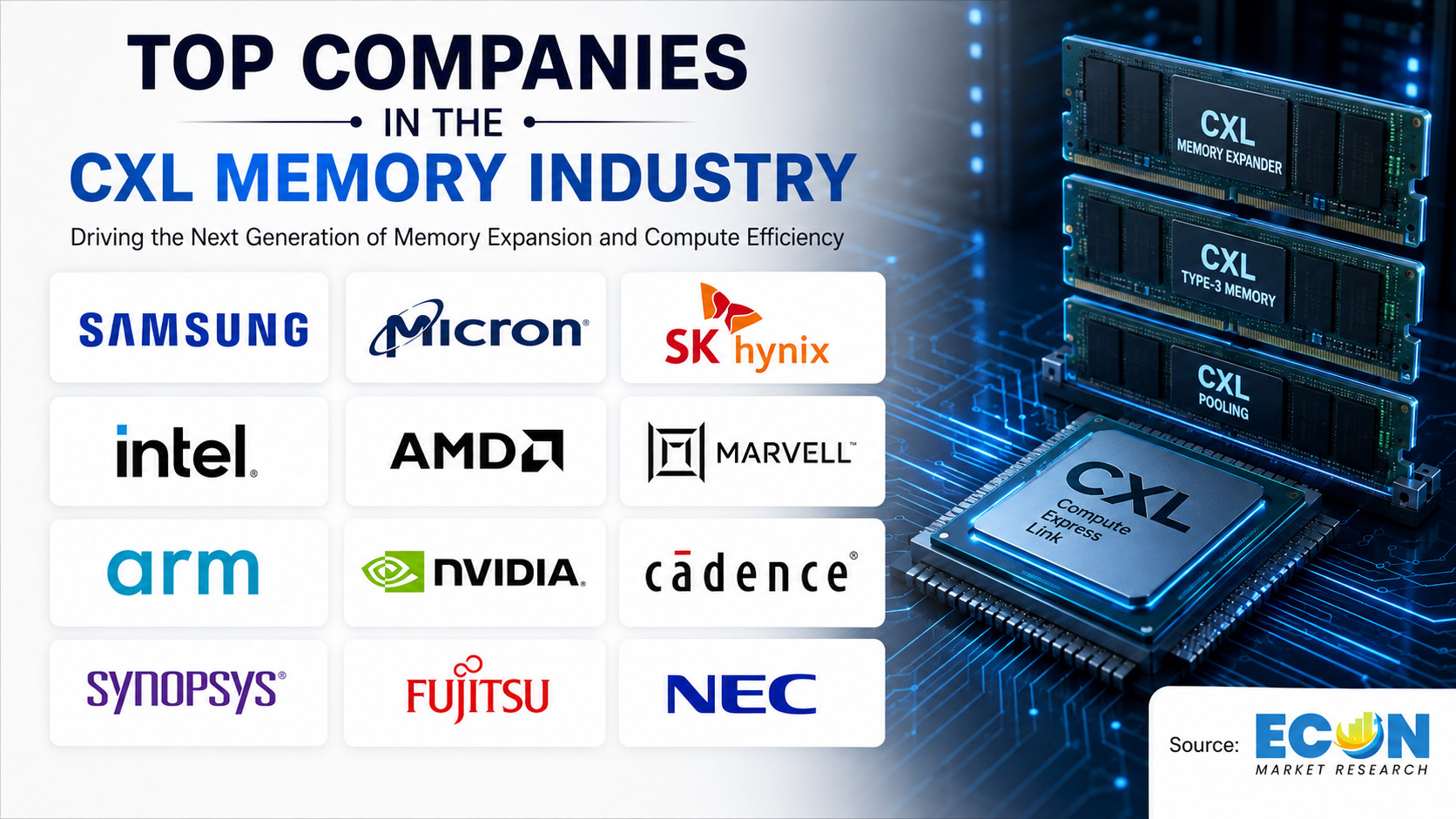
CXL memory is progressing through multiple maturity levels rather than following a single product category. Type 3 modules expand system memory, memory controllers connect DDR4 or DDR5 media to CXL links, fabric switches enable pooled capacity, and software platforms move application pages between local DRAM and attached memory. CXL 2.0 products represent the principal commercial foundation in 2026, while CXL 3.1 and 3.2 introduce stronger fabric, management, security, and memory-device capabilities. CXL 4.0, released in November 2025, raises the signaling rate from 64 GT/s to 128 GT/s and adds bundled ports, enhanced memory reliability features, native x2 links, and support for as many as 4 retimers. These generations create a competitive structure involving processor vendors, DRAM manufacturers, controller designers, switch suppliers, intellectual-property companies, server builders, and memory-software developers.
Market Evolution and Growth Drivers
The CXL ecosystem began in 2019 with 9 founding organizations and expanded to more than 125 participating companies by September 2020, reflecting demand for an open alternative to proprietary processor-to-device interconnects. CXL 1.1 established coherent accelerator and memory connectivity, CXL 2.0 introduced switching and pooling, CXL 3.1 arrived in 2023 with fabric and memory-device enhancements, and CXL 3.2 followed in December 2024 with improved manageability, security, and trusted-device capabilities. The transition is being driven by servers that cannot satisfy every AI, analytics, and in-memory database workload through fixed motherboard DIMM slots. Technical analysis presented through the consortium indicates that a server architecture combining 8–12 DDR5 channels with 4 CXL ports can increase available memory capacity and bandwidth by more than 50%, depending on the configuration.
Artificial intelligence is accelerating this evolution because parameter storage, retrieval-augmented generation, vector databases, key-value caches, and checkpointing can consume hundreds of gigabytes per server. Processor support has also widened: Intel platforms from the 4th Generation Xeon family onward incorporate CXL capabilities, while AMD EPYC processors provide CXL connectivity through PCIe 5.0 lanes. Memory manufacturers have progressed from engineering samples to customer validation, operating-system certification, and interoperability demonstrations. Software development kits from Samsung and SK hynix, together with products from MemVerge, reduce adoption barriers by presenting local DRAM and CXL-attached capacity as manageable memory tiers. These developments allow enterprises to introduce CXL without rewriting every application, which is essential for commercial workloads with 10–20 years of accumulated software dependencies.
Top 5 Latest Trends in the CXL Memory Industry
Transition toward CXL 3.2 and CXL 4.0 architectures
Commercial qualification of high-capacity Type 3 modules
Application-transparent memory tiering and interleaving
Rack-scale memory pooling, sharing, and disaggregation
AI-focused near-memory processing and inference acceleration
Trend 1: Transition Toward CXL 3.2 and CXL 4.0 Architectures
One of the most consequential trends among the top companies in the CXL Memory Industry is the shift from basic CXL 2.0 expansion toward fabric-ready CXL 3.2 and CXL 4.0 systems. CXL 3.2, released in 2024, strengthened fabric management, security, and trusted-device operation, addressing requirements that become critical when memory resources are shared among multiple hosts. CXL 4.0 doubled the transfer rate from 64 GT/s to 128 GT/s in 2025 while retaining compatibility with CXL 3.x, 2.0, 1.1, and 1.0 devices. The specification also added 256-byte flit operation, bundled ports, native x2 connectivity, memory reliability enhancements, and support for as many as 4 retimers. These capabilities prepare the ecosystem for larger AI clusters in which latency, failure isolation, encryption, and physical link reach must be managed across more than 1 server chassis.
Trend 2: Commercial Qualification of High-Capacity Type 3 Modules
CXL Type 3 memory devices are advancing from prototypes to validated server components with measurable capacity and bandwidth specifications. Samsung has introduced 128 GB and 512 GB CXL DRAM products, SK hynix has completed customer validation of a 96 GB CXL 2.0 module and continued validation of a 128 GB version, and Micron offers 128 GB and 256 GB CZ120 modules. Samsung’s 128 GB device uses a PCIe 5.0 x8 interface and delivers bandwidth reaching 35 GB/s, while Micron specifies bandwidth reaching 36 GB/s and configurations that can add 2 TB of capacity. Controller vendors also support multi-terabyte systems: Astera Labs’ Leo platform can address 2 TB, while Marvell’s Structera X family supports more than 6 TB of DDR5 or more than 4 TB of DDR4. The 60 Type 3 entries visible through the CXL qualification ecosystem indicate that product differentiation is expanding across capacity, media type, form factor, telemetry, and security.
Trend 3: Application-Transparent Memory Tiering and Interleaving
CXL adoption increasingly depends on software that can place frequently accessed data in local DRAM and colder pages in attached memory without requiring extensive application changes. Intel’s Flat Memory Mode can combine DDR5 and CXL memory into a unified addressable environment, while Samsung’s Scalable Memory Development Kit has supported memory virtualization and tiering since 2021. SK hynix reports that its Heterogeneous Memory Software Development Kit can improve bandwidth by more than 30% and application performance by more than 12% under tested configurations. MemVerge Memory Machine X adds policy-driven tiering, observability, snapshots, and compatibility with CXL devices from multiple semiconductor suppliers. This software trend matters because a hardware module alone cannot determine which of millions of memory pages should remain in the lowest-latency tier. Automated placement enables existing database, scientific, and AI applications to use 2 or more memory classes while limiting disruptive code changes.
Trend 4: Rack-Scale Memory Pooling, Sharing, and Disaggregation
CXL 2.0 introduced memory pooling, and CXL 3.x expanded the architectural foundation for memory sharing and fabric-connected systems. Instead of assigning a fixed quantity of memory permanently to each server, operators can place capacity behind switches and allocate it according to workload demand. Marvell’s Structera S portfolio includes configurable 16×16 and 32×8 switching arrangements with aggregate bandwidth reaching 2 TB/s, while its 30260 device extends the platform to 260 lanes. SK hynix demonstrated its CMM-DDR5 inside a Liqid CXL pooled-memory server in 2026, showing how modules and fabric infrastructure can operate as a combined system. MemVerge has also demonstrated CXL-based multi-server shared memory, targeting data-intensive applications that traditionally exchange information through network or storage input/output. Pooling can reduce stranded capacity across a 10-server cluster because unused memory in 1 node becomes assignable to another compatible host.
Trend 5: AI-Focused Near-Memory Processing and Inference Acceleration
CXL memory technology providers are extending their designs beyond capacity expansion to address AI inference, data movement, and near-memory processing. Marvell’s Structera A 2504 combines 4 DDR5 memory channels with 16 Arm Neoverse V2 processor cores operating at up to 3.2 GHz, providing computational resources close to attached memory. SK hynix has developed CMM-Ax concepts that combine CXL memory with accelerator functionality, reducing the distance between stored data and processing logic. In a joint demonstration using Micron CXL memory and MemVerge software, the companies reported a 77% increase in GPU utilization and more than 2 times the batch-inference throughput for an OPT-66B workload. SK hynix has separately reported AI token-throughput gains reaching 31% under selected CXL memory configurations. These results position CXL as a potential extension tier for key-value caches, embedding databases, model data, and preprocessing workloads rather than simply a larger replacement for conventional server DRAM.
Top 10 Companies in the CXL Memory Industry
The following 10 companies are not presented as a strict financial or market-share ranking. They were selected according to active CXL products, processor support, memory manufacturing, controller or switch expertise, software capabilities, interoperability work, technical specifications, and relevance to commercial deployment.
1. Intel Corporation
Company Overview: Intel was founded in 1968 and is headquartered in Santa Clara, California, United States. Its processor roadmap is central to CXL adoption because server hosts must expose compatible links before memory expansion can be deployed. Core CXL Memory Expertise: Intel has supported CXL across the 4th and 5th Generation Xeon families and Xeon 6 platforms, integrating host-side protocol, firmware, reliability, and memory-management capabilities. Major Products and Services: Xeon 6 processors support CXL 2.0 and configurations with as many as 136 PCIe 5.0 and CXL lanes. Intel’s Flat Memory Mode enables local DDR5 and CXL-attached memory to operate as a combined space without mandatory operating-system or application modification. The company’s host platforms also appear in the CXL Integrators List, making Intel relevant to module qualification, controller testing, server interoperability, and tiered-memory deployment.
2. Advanced Micro Devices, Inc.
Company Overview: AMD was founded in 1969 and is headquartered in Santa Clara, California, United States, with engineering operations across locations including Austin, Markham, Shanghai, Bengaluru, Hyderabad, Singapore, and Dublin. Core CXL Memory Expertise: The company integrates CXL connectivity into EPYC server processors, supplying host platforms for cloud, enterprise, embedded, telecommunications, and high-performance computing systems. Major Products and Services: The 5th Generation EPYC 9005 family, introduced in October 2024, supports as many as 192 processor cores, 12 DDR5 memory channels, 128 PCIe 5.0 lanes, and memory bandwidth reaching 614 GB/s per socket. EPYC Embedded 9005 configurations provide as many as 160 PCIe 5.0 lanes with CXL 2.0 and support up to 6 TB of DDR5 memory per socket. AMD also documents configurations in which earlier DDR4 capacity can be reused through compatible CXL expansion hardware.
3. Samsung Electronics Co., Ltd.
Company Overview: Samsung Electronics was established in 1969 and is headquartered in Suwon, South Korea. The company combines DRAM manufacturing, module engineering, firmware, validation infrastructure, and open-source software development. Core CXL Memory Expertise: Samsung introduced its first CXL memory module in 2021 and followed it with a 512 GB CXL DRAM product in 2022. That E3.S module used PCIe 5.0 connectivity, offered 4 times the capacity of Samsung’s preceding CXL design, and reduced latency to one-fifth of the earlier level. Major Products and Services: Samsung’s 128 GB CXL 2.0 module uses a PCIe 5.0 x8 interface and provides bandwidth reaching 35 GB/s. Its Scalable Memory Development Kit supports tiering and virtualization, while its Hwaseong validation infrastructure achieved Red Hat certification in 2024 after verifying CXL Memory Module-DRAM operation with Red Hat Enterprise Linux 9.3.
4. SK hynix Inc.
Company Overview: SK hynix began its semiconductor operations in February 1983 and is headquartered in Icheon, South Korea. Its global network includes 4 production sites, 5 research-and-development subsidiaries, and 24 sales offices. Core CXL Memory Expertise: The company developed its first CXL DDR5 module as a 96 GB E3.S product using 24 Gb 1anm DRAM and a PCIe 5.0 x8 interface. It completed customer validation of the 96 GB CXL 2.0 module and continued qualification of a 128 GB configuration. Major Products and Services: SK hynix provides CMM-DDR5 modules, the HMSDK tiering software, pooled-memory demonstrations, and CMM-Ax accelerator concepts. In published testing, its CXL platform increased memory bandwidth by 82%, doubled available capacity, raised AI token throughput by 31%, and improved selected high-performance computing throughput by 33%. A 256 GB CXL 3.2 generation has also been demonstrated for next-generation infrastructure.
5. Micron Technology, Inc.
Company Overview: Micron was founded in 1978 in Boise, Idaho, United States, beginning with a team of 4 people and retaining its headquarters in Boise. Its intellectual-property portfolio has accumulated more than 50,000 patents over the company’s operating history. Core CXL Memory Expertise: Micron develops DRAM media, firmware, modules, platform-validation methods, and workload optimization for CXL Type 3 products. Major Products and Services: The Micron CZ120 portfolio includes 128 GB and 256 GB E3.S 2T modules based on CXL 2.0 and PCIe 5.0 x8 connectivity. The modules provide bandwidth reaching 36 GB/s and can support configurations with as much as 2 TB of incremental memory. Micron reports tested improvements including 24% higher memory bandwidth per processor core and 96% additional database queries per day compared with the evaluated RDIMM-only configuration, demonstrating measurable benefits beyond raw capacity.
6. Astera Labs, Inc.
Company Overview: Astera Labs was founded in October 2017 and opened a new global headquarters in San Jose, California, United States, in July 2025. The facility was designed to accommodate as many as 900 employees and includes an interoperability laboratory for cloud-scale systems. Core CXL Memory Expertise: Astera Labs develops semiconductor controllers, connectivity devices, firmware, diagnostics, and software for attaching DDR memory to CXL hosts. Major Products and Services: Its Leo CXL Smart Memory Controller portfolio supports CXL 1.1 and 2.0, PCIe 5.0 x16 links, 2 DDR5-5600 channels, and addressable capacity reaching 2 TB. The Leo A1000 platform supports 4 DDR5-5600 RDIMM slots and expansion, pooling, or sharing use cases. Astera Labs has reported workload improvements including 73% higher recommendation throughput, 40% faster large-language-model insights, and 50% additional computer-aided engineering iterations under tested configurations.
7. Marvell Technology, Inc.
Company Overview: Marvell was founded in 1995 and is headquartered in Santa Clara, California, United States. Its portfolio spans data-center interconnects, processors, switches, storage controllers, networking silicon, and custom infrastructure products. Core CXL Memory Expertise: Marvell addresses both direct memory expansion and switched rack-scale memory through its Structera family. Major Products and Services: Structera X controllers support 4 DDR4 or DDR5 channels, bandwidth reaching 200 GB/s, more than 6 TB of DDR5 capacity, more than 4 TB of DDR4 capacity, AES-XTS-256 encryption, and LZ4 compression. Structera A 2504 adds 16 Arm Neoverse V2 cores operating at up to 3.2 GHz for near-memory processing. Structera S offers configurable 16×16 and 32×8 switching with aggregate bandwidth reaching 2 TB/s, while the 30260 generation extends the switch architecture to 260 lanes for larger memory fabrics.
8. Montage Technology Co., Ltd.
Company Overview: Montage Technology was founded in 2004 and is headquartered in Shanghai, China. It maintains offices in Kunshan, Beijing, Xi’an, Hengqin, Macau, the United States, and South Korea and operates as a fabless interconnect-chip designer. Core CXL Memory Expertise: Montage develops CXL Memory eXpander Controllers that connect host processors with DDR4 or DDR5 memory modules. Major Products and Services: Its first MXC controller was delivered in 2022 with CXL 2.0 and PCIe 5.0 support. The M88MX6852 generation supports CXL 1.1, 2.0, and 3.2, a 64 GT/s x8 interface or dual x4 links, dual-channel DDR5 operation reaching 8,000 MT/s, and 2 embedded RISC-V processor cores. Earlier M88MX5891 and M88MX5851 controllers support 32 GT/s interfaces and DDR4 or DDR5. Montage completed CXL 2.0 compliance testing in January 2025, with ecosystem verification involving Samsung and SK hynix memory.
9. Rambus Inc.
Company Overview: Rambus was incorporated in 1990 and is headquartered in San Jose, California, United States. Its role in the CXL Memory Industry centers on licensable interface-controller intellectual property rather than finished DRAM modules. Core CXL Memory Expertise: Rambus supplies configurable CXL controller IP for semiconductor companies developing host, accelerator, and Type 3 memory devices. Major Products and Services: Its CXL 3.1 controller supports signaling rates reaching 64 GT/s, lane configurations from x1 through x16, CXL.io, CXL.cache, CXL.mem, PCIe 6.1, and compatibility with earlier CXL generations. The CXL 2.0 controller supports as many as 64 physical functions and 512 virtual functions and can shorten link-training time by up to 4 times. Rambus added its CXL 2.0 controller to the official compliance list in April 2025 and has demonstrated optical CXL connectivity for systems requiring greater physical reach.
10. MemVerge, Inc.
Company Overview: MemVerge began operations in 2017 and is headquartered in Milpitas, California, United States. The company focuses on software for memory virtualization, tiering, checkpointing, sharing, and GPU-centric infrastructure. Core CXL Memory Expertise: MemVerge enables applications to use CXL expansion and multi-node shared memory without requiring each workload to manage hardware tiers directly. Major Products and Services: Memory Machine X 1.5 supports Intel Sapphire Rapids and Emerald Rapids platforms, AMD Genoa and Turin processors, multiple CXL devices, and hardware from Samsung, Micron, SK hynix, Astera Labs, Montage Technology, and other suppliers. Its software has demonstrated a 77% increase in GPU utilization and more than 2 times the batch-inference throughput for an OPT-66B workload with Micron CXL memory. MemVerge also introduced a QEMU-based CXL Flight Simulator in 2023 and demonstrated multi-server shared-memory technology for distributed applications.
Regional Outlook
North America
North America holds a central position in CXL processor, controller, switch, intellectual-property, and software development. Of the 10 companies profiled in this article, 7 are headquartered in the United States: Intel, AMD, Micron, Astera Labs, Marvell, Rambus, and MemVerge. Intel and AMD supply compatible host processors, Micron manufactures CXL memory modules, Astera Labs and Marvell develop controllers and switches, Rambus licenses controller IP, and MemVerge provides software orchestration. This concentration gives United States cloud providers and server manufacturers access to a vertically connected ecosystem. Xeon 6 supports as many as 136 PCIe 5.0 and CXL lanes, while EPYC Embedded 9005 supports as many as 160 PCIe 5.0 lanes with CXL 2.0. These specifications allow North American system builders to test multiple memory devices, accelerators, network controllers, and storage components within a single server architecture.
The United States nevertheless faces a manufacturing imbalance: federal semiconductor analysis stated that 100% of leading-edge DRAM production was located outside the country as of 2025, while Micron remained the only United States-based manufacturer of advanced memory. This creates supply-chain exposure even though domestic companies design many CXL controllers and host processors. Canada contributes cloud computing, artificial-intelligence research, and enterprise deployment capacity, while Mexico’s near-term role is more closely connected to electronics assembly and North American server supply chains. Public qualification data do not show Canada or Mexico matching the United States in commercial CXL controller or module entries, so their early opportunity is likely to center on system integration, testing, data-center deployment, and technical services. The region’s main challenge is converting 60 qualified Type 3 ecosystem entries into repeatable production deployments with standardized management and security practices.
Europe
Europe’s CXL opportunity is linked to semiconductor sovereignty, high-performance computing, automotive engineering, scientific research, and energy-efficient data centers. The European Chips Act entered into force on September 21, 2023, establishing a policy objective of raising Europe’s global semiconductor share to 20% by 2030. The framework includes 5 pilot lines intended to support semiconductor research, prototyping, and industrial development. In June 2026, policymakers advanced the Chips Act 2.0 discussion, maintaining pressure for stronger design, manufacturing, packaging, and supply-chain capabilities. CXL can support these objectives by providing an open interface for European processor, accelerator, memory-controller, system, and software projects. Germany, France, the Netherlands, the United Kingdom, Italy, Spain, and Nordic countries possess complementary strengths in industrial computing, equipment, chip design, data centers, telecommunications, and research, although publicly disclosed commercial CXL module volumes remain limited.
European supercomputing infrastructure illustrates the workloads that could benefit from future composable-memory designs. EuroHPC had procured 12 supercomputers, while the JUPITER system reached 1 exaflop of peak-class computing capability, 1,226.28 petaflops of stated peak performance, and 20 PB of flash storage. By June 2026, every operational EuroHPC system appeared in the TOP500 ranking, with 2 newly added systems positioned at numbers 31 and 42. Europe was also developing 19 AI Factories and 13 AI Factory Antennas, expanding access to accelerator-rich computing. These figures do not prove that each facility deploys CXL memory, but they identify a large addressable environment for tiering, pooling, checkpointing, and memory sharing. Regional adoption will depend on energy efficiency, cybersecurity, data sovereignty, software portability, and interoperability across systems expected to operate for 5–10 years.
Asia-Pacific
Asia-Pacific contains the strongest manufacturing base among the profiled CXL memory manufacturers. Samsung Electronics and SK hynix are headquartered in South Korea, while Montage Technology is headquartered in China. Samsung has progressed from its first CXL module in 2021 to 128 GB and 512 GB products, and SK hynix has advanced through 96 GB, 128 GB, and 256 GB generations. Montage supplies controllers supporting CXL 3.2, 64 GT/s connectivity, and DDR5 speeds reaching 8,000 MT/s. This combination of DRAM fabrication, module design, controller engineering, packaging, and server manufacturing gives the region a substantial role in global supply. Taiwan’s server and component ecosystem, Japan’s semiconductor research base, India’s engineering workforce, and China’s data-center supply chain broaden the deployment environment, although commercial product announcements are currently most visible in South Korea and China.
Government and infrastructure programs are also increasing the region’s need for scalable memory. Japan updated its semiconductor and artificial-intelligence strategy in June 2026 after policy initiatives developed through 2021, 2023, and 2025. Singapore reported data-center capacity above 1.4 GW and structured its Green Data Centre Roadmap around at least 300 MW of near-term capacity, followed by a second call supporting at least 200 MW. A 20 MW facility scheduled for 2026 illustrates the continued construction of AI-ready infrastructure. Australia, India, and Southeast Asian economies can initially adopt CXL through imported server platforms and cloud services rather than domestic memory fabrication. The regional challenge is coordinating products across multiple countries, supply chains, and export-control environments while maintaining interoperability among 2.0, 3.x, and future 4.0 generations.
Middle East & Africa
The Middle East and Africa currently represent deployment markets rather than major CXL DRAM or controller manufacturing centers. The Gulf Cooperation Council contains 6 countries, several of which are expanding sovereign cloud, artificial-intelligence, public-sector digital services, and high-performance computing. The United Arab Emirates launched its national AI strategy in 2017 and established a 2031 objective covering fully AI-supported government services and data analysis. Its National Technology Transformation Program targets 1,000 technology projects by 2031, while the National Advanced Sciences Agenda identifies 8 scientific priorities. These programs can generate demand for servers with expandable memory, especially for language models, digital twins, cybersecurity, energy optimization, and government analytics. Saudi Arabia, Qatar, and the UAE are likely to be the earliest Gulf adopters, although public disclosures rarely identify CXL memory capacities separately from broader AI infrastructure.
Israel has a stronger semiconductor-design and data-center engineering ecosystem than most markets in the region. In June 2026, proposed legislation sought to classify AI server farms as national infrastructure and enable processing of as many as 10 qualifying plans per year. A separate technical recommendation called for a national supercomputer containing roughly 60,000 GPUs within 3 years, although that figure represents a recommendation rather than an operating deployment. South Africa announced a goal of 50,000 technical certifications in 2025, supporting the workforce required for cloud and AI infrastructure. Egypt, Kenya, and Nigeria have expanding digital-service sectors, but imported hardware, skills availability, electricity reliability, cooling requirements, and limited public CXL validation data constrain near-term adoption. Across Africa’s 54 countries, shared cloud services may introduce CXL earlier than individually operated enterprise systems.
Future Opportunities in the CXL Memory Industry
The strongest future opportunity for the top companies in the CXL Memory Industry is the transition from individual expansion modules to managed memory fabrics. CXL 4.0 provides 128 GT/s signaling, bundled ports, native x2 links, memory reliability features, and support for as many as 4 retimers, creating a technical foundation for larger rack-scale topologies. Controller platforms already support capacities from 2 TB to more than 6 TB, while switch products reach 260 lanes and aggregate bandwidth of 2 TB/s. The next commercial step is likely to combine these capabilities with automated provisioning, encryption, telemetry, quality-of-service controls, failure isolation, and workload-aware placement. Verified specifications establish the hardware potential, but broad production use will require server vendors and cloud operators to demonstrate predictable latency, security, and recovery behavior across thousands of devices.
AI inference offers another practical opportunity because memory capacity often limits model concurrency, context length, retrieval databases, and key-value cache size. Existing demonstrations have reported a 77% increase in GPU utilization, more than 2 times the OPT-66B batch-inference throughput, and AI token-throughput improvements reaching 31%. Future systems could place active tensors in HBM, frequently accessed model data in local DDR5, larger caches in CXL memory, and checkpoints or archives in storage. This 4-tier structure would allow infrastructure operators to balance speed, capacity, and energy consumption without assigning every byte to the most expensive and power-intensive memory class. Near-memory processors such as the 16-core Structera A design and accelerator concepts such as CMM-Ax may also handle compression, filtering, data movement, and preprocessing before information reaches a GPU.
Additional opportunities include optical CXL links, composable private clouds, telecommunications infrastructure, scientific computing, financial analytics, and memory-as-a-service operating models. Rambus has demonstrated CXL over optical connectivity, while CXL 3.x and 4.0 specifications provide features required for longer, more complex fabrics. Small and medium-sized enterprises may gain access through managed cloud instances rather than purchasing complete CXL systems. Workforce development will remain essential because deployment requires expertise spanning processors, BIOS, operating systems, NUMA behavior, memory allocation, security, and workload profiling. Regional targets such as Europe’s 20% semiconductor objective for 2030 and the UAE’s 1,000-technology-project objective for 2031 could support research, localization, testing, and integration. These are verified policy targets, while the scale of resulting CXL adoption remains an analytical expectation rather than an established deployment forecast.
Conclusion
The CXL Memory Industry entered 2026 with qualified host platforms, Type 3 modules, controllers, switches, intellectual-property blocks, and software products available across an increasingly interconnected ecosystem. The 5 principal trends—CXL 4.0 development, high-capacity module qualification, transparent tiering, rack-scale pooling, and AI-oriented near-memory processing—show that the technology is moving beyond simple memory expansion. Products now range from 96 GB modules to controller platforms supporting more than 6 TB, while links have progressed from 32 GT/s CXL 2.0 implementations to the 128 GT/s specification defined by CXL 4.0. The 10 selected companies contribute different layers of this architecture, preventing the ecosystem from depending on a single processor, memory supplier, controller, switch, or software platform.
Regional capabilities remain uneven. North America concentrates host processors, controller design, intellectual property, and software; Asia-Pacific provides much of the DRAM manufacturing and module engineering; Europe is building semiconductor and supercomputing programs around a 2030 policy horizon; and the Middle East and Africa are approaching CXL through AI infrastructure and digital-transformation programs extending to 2031. Commercial success will depend on interoperability, security, operating-system support, energy efficiency, failure recovery, and application performance rather than capacity alone. The top companies in the CXL Memory Industry that can validate complete solutions across 2 or more hardware and software tiers will be positioned to influence how cloud, AI, database, and scientific systems overcome the memory constraints of the next server generation.