

Top Autonomous Mobile Robot Companies Driving Smart Logistics in 2026
The top autonomous mobile robot companies are transforming warehouse and factory logistics with AI navigation, fleet software, pallet handling, and automation.
Introduction
Overview of the Global Autonomous Mobile Robot Industry
The autonomous mobile robot industry has moved from experimental warehouse automation into routine material movement across manufacturing plants, distribution centers, hospitals, semiconductor facilities, automotive factories, and fulfillment operations. Professional transportation and logistics robots accounted for more than 100,000 new units globally in 2024, establishing mobile transportation as the largest application category within professional service robotics. Unlike conventional automated guided vehicles that generally follow magnetic tape, wires, reflectors, or fixed routes, modern AMRs use combinations of LiDAR, cameras, wheel encoders, inertial sensors, simultaneous localization and mapping, obstacle detection, and fleet-management software to select routes dynamically. Commercial systems now transport payloads ranging from small totes to loads exceeding 1,500 kg.
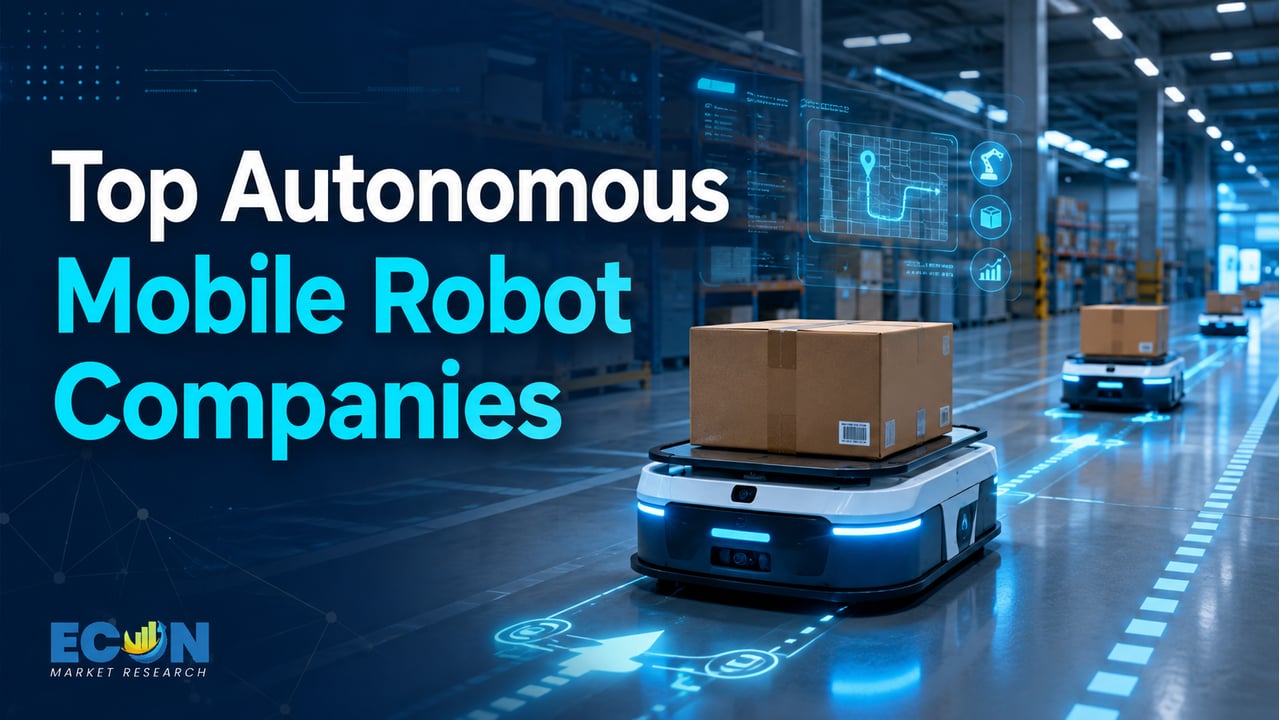
Warehousing remains one of the most visible applications, but industrial AMRs increasingly move pallets, racks, components, work-in-process materials, tools, finished goods, and waste between production areas. The wider manufacturing automation environment included 4.664 million industrial robots operating globally during 2024, demonstrating the scale of facilities already prepared for digitally coordinated automation. AMRs are commonly integrated with warehouse management systems, warehouse execution systems, manufacturing execution systems, conveyors, robotic arms, automated storage systems, elevators, doors, and enterprise resource planning platforms. Fleet sizes range from fewer than 10 vehicles in flexible manufacturing environments to hundreds or thousands of robots inside large fulfillment networks.
Market Evolution and Growth Drivers
The autonomous mobile robot industry evolved from automated guided vehicles developed for predictable factory transport into software-defined robots capable of dynamically navigating shared industrial spaces. AGVs had already been used for decades when advances in LiDAR, computer vision, embedded computing, battery technology, and SLAM algorithms accelerated AMR commercialization during the 2010s. Mobile Industrial Robots was established in 2013, Geek+ in 2015, ForwardX Robotics in 2016, and several warehouse-focused AMR platforms reached large-scale commercial deployment before 2020. The ability to change routes through software instead of installing new physical guidance infrastructure reduced the disruption associated with warehouse or production-layout changes.
Labor availability and the expansion of high-throughput logistics are reinforcing adoption. Global factories installed 542,000 industrial robots in 2024, while China alone installed 295,000 units, demonstrating how automation is becoming embedded into production infrastructure. AMRs address repetitive transport rather than fixed-position processing, allowing workers to focus on picking, assembly, inspection, maintenance, or exception handling. Safety technology has developed in parallel: ISO 3691-4 establishes requirements for driverless industrial trucks and their systems, while ANSI/RIA R15.08 provides a North American framework specifically addressing industrial mobile robots. These standards become increasingly important as AMRs share aisles and workspaces with people, forklifts, conveyors, and other autonomous systems.
Top 5 Latest Trends in the Autonomous Mobile Robot Industry
The 5 important trends currently influencing the Top Companies in the Autonomous Mobile Robot Industry are:
AI-Based Navigation and 3D Perception
Heavy-Payload Autonomous Pallet Movement
Multi-Robot Fleet Orchestration and Interoperability
Goods-to-Person and High-Density Fulfillment Automation
Mobile Manipulation and Integrated Robotic Workflows
Trend 1: AI-Based Navigation and 3D Perception
AMRs are increasingly using 3D cameras, machine learning, semantic mapping, and more sophisticated obstacle classification instead of relying entirely on conventional 2D LiDAR navigation. Mobile Industrial Robots introduced the MiR1200 Pallet Jack in 2024 with automated pallet detection designed to improve autonomous pallet identification and pickup. Vision-enhanced navigation allows mobile robots to distinguish fixed infrastructure from temporary objects, recognize pallet openings, identify changing aisle conditions, and operate in facilities where people and equipment move continuously. This capability is especially relevant in manufacturing and distribution environments containing hundreds of dynamic obstacles during each operating shift, because route planning must adapt without requiring technicians to manually reprogram every temporary change.
Trend 2: Heavy-Payload Autonomous Pallet Movement
AMR manufacturers are expanding beyond lightweight tote transportation into pallet and heavy-component logistics. The MiR1200 Pallet Jack handles loads of up to 1,200 kg, while OMRON's HD-1500 platform is designed for loads of up to 1,500 kg. Rockwell Automation's OTTO 1500 targets similar heavy-material workflows, and KUKA's mobile platforms include payload classes reaching 1,500 kg and higher in specialized configurations. This capability enables autonomous movement of engine components, battery assemblies, metal parts, finished pallets, raw materials, and work-in-process loads that previously depended heavily on manually driven forklifts. Heavy-payload AMRs also enable manufacturers to automate transport without installing fixed conveyor systems across every production route.
Trend 3: Multi-Robot Fleet Orchestration and Interoperability
Large AMR deployments increasingly depend on software that coordinates dozens or hundreds of robots rather than optimizing 1 vehicle at a time. Fleet-management systems assign missions, calculate traffic priorities, monitor battery conditions, control charging, prevent congestion, and interact with warehouse or manufacturing software. The development of VDA 5050 in Europe created a standardized communication approach between master-control systems and vehicles from different manufacturers, while MassRobotics introduced an interoperability standard in 2021 to improve information exchange among heterogeneous mobile robots. These initiatives matter because large industrial sites can operate multiple robot types, including pallet movers, tote carriers, autonomous forklifts, cleaning robots, and mobile manipulators within the same building.
Trend 4: Goods-to-Person and High-Density Fulfillment Automation
Goods-to-person AMRs have become a major warehouse automation architecture because robots can bring shelves, racks, totes, or containers directly to stationary picking areas. Geek+ has built systems around goods-to-person, tote-to-person, pallet transport, and sorting workflows since its founding in 2015, while Quicktron and other Asian manufacturers operate similar large-fleet architectures. Locus Robotics uses a different collaborative model in which autonomous robots travel between storage locations and human pickers rather than carrying entire shelves. Locus surpassed billions of completed picks during the first half of the 2020s, demonstrating the throughput possible when fleet software coordinates mobile robots with warehouse labor. These systems are particularly useful where product assortments can include tens of thousands of SKUs.
Trend 5: Mobile Manipulation and Integrated Robotic Workflows
The distinction between a transport robot and a robotic workstation is becoming less rigid. A mobile base can now carry a collaborative arm, inspection system, conveyor module, lift mechanism, or custom fixture to perform tasks after reaching its destination. KUKA combines mobile platforms with robotic manipulators, while several AMR manufacturers support top modules designed for automated loading and unloading. A 6-axis robotic arm mounted on an AMR can theoretically serve multiple machines during a shift instead of remaining attached to 1 production cell. Mobile manipulation is therefore relevant to semiconductor fabs, machine shops, laboratories, automotive plants, and electronics factories where the same autonomous system can transport material and then interact physically with equipment.
Top 10 Companies in the Autonomous Mobile Robot Industry
The following 10 companies are presented based on AMR product capabilities, deployment experience, navigation technology, payload coverage, fleet-management expertise, geographic presence, industrial integration, and relevance to autonomous intralogistics rather than as a strict numerical ranking.
1. Mobile Industrial Robots
Company Overview: Mobile Industrial Robots was founded in 2013 in Denmark and became part of Teradyne in 2018. The business was subsequently combined with AutoGuide Mobile Robots in 2022, broadening its heavy-duty autonomous transport capability. Headquarters: Odense, Denmark. Core Autonomous Mobile Robot Expertise: MiR specializes in autonomous factory and warehouse transportation using SLAM navigation, fleet management, safety scanners, configurable top modules, and autonomous pallet handling. Major Products and Services: The portfolio includes the MiR250 for loads up to 250 kg, MiR600 for 600 kg, MiR1350 for 1,350 kg, and MiR1200 Pallet Jack for loads up to 1,200 kg. These platforms support production logistics, pallet movement, waste transportation, material replenishment, and work-in-process flows.
2. Geekplus Technology
Company Overview: Geekplus was established in 2015 and developed from a warehouse robotics startup into a global provider of AMR-based logistics automation. Headquarters: Beijing, China. Core Autonomous Mobile Robot Expertise: Geek+ develops fleet-scale robotic systems for goods-to-person picking, tote handling, pallet movement, sorting, and automated storage workflows. Its approach combines autonomous robots with AI-based scheduling and warehouse orchestration rather than treating each AMR as an independent machine. Major Products and Services: Its portfolio spans 4 major workflow families, including goods-to-person systems, tote-to-person solutions, sorting robots, and pallet-moving systems. Deployments can coordinate hundreds of mobile robots within a single facility, making the platform suitable for e-commerce, retail distribution, apparel, third-party logistics, pharmaceuticals, and manufacturing logistics.
3. Locus Robotics
Company Overview: Locus Robotics emerged as an independent warehouse robotics company in 2014 and expanded its technology portfolio through the 2021 acquisition of Waypoint Robotics. Headquarters: Wilmington, Massachusetts, United States. Core Autonomous Mobile Robot Expertise: Locus focuses on collaborative warehouse AMRs that travel dynamically between storage locations while human workers complete picking and replenishment tasks. Major Products and Services: Locus Origin supports high-frequency fulfillment workflows, while Vector and Max platforms extend the system toward larger and heavier material movement. The Max platform is designed for loads reaching roughly 3,000 lb, equivalent to 1,361 kg. By the middle of the 2020s, Locus systems had completed billions of warehouse picks, providing a substantial operating dataset for route optimization and fleet orchestration.
4. OMRON Corporation
Company Overview: OMRON was founded in 1933 and has accumulated more than 90 years of experience in sensing, control, automation, and industrial equipment. Headquarters: Kyoto, Japan. Core Autonomous Mobile Robot Expertise: OMRON integrates mobile robotics with factory automation, sensors, machine vision, safety systems, programmable control, and manufacturing software. Major Products and Services: Its LD series includes mobile robots for payloads such as 60 kg, 90 kg, and 250 kg, while the HD-1500 supports loads up to 1,500 kg. Newer medium-duty mobile robots further extend its payload coverage. Fleet-management software can coordinate AMRs with factory traffic and production systems, making OMRON particularly relevant to electronics, automotive, semiconductor, medical-device, and precision-manufacturing environments.
5. Rockwell Automation
Company Overview: Rockwell Automation traces its origins to 1903 and expanded directly into autonomous material movement by acquiring Clearpath Robotics, including the OTTO Motors business, in 2023. Headquarters: Milwaukee, Wisconsin, United States. Core Autonomous Mobile Robot Expertise: The OTTO portfolio combines autonomous vehicle navigation with industrial production workflows and Rockwell's broader control, manufacturing software, and automation infrastructure. Major Products and Services: OTTO 600 supports material movement in the 600 kg payload class, while OTTO 1500 targets loads reaching 1,500 kg. The systems can transport pallets, racks, parts, and production materials between workstations without fixed guidance infrastructure. Rockwell's industrial presence also creates opportunities to connect AMRs directly with manufacturing execution, programmable automation, safety, and production-control environments.
6. Seegrid
Company Overview: Seegrid was founded in 2003 and has spent more than 20 years developing autonomous material-handling systems for industrial environments. Headquarters: Pittsburgh, Pennsylvania, United States. Core Autonomous Mobile Robot Expertise: The company concentrates on vision-guided autonomous vehicles and AMRs designed for repetitive horizontal transport, pallet movement, and industrial material flow. Major Products and Services: Seegrid has developed autonomous tow tractors, pallet-moving systems, and lift-truck platforms for manufacturing and distribution facilities. Its installed vehicles have accumulated more than 10 million autonomous operating miles, providing real-world navigation experience across high-traffic industrial sites. Automotive, consumer goods, manufacturing, and logistics facilities use these systems to reduce manual tugger and forklift movements while maintaining continuous material supply.
7. ABB
Company Overview: ABB was formed in its current multinational structure in 1988 and operates with roughly 110,000 employees across approximately 100 countries. The company strengthened its mobile robotics capability through the acquisition of ASTI Mobile Robotics in 2021. Headquarters: Zurich, Switzerland. Core Autonomous Mobile Robot Expertise: ABB combines AMRs with industrial robots, machine automation, digital manufacturing, AI-supported perception, and fleet-management technology. Major Products and Services: The Flexley family includes autonomous movers and towing platforms for factories, automotive manufacturing, consumer goods, and logistics operations. ABB has also introduced Visual SLAM-based navigation designed to reduce dependence on fixed reflectors and infrastructure. This integrated portfolio supports manufacturers seeking to coordinate fixed robotic cells with autonomous material transport under a common automation strategy.
8. KUKA
Company Overview: KUKA was founded in 1898 and has more than 125 years of industrial engineering history. Headquarters: Augsburg, Germany. Core Autonomous Mobile Robot Expertise: KUKA develops autonomous mobile platforms that can operate independently or support robotic manipulation, manufacturing logistics, and flexible production systems. Major Products and Services: The KMP family includes platforms such as the KMP 600-S diffDrive for loads in the 600 kg category and heavier mobile platforms designed for payload classes reaching 1,500 kg. KUKA also integrates mobile robots with 6-axis robotic arms, enabling mobile manipulation and flexible assembly concepts. These systems are particularly relevant to automotive production, machinery, electronics, battery manufacturing, intralogistics, and facilities that require robots to move between multiple production stations.
9. ForwardX Robotics
Company Overview: ForwardX Robotics was founded in 2016 and has concentrated its development on vision-based autonomous mobile robots and AI-driven fleet management. Headquarters: Beijing, China. Core Autonomous Mobile Robot Expertise: ForwardX uses multi-sensor perception, autonomous navigation, fleet orchestration, and adaptable material-handling platforms for warehouses and manufacturing facilities. Major Products and Services: Its product families support order picking, case movement, pallet transport, line-side delivery, and heavy-material handling. The company's Max family extends autonomous movement into payload categories approaching 1,500 kg, while smaller platforms are used for collaborative warehouse picking. Since 2016, the company has expanded beyond China into North American, Asian, and European deployments, reflecting the internationalization of Chinese AMR technology providers.
10. Quicktron Intelligent Technology
Company Overview: Quicktron was founded in 2014 in China and has developed 12 years of expertise in warehouse and factory mobile robotics by 2026. Headquarters: Shanghai, China. Core Autonomous Mobile Robot Expertise: Quicktron combines autonomous mobile hardware with intelligent scheduling, goods-to-person workflows, robot-to-person systems, sorting, pallet movement, and warehouse execution software. Major Products and Services: Its systems include shelf-moving robots, tote-handling robots, autonomous forklifts, picking platforms, and industrial transport robots. Large deployments can use fleets containing hundreds of robots coordinated through centralized scheduling software. The company serves applications in e-commerce, retail, manufacturing, pharmaceuticals, apparel, electronics, and third-party logistics where inventory locations and order profiles change continuously.
Regional Outlook
North America
North America has become an important AMR deployment region because its manufacturing and distribution sectors combine high labor costs, large fulfillment facilities, advanced software infrastructure, and substantial automation adoption. The United States operated 393,700 industrial robots in 2024 and added 34,200 units during the year, demonstrating the wider automation maturity of factories that can also integrate AMRs. Distribution centers increasingly use mobile robots for order picking, replenishment, pallet transfer, and staging, while automotive and industrial plants apply them to line-side delivery and work-in-process transport. Companies including Locus Robotics, Seegrid, and Rockwell Automation maintain headquarters in the United States, creating a domestic engineering and deployment ecosystem.
Canada and Mexico offer different use cases. Canada installed 3,800 industrial robots in 2024, with automotive manufacturing representing 47% of installations, while Mexico added 5,600 units and automotive applications represented 63%. AMRs can complement these fixed robots by transporting components between machining, welding, paint, assembly, inspection, and warehouse areas. Safety requirements are reinforced by ANSI/RIA R15.08, which was developed specifically for industrial mobile robots and their applications. A key North American challenge remains brownfield integration because a facility operating for 20 or 30 years may contain narrow aisles, manual forklifts, legacy software, and irregular material routes that were never designed for autonomous traffic.
Europe
Europe provides a mature industrial environment for autonomous mobile robots. The region installed 85,000 industrial robots during 2024, including 67,800 inside the European Union. Germany accounted for 26,982 installations, Italy recorded 8,783, Spain installed 5,100, and France deployed 4,900. Automotive production, machinery, chemicals, pharmaceuticals, food processing, aerospace, consumer products, and logistics all create recurring material-movement requirements suitable for AMRs. Europe also hosts Mobile Industrial Robots in Denmark, ABB in Switzerland, and KUKA in Germany, giving the region a combination of mobile-robot engineering, industrial integration, safety expertise, and advanced manufacturing demand.
Interoperability is a particularly important European development. VDA 5050 was created to establish a common communication interface between fleet-control systems and driverless transport vehicles, addressing the operational difficulty of coordinating robots from different suppliers. The EU Machinery Regulation 2023/1230 will apply from January 20, 2027, strengthening the regulatory framework surrounding machinery placed on the European market. For AMR operators, compliance extends beyond the robot itself because traffic routes, charging areas, pedestrian interactions, payload stability, automated doors, lifts, and transfer stations all contribute to system safety. Europe therefore offers opportunities for vendors capable of combining hardware with standardized interfaces, functional safety, digital twins, energy-efficient operation, and multi-vendor fleet orchestration.
Asia-Pacific
Asia-Pacific combines the world's largest manufacturing automation base with a rapidly expanding warehouse robotics ecosystem. Asia accounted for 74% of global industrial robot installations during 2024. China installed 295,000 industrial robots, representing 54% of worldwide deployments, and its operational stock exceeded 2 million units. Japan installed 44,500 robots, while South Korea recorded 30,600 installations. These figures indicate a manufacturing environment with extensive automation expertise, systems integration capability, electronics supply chains, and demand for continuous material transport. Chinese AMR companies such as Geek+, Quicktron, and ForwardX have also developed large product portfolios serving both domestic and international warehouse and manufacturing applications.
India installed a record 9,100 industrial robots in 2024, an increase of 7%, with automotive applications representing 45% of installations. That lower but expanding automation base creates a different AMR opportunity from the high-density robot markets of China, Japan, Singapore, Taiwan, and South Korea. New factories can design autonomous logistics into their layouts from the beginning rather than retrofit robots into legacy facilities. Southeast Asian electronics, automotive, semiconductor, and consumer-product manufacturing also supports line-side AMRs and warehouse transport. Regional advantages include electronics manufacturing capacity, battery supply chains, lower hardware production costs, and large engineering workforces, while challenges include uneven safety practices, different communication standards, price competition, and varying levels of warehouse digitization.
Middle East & Africa
The Middle East is increasingly adopting autonomous logistics as part of manufacturing diversification, smart warehousing, and national digital-transformation programs. Saudi Arabia's Future Factories Program targets the transformation of 4,000 industrial facilities through advanced manufacturing and automation. The UAE introduced Transform 4.0 in 2024 to support 100 high-potential manufacturers over a 3-to-5-year period. AMRs fit these initiatives because autonomous transport can be deployed incrementally without installing extensive fixed conveyor infrastructure. Potential applications include food production, pharmaceuticals, airports, logistics centers, metals, automotive components, energy facilities, consumer goods, and large warehouses serving regional distribution networks.
African AMR adoption remains more concentrated in modern logistics facilities, mines, automotive manufacturing, consumer-product factories, healthcare environments, and internationally operated industrial sites. South Africa has the continent's most established automotive production ecosystem, while Egypt, Morocco, Kenya, and Nigeria are developing additional manufacturing and logistics capabilities. A facility operating 24 hours per day can gain greater utilization from autonomous transport than one working a single 8-hour shift, but regional conditions can create technical constraints. Dust, temperature, floor quality, wireless coverage, imported spare parts, limited local integration expertise, and mixed pedestrian-forklift traffic influence deployment planning. These conditions favor AMRs with robust sensing, remote diagnostics, standardized interfaces, and service partners capable of supporting operations locally.
Future Opportunities in the Autonomous Mobile Robot Industry
The strongest technology opportunity for the Top Companies in the Autonomous Mobile Robot Industry is the convergence of AMRs with physical AI. A traditional mobile robot determines where it is and how to reach a destination, while newer systems increasingly interpret semantic information about what surrounds them. The transition from 2D localization toward 3D perception, object classification, dynamic path prediction, and vision-language-enabled robotics could allow AMRs to understand loading bays, pallets, workstations, doors, forklifts, and human activity with greater contextual awareness. Products introduced since 2024 are already using enhanced vision for autonomous pallet handling, indicating that the industry is moving from simple navigation toward perception-based manipulation and material interaction.
Mobile manipulation creates another realistic opportunity. A platform carrying a 6-axis collaborative robot can transport material, open machines, load components, remove completed parts, perform inspection, and travel to another workstation. Heavy-duty AMRs already support payload classes of 1,200 kg to 1,500 kg, while collaborative arms commonly support payloads from 3 kg to 35 kg. Combining the 2 technologies can create flexible automation for semiconductor facilities, laboratories, machine shops, electronics production, battery plants, hospitals, and small-batch manufacturing. The technical challenge is substantially greater than navigation alone because the system must coordinate base positioning, arm accuracy, machine communication, tool changing, safety zones, payload stability, and real-time human movement.
Interoperability will become more valuable as industrial fleets grow. A large facility may eventually operate 5 or more categories of autonomous machines, including tote robots, pallet movers, automated forklifts, cleaning robots, mobile manipulators, and inspection platforms. Standards such as VDA 5050 and the MassRobotics interoperability framework provide a foundation for exchanging status, position, task, and fleet information across different platforms. The opportunity is not limited to vehicle manufacturers; fleet-management software providers can become an important orchestration layer connecting AMRs with warehouse management systems, manufacturing execution systems, elevators, automated doors, conveyors, chargers, robotic arms, and digital twins.
SMEs represent another expansion opportunity because autonomous transport can be deployed in smaller increments than traditional fixed automation. A manufacturer can begin with 2 or 3 AMRs serving repetitive routes before expanding to 10 or 20 vehicles as workflows become standardized. Subscription models, cloud fleet analytics, easier mapping, automatic charging, modular top modules, and low-code integration can reduce the engineering effort required for initial deployment. Safety regulation will remain central to adoption through 2027 and beyond as the EU Machinery Regulation and existing mobile-robot standards shape system design. Suppliers that simplify commissioning without compromising risk assessment are positioned to extend AMRs beyond large enterprises into smaller production and distribution environments.
Conclusion
The autonomous mobile robot industry has become an established part of modern intralogistics as factories and warehouses replace fixed transport routes with software-defined movement. Professional logistics robots accounted for more than 100,000 new units globally in 2024, while the broader industrial environment operated 4.664 million industrial robots. The 5 major trends—AI-based perception, heavy-payload movement, fleet interoperability, goods-to-person automation, and mobile manipulation—show that AMRs are evolving from simple transport vehicles into intelligent components of connected production and fulfillment systems. Commercial platforms now cover loads from lightweight totes to approximately 1,500 kg, enabling automation across picking, pallet movement, manufacturing logistics, machine servicing, and distribution.
The 10 Top Companies in the Autonomous Mobile Robot Industry—Mobile Industrial Robots, Geekplus Technology, Locus Robotics, OMRON, Rockwell Automation, Seegrid, ABB, KUKA, ForwardX Robotics, and Quicktron—represent different approaches to autonomous logistics. Asia accounted for 74% of worldwide industrial robot installations in 2024, Europe installed 85,000 robots, and the United States operated 393,700 industrial robots, creating distinct regional foundations for AMR adoption. Saudi Arabia's 4,000-factory transformation target and the UAE's 100-manufacturer Transform 4.0 program demonstrate that autonomous logistics is also extending into developing smart-manufacturing ecosystems. Future competitiveness will depend on safe navigation, AI perception, interoperability, fleet intelligence, heavy-payload capability, mobile manipulation, energy management, and reliable integration with existing industrial software.