


Top Companies in the AI Server Industry Driving AI Infrastructure
The top AI server companies are advancing GPU computing, liquid cooling, rack-scale systems, and enterprise AI infrastructure across global markets today.
Introduction
Overview of the Global AI Server Industry
The global AI server industry has become a critical foundation for generative AI, machine lea ing, autonomous systems, computer vision, scientific simulation, and real-time analytics. Unlike conventional enterprise servers, an AI server may integrate 4, 8, 32, or 72 accelerators connected through high-bandwidth fabrics. Mode rack-scale platforms can provide 13.4 TB of high-bandwidth GPU memory, 576 TB per second of aggregate memory bandwidth, and 130 TB per second of interconnect bandwidth. These capabilities allow organizations to train trillion-parameter models, process multimodal datasets, and deploy thousands of simultaneous inference sessions. Demand is increasing across healthcare, manufacturing, banking, telecommunications, gove ment, retail, automotive, and cloud infrastructure.
Market Evolution and Growth Drivers
The AI server market has evolved from individual 1-GPU and 2-GPU systems into tightly integrated 8-GPU servers, 72-GPU racks, and multi-rack AI factories. This transition is being driven by larger language models, increasing inference volumes, sovereign AI programs, and enterprise adoption of retrieval-augmented generation. Global data-center electricity consumption is projected to reach 565 TWh in 2026, compared with 447 TWh in 2025, while AI-optimized infrastructure could account for 175 TWh during 2026. Growing power requirements are accelerating the adoption of direct liquid cooling, high-voltage power distribution, 400 Gb/s networking, and advanced workload scheduling. AI server manufacturers are consequently competing on compute density, memory capacity, cooling efficiency, scalability, security, and deployment speed.
Top 5 Latest Trends in the AI Server
1. Rack-Scale AI Systems Are Replacing Standalone GPU Servers
Rack-scale architecture is becoming one of the most influential AI server trends because advanced models require hundreds or thousands of accelerators to operate as a coordinated computing system. A current rack-scale platform can combine 72 GPUs, 36 CPUs, 2,592 processor cores, and 13.4 TB of GPU memory within 1 integrated architecture. The same configuration can deliver 130 TB per second of GPU interconnect bandwidth and connect exte ally through 400 Gb/s networking. This design reduces communication delays that occur when separate servers exchange model parameters over conventional networks. Rack-scale systems are particularly valuable for large language model training, multimodal model development, recommendation engines, digital twins, and scientific AI. The trend is also changing procurement strategies because customers increasingly purchase complete racks containing compute, networking, power distribution, management software, and cooling rather than ordering 8-GPU nodes independently.
Rack-level integration also improves deployment consistency across clusters containing 1,000 or 10,000 accelerators. Manufacturers can validate thermal behavior, firmware, networking, cable layouts, and power requirements before installation. This approach reduces integration risks and enables organizations to scale capacity through repeatable rack units. However, the transition requires facilities capable of supporting power densities that can progress toward 1 MW for advanced deployments by 2027. Data-center planners must therefore coordinate server selection with electrical substations, backup power, coolant distribution units, network fabrics, and floor-loading requirements. AI server vendors that provide factory-tested rack-scale infrastructure are gaining strategic importance because customers want operational systems rather than collections of disconnected components.
2. Direct Liquid Cooling Is Becoming a Standard Requirement
Direct liquid cooling is moving from a specialized high-performance computing technology into a standard design requirement for high-density AI servers. A mode 8-GPU AI server may occupy 4U, 5U, or 6U of rack space while generating heat that cannot be managed efficiently through traditional air cooling alone. Direct-to-chip systems circulate liquid through cold plates attached to CPUs, GPUs, memory components, and networking devices, capturing heat close to its source. Current server platforms are available in 5U direct-liquid-cooled configurations and 6U air-cooled configurations, demonstrating how liquid cooling can reduce physical space while supporting higher accelerator density. Cooling innovation is becoming essential as AI workloads increase data-center cooling electricity requirements and create localized thermal hotspots.
AI server manufacturers are also optimizing cooling channels through simulation and generative design. In 1 experimental direct-to-chip cooling design for a rack-scale AI processor, optimized channels reduced average temperature by over 5°C and maximum temperature by over 35°C compared with a baseline parallel-channel layout. These improvements indicate that future AI servers will use cooling systems designed specifically for the thermal profile of each accelerator package. Liquid cooling can also support warmer facility-water temperatures, lower fan activity, and heat-reuse applications. Nevertheless, adoption requires leak detection, service procedures, water-quality management, redundant pumps, coolant distribution units, and trained technicians. Vendors offering integrated servers, racks, cooling equipment, monitoring software, and maintenance services are therefore positioned strongly within the expanding AI server industry.
3. Multi-Vendor Accelerator Support Is Expanding
The AI server market is becoming less dependent on a single accelerator architecture as enterprises seek greater flexibility, supply-chain resilience, and workload-specific performance. Current systems can support 8 accelerators from multiple chip providers, including high-bandwidth GPU platforms designed for large language models, natural language processing, multimodal training, simulation, and inference. Some 5U and 6U servers can be configured with 8 NVIDIA B300, B200, or H200 accelerators, as well as 8 AMD MI355X accelerators. This flexibility allows buyers to compare memory capacity, interconnect design, software compatibility, power requirements, model performance, and availability before selecting an infrastructure platform.
Open rack architectures are also emerging with 72-GPU designs, Ethe et-based scale-up fabrics, next-generation CPUs, and 31 TB of HBM4 memory per rack. One planned architecture targets 2.9 exaFLOPS of low-precision AI performance while using open standards for rack dimensions and accelerator connectivity. The shift toward multi-vendor AI servers does not eliminate software challenges because organizations must still optimize frameworks, communication libraries, compilers, drivers, and model code for each architecture. However, increased competition can accelerate innovation in memory bandwidth, energy efficiency, open networking, and system management. AI server companies with broad accelerator support will appeal to customers that want to avoid hardware lock-in and match each workload to the most appropriate combination of GPUs, CPUs, memory, storage, and networking.
4. AI Inference Servers Are Moving Closer to Enterprise Data
AI infrastructure spending initially concentrated on large training clusters, but inference is now creating sustained demand for enterprise, regional, and edge AI servers. Training may run for 30, 60, or 90 days, while inference services can process requests 24 hours per day across customer support, fraud detection, medical imaging, industrial inspection, coding assistance, and document analysis. Many organizations are deploying smaller clusters containing 2, 4, or 8 accelerators because sensitive data cannot always be transferred to exte al cloud environments. On-premises inference also provides greater control over latency, security, model versions, and operating costs.
This trend is encouraging manufacturers to design AI servers for quantized models, retrieval-augmented generation, vector search, and high-throughput token generation. A server used for inference may prioritize 80 GB, 141 GB, 192 GB, or 288 GB of accelerator memory per device depending on the model architecture and concurrency target. Enterprises are also combining CPU-based inference, GPU acceleration, and dedicated AI processors within the same environment. Edge systems may use compact 1U or 2U designs, while central enterprise deployments may use 4U or 8U platforms. AI server vendors are responding with validated software stacks that include orchestration, container support, model monitoring, security controls, and lifecycle management for deployments ranging from 1 server to 1,000 nodes.
5. Power-Aware Computing Is Becoming a Competitive Differentiator
Power availability has become a major constraint for AI server deployment because advanced clusters require significant electricity for compute, networking, memory, storage, and cooling. Global data-center peak power demand could rise from 104 GW in 2025 to 132 GW in 2026, while total electricity use could reach 565 TWh during 2026. AI-optimized servers alone may consume 175 TWh in 2026 and 258 TWh in 2027. These figures are encouraging data-center operators to evaluate AI server performance per watt rather than relying only on maximum computational throughput.
Power-aware AI servers use techniques such as dynamic voltage and frequency scaling, workload scheduling, direct liquid cooling, high-efficiency power supplies, accelerator partitioning, and real-time thermal monitoring. Coordinated control of compute and cooling can adjust GPU frequency, parallelism, and cooling output according to workload demand. Facilities are also transitioning beyond conventional 48 V rack power systems toward higher-voltage direct-current architectures and more efficient conversion stages. These technologies can reduce electrical losses and improve deployable capacity across clusters containing 100, 1,000, or 10,000 accelerators. AI server companies that demonstrate predictable power usage, higher utilization, and efficient cooling will have an advantage as customers face grid constraints, environmental requirements, and limits on available megawatts.
Top 5 Companies in the AI Server
1. NVIDIA
Company overview: NVIDIA was founded in 1993 and has become a central technology provider for accelerated computing and artificial intelligence. The company develops GPUs, CPUs, networking products, interconnect technologies, AI software, and complete server systems. Its platform supports AI training, inference, high-performance computing, robotics, digital twins, healthcare research, automotive systems, and industrial applications.
Headquarters: Santa Clara, Califo ia, United States, with operations supporting customers across 50+ countries.
Core AI server expertise: NVIDIA specializes in vertically integrated AI infrastructure that combines GPUs, Grace CPUs, NVLink interconnects, InfiniBand or Ethe et networking, data-processing units, communication libraries, and enterprise AI software. This integration enables thousands of accelerators to operate as a unified computing platform.
Major products and services: Major offerings include DGX systems, HGX platforms, GB200 NVL72 racks, Grace Blackwell Superchips, H100 and H200 GPUs, B200 and B300 GPUs, ConnectX networking, BlueField data-processing units, InfiniBand switches, AI Enterprise software, Base Command, and reference architectures. A DGX GB200 configuration integrates 72 Blackwell GPUs, 36 Grace CPUs, 2,592 CPU cores, and 30.2 TB of total fast memory.
2. Dell Technologies
Company overview: Dell Technologies traces its origins to 1984 and supplies servers, storage, networking, personal computing, data protection, professional services, and infrastructure management solutions. Its PowerEdge portfolio serves enterprises, cloud providers, research institutions, telecommunications companies, and gove ment organizations deploying AI and high-performance computing.
Headquarters: Round Rock, Texas, United States, at 1 Dell Way.
Core AI server expertise: Dell specializes in enterprise-ready GPU servers, rack-scale integration, direct liquid cooling, high-speed networking, storage integration, deployment services, and lifecycle support. Its AI server strategy addresses model training, fine-tuning, retrieval-augmented generation, inference, simulation, and data analytics.
Major products and services: Important products include the PowerEdge XE9680, XE9680L, XE9640, XE8640, XE7740, and rack-scale integrated systems. The XE9680L is a 4U, 2-socket, direct-liquid-cooled platform designed for AI, machine lea ing, and high-performance computing. It supports configurations based on 8 high-performance accelerators and provides expansion capacity through as many as 12 PCIe slots. Dell also provides storage, networking, consulting, deployment, support, and managed services for AI infrastructure.
3. Hewlett Packard Enterprise
Company overview: Hewlett Packard Enterprise became an independent company in 2015 and provides enterprise servers, supercomputing systems, networking, storage, hybrid cloud platforms, and consulting services. Its AI infrastructure portfolio serves commercial enterprises, national laboratories, universities, telecommunications providers, and gove ment agencies.
Headquarters: Houston, Texas, United States, with operations across 100+ countries.
Core AI server expertise: The company specializes in high-density AI servers, supercomputing, direct liquid cooling, cluster management, high-speed networking, security, and hybrid consumption models. Its experience covers installations ranging from departmental AI systems to exascale-class computing environments.
Major products and services: Key offerings include ProLiant Compute XD systems, Cray supercomputers, Private Cloud AI solutions, GreenLake services, Slingshot networking, and direct-liquid-cooled infrastructure. The ProLiant Compute XD685 can support 8 B300, B200, H200, or MI355X accelerators and is offered in a 5U liquid-cooled design or 6U air-cooled design. It is optimized for large language model training, multimodal lea ing, natural language processing, and deep lea ing.
4. Super Micro Computer
Company overview: Super Micro Computer was founded in 1993 and develops application-optimized servers, storage systems, networking platforms, racks, management software, and liquid-cooling infrastructure. The company has established a strong position in GPU computing by rapidly integrating new CPUs, GPUs, memory standards, and networking technologies.
Headquarters: San Jose, Califo ia, United States, close to multiple semiconductor and data-center technology suppliers.
Core AI server expertise: Supermicro specializes in high-density GPU servers, modular building-block architecture, rack-scale integration, direct liquid cooling, and accelerated product deployment. Its portfolio supports generative AI, language-model training, inference, scientific computing, media processing, autonomous systems, and cloud services.
Major products and services: The company offers 4U, 5U, 6U, 8U, and rack-scale GPU systems supporting 4, 8, 32, or 72 accelerators. Major product families include SuperBlade, GPU SuperServer, Hyper, BigTwin, CloudDC, and complete liquid-cooled AI racks. Its close coordination with accelerator suppliers has historically allowed it to introduce systems quickly, while advanced liquid cooling can reduce cooling-related power consumption by as much as 40% in suitable deployments.
5. Lenovo
Company overview: Lenovo was established in 1984 and provides personal computing, servers, storage, edge infrastructure, supercomputing systems, and enterprise services. Its data-center portfolio addresses private AI, hybrid AI, high-performance computing, analytics, virtualization, and edge processing.
Headquarters: Beijing, China, and Morrisville, North Carolina, United States, reflecting a dual operational structure across 2 major technology regions.
Core AI server expertise: Lenovo specializes in enterprise AI servers, Neptune liquid cooling, GPU-dense systems, hybrid AI infrastructure, edge computing, and energy-efficient supercomputing. Its server platforms support NVIDIA and AMD accelerators alongside Intel and AMD processors.
Major products and services: Important systems include ThinkSystem SR780a V3, SR680a V3, SR675 V3, SD665 V3, SD650-I V3, ThinkAgile platforms, and ThinkEdge servers. The SR780a V3 can support 8 H200 GPUs connected through NVLink and uses Neptune liquid cooling for high-density AI workloads. Lenovo also offers 8-GPU liquid-cooled boards and direct-water-cooled systems using 2 AMD EPYC processors per node.
Regional Outlook
North America
North America remains a central region for AI server innovation because it contains major accelerator designers, server manufacturers, cloud providers, software companies, research laboratories, and hyperscale data-center operators. The United States could account for 204 TWh of data-center electricity consumption in 2026, representing 36% of the projected global total of 565 TWh. Dedicated AI facilities may consume 1-third of the American data-center total, demonstrating the scale of infrastructure being deployed for model training and inference. The region is also home to several leading AI server companies headquartered in Califo ia and Texas, creating a concentrated ecosystem of semiconductor design, server engineering, networking, cooling, and software development.
Demand in North America is being generated by cloud computing, healthcare, financial services, defense, automotive technology, media, biotechnology, retail, and manufacturing. Organizations are building clusters with 8, 72, 1,000, or 10,000 GPUs to support foundation models and specialized applications. Federal laboratories and universities continue to invest in supercomputing systems, while businesses are adopting smaller private AI environments for secure inference and retrieval-augmented generation. Power availability is becoming a limiting factor, with over 75 planned projects reportedly affected by electricity or water constraints during 2026. The regional market is therefore shifting toward liquid-cooled servers, modular data centers, higher-voltage power distribution, renewable electricity, natural-gas generation, and long-term nuclear-energy agreements. Vendors capable of delivering complete systems within constrained power envelopes will remain highly competitive.
Europe
Europe is developing a diverse AI server ecosystem through sovereign computing programs, national supercomputers, research networks, industrial digitalization, and stricter data-gove ance requirements. The European Union contains 27 member states, many of which are expanding domestic computing resources to reduce dependence on infrastructure located outside the region. Demand is particularly visible in Germany, France, the United Kingdom, Italy, Spain, the Netherlands, Switzerland, Finland, and Sweden. These countries are deploying AI systems for automotive engineering, pharmaceutical research, climate modeling, advanced manufacturing, aerospace, cybersecurity, language technologies, and public administration.
European AI server buyers frequently prioritize energy efficiency, data residency, security, and heat reuse alongside computational performance. Liquid-cooled systems operating with warm water can transfer waste heat to district-heating networks, university buildings, laboratories, and industrial processes. Some next-generation supercomputers planned for 2027 are being designed to capture server heat for nearby facilities. Europe also benefits from colder climates in Nordic countries, where outside-air temperatures can support efficient cooling during 8 to 12 months of the year. However, electricity prices, grid-connection delays, environmental permitting, and limited availability of high-density data-center sites remain significant challenges.
The region is also supporting alte atives to closed accelerator ecosystems through open networking standards, European processor initiatives, and multi-vendor procurement. Organizations may combine 8-GPU training nodes with CPU-rich simulation systems and large storage platforms to create integrated scientific workflows. European enterprises are increasingly deploying private AI servers to comply with sector-specific regulations and maintain direct control over sensitive information. As implementation of AI gove ance requirements progresses through 2026 and subsequent years, demand will expand for auditable infrastructure, secure model hosting, energy measurement, access controls, and documented lifecycle management.
Asia-Pacific
Asia-Pacific represents one of the most strategically important AI server regions because it combines semiconductor manufacturing, electronics production, cloud expansion, large digital populations, gove ment AI programs, and growing enterprise adoption. China, Japan, South Korea, India, Taiwan, Singapore, and Australia are investing in AI computing for manufacturing, telecommunications, financial services, e-commerce, public services, robotics, education, healthcare, and scientific research. The region contains countries with populations exceeding 100 million and digital-service ecosystems serving 1 billion or more users, creating substantial inference requirements.
China continues to develop domestic accelerators, server platforms, networking products, and software ecosystems in response to technology restrictions and sovereign-computing objectives. Japan is expanding AI infrastructure for robotics, automotive engineering, materials science, weather forecasting, and language models. South Korea is combining its semiconductor expertise with cloud and telecommunications investments, while Taiwan remains essential to advanced chip and server manufacturing. Singapore and Australia function as major regional data-center locations, although electricity, land, water, and sustainability limits affect new construction.
India is emerging as a major AI infrastructure market through public-sector programs, cloud-region development, data-center investment, and demand from over 1.4 billion residents. Indian organizations are adopting AI servers for multilingual models, digital payments, healthcare analytics, agriculture, cybersecurity, education, and gove ment services. The region also benefits from a large engineering workforce and increasing availability of locally hosted cloud services. However, AI server deployment must address high ambient temperatures, electricity reliability, network connectivity, and water availability. Direct liquid cooling, modular facilities, renewable power, and edge AI servers will therefore become increasingly important across Asia-Pacific during the next 5 to 10 years.
Middle East & Africa
The Middle East and Africa AI server market is being shaped by national digital-transformation programs, sovereign AI initiatives, smart-city projects, energy-sector analytics, telecommunications expansion, and demand for local data hosting. The United Arab Emirates, Saudi Arabia, Qatar, Israel, and South Africa are among the most active infrastructure markets, while additional opportunities are developing in Egypt, Kenya, Nigeria, Morocco, and other regional economies. Several countries are investing in Arabic-language models, gove ment AI services, healthcare platforms, cybersecurity, autonomous mobility, and industrial automation.
Middle Easte countries possess advantages in available land, capital investment, and access to large-scale energy resources, but ambient temperatures can exceed 40°C during summer months. These conditions increase the importance of direct liquid cooling, efficient chillers, closed-loop water systems, and carefully designed heat-rejection infrastructure. Solar power is also attractive because several markets receive over 2,000 hours of sunshine annually. However, solar generation must be combined with storage, grid capacity, gas generation, or other dependable power sources to support AI servers operating 24 hours per day.
Africa presents a different growth patte , with AI server demand concentrated in telecommunications, banking, gove ment, healthcare, mining, agriculture, and education. Edge AI systems containing 1, 2, or 4 accelerators can support local inference where inte ational connectivity is limited or expensive. Regional data centers can also reduce application latency from 100 milliseconds to lower local-response levels for digital services. Challenges include electricity reliability, limited high-capacity fiber routes, import costs, technical skills, and access to advanced accelerators. Partnerships involving gove ments, telecommunications operators, universities, cloud providers, and AI server manufacturers will be important for creating sustainable computing capacity across the region.
Future Opportunities in the AI Server
Future opportunities in the AI server industry will expand as artificial intelligence moves from experimental projects into operational systems used by millions of employees and consumers. Enterprises will require infrastructure for model training, fine-tuning, retrieval, inference, monitoring, and continuous improvement. A large organization may operate 10 to 100 specialized models rather than relying on 1 universal model. This shift will generate demand for modular servers that support different accelerator types, memory capacities, networking standards, and security configurations.
Private and sovereign AI represent major opportunities because gove ments, healthcare providers, financial institutions, manufacturers, and defense organizations need local control over sensitive data. These customers may deploy clusters containing 8, 64, 72, or several hundred accelerators within national or organizational boundaries. AI server vendors can address this requirement through integrated hardware, model-management software, encryption, confidential computing, identity controls, and audit capabilities. Regional language models and industry-specific models will further increase demand for localized computing resources.
Inference optimization will create another significant opportunity as the number of daily AI interactions rises. Techniques such as 8-bit, 4-bit, and lower-precision computation can reduce memory usage and increase throughput without requiring full model retraining. Server platforms that support accelerator partitioning can allow 1 GPU to serve multiple applications, improving utilization and reducing unused capacity. CPU-based inference and specialized AI processors will also expand the addressable market beyond premium GPU clusters.
Cooling and energy technologies will become central commercial opportunities. AI server racks progressing from 100 kW toward several hundred kilowatts require direct-to-chip cooling, immersion systems, coolant distribution units, leak detection, and intelligent thermal controls. High-voltage DC distribution, energy storage, heat reuse, and workload-aware scheduling can improve facility efficiency. Vendors that integrate these technologies with 24-hour monitoring and predictive maintenance can provide measurable operational benefits.
Edge AI is another emerging category because factories, hospitals, stores, vehicles, telecommunications sites, and remote facilities often require responses within 10 or 20 milliseconds. Compact 1U and 2U servers can run computer vision, robotics, speech recognition, fraud detection, and predictive-maintenance models near the source of data. Over the next 5 years, the AI server market will therefore extend beyond hyperscale data centers into thousands of enterprise and edge locations.
Conclusion
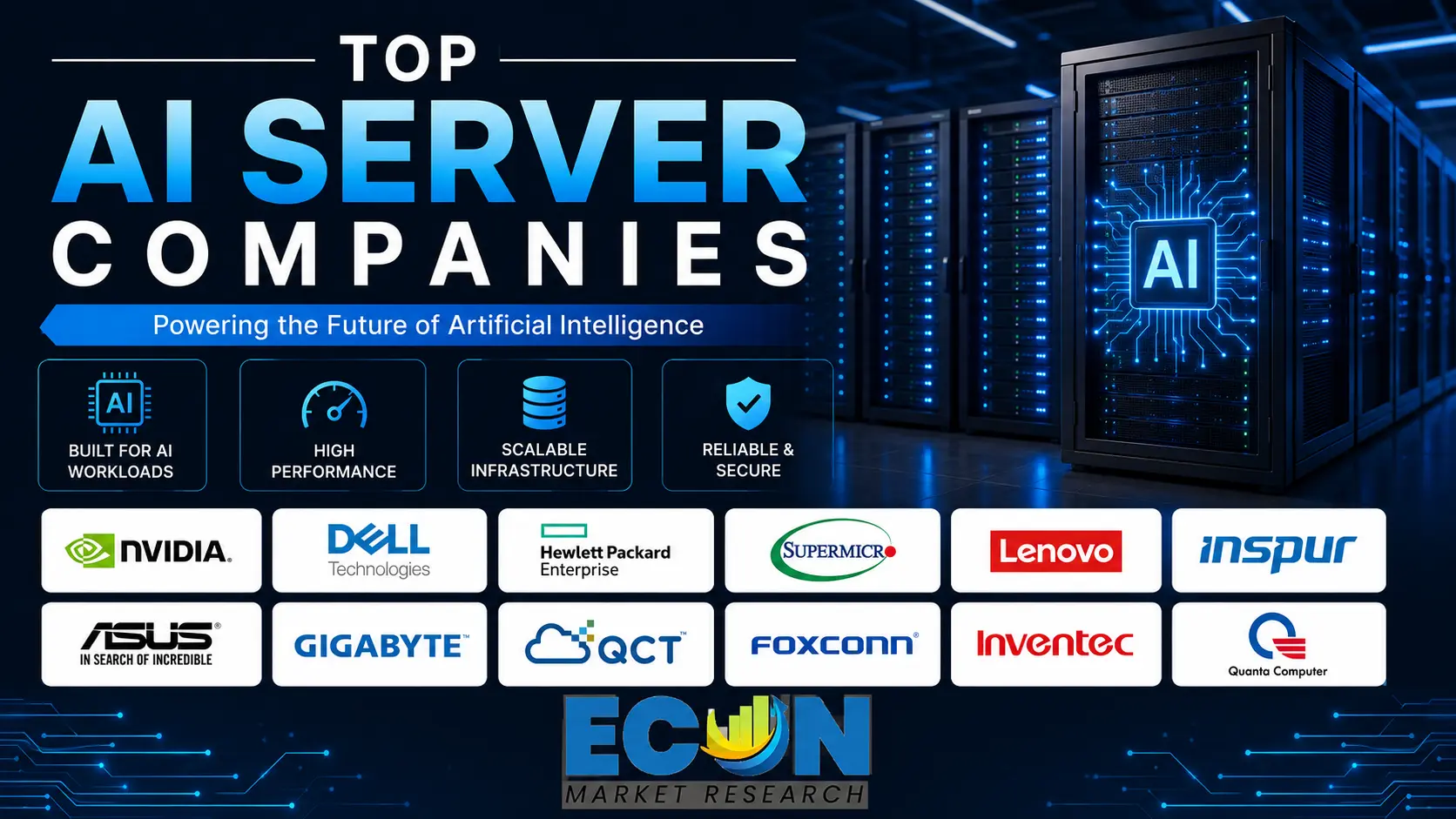
The global AI server industry is transitioning from conventional server deployment toward accelerator-dense, liquid-cooled, rack-scale computing systems. Leading platforms now combine 8 GPUs per server or 72 GPUs per rack, alongside high-bandwidth memory, advanced networking, integrated software, and specialized cooling. NVIDIA, Dell Technologies, Hewlett Packard Enterprise, Super Micro Computer, and Lenovo are among the top companies in the AI server market because each provides distinct capabilities across accelerators, system engineering, rack integration, enterprise support, cooling, and lifecycle services.
The competitive environment will increasingly depend on performance per watt, model throughput, memory capacity, networking efficiency, system reliability, deployment speed, and software compatibility. Power consumption could reach 565 TWh across global data centers in 2026, making energy availability and cooling design essential purchasing considerations. North America will remain a major technology center, while Europe will emphasize sovereign and energy-efficient computing. Asia-Pacific will benefit from manufacturing strength and large digital populations, and the Middle East and Africa will create opportunities through sovereign AI, smart infrastructure, and edge deployment.
Over the next 5 to 10 years, AI servers will become essential infrastructure for healthcare, banking, manufacturing, telecommunications, gove ment, automotive, retail, cybersecurity, and scientific research. Companies that deliver scalable systems with secure software, flexible accelerators, efficient cooling, and dependable support will be best positioned to lead the next phase of the AI server industry.