


Top Companies in AI Observability: Leading Platforms in 2026
The top AI observability companies in 2026 are advancing LLM monitoring, agent tracing, model evaluation, governance, security, and performance at scale.
Introduction
Overview of the Global AI Observability Industry
The global AI observability industry has become a critical part of enterprise artificial intelligence infrastructure as organizations move machine learning models, generative AI applications, and autonomous agents into production. In 2025, 88% of surveyed organizations reported using AI, while 70% used generative AI in at least 1 business function. Despite this adoption, AI-agent deployment remained in the single digits across most business functions, showing that reliability concerns still limit production expansion. AI observability platforms address this gap by monitoring model quality, prompts, responses, token consumption, latency, hallucinations, data drift, agent decisions, infrastructure usage, and security events through 1 unified operational layer.
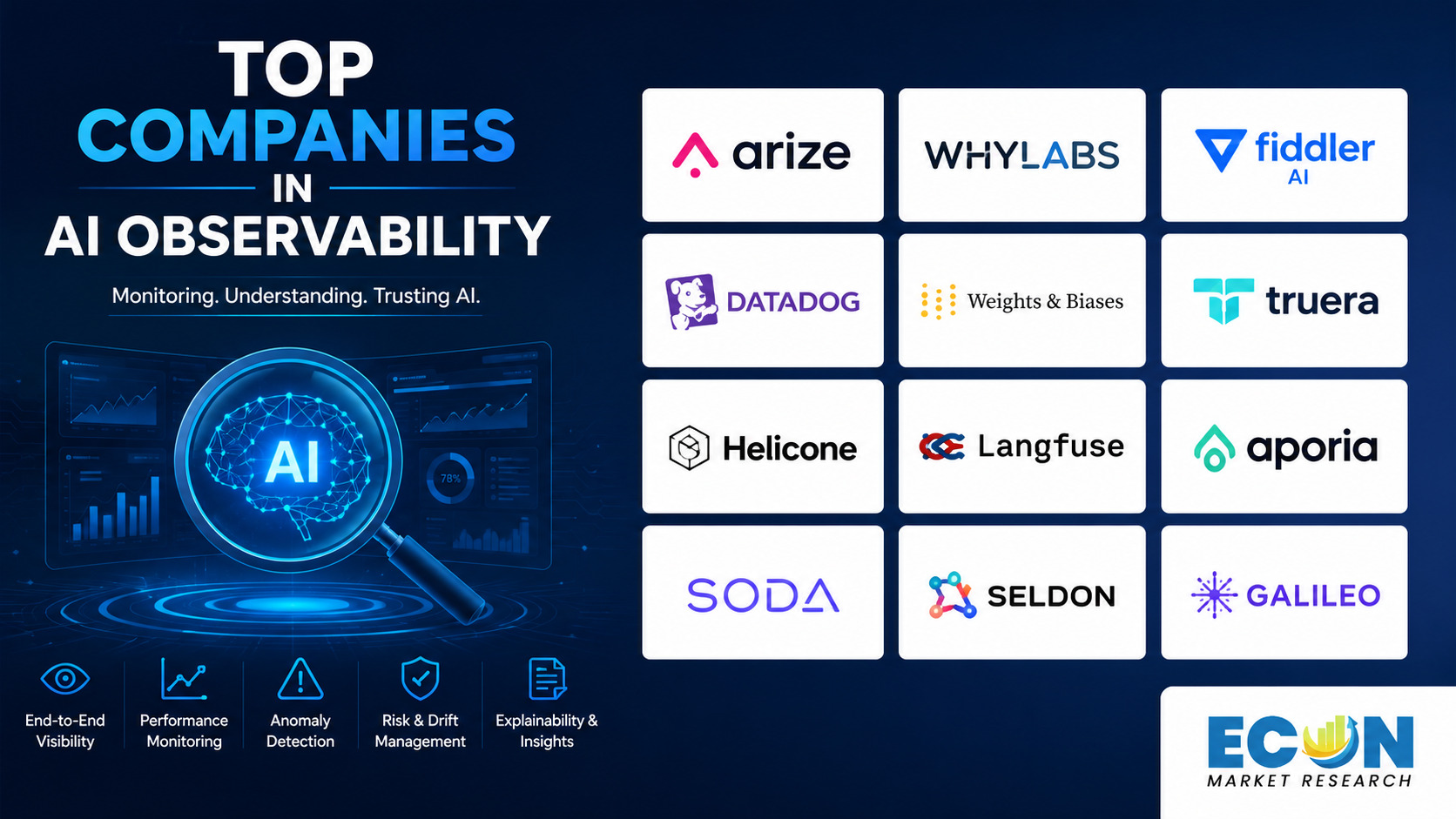
AI observability differs from traditional application monitoring because an AI system can return a technically successful response within 2 seconds while still producing inaccurate, unsafe, biased, or irrelevant content. Enterprises therefore monitor not only uptime and errors but also groundedness, context relevance, retrieval quality, toxicity, prompt injection, tool selection, model drift, and task completion. AI data-center power capacity reached 29.6 gigawatts in 2025, demonstrating the infrastructure scale behind production AI. This expansion is increasing demand for AI observability solutions that correlate model behavior with application services, databases, vector stores, GPUs, APIs, and user interactions.
Market Evolution and Growth Drivers
The AI observability market evolved from conventional model monitoring systems that tracked prediction accuracy, feature drift, and data quality into full-stack platforms supporting LLMs, retrieval-augmented generation, multimodal models, and multi-agent workflows. Between November 2022 and October 2024, the inference cost of a model delivering GPT-3.5-level benchmark performance declined 280-fold, enabling enterprises to run substantially larger numbers of AI requests. Open-source AI development also expanded to 5.6 million projects by 2025, creating complex ecosystems in which multiple models, prompts, frameworks, gateways, databases, and tools must be monitored simultaneously.
Growth is being driven by at least 5 operational requirements: dependable model outputs, transparent agent decisions, regulatory compliance, infrastructure efficiency, and rapid troubleshooting. Modern AI observability platforms collect 3 core telemetry signals—traces, metrics, and logs—and enrich them with model names, input and output tokens, prompt versions, tool calls, retrieval documents, evaluation scores, and user feedback. This expanded telemetry allows engineering teams to identify whether a failure originated in the model, prompt, retriever, vector database, agent framework, external tool, cloud service, or application code rather than treating every failure as a generic software incident.
Top 5 Latest Trends in the AI Observability
1. Agentic AI Observability and Decision-Lineage Monitoring
Agentic AI observability is becoming one of the most important AI observability trends because autonomous agents perform multiple actions before generating a final result. A single agent session can include 10 tool calls, 4 sub-agents, 3 model providers, 2 retrieval systems, and dozens of intermediate decisions. Traditional dashboards that show only the final response cannot explain why an agent selected the wrong tool, repeated a task, entered a loop, exceeded a token budget, or passed incorrect context to another agent. Agent observability platforms solve this problem by capturing complete session trees, parent-child spans, decision paths, tool inputs, tool outputs, retries, memory calls, and agent handoffs.
Organizational AI adoption reached 88% in 2025, but agent use remained in the single digits across most business functions, indicating that production reliability is still developing. AI observability vendors are therefore introducing agent service maps, execution timelines, automated evaluations, root-cause analysis, and fleet-level dashboards. These capabilities enable teams to compare 2 agent versions, determine which step caused a failure, and calculate completion rates across thousands of sessions. Agentic AI observability will become essential as organizations move from simple chat interfaces to systems that autonomously schedule tasks, update databases, generate code, process claims, or interact with customers.
2. OpenTelemetry-Based AI Observability
OpenTelemetry is emerging as a common foundation for AI observability because enterprises want portable telemetry rather than proprietary tracing formats. Its generative AI semantic conventions standardize how applications record model identifiers, prompt events, input tokens, output tokens, tool calls, tool results, embeddings, and agent operations. Compatible platforms can ingest 3 primary signals—metrics, traces, and logs—through a shared telemetry pipeline, helping teams correlate an LLM response with the application, database, infrastructure, and network activity that supported it.
Support for OpenTelemetry GenAI semantic conventions version 1.37 and later allows applications to send compliant spans without depending entirely on a vendor-specific SDK. This architecture reduces instrumentation duplication when an enterprise operates 5 model providers or replaces 1 AI framework with another. OpenTelemetry also supports vendor-neutral data collection through collectors and OTLP exporters, giving organizations greater control over data residency and retention. However, standardized telemetry records what happened; specialized AI observability platforms are still needed to evaluate whether the output was accurate, relevant, safe, grounded, or compliant. The strongest platforms combine open instrumentation with purpose-built evaluations rather than treating the 2 capabilities as substitutes.
3. Continuous Evaluation and Production Quality Gates
Continuous AI evaluation is replacing periodic offline testing because model behavior can change after a prompt update, provider upgrade, retrieval-data modification, or user-behavior shift. A 2026 assessment of 26 leading models found hallucination rates ranging from 22% to 94% under a demanding accuracy benchmark. This variation demonstrates why selecting a well-known model is not enough to ensure dependable performance in a specific application. AI observability platforms increasingly apply automated evaluators to production traces and measure groundedness, relevance, safety, task completion, retrieval quality, sentiment, and policy compliance.
Production quality gates connect AI observability data with deployment workflows. For example, a release can be blocked when groundedness falls below 90%, p95 latency rises above 4 seconds, or task completion declines by 8 percentage points. Open-source observability and evaluation platforms have also accelerated adoption; 1 major open-source AI observability project reached 2 million monthly downloads following its 2023 launch. Leading platforms now integrate with 40 or more models, agent frameworks, and AI development tools, enabling teams to apply the same evaluation rules across diverse environments. This trend transforms observability from passive dashboard viewing into an active quality-control system.
4. AI Security, Governance, and Regulatory Observability
AI observability is converging with security and governance because production AI systems process sensitive data, execute tools, and generate decisions that may affect customers, employees, or regulated operations. In 2025, AI-specific governance roles increased by 17%, while the percentage of businesses without responsible AI policies declined from 24% to 11%. However, 59% of organizations still identified knowledge gaps as a responsible AI obstacle, 48% cited budget limitations, and 41% reported regulatory uncertainty. These figures are driving demand for platforms that produce continuous evidence rather than relying on annual compliance reviews.
Governance-focused AI observability records prompt versions, model versions, evaluator results, user consent, data access, policy violations, human overrides, and deployment approvals. In Europe, prohibited AI practices and AI-literacy provisions became applicable on February 2, 2025, while major transparency requirements are scheduled to apply from August 2, 2026. Organizations therefore need auditable logs showing when users interacted with AI, what model produced an output, which data was used, and whether content disclosures or controls were activated. AI observability platforms are responding with real-time guardrails, personally identifiable information detection, prompt-injection monitoring, policy engines, risk reports, and immutable audit histories.
5. Full-Stack Cost and Infrastructure Observability
The fifth major trend is the integration of model-quality observability with infrastructure, token, latency, and capacity monitoring. AI data-center capacity reached 29.6 gigawatts in 2025, making compute efficiency a direct operational concern for organizations deploying AI at scale. A model may deliver accurate results but remain unsuitable for production if it requires 5 times as many tokens, produces 3 times the latency, or consumes excessive GPU resources. Full-stack AI observability connects response quality with GPU utilization, memory, queue depth, network delay, API limits, cache performance, token usage, and model routing.
A 2026 developer-observability study used a 24-model pricing registry and reported less than 2% variance between tracked usage and provider billing data. Although individual implementations differ, the result shows the value of collecting real token counts instead of relying on estimates. Modern dashboards measure time to first token, total generation time, input-output ratios, cache-hit rates, p50 latency, p95 latency, error percentages, and cost per completed task. The business value comes from comparing quality and efficiency together: a model that costs 20% less per request may be unsuitable if its failure rate is 12 percentage points higher.
Top 5 Companies in the AI Observability
1. Arize AI
Arize AI is a specialized AI engineering, evaluation, and observability company headquartered in San Francisco, California. Its platform supports traditional machine learning, generative AI, computer vision, LLM applications, retrieval-augmented generation, and autonomous agents. The company operates across 2 principal product environments: an enterprise AI engineering platform and an open-source observability platform. Its open-source platform launched in 2023 and had reached 2 million monthly downloads by February 2025, demonstrating strong adoption among AI developers.
Company overview: Arize AI focuses on helping engineering teams build, evaluate, observe, and improve production AI through 1 connected development and monitoring workflow.
Headquarters: San Francisco, California, United States, with a workforce category of 51–200 employees listed in 2026.
Core AI observability expertise: Agent tracing, LLM evaluation, drift detection, explainability, root-cause analysis, prompt experimentation, retrieval diagnostics, and computer-vision monitoring across 5 major AI workload categories.
Major products and services: Arize AX, Phoenix, OpenInference instrumentation, Prompt IDE, online evaluations, offline evaluations, experiments, model monitoring, and integrations with 40+ AI models, frameworks, and development tools.
Arize AI is particularly relevant for organizations that want observability to begin before deployment rather than after a production failure. Teams can compare 2 prompt versions, run evaluation datasets, inspect traces, identify retrieval failures, and reuse production examples in experiments. Phoenix provides open-source tracing and evaluation, while Arize AX adds enterprise controls, collaboration, scalability, security, and governance. This 2-tier product strategy supports both individual developers testing early applications and large organizations managing multiple production AI systems.
2. Fiddler AI
Fiddler AI was founded in 2018 and is headquartered in Palo Alto, California. The company began with explainable AI and model-performance monitoring before expanding into generative AI, LLM security, agentic observability, continuous evaluation, governance, and real-time guardrails. Its platform is designed as a control plane covering 3 operational requirements: visibility into agent behavior, enforcement of safety policies, and governance across the AI lifecycle.
Company overview: Fiddler AI provides observability and security for predictive models, generative AI applications, coding agents, and multi-agent systems within 1 centralized platform.
Headquarters: Palo Alto, California, United States, with additional operations in India supporting regional customers and 24/7 service requirements.
Core AI observability expertise: Model explainability, root-cause analysis, agent decision lineage, hallucination monitoring, drift detection, safety evaluation, privacy controls, and AI governance developed since 2018.
Major products and services: Fiddler Control Plane, Agentic Observability, LLM Observability, Fiddler Experiments, Guardrails, Centor Models, Evaluator Rules, risk reporting, and governance workflows across 3 lifecycle stages—testing, production monitoring, and enforcement.
Fiddler AI differentiates itself through the integration of observability with inline controls. Its platform can inspect inputs before they reach a model and review outputs before they reach an application or user. This 2-direction enforcement model is useful for detecting personally identifiable information, protected health information, unsafe content, secrets, and unsupported claims. The company also acquired an agent-security specialist in 2026, extending its focus from model monitoring to security-posture management for complex agent ecosystems.
3. Datadog
Datadog was founded in 2010 and maintains its global headquarters in New York City. The company is known for full-stack cloud observability and has extended that platform into LLM and agent observability. Its approach connects AI traces with application performance, logs, infrastructure, databases, security events, network activity, and user experience. This unified architecture is valuable when a generative AI failure depends on 3 interconnected layers: the AI model, the application workflow, and the underlying cloud infrastructure.
Company overview: Datadog provides cloud-scale monitoring, security, application performance management, log management, infrastructure observability, and AI observability through 1 integrated platform.
Headquarters: New York City, New York, United States, at its global headquarters established within a company incorporated in 2010.
Core AI observability expertise: End-to-end agent tracing, latency analysis, token tracking, usage monitoring, quality evaluations, error analysis, infrastructure correlation, and prompt-injection monitoring across 3 telemetry layers.
Major products and services: Agent Observability, LLM tracing, evaluation tools, prompt testing, cost dashboards, GPU Monitoring, Application Performance Monitoring, Log Management, Cloud Security, and automatic instrumentation for OpenTelemetry GenAI convention version 1.37 or later.
Datadog supports automated evaluations through 6 listed third-party model-provider categories, including major cloud and foundation-model environments. Its automatic instrumentation can trace popular LLM frameworks without requiring developers to manually create every span. This feature reduces deployment effort for teams operating dozens of services. Datadog is a strong option when AI applications form part of a larger digital platform and engineering teams want to troubleshoot model, application, infrastructure, and security issues without switching between 4 separate monitoring systems.
4. Dynatrace
Dynatrace was founded in 2005 and is headquartered in Boston, Massachusetts. The company applies observability across cloud applications, infrastructure, security, digital experience, generative AI, LLMs, and autonomous agents. Its AI observability capabilities correlate model activity with upstream services and downstream infrastructure, allowing teams to investigate failures across the complete application path rather than examining isolated model requests.
Company overview: Dynatrace delivers observability, application security, automation, and operational intelligence for complex enterprise environments through 1 integrated architecture.
Headquarters: Boston, Massachusetts, United States, with the current corporate headquarters opened at Atlantic Wharf in 2025.
Core AI observability expertise: LLM tracing, agent monitoring, token-level visibility, application dependency analysis, infrastructure correlation, anomaly detection, causal analysis, and automated root-cause identification across 3 telemetry signals.
Major products and services: Dynatrace AI Observability, Davis AI, Grail data analytics, distributed tracing, OpenTelemetry ingestion, application security, infrastructure monitoring, and out-of-the-box support for 20+ AI technologies.
Dynatrace is suited to large enterprises that operate hybrid cloud, Kubernetes, microservices, and regulated applications. Its AI Observability application includes ready-made dashboards, automatic instrumentation, targeted metrics, and guided debugging flows. Support for 20+ technologies allows engineering teams to observe model providers, agent frameworks, orchestration systems, and downstream services through a shared platform. The company’s long operating history since 2005 also gives it experience with enterprise-scale telemetry, service dependencies, and high-volume production monitoring.
5. New Relic
New Relic was founded in 2008 and is headquartered in San Francisco, California. The company provides application, infrastructure, digital experience, log, security, and AI monitoring. It introduced dedicated AI monitoring in 2023 and expanded agentic AI monitoring capabilities in February 2026. These capabilities include service maps showing interactions among agents, request counts, latency, error percentages, and trace-level inspection of agent and tool calls.
Company overview: New Relic offers intelligent observability for software applications, cloud services, AI models, and autonomous agents across 1 unified telemetry platform.
Headquarters: San Francisco, California, United States, with operations across 14 countries and a workforce reported at over 2,000 employees.
Core AI observability expertise: AI application monitoring, agent service maps, model comparison, response tracing, latency analysis, token monitoring, quality analysis, vector-store visibility, and autonomous incident support across 2 monitoring levels.
Major products and services: New Relic AI Monitoring, AI Agent Monitoring, New Relic AI, New Relic Autopilot, Ground Truth, Application Performance Monitoring, infrastructure monitoring, and more than 50 AI ecosystem integrations.
New Relic provides more than 50 AI quick-start integrations spanning model providers, vector databases, frameworks, and supporting AI technologies. Its platform can compare model performance across application environments and provide traces for individual AI responses. In 2026, New Relic also expanded its agentic capabilities through real-time operational knowledge and Model Context Protocol integrations. This direction positions the company for organizations that want AI agents to consume live observability context while keeping engineering teams involved in the final operational decisions.
Regional Outlook
North America
North America is a central region for AI observability because it contains a high concentration of model developers, cloud providers, enterprise software vendors, AI startups, research institutions, and large-scale AI adopters. United States-based institutions produced 40 notable AI models in 2024, compared with 15 from China and 3 from Europe. The number of models and providers gives North American enterprises greater choice, but it also increases monitoring complexity. A company may use 3 foundation models, 2 vector databases, 4 agent frameworks, and several cloud environments, creating demand for vendor-neutral tracing, model comparisons, automated evaluations, and centralized policy enforcement.
North American AI observability adoption is also influenced by the shift from experimentation to production. Global organizational AI use reached 88% in 2025, while generative AI appeared in at least 1 business function at 70% of organizations. North American enterprises in financial services, healthcare, retail, telecommunications, software, insurance, and government are deploying AI in customer service, software development, fraud detection, claims processing, search, and analytics. Each production deployment requires monitoring of quality, latency, data access, model versions, security, and user impact rather than basic API availability alone.
Regulatory fragmentation is another market driver. The number of enacted state-level AI laws in the United States increased from 49 in 2023 to 131 in 2024. Because requirements may differ across employment, consumer protection, privacy, healthcare, education, and automated decision-making, organizations need configurable AI observability controls. North American demand will therefore favor platforms that provide automated evidence collection, flexible evaluation rules, regional data handling, complete audit histories, and integrations with DevOps and security workflows.
The region also has strong opportunities in agent observability and AI infrastructure monitoring. Agent use remained in the single digits across most business functions during 2025, leaving substantial room for expansion as reliability improves. Enterprises will need to observe agent plans, memory, tool calls, handoffs, permissions, and final outcomes. At the infrastructure level, rising GPU usage and data-center capacity will increase demand for solutions that correlate response quality with token consumption, p95 latency, GPU utilization, cache performance, rate limits, and energy intensity.
Europe
Europe’s AI observability industry is shaped by enterprise digitalization, multilingual AI deployment, strong privacy expectations, and a detailed regulatory environment. In 2025, 20.0% of European Union enterprises with at least 10 employees used AI technologies, compared with 13.5% in 2024. Adoption varied significantly by organization size: 17% of small enterprises used AI, compared with 30.36% of medium enterprises and 55.03% of large enterprises. These differences create 2 distinct observability markets—enterprise platforms for complex multinational deployments and accessible managed solutions for smaller companies.
The region’s regulatory structure is increasing demand for transparent, auditable AI operations. The AI regulatory framework entered into force on August 1, 2024, prohibited-practice and AI-literacy provisions became applicable on February 2, 2025, and key transparency requirements are scheduled for August 2, 2026. AI observability platforms can help organizations document model versions, training-data information, user disclosures, prompt-response records, human oversight, safety tests, and policy violations. However, observability technology supports compliance evidence and does not replace legal assessment or organizational accountability.
Europe also has growing AI infrastructure capacity. State-supported AI supercomputing clusters in Europe and Central Asia increased from 3 in 2018 to 44 in 2025. This infrastructure can support domestic AI development, scientific models, industrial applications, sovereign AI systems, and public-sector deployments. As workloads spread across regional clouds and private infrastructure, enterprises will need observability that supports OpenTelemetry, self-hosted deployment, configurable retention, data masking, and local processing.
User adoption further supports market development. In 2025, 32.7% of EU residents aged 16–74 used generative AI tools, while usage among people aged 16–24 reached 63.8%. As AI becomes integrated into work, education, customer service, public services, and digital products, organizations will face greater pressure to monitor accuracy and disclose automated interactions. Europe is therefore likely to become a leading market for governance-focused AI observability, multilingual evaluation, sovereign telemetry, explainability, and transparent AI content monitoring.
Asia-Pacific
Asia-Pacific contains several of the world’s fastest-developing AI ecosystems, including China, India, Singapore, Japan, South Korea, and Australia. China-based institutions produced 15 notable AI models in 2024, ranking behind the United States but ahead of Europe. The region’s model development, large digital-user base, cloud expansion, manufacturing automation, financial technology, telecommunications systems, and multilingual requirements are creating demand for AI observability platforms capable of supporting high request volumes and diverse production environments.
Singapore illustrates the region’s rapid enterprise adoption. AI usage among Singapore’s small and medium enterprises increased from 4.2% to 14.5% in 1 year, while adoption among larger enterprises increased from 44.0% to 62.5%. A separate initiative announced in 2025 targeted 2,000 local enterprises for expanded practical AI adoption. As more businesses deploy AI in customer operations, logistics, finance, marketing, and professional services, demand will increase for managed observability, prebuilt evaluations, model comparisons, privacy controls, and low-code monitoring.
India also represents a strong opportunity for AI observability. A reported 59% of surveyed Indian enterprises had actively deployed AI, while 94% identified the ability to explain AI decisions as important. India’s AI adoption index reached 2.47 on a 4-point scale in 2024, and 87% of surveyed companies were positioned within the middle stages of AI maturity. These figures indicate broad adoption alongside an ongoing need for governance, explainability, skills, and production controls.
Asia-Pacific enterprises frequently need to monitor models across multiple languages, scripts, cultural contexts, and regulatory jurisdictions. A customer-support system may require evaluation in 10 languages, while a financial model may need separate fairness and performance thresholds for several markets. Regional growth will favor platforms offering multilingual evaluations, self-hosted collectors, data-residency controls, edge monitoring, mobile AI observability, and integrations with local cloud infrastructure. The region will also drive observability for robotics, smart manufacturing, connected vehicles, telecommunications, and industrial computer vision.
Middle East and Africa
The Middle East and Africa AI observability market is developing alongside national AI strategies, smart-government programs, financial technology, energy digitalization, telecommunications expansion, healthcare modernization, and sovereign AI infrastructure. In 2025, generative AI adoption reached 64% in the United Arab Emirates, compared with a global adoption level of 53%. This strong usage increases the need for monitoring systems that measure Arabic-language quality, factual accuracy, data privacy, service reliability, and compliance across government and enterprise applications.
Regional infrastructure remains uneven but is expanding. By 2025, the Middle East and North Africa had reached 8 state-supported AI supercomputing clusters, compared with 44 across Europe and Central Asia. This difference presents both a limitation and an opportunity. As governments and enterprises add domestic cloud, data-center, and AI compute capacity, observability platforms will be needed to optimize GPU utilization, latency, model routing, capacity planning, energy use, and service availability.
Saudi Arabia’s Vision 2030 is organized around 3 pillars—a vibrant society, a thriving economy, and an ambitious nation—and includes broad digital-transformation initiatives. The United Arab Emirates consists of 7 emirates with significant public- and private-sector AI activity in Abu Dhabi and Dubai. These national programs can expand AI observability demand in citizen services, transport, tourism, energy, healthcare, banking, cybersecurity, and smart-city operations. High-impact applications will require traceability, human oversight, identity protection, Arabic-language evaluations, and auditable records.
Africa’s opportunity is likely to focus on cloud-based and managed AI observability rather than large internal platforms during the initial adoption stage. Telecommunications providers, banks, healthcare systems, public agencies, and technology startups can use AI observability to detect model drift, monitor mobile-service assistants, protect customer information, and evaluate multilingual outputs. Platforms that support low-bandwidth environments, flexible data collection, regional hosting, and affordable deployment models will be better positioned. Over the next 5 years, partnerships with cloud providers, governments, universities, and local systems integrators could accelerate practical adoption across the region.
Future Opportunities in the AI Observability
The largest future opportunity is the gap between broad AI adoption and limited autonomous-agent deployment. Although 88% of surveyed organizations used AI in 2025, agent deployment remained in the single digits across most functions. Organizations will require tools that simulate agent behavior before release, monitor every production action, enforce permissions, detect loops, evaluate task completion, and provide human approval for high-impact decisions. Agent fleet management could become a major AI observability category as enterprises operate hundreds or thousands of specialized agents.
A second opportunity is industry-specific evaluation. Healthcare applications need to monitor clinical accuracy and protected information, financial systems need fairness and auditability, industrial AI requires sensor and computer-vision drift detection, while customer-service agents need groundedness and policy adherence. Generic metrics cannot represent all 4 environments. AI observability providers can develop preconfigured evaluation libraries, risk templates, benchmark datasets, regulatory mappings, and dashboards for individual sectors.
AI security observability represents a third major opportunity. Future platforms will combine prompt-injection detection, sensitive-data controls, agent permission monitoring, model behavior analysis, tool-risk scoring, and output validation within 1 policy layer. The share of organizations without responsible AI policies fell from 24% to 11% during 2025, showing that governance is becoming formalized. Observability systems can turn written policies into measurable technical controls and provide evidence when a policy was triggered, bypassed, or manually overridden.
Infrastructure efficiency will create a fourth opportunity as AI capacity expands beyond 29.6 gigawatts. Enterprises will increasingly compare models using combined quality, latency, energy, token, and GPU metrics. Model-routing engines could use observability data to select among 3 models based on complexity, quality thresholds, regional availability, and capacity. Smaller models may handle routine tasks, while more capable models are reserved for difficult requests. This approach can improve efficiency without reducing output standards.
The fifth opportunity involves observability for AI-generated software. A 2026 study evaluated 200 generated microservice systems with 13 injected fault types and found that explicit fault evidence appeared for only a limited percentage of failures, reaching 13.99% in the strongest measured case. This suggests that functionally correct AI-generated code may still lack useful logs, metrics, and diagnostic context. Future AI observability platforms could automatically inspect generated code, recommend instrumentation, validate telemetry coverage, and test whether failures produce actionable signals before applications reach production.
Conclusion
The top companies in AI observability are building a new operational layer for machine learning models, generative AI applications, and autonomous agents. Arize AI combines open-source and enterprise evaluation workflows, Fiddler AI integrates observability with security and governance, Datadog connects agent traces with full-stack cloud telemetry, Dynatrace correlates AI behavior with enterprise application dependencies, and New Relic provides more than 50 AI ecosystem integrations. These 5 companies represent different approaches, but all recognize that traditional uptime monitoring cannot determine whether an AI response is accurate, grounded, safe, efficient, or compliant.
AI adoption reached 88% of surveyed organizations in 2025, yet autonomous-agent deployment remained in the single digits across most functions. This gap defines the future of AI observability. Enterprises need visibility into 3 telemetry signals—traces, metrics, and logs—along with prompts, responses, retrieval documents, token counts, tool calls, evaluation scores, permissions, and user feedback. Without this context, engineering teams cannot reliably explain why an AI system failed or determine whether a new version improved performance.
The next phase of AI observability will combine development testing, production monitoring, security enforcement, governance evidence, and infrastructure optimization within 1 continuous system. Organizations selecting an AI observability platform should evaluate at least 6 criteria: framework coverage, evaluation flexibility, agent tracing, deployment options, security controls, and full-stack correlation. Companies that establish these capabilities before scaling AI will be better equipped to improve model quality, reduce operational risk, satisfy regulatory requirements, and deploy dependable AI systems across global markets.