


Top Generative AI Server Companies Shaping AI Infrastructure
Top Generative AI Server Companies Leading in 2026
1. Introduction
Overview of the Global Generative AI Server Industry
The global Generative AI Server industry has moved from experimental GPU clusters to production-scale infrastructure designed for language models, multimodal systems, coding assistants, synthetic media, and AI agents. Data centres consumed about 415 TWh of electricity in 2024, equal to roughly 1.5% of global electricity use, while the United States, China, and Europe represented approximately 45%, 25%, and 15% of that demand. By 2025, global data-centre consumption had reached about 485 TWh, and AI-focused facilities were expanding faster than conventional cloud environments. This shift is increasing demand for dense GPU servers, high-bandwidth memory, advanced networking, direct liquid cooling, and enterprise-grade orchestration.
Market Evolution and Growth Drivers
Generative AI Server architecture has evolved rapidly since 2022, when many deployments relied on isolated 4-GPU or 8-GPU nodes connected through standard data-centre networks. By 2026, leading platforms had advanced to rack-scale designs combining 72 accelerators, 36 CPUs, tens of terabytes of fast memory, and fabric bandwidth above 100 TB/s. The growth drivers are practical: larger models, longer context windows, real-time reasoning, retrieval-augmented generation, video generation, and agentic workflows require more memory capacity and faster communication between processors. Power density is also changing procurement decisions because a single high-end rack can approach 120 kW, forcing buyers to evaluate cooling, electrical distribution, software, security, and serviceability as 1 integrated system.
2. Top 5 Latest Trends in the Generative AI Server
Trend 1: Rack-Scale Computing Is Replacing Standalone GPU Nodes
The 1st major Generative AI Server trend is the transition from individual servers to rack-scale computers that operate as 1 coordinated accelerator domain. A current 72-GPU system can combine 36 Grace CPUs, 72 Blackwell Ultra GPUs, 2,592 Arm cores, approximately 20 TB of GPU memory, and about 130 TB/s of NVLink bandwidth. This structure reduces the communication penalty that appears when very large models are divided across dozens of separate machines. Rack-scale platforms are especially relevant for mixture-of-experts models, trillion-parameter research, long-context inference, and multi-agent applications that require continuous access to shared memory. Buyers are therefore evaluating the complete rack, including compute trays, network switches, power shelves, cooling manifolds, management software, and service procedures, rather than comparing only 1 server’s processor count.
Trend 2: Direct Liquid Cooling Is Becoming a Core Design Requirement
The 2nd Generative AI Server trend is the adoption of direct liquid cooling for high-density training and inference. Traditional enterprise racks commonly operate in the 10 kW to 30 kW range, yet 64-GPU AI racks can require roughly 80 kW to 90 kW, and advanced 72-GPU systems can approach 120 kW. This difference makes air-only cooling difficult in many existing facilities. Server manufacturers are responding with cold plates for GPUs, CPUs, and interconnect switches, along with redundant coolant distribution units and leak-detection systems. One large 256-GPU cluster design uses 5 racks and a 250 kW in-rack coolant distribution unit. The trend is not merely about removing heat; liquid cooling can reduce fan power, maintain stable accelerator frequencies, increase rack density, and help operators deploy more Generative AI Server capacity within limited floor space.
Trend 3: Inference Efficiency Is Becoming as Important as Training Speed
The 3rd trend is the shift from training-first procurement to balanced Generative AI Server infrastructure for training, fine-tuning, reasoning, and continuous inference. A model may be trained 1 time but queried millions of times, so token throughput, time-to-first-token, latency, batching efficiency, memory bandwidth, and power per response increasingly influence server selection. New accelerator architectures use lower-precision formats such as FP4 and include specialized transformer engines to increase inference output without expanding physical space at the same rate. Current rack-scale systems claim up to 30 times faster real-time inference for trillion-parameter models under specified comparisons, while industry benchmarks introduced a 120-billion-parameter open-weight model and latency-constrained reasoning tests in 2026. This trend is encouraging enterprises to build separate inference pools, use smaller specialized models, and adopt speculative decoding, quantization, caching, and dynamic GPU allocation.
Trend 4: Heterogeneous and Sovereign AI Infrastructure Is Expanding
The 4th Generative AI Server trend is the growth of heterogeneous computing and sovereign AI programs. Enterprises no longer want every workload locked to 1 accelerator type, so modern servers increasingly support NVIDIA B300, B200, and H200 options alongside AMD MI355X-class accelerators. At the national level, governments are creating shared compute capacity for universities, startups, public agencies, and domestic model developers. India’s AI compute program identified 18,693 GPUs, including 10,000 operational units and 8,693 additional units in the pipeline, while Europe established 19 AI Factories and 13 supporting antennas. These initiatives expand demand for secure Generative AI Server platforms with local data control, multilingual model support, usage metering, workload isolation, and policy-based access. Sovereign deployments also favor modular systems because capacity must be distributed across research, healthcare, manufacturing, education, and public-service workloads.
Trend 5: High-Speed Fabric, Storage, and Benchmark Transparency Are Differentiators
The 5th trend is the recognition that a Generative AI Server is only as productive as its data and network pipeline. A 256-GPU cluster can contain about 45 TB of HBM3e memory and use 400 Gb/s Ethernet or InfiniBand links, but underutilized accelerators remain possible when storage, data preparation, checkpointing, or collective communication is slow. Vendors are therefore integrating scale-up links inside nodes, scale-out fabrics between nodes, dedicated storage networks, GPUDirect-class data paths, and all-flash systems. Procurement teams are also demanding reproducible benchmark evidence rather than relying on peak specifications. One industry benchmarking organization reports more than 125 members, 10 benchmark suites, and over 89,700 performance results. In 2026, its inference suite added a 120B open model and updated reasoning tests, giving buyers more relevant ways to compare Generative AI Server latency, throughput, accuracy, and efficiency.
3. Top 5 Companies in the Generative AI Server
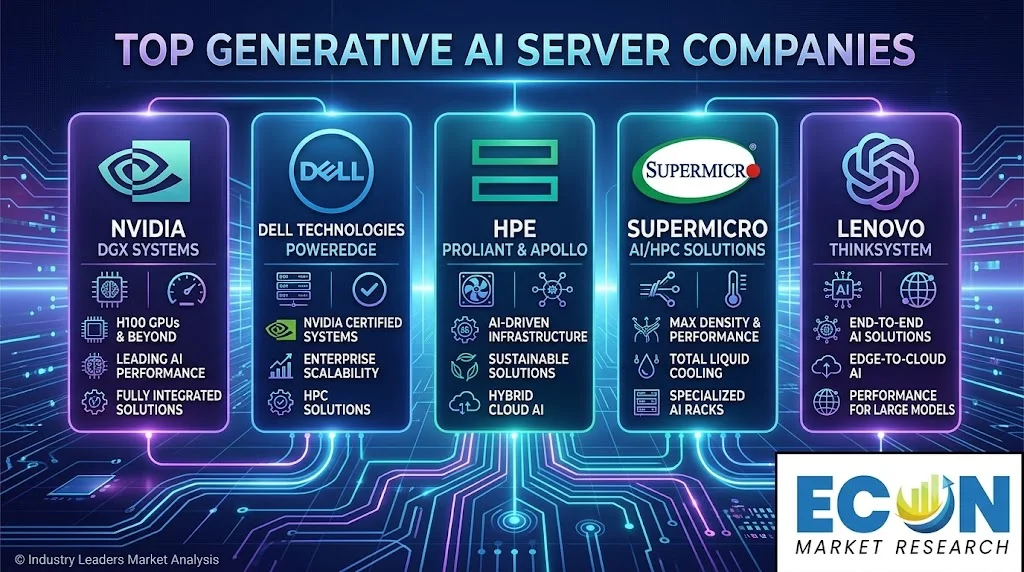
The following 5 companies are presented as leading Generative AI Server providers based on platform breadth, current accelerator support, rack-scale engineering, cooling capability, enterprise software, and global deployment experience rather than revenue-based ranking.
1. NVIDIA
NVIDIA, founded in 1993 and headquartered in Santa Clara, California, is a foundational Generative AI Server company because it supplies accelerators, interconnects, rack-scale systems, networking, software libraries, and reference architectures. Its core expertise spans GPU computing, transformer acceleration, NVLink scale-up communication, InfiniBand and Ethernet scale-out networking, and full-stack AI software. Major products and services include DGX systems, HGX baseboards, GB200 NVL72, GB300 NVL72, DGX SuperPOD, AI Enterprise software, CUDA libraries, and cluster-management tools. The GB300 NVL72 configuration integrates 72 Blackwell Ultra GPUs and 36 Grace CPUs, while offering about 20 TB of GPU memory and 130 TB/s of NVLink bandwidth. NVIDIA’s advantage is vertical integration across silicon, systems, networking, compilers, model frameworks, and deployment blueprints, enabling customers to build Generative AI Server environments from 1 node to multi-rack AI factories.
2. Dell Technologies
Dell Technologies, founded in 1984 and headquartered in Round Rock, Texas, is a major enterprise Generative AI Server supplier with established capabilities in PowerEdge servers, storage, networking, lifecycle services, and validated AI solutions. Its core expertise is integrating current GPUs with x86 or Grace-based compute, high-capacity memory, NVMe storage, liquid cooling, redundant power, and enterprise management. Major products include the PowerEdge XE9680, XE9680L, XE9780, XE9785, XE8712, and rack-scale XE9712. The XE9712 is a 48U platform designed around 72 NVIDIA B300 GPUs and 36 Grace CPUs, while the XE9780 is a 10U system supporting 8 NVIDIA HGX B200 or B300 accelerators. Dell also offers deployment, support, data protection, and professional services, making its Generative AI Server portfolio suitable for enterprises that need standardized procurement, global service coverage, security controls, and integration with existing data-centre operations.
3. Hewlett Packard Enterprise
Hewlett Packard Enterprise, established as an independent company in 2015 and headquartered in Spring, Texas, combines enterprise servers with decades of supercomputing and liquid-cooling experience. Its core Generative AI Server expertise covers large-model training, inference, HPC, high-speed fabrics, cluster software, direct liquid cooling, and managed private-cloud deployment. Major products and services include HPE ProLiant Compute XD685, HPE Cray XD670, HPE Cray Supercomputing platforms, Slingshot networking, AI software, and GreenLake-based consumption models. The XD685 supports 8 accelerators, including NVIDIA B300, B200, H200, or AMD MI355X options, in a 5U direct-liquid-cooled or 6U air-cooled design. HPE’s Cray XD670 also achieved 6 first-place results in specified MLPerf Inference v5.1 tests. This combination positions HPE strongly for research institutions, governments, regulated enterprises, and organizations building Generative AI Server clusters that require proven cooling and large-scale operational support.
4. Supermicro
Supermicro, founded in 1993 and headquartered in San Jose, California, is known for rapid server platform development, broad component choice, high-density designs, and building-block data-centre architecture. Its core Generative AI Server expertise includes HGX systems, rack integration, direct liquid cooling, storage servers, high-speed networking, and factory-level cluster validation. Major offerings include 8-GPU HGX B200 systems, GB200 and GB300 rack-scale platforms, Universal GPU systems, AI SuperClusters, storage nodes, networking, and complete rack deployment. One reference SuperCluster combines 256 B200 GPUs across 5 racks, approximately 45 TB of HBM3e memory, 400 Gb/s networking, and a 250 kW coolant distribution unit. Supermicro is especially relevant to cloud providers, model developers, and enterprises that need many configuration choices, fast access to new accelerators, and dense Generative AI Server deployments tailored to specific power, cooling, storage, and network requirements.
5. Lenovo
Lenovo, founded in 1984, is incorporated in Hong Kong and maintains headquarters in Beijing, China, and Morrisville, North Carolina. Its core Generative AI Server expertise spans ThinkSystem infrastructure, hybrid AI, enterprise reliability, Neptune liquid cooling, GPU-dense platforms, storage, and professional services. Major products include the ThinkSystem SR780a V3, SR680a V3, SR675 V3, AI-ready ThinkAgile solutions, Lenovo Hybrid AI platforms, XClarity management, and Neptune cooling technologies. The liquid-cooled SR780a V3 occupies 5U, uses 2 fifth-generation Intel Xeon processors, and supports 8 NVIDIA H100, H200, or B200 GPUs; each B200 option provides 180 GB of HBM3e memory. Lenovo’s approach is attractive for organizations seeking Generative AI Server infrastructure that spans edge, private data centre, and cloud environments while emphasizing modularity, sustained thermal performance, lifecycle management, and integration with existing enterprise systems.
4. Regional Outlook
North America
North America remains the most mature Generative AI Server region because it contains major accelerator designers, server manufacturers, cloud platforms, model developers, research laboratories, and large data-centre clusters. The United States accounted for about 45% of global data-centre electricity consumption in 2024. U.S. data centres used approximately 176 TWh in 2023, equal to 4.4% of national electricity consumption, compared with 58 TWh in 2014. By 2028, consumption is projected at roughly 325 TWh to 580 TWh, or 6.7% to 12% of total U.S. electricity. These figures indicate strong demand for high-efficiency Generative AI Server hardware, direct liquid cooling, power-aware scheduling, and new generation capacity. Canada is also attracting AI infrastructure because of available land, cooler climates, hydroelectric resources in several provinces, and proximity to U.S. technology ecosystems.
The regional opportunity extends beyond hyperscale training clusters. Banks, healthcare systems, manufacturers, universities, government agencies, retailers, and software companies are deploying private inference environments with 4-GPU, 8-GPU, and multi-rack configurations. North American buyers typically prioritize cybersecurity, supply-chain visibility, service-level agreements, model governance, and compatibility with existing virtualization and container platforms. Grid availability is becoming a major constraint because nearly 50% of U.S. data-centre capacity is concentrated in 5 regional clusters. This concentration supports demand for modular data centres, behind-the-meter generation, workload shifting, energy storage, and servers that deliver more tokens per watt. The strongest Generative AI Server opportunities will therefore combine accelerator performance with cooling, networking, storage, energy management, and deployment services rather than treating the server as an isolated product.
Europe
Europe’s Generative AI Server outlook is shaped by sovereign compute, regulated data handling, multilingual model development, energy efficiency, and publicly supported supercomputing. The region represented about 15% of global data-centre electricity consumption in 2024, and its consumption is projected to increase by more than 45 TWh, or about 70%, between 2024 and 2030. Europe has established 19 AI Factories and 13 AI Factory Antennas to provide computing access and support for startups and small businesses. These facilities create demand for AI-optimized servers, shared scheduling platforms, secure tenant isolation, high-speed storage, and professional services. Several systems scheduled for 2026 use liquid-cooled architectures, showing that public infrastructure buyers are moving toward the same dense technologies used in commercial AI factories.
The European market also requires Generative AI Server vendors to address energy reporting, data residency, cybersecurity, model transparency, and the operational requirements of 27 European Union member states plus associated countries. Demand is distributed across automotive engineering, pharmaceuticals, industrial automation, financial services, climate research, public administration, media, and scientific computing. Europe’s language diversity creates practical demand for fine-tuning and inference across more than 20 widely used official languages, often with local or sector-specific datasets. Grid constraints in established hubs are encouraging expansion into Nordic countries, southern Europe, and secondary cities with available renewable electricity or district-heating opportunities. Vendors that offer direct liquid cooling, heat reuse, auditable software stacks, and flexible 8-GPU to 72-GPU configurations are positioned to benefit from Europe’s combination of sovereign AI investment and enterprise modernization.
Asia-Pacific
Asia-Pacific is a diverse Generative AI Server region led by China, Japan, India, South Korea, Singapore, Australia, and rapidly digitizing Southeast Asian markets. China represented about 25% of global data-centre electricity consumption in 2024, while its consumption is projected to rise by around 175 TWh, or 170%, by 2030. Japan’s increase is projected near 15 TWh, or 80%, over the same period. Japan’s ABCI 3.0 system, launched for general use in 2025, includes 766 compute nodes and 6,128 NVIDIA H200 GPUs, with approximately 6.2 exaflops of half-precision performance. Such national infrastructure supports foundation models, multimodal AI, robotics, manufacturing, and scientific research while creating a reference point for dense Generative AI Server deployment.
India is building another major demand centre through a compute pool of 18,693 GPUs, including 10,000 operational units and 8,693 units identified for expansion. The region’s opportunities range from frontier-model training to high-volume inference for populations measured in billions. Multilingual assistants, telecom automation, e-commerce, financial inclusion, smart manufacturing, healthcare imaging, and public digital services require different server sizes and cost structures. Singapore and Australia emphasize trusted regional cloud and enterprise deployments, while South Korea and Japan connect Generative AI Server demand with semiconductor, electronics, automotive, and robotics ecosystems. Power availability, import controls, chip supply, tropical cooling conditions, and data-sovereignty rules vary widely, so successful vendors need localized support, multiple accelerator choices, and configurations spanning compact 2U or 5U systems through 72-GPU rack-scale platforms.
Middle East & Africa
The Middle East and Africa Generative AI Server market is developing at 2 distinct speeds. Gulf countries are planning large AI factories backed by energy resources, government programs, sovereign investment, and new data-centre campuses, while much of Africa remains limited by power availability, connectivity, and smaller installed capacity. Saudi Arabia announced plans for AI factories with capacity of up to 500 MW over 5 years, supported by several hundred thousand advanced GPUs; the 1st phase includes an 18,000-GPU GB300 supercomputer. These plans create demand for rack-scale Generative AI Server systems, direct liquid cooling, desert-climate engineering, high-speed networking, cybersecurity, and local technical talent. The United Arab Emirates is similarly positioning Abu Dhabi and Dubai as regional hubs for cloud, models, and AI services.
Africa’s opportunity is smaller today but strategically important. Average data-centre electricity consumption on the continent was below 1 kWh per person in 2024 and is projected to remain slightly below 2 kWh by 2030. South Africa is the regional exception, with projected 2030 intensity above 25 kWh per person, more than 15 times the continental average. This gap indicates room for regional inference hubs, university clusters, language-model development, public-service AI, and managed GPU clouds. Practical Generative AI Server deployments in Africa may favor efficient 1-node to 8-node clusters, renewable-backed microgrids, shared national facilities, and models optimized for local languages. Vendors that combine affordable compute, remote management, training, financing, and resilient cooling will be better positioned than suppliers focused only on maximum rack density.
5. Future Opportunities in the Generative AI Server
Future Generative AI Server opportunities will come from the expansion of inference, sovereign AI, multimodal systems, robotics, scientific models, and autonomous agents. Global data-centre electricity consumption is projected to move from about 485 TWh in 2025 to around 950 TWh in 2030, while AI-focused data-centre power use could triple during that 5-year period. The resulting opportunity is not limited to selling more GPUs. Enterprises need complete systems that combine compute, memory, fabric, storage, cooling, security, observability, orchestration, and energy management. Specialized inference servers for 8B, 70B, and 120B models can become a major segment because many production applications do not require the largest frontier systems. Smaller models, retrieval, quantization, and caching can deliver acceptable quality with lower latency and power.
Another opportunity is the modernization of existing data centres that were designed for racks below 30 kW but must now support AI zones operating at 80 kW, 90 kW, or 120 kW. Vendors can address this transition through rear-door heat exchangers, direct-to-chip cooling, modular coolant distribution, high-voltage power shelves, prefabricated AI pods, and remote fleet management. Open networking and heterogeneous acceleration will also expand because buyers want alternatives across at least 2 accelerator ecosystems. By 2030, the most successful Generative AI Server providers are likely to sell measurable outcomes such as training time, tokens per second, time-to-first-token, uptime, and energy per task. Service opportunities will include model optimization, cluster tuning, benchmark validation, capacity planning, cybersecurity, and responsible decommissioning of earlier GPU generations.
6. Conclusion
The Generative AI Server industry has become a critical layer of global digital infrastructure in only 4 years, moving from experimental 8-GPU systems to integrated 72-GPU rack-scale platforms with more than 100 TB/s of internal fabric bandwidth. NVIDIA, Dell Technologies, Hewlett Packard Enterprise, Supermicro, and Lenovo represent 5 influential approaches to this market, ranging from full-stack accelerator platforms to enterprise integration, supercomputing, rapid building-block design, and liquid-cooled hybrid AI systems. Regional demand will remain uneven: North America leads in installed capacity, Europe is scaling 19 AI Factories, Asia-Pacific combines China’s scale with India’s 18,693-GPU program and Japan’s 6,128-GPU ABCI 3.0, while the Middle East is planning AI factories measured in hundreds of megawatts. Long-term leadership will depend on more than peak performance. Buyers will favor Generative AI Server solutions that balance throughput, latency, reliability, cooling, energy use, security, interoperability, and lifecycle support across 1 complete infrastructure stack.