


Top AI-Powered Digital Twin Companies Transforming Industry
The top AI-powered digital twin companies are advancing industrial simulation, predictive maintenance, smart infrastructure, robotics, and enterprise growth.
Introduction
Overview of the Global AI-Powered Digital Twin Industry
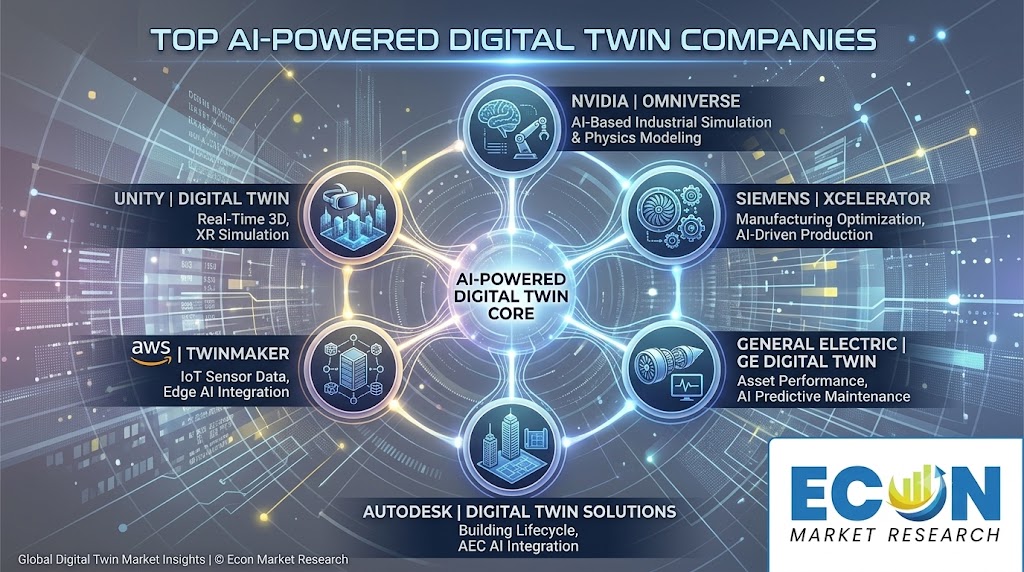
The global AI-powered digital twin industry is moving from isolated equipment models to intelligent virtual environments that represent factories, cities, energy systems, vehicles, buildings, and supply chains. An AI-powered digital twin combines real-time sensor data, physics-based simulation, machine learning, 3D visualization, and predictive analytics within 1 continuously updated digital model. Industrial automation provides a strong adoption foundation, with 542,000 industrial robots installed worldwide in 2024 and annual installations remaining above 500,000 units for 4 consecutive years. AI-powered digital twin platforms increasingly connect these machines with operational data, enabling predictive maintenance, production simulation, anomaly detection, energy optimization, and automated decision support.
Market Evolution and Growth Drivers
The AI-powered digital twin market has evolved through 3 major stages: static computer-aided models, connected IoT twins, and autonomous AI-driven twins. Modern platforms can analyze past performance, reflect current operating conditions, and simulate future scenarios before physical changes are implemented. This progression is being accelerated by 5G connectivity, cloud computing, edge processing, generative AI, computer vision, and GPU-based simulation. One automotive deployment has created virtual factory environments covering 1 million square meters, while another digital twin implementation delivered planning-process efficiency gains of 30%. The ability to test hundreds of operational scenarios without interrupting physical production is turning AI-powered digital twin technology into a central Industry 4.0 investment.
Top 5 Latest Trends in the AI-Powered Digital Twin Industry
1. Generative AI Copilots for Digital Twin Interaction
Generative AI is changing how engineers, operators, and maintenance teams interact with AI-powered digital twin systems. Instead of navigating complex dashboards, users can ask natural-language questions such as why a machine exceeded its temperature threshold during the previous 24 hours or which production configuration could reduce energy consumption by 10%. Digital Twin Composer, introduced at CES 2026, reflects this transition by helping organizations build, test, and optimize products and factories in photorealistic virtual environments. Cloud-based digital twin platforms also combine twin graphs with 3D scenes, enabling operators to monitor, diagnose, and investigate operational data through visual models. The next generation of AI-powered digital twin solutions will use 1 conversational interface to coordinate simulation, data retrieval, maintenance recommendations, and workflow automation.
2. Physics-Informed AI and High-Speed Surrogate Models
Physics-informed AI is becoming one of the most important AI-powered digital twin trends because it combines engineering laws with machine-learning speed. Conventional computational fluid dynamics or structural simulations may require hours of high-performance computing, whereas trained surrogate models can return predictions in seconds. A 2025 physical-AI research framework for data-center operations incorporated 3 core modules: an industrial simulation engine, a physics-informed machine-learning engine, and a 5-tier digital twin platform. Its thermal and airflow model achieved a median absolute temperature-prediction error of 0.18°C. Similar approaches can support aerospace structures, batteries, wind turbines, chemical plants, data centers, and semiconductor facilities. By reducing simulation time from hours to seconds, physics-informed AI-powered digital twins enable continuous optimization rather than occasional engineering studies.
3. Industrial Metaverse and Photorealistic Factory Twins
The industrial metaverse is expanding AI-powered digital twin technology from individual machines to complete virtual factories, logistics networks, and production ecosystems. These environments combine 3D engineering models, operational data, AI agents, robotics simulation, human movement, and real-time collaboration. One global automotive manufacturer operates virtual factory environments covering 1 million square meters, equal to 140 football fields, allowing planners to modify layouts, robotics, and logistics years before physical production begins. Another implementation used digital twins across 31 factories and targeted planning-process efficiency improvements of 30%. Unlike consumer-oriented virtual worlds, industrial-metaverse platforms focus on measurable outcomes such as shorter commissioning periods, fewer collisions, improved worker safety, lower scrap rates, and faster production-line reconfiguration.
4. Robotics, Autonomous Systems, and Synthetic Training Data
AI-powered digital twins are becoming essential training grounds for robots, autonomous vehicles, drones, and intelligent machines. Virtual environments allow developers to generate thousands of rare, dangerous, or expensive operating scenarios without damaging physical equipment. This capability is increasingly important because 542,000 industrial robots were installed globally in 2024, while 102,900 professional transportation and logistics robots were sold during the same year. Medical-robot sales reached 16,700 units, and demand for diagnostic and laboratory robots increased by 610%. AI-powered digital twins can simulate lighting conditions, sensor failures, obstacles, human movement, mechanical wear, and emergency situations before an autonomous system enters a real facility. The result is safer training, broader test coverage, repeatable validation, and faster deployment of physical AI applications.
5. City, Infrastructure, and Planet-Scale Digital Twins
AI-powered digital twin adoption is expanding beyond manufacturing into bridges, dams, transportation networks, utilities, cities, and environmental systems. Europe launched the first operational phase of its Earth-system digital twin on June 10, 2024, following 2.5 years of development involving climate, extreme-event, cloud, data-lake, and high-performance-computing capabilities. The initiative is designed to progress toward a complete Earth-system twin by 2030. Infrastructure platforms are also combining 3D engineering models with data from 100+ certified sensor types, including strain gauges and accelerometers. One infrastructure project reported operational-efficiency improvements of 40%, while AI-supported monitoring systems can provide 24/7 alerts, deformation tracking, anomaly detection, and predictive maintenance for critical assets.
Top 5 Companies in the AI-Powered Digital Twin Industry
1. Siemens
Company overview: Siemens is a major industrial-technology company connecting automation, engineering software, artificial intelligence, electrification, and lifecycle management within comprehensive digital twin environments. Headquarters: The company maintains 2 corporate headquarters in Berlin and Munich, Germany. Core AI-powered digital twin expertise: Its expertise covers product twins, production twins, performance twins, industrial AI, virtual commissioning, predictive maintenance, factory simulation, and closed-loop optimization. Major products and services: Its portfolio includes Siemens Xcelerator, NX, Teamcenter, Simcenter, Tecnomatix, Industrial Edge, Industrial Copilot, and Digital Twin Composer, which was unveiled at CES 2026. In one machining application, its digital twin technology supported production ramp-up that was 40% faster and reduced unproductive machine time by as much as 75%, demonstrating its strength in high-precision industrial deployment.
2. NVIDIA
Company overview: NVIDIA is a leading accelerated-computing and AI company supplying the computing foundation for photorealistic simulation, robotics development, industrial AI, and large-scale digital twin environments. Headquarters: Its principal corporate location is in Santa Clara, California, United States. Core AI-powered digital twin expertise: NVIDIA specializes in GPU-accelerated simulation, physical AI, synthetic-data generation, computer vision, robotic learning, ray tracing, and real-time 3D collaboration. Major products and services: Its major offerings include NVIDIA Omniverse libraries and microservices, OpenUSD technologies, Isaac Sim, Isaac Lab, Cosmos models, PhysicsNeMo, and enterprise AI infrastructure. Omniverse-supported automotive factory twins cover 1 million square meters, while earlier factory-planning programs reported efficiency improvements of 30%. Its platforms also support digital twins for data centers ranging from individual facilities to multi-gigawatt AI infrastructure.
3. Microsoft
Company overview: Microsoft provides a cloud-centered AI-powered digital twin ecosystem for buildings, factories, farms, energy networks, railway systems, stadiums, supply chains, and smart cities. Headquarters: Its global headquarters occupies a 500-acre campus in Redmond, Washington, containing over 125 buildings. Core AI-powered digital twin expertise: The company focuses on cloud twin graphs, IoT integration, enterprise data platforms, generative AI, low-code visualization, analytics, security, and application development. Major products and services: Azure Digital Twins is its central platform-as-a-service offering, supported by Digital Twins Definition Language, Azure IoT, Azure AI, Microsoft Fabric, Power BI, Azure Functions, and 3D Scenes Studio. The 3D environment allows users to monitor, diagnose, and investigate operational data through browser-accessible models while connecting business logic with physical assets.
4. Dassault Systèmes
Company overview: Dassault Systèmes develops science-based virtual twin experiences that combine engineering, simulation, data science, lifecycle management, manufacturing planning, and artificial intelligence. Headquarters: Its global headquarters is located in Vélizy-Villacoublay, France, on a 7-acre campus containing 6 buildings. Core AI-powered digital twin expertise: The company specializes in virtual product development, biological modeling, manufacturing simulation, material science, systems engineering, and AI-assisted design optimization. Major products and services: Its ecosystem includes the 3DEXPERIENCE platform, CATIA, SIMULIA, DELMIA, ENOVIA, NETVIBES, BIOVIA, and MEDIDATA. The company employs 25,000 people across 45 countries and operates 184+ offices, giving it implementation capabilities across aerospace, automotive, healthcare, life sciences, industrial equipment, energy, and consumer products.
5. Bentley Systems
Company overview: Bentley Systems is an infrastructure-engineering software provider focused on digital twins for roads, railways, bridges, buildings, tunnels, water systems, industrial plants, dams, and energy infrastructure. Headquarters: The company’s corporate headquarters is located in Exton, Pennsylvania, United States, and the business was founded in 1984. Core AI-powered digital twin expertise: Bentley combines engineering models, geospatial information, IoT sensors, reality capture, AI analytics, and asset-performance data within continuously updated infrastructure twins. Major products and services: Its portfolio includes the iTwin Platform, iTwin IoT, iTwin Experience, iTwin Capture, AssetWise, OpenCities, and digital-twin development APIs. The iTwin IoT ecosystem supports 100+ certified sensor types and has demonstrated operational-efficiency improvements of 40% in infrastructure monitoring projects.
Regional Outlook
North America
North America remains a major center for AI-powered digital twin development because of its strong cloud ecosystem, semiconductor research, automotive manufacturing, aerospace industry, energy infrastructure, and AI-computing capacity. Industrial robot installations in the United States reached 38,000 units in 2025, representing an 11% annual increase, while the automotive sector accounted for 13,500 installations. These connected machines generate operational data that can feed AI-powered digital twins for cycle-time analysis, quality monitoring, robotic coordination, and predictive maintenance. Canada is applying digital twins in mining, utilities, construction, transportation, and smart infrastructure, while Mexico’s automotive sector represented 63% of its 5,600 industrial robot installations in 2024.
Public-private programs are strengthening the region’s AI-powered digital twin ecosystem. A semiconductor digital twin institute announced in December 2024 brought together 10 national laboratories, participants from 30+ states, and 150+ expected industry and academic partners. The initiative plans to train 100,000 workers and students while developing an interoperable digital twin backbone for semiconductor design, fabrication, advanced packaging, assembly, and testing. North American opportunities also extend to defense systems, electric grids, data centers, healthcare, logistics, aviation, and building operations. The region’s competitive advantage comes from combining GPU infrastructure, cloud platforms, engineering software, AI research, and large quantities of industrial data within 1 integrated technology environment.
Europe
Europe has a highly developed AI-powered digital twin ecosystem supported by industrial engineering, automotive production, aerospace, energy systems, climate research, and advanced manufacturing. European factories installed 85,000 industrial robots in 2024, representing 16% of worldwide deployments. European Union countries accounted for 67,800 installations, equal to 80% of the regional total. Germany installed 26,982 units and retained a 32% share of Europe’s annual installations, while Italy recorded 8,783 units, Spain installed 5,100 units, and France deployed 4,900 units. This automation base creates strong demand for digital twins that simulate production cells, optimize energy use, support virtual commissioning, and coordinate human-robot interaction.
Europe is also advancing government-supported environmental and infrastructure twins. The Destination Earth system was launched on June 10, 2024, after 2.5 years of development involving 3 implementing organizations. Its first generation included 2 digital twins focused on extreme events and climate-change adaptation, with additional AI capabilities planned by 2027 and a full Earth-system twin targeted for 2030. European enterprises are similarly applying virtual twins to automotive plants, aircraft development, pharmaceutical production, rail systems, renewable energy, and urban planning. Strong engineering standards, 27-country collaboration, and demand for transparent AI governance are encouraging platforms that maintain traceable data, explainable predictions, cybersecurity controls, and lifecycle accountability.
Asia-Pacific
Asia-Pacific represents the largest operational environment for AI-powered digital twin applications because it accounted for 74% of global industrial robot deployments in 2024. China installed 295,000 robots, representing 54% of the worldwide total, and its operational robot stock passed 2 million units. Chinese suppliers captured 57% of their domestic market, compared with 28% during the preceding decade. Japan installed 44,500 robots and operated 450,500 units, while South Korea installed 30,600 robots. These automation levels create substantial demand for factory twins, semiconductor twins, warehouse simulations, robotic training environments, machine-vision systems, and AI-based production optimization.
India recorded 9,100 industrial robot installations in 2024, with automotive applications representing 45% of national demand and lifting the country to 6th position globally. Across Asia-Pacific, AI-powered digital twin deployments are expanding into electronics, electric vehicles, batteries, ports, railways, shipbuilding, smart buildings, telecom networks, and renewable-energy systems. Digital twins are particularly valuable in high-volume manufacturing environments where a 1-second cycle-time improvement can affect thousands of daily production units. Governments and enterprises are also using 3D city models, geospatial data, IoT sensors, and AI forecasting to improve traffic, flood management, energy distribution, public infrastructure, and disaster preparedness across densely populated urban regions.
Middle East & Africa
The Middle East is positioning AI-powered digital twin technology as a foundation for smart cities, transportation, energy management, water infrastructure, real estate, and public services. Dubai officially launched a city-level Digital Twin Platform on July 2, 2026, with applications covering urban planning, infrastructure, operations, asset management, and data-driven decision-making. Its transport authority previously introduced 24 digital initiatives across 7 technology areas, including digital twins, the metaverse, robotics, AI, enterprise platforms, ecosystems, and data, under its 2023–2030 digital strategy. Saudi Arabia is similarly evaluating smart-city twins that integrate transportation, water, electricity, and public facilities within 1 connected operational model aligned with Vision 2030.
Across Africa, the strongest AI-powered digital twin opportunities are emerging in mining, utilities, telecom infrastructure, ports, renewable energy, agriculture, construction, and climate resilience. The continent’s 54 countries face different infrastructure and connectivity conditions, making cloud-edge architectures more practical than fully centralized platforms in many locations. A mining operator can use a 3D twin to track equipment location, ground movement, ventilation, energy consumption, and worker safety, while a utility can combine 24/7 sensor data with AI-based leak or outage prediction. Wider adoption will depend on affordable sensors, reliable connectivity, geospatial-data quality, engineering skills, cybersecurity, and partnerships that convert small pilot programs into multi-site operational systems.
Future Opportunities in the AI-Powered Digital Twin Industry
The future of the AI-powered digital twin industry will be shaped by autonomous decision-making, interoperable twin networks, physics-informed AI, generative engineering, and continuous lifecycle intelligence. Instead of representing 1 isolated machine, future platforms will connect product twins, factory twins, supply-chain twins, customer-demand models, and energy-system twins. AI agents will continuously evaluate thousands of operational alternatives, but human approval will remain important for safety-critical decisions. Semiconductor manufacturing presents a major opportunity because connected twins can optimize design, fabrication, packaging, assembly, and testing across 100,000 workforce participants. Healthcare twins may simulate organs, patient pathways, clinical operations, and medical devices, while energy twins will support grids, wind farms, batteries, hydrogen facilities, and data centers.
Interoperability will become a central purchasing criterion during the period to 2030. Enterprises will increasingly require AI-powered digital twin platforms that support open 3D standards, engineering files, BIM, GIS, IoT protocols, time-series databases, edge systems, and cloud APIs. Infrastructure operators already connect 100+ sensor types with 3D twins, while planet-scale programs are integrating 3 implementing organizations, data lakes, cloud resources, and high-performance computing. Additional opportunities will emerge in digital-twin-as-a-service, cybersecurity testing, autonomous laboratories, synthetic-data marketplaces, workforce training, and regulatory simulation. Companies that combine accurate engineering models with trustworthy AI, real-time operational data, and measurable performance outcomes will be better positioned than vendors offering visually impressive but operationally disconnected 3D models.
Conclusion
The AI-powered digital twin industry has progressed from static visualization into a real-time decision infrastructure for factories, cities, infrastructure, robots, energy systems, and environmental models. With 542,000 industrial robots installed during 2024, 1 million-square-meter virtual factory environments already in use, and complete Earth-system twins targeted for 2030, the technology has moved beyond experimental demonstrations. Siemens, NVIDIA, Microsoft, Dassault Systèmes, and Bentley Systems represent 5 influential companies combining engineering, AI, cloud computing, simulation, IoT, and 3D visualization in different market segments.
Future competitive advantage will depend on digital twin accuracy, data quality, model interoperability, cybersecurity, explainable AI, and the ability to generate measurable operational improvements. Organizations should begin with 1 high-value use case, establish baseline performance indicators, validate the model against physical data, and then scale the AI-powered digital twin across connected assets. Businesses that treat digital twins as continuously managed operational systems rather than one-time visualization projects will be more capable of improving reliability, productivity, sustainability, worker safety, and strategic decision-making during the next 5 to 10 years.