


Top 5 Companies Leading AI in Medical Devices in 2026
The top AI in medical devices companies are advancing imaging, surgery, diagnostics, monitoring, and patient care through intelligent healthcare technologies.
Introduction
Overview of the Global AI in Medical Devices Industry
The global AI in medical devices industry is moving from experimental software toward regulated clinical systems used in imaging, surgery, cardiology, pathology, endoscopy, patient monitoring, and treatment planning. By 2025, regulators had authorized hundreds of AI-enabled medical devices, with radiology representing the largest clinical category because CT, MRI, ultrasound, mammography, and X-ray systems produce standardized digital datasets suitable for algorithmic analysis. AI-enabled medical devices now support at least 4 core functions: detection, diagnosis, workflow prioritization, and treatment guidance. The industry is also expanding into connected sensors, robotic systems, wearable devices, and software-as-a-medical-device platforms that provide real-time clinical decision support.
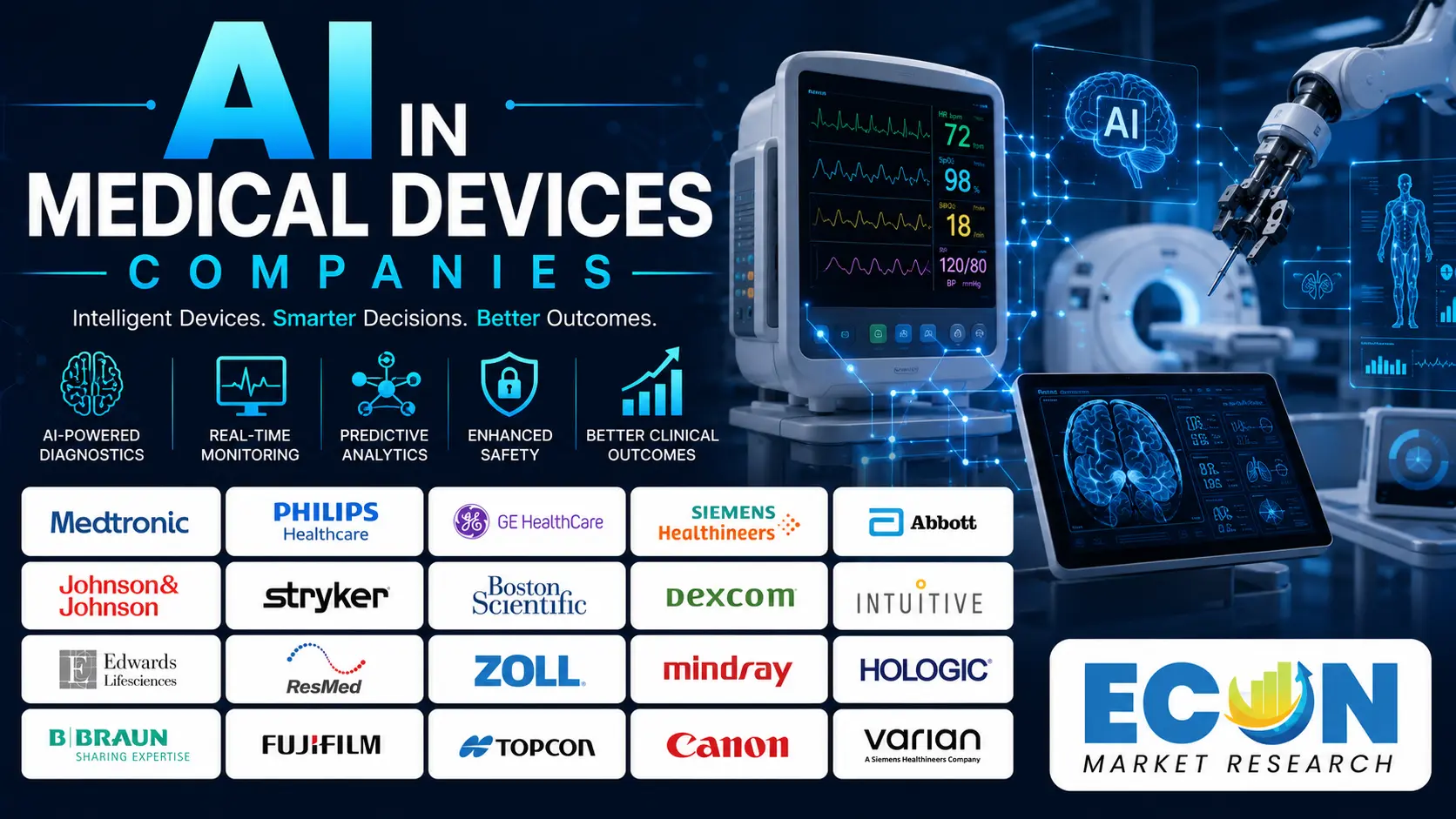
Market Evolution and Growth Drivers
AI in medical devices has evolved through 3 major stages: rule-based clinical software, machine-learning-assisted detection, and adaptive or multimodal clinical intelligence. Since 2020, manufacturers have increasingly integrated deep learning into devices instead of offering AI as a separate application. The leading growth drivers include rising imaging volumes, ageing populations, clinician shortages, demand for earlier disease detection, and the need to reduce repetitive tasks. The projected global shortage of 11 million health workers by 2030 strengthens the case for technologies that automate measurements, prioritize urgent cases, and support clinical teams. In a 2025 healthcare survey, 82% of professionals said AI and predictive analytics could save lives through earlier intervention, while 75% expected digital technologies to reduce hospital admissions.
Top 5 Latest Trends in the AI in Medical Devices
1. AI-Powered Medical Imaging and Automated Diagnosis
AI-powered medical imaging remains the most mature trend in the AI in medical devices industry because radiology departments process millions of CT, MRI, ultrasound, mammography, and X-ray images every year. Modern algorithms can segment organs, identify suspected lesions, quantify coronary calcium, prioritize emergency scans, and compare current images with earlier examinations. Several platforms now analyze 3-dimensional datasets and automatically highlight abnormalities before a radiologist begins the final review. One AI-Rad Companion application can identify coronary calcium on routine chest CT images, calculate calcium volume, and generate additional cardiovascular measurements. These capabilities can transform 1 scan into multiple clinical insights without requiring a separate imaging appointment.
The next phase of medical imaging AI is focused on reconstruction quality, speed, and multi-modality integration. Deep-learning reconstruction tools can reduce image noise and improve sharpness in MRI or CT examinations, potentially supporting shorter scans and better visualization of small anatomical structures. AI platforms are also being connected with hospital image archives, worklists, and cloud-based diagnostic viewers so that clinicians can access the same information across multiple locations. By 2024, 1 major medical technology company reported 80 AI-enabled devices on the U.S. authorization list, demonstrating how quickly imaging intelligence is becoming embedded in standard equipment. The trend now extends beyond abnormality detection to acquisition assistance, protocol selection, dose optimization, and automated reporting.
2. AI-Assisted Robotic Surgery and Procedural Guidance
AI-assisted robotic surgery is emerging as a major trend because operating rooms increasingly generate video, movement, instrument, imaging, and procedural data. Surgical platforms can use these datasets to improve instrument control, provide performance analytics, standardize operating-room workflows, and support more precise minimally invasive procedures. A next-generation robotic surgery system introduced with over 150 design innovations offers 10,000 times the computing power of its earlier platform. That expanded computing capacity creates a foundation for real-time analytics, enhanced sensing, workflow automation, and future AI-assisted surgical applications. These technologies are designed to support surgeons rather than replace them, maintaining human control over clinical decisions.
Adoption is being supported by the growing procedural base of robotic surgery. By the end of 2025, 20 million patients had undergone procedures using 1 leading robotic surgery platform, while over 3.1 million procedures were completed during 2025 alone. The large volume of standardized procedural data creates opportunities to identify efficient instrument movements, measure surgical phases, assess operating-room performance, and improve training. AI-supported navigation is also expanding into bronchoscopy, orthopedics, spine surgery, and catheter-based cardiovascular procedures. In interventional care, newer systems can continuously show where a device is located, how it is oriented, and where it should move during complex procedures inside a beating heart.
3. Real-Time AI in Endoscopy and Cancer Detection
Real-time AI-assisted endoscopy is expanding because colorectal cancer prevention depends heavily on the accurate identification of polyps during colonoscopy. Computer-aided detection systems analyze live endoscopic video and place visual markers around suspected lesions while the procedure is taking place. In 2021, the first U.S. De Novo authorization was granted to an AI-based computer-aided detection system designed to identify colorectal polyps. The technology acts as a second observer throughout the examination and can help clinicians recognize lesions that may appear briefly, sit behind folds, or have subtle visual characteristics. This is an important development because colonoscopy quality is influenced by withdrawal technique, bowel preparation, lesion shape, and operator attention.
The trend is progressing from basic polyp detection toward lesion characterization, procedural documentation, and quality analytics. Future AI endoscopy devices may help distinguish between adenomatous and non-adenomatous tissue, estimate lesion size, document anatomical location, and calculate quality indicators automatically. The technology can also support training by reviewing procedural video and identifying missed examination areas. Wider installations across hospital networks, including public healthcare facilities, are increasing the availability of AI-supported colonoscopy. Manufacturers are also developing cloud-connected platforms that enable algorithm updates, centralized performance review, and integration with electronic procedure records. These developments make gastrointestinal applications 1 of the most practical use cases for real-time AI in medical devices.
4. Predictive Monitoring Through Wearable and Implantable Devices
Predictive monitoring is developing rapidly as wearable, implantable, and bedside medical devices generate continuous streams of physiological data. A conventional clinic examination may capture information for 15 or 30 minutes, while a connected device can monitor heart rhythm, glucose levels, respiratory status, movement, oxygen saturation, or neurological activity across 24 hours. AI algorithms can analyze these repeated measurements to identify deviations from an individual patient’s baseline rather than relying only on population averages. This supports earlier alerts for arrhythmias, glucose instability, respiratory deterioration, and other clinically significant changes. The approach is especially relevant for chronic diseases that require daily management rather than occasional hospital-based assessment.
AI-enabled monitoring systems are also designed to reduce false alarms, which remain a major problem in hospitals and remote-care programs. Insertable cardiac monitors, for example, may generate alerts that require clinician review even when no urgent event has occurred. Machine-learning models can classify rhythm patterns and prioritize higher-risk events before the data reaches a clinical team. Connected insulin delivery devices use sensor information and automated algorithms to adjust therapy throughout the day, creating a closed or partially closed treatment loop. As devices collect information across 7 days a week, manufacturers must address cybersecurity, data integrity, battery performance, and algorithm reliability under different patient conditions.
5. Lifecycle Regulation, Explainability, and Continuous Performance Monitoring
Regulatory lifecycle management has become 1 of the most important trends in AI in medical devices because machine-learning systems may change through updates, new datasets, and expanded clinical use. On January 6, 2025, the U.S. regulator published draft recommendations covering lifecycle management and marketing submissions for AI-enabled device software. The proposed approach emphasizes documentation of intended use, model development, performance validation, risk management, update procedures, and real-world monitoring. Manufacturers must demonstrate that an AI system performs reliably across relevant ages, sexes, ethnic groups, device configurations, clinical settings, and disease presentations. A high test score from 1 controlled dataset is not sufficient evidence of safe performance in every hospital.
International regulators are also testing new oversight models. The United Kingdom launched its first AI-as-a-medical-device regulatory sandbox in spring 2024, and its initial pilot continued through March 2025. A second phase organized participating technologies around 3 regulatory challenge areas, providing controlled environments for testing evidence requirements and real-world performance. Ethical governance is receiving equal attention, with over 40 recommendations issued in 2024 for governments, healthcare providers, and technology developers working with large multimodal AI systems. These developments indicate that future competition will depend on 4 capabilities: clinical accuracy, transparent risk controls, cybersecurity resilience, and continuous post-market surveillance.
Top 5 Companies in the AI in Medical Devices
1. GE HealthCare
Company overview: GE HealthCare is a global medical technology company with operations across imaging, ultrasound, patient care solutions, and pharmaceutical diagnostics. Its headquarters are located in Chicago, Illinois, United States. The company has established 1 of the largest portfolios of authorized AI-enabled medical devices, reporting 80 listed devices in 2024. Its scale allows AI capabilities to be incorporated directly into scanners, workstations, monitoring systems, and hospital workflows instead of being deployed only as independent applications.
Core AI in medical devices expertise: The company specializes in AI-assisted image acquisition, reconstruction, workflow prioritization, automated measurements, diagnostic support, and equipment intelligence. Its Edison platform provides a digital foundation for deploying algorithms across multiple device categories. A major example is AIR Recon DL, which applies deep learning to MRI image reconstruction and is available for selected new systems and equipment upgrades. By embedding AI into the imaging chain, the technology can support improved image clarity and operational efficiency without requiring clinicians to switch between several disconnected platforms.
Major products and services: Key offerings include Edison-powered applications, AIR Recon DL, Critical Care Suite, automated ultrasound tools, intelligent CT workflows, and AI-supported patient monitoring solutions. The company’s AI-enabled portfolio has included at least 58 listed authorizations by March 2024 and increased to 80 listed devices by October 2024. This progression illustrates a strategy based on repeated integration of machine learning across hardware and software. The company also provides implementation, service, training, analytics, and workflow support for hospitals deploying AI-enabled medical devices.
2. Siemens Healthineers
Company overview: Siemens Healthineers is headquartered in Erlangen, Germany, and operates across diagnostic imaging, laboratory diagnostics, cancer care, and advanced therapies. The company has spent multiple decades developing CT, MRI, X-ray, ultrasound, and image-guided therapy systems. Its position in AI in medical devices is strengthened by access to large volumes of imaging data, established hospital integration capabilities, and a broad installed equipment base across multiple regions.
Core AI in medical devices expertise: The company’s principal AI expertise includes automated organ segmentation, anatomical measurement, abnormality detection, cardiovascular assessment, radiation therapy planning, image post-processing, and clinical workflow support. Its AI-Rad Companion family is designed as a group of augmented workflow solutions rather than a single algorithm. One chest CT application can analyze pulmonary and cardiovascular structures, while another solution automatically outlines organs at risk for radiation treatment planning. The chest platform was validated for CT systems made by 3 different manufacturers, supporting multi-vendor deployment.
Major products and services: Major offerings include AI-Rad Companion Chest CT, AI-Rad Companion Chest X-ray, AI-Rad Companion Organs RT, syngo.via, teamplay digital health solutions, and AI-supported imaging systems. These products automate repetitive post-processing tasks and provide quantified findings directly within the reading workflow. The company also offers cloud deployment, integration services, clinical education, and digital workflow consulting. Its strategy connects AI algorithms with scanners, picture archiving systems, radiation planning tools, and enterprise imaging environments rather than treating every AI application as an isolated product.
3. Philips
Company overview: Philips is headquartered in Amsterdam, Netherlands, and focuses on diagnostic imaging, ultrasound, image-guided therapy, patient monitoring, sleep care, and health informatics. The company applies AI throughout the patient pathway, from image acquisition and clinical interpretation to procedural guidance and remote monitoring. In a 2025 global healthcare survey, 82% of professionals believed AI and predictive analytics could enable earlier life-saving interventions, highlighting the clinical demand addressed by the company’s portfolio.
Core AI in medical devices expertise: Philips specializes in AI-enabled imaging workflow, smart examination planning, automated measurements, patient deterioration detection, interventional navigation, and enterprise clinical informatics. Its technologies can support cardiac MRI, ultrasound quantification, CT reconstruction, image-guided therapy, and centralized patient monitoring. The company is also exploring synthetic medical images for oncology and cardiovascular model development, allowing algorithms to learn from diverse cases while reducing direct exposure of patient data. Synthetic datasets may help address rare conditions and underrepresented patient groups when appropriate validation controls are applied.
Major products and services: Key offerings include SmartSpeed MR imaging, AI-enabled ultrasound applications, IntelliSpace and enterprise informatics tools, image-guided therapy platforms, and patient monitoring solutions. The company has also expanded collaborations in prostate imaging and pulmonary assessment, connecting external algorithms with existing diagnostic platforms. In interventional cardiology, newer device-tracking technology provides continuous information on device position and orientation during catheter-based procedures. Philips complements its products with implementation services, workflow redesign, interoperability support, cybersecurity services, and clinical training for healthcare organizations.
4. Medtronic
Company overview: Medtronic has its operational headquarters in Minneapolis, Minnesota, United States, and its legal headquarters in Dublin, Ireland. The company develops medical devices across cardiovascular care, diabetes, neuroscience, surgery, and gastrointestinal treatment. Its AI strategy combines machine learning with sensors, implantable devices, robotic platforms, and procedure-based systems. This enables the company to apply AI to both diagnostic and therapeutic medical devices rather than concentrating only on image analysis.
Core AI in medical devices expertise: Medtronic has developed expertise in computer-aided polyp detection, automated insulin delivery, cardiac rhythm classification, surgical analytics, and personalized treatment support. The GI Genius intelligent endoscopy module uses AI to analyze live colonoscopy video and highlight suspected colorectal polyps. In 2021, the device received the first U.S. De Novo authorization for a commercially available AI-based computer-aided detection system in colonoscopy. The company also uses algorithms in connected diabetes technologies and insertable cardiac monitors to interpret continuous sensor data.
Major products and services: Major AI-related offerings include GI Genius, MiniMed insulin delivery systems, LINQ insertable cardiac monitors, Touch Surgery digital tools, and robotic-assisted surgery platforms. GI Genius provides real-time visual assistance during colonoscopy, while diabetes systems combine glucose-sensor readings with automated insulin-delivery logic. The company also provides professional training, technical support, procedural education, remote device services, and clinical evidence programs. Its portfolio demonstrates how AI in medical devices can move beyond detection and contribute to 24-hour therapy adjustment, implant monitoring, and procedural standardization.
5. Intuitive Surgical
Company overview: Intuitive Surgical is headquartered in Sunnyvale, California, United States, and is a leading developer of robotic-assisted systems for minimally invasive care. The company’s platforms have been used in millions of surgical procedures across urology, gynecology, general surgery, thoracic surgery, and other specialties. By the end of 2025, 20 million patients had undergone da Vinci procedures globally, including over 3.1 million procedures during 2025.
Core AI in medical devices expertise: Intuitive’s expertise includes robotic control, computer vision, procedural data analysis, advanced instrumentation, digital workflow support, and surgical performance insights. The da Vinci 5 system contains over 150 design innovations and delivers 10,000 times the computing power of the da Vinci Xi platform. Although surgeons retain direct control of the system, the expanded computing architecture supports advanced sensing, analytics, workflow automation, and future AI-enabled capabilities. The company also develops endoluminal robotic technologies for lung procedures through its Ion platform.
Major products and services: Major offerings include da Vinci 5, da Vinci Xi, da Vinci SP, Ion, Firefly fluorescence imaging, integrated table motion, training simulators, and digital performance tools. During the second quarter of 2025, the company placed 395 da Vinci systems, including 180 da Vinci 5 systems, compared with 70 da Vinci 5 placements in the same quarter of 2024. These numbers show rapid adoption of a platform built for higher computing capacity and data-driven surgery. The company also provides surgeon training, hospital analytics, maintenance, clinical support, and procedure-development services.
Regional Outlook
North America
North America remains a leading region for AI in medical devices because of its established regulatory pathways, strong medical technology sector, advanced hospital infrastructure, and large volume of digitized clinical data. The United States maintains a dedicated public list of authorized AI-enabled medical devices, creating a transparent reference for manufacturers, healthcare providers, and patients. Radiology accounts for the largest portion of listed products, but the regional ecosystem also includes cardiovascular devices, pathology software, endoscopy systems, neurological applications, and surgical platforms. The publication of draft lifecycle guidance on January 6, 2025, also signaled a move toward more detailed oversight of algorithm development, updates, risk controls, and post-market performance.
The regional market benefits from extensive adoption of electronic health records, cloud imaging, connected monitoring, and robotic-assisted surgery. Hospitals are evaluating AI-enabled medical devices according to at least 5 criteria: clinical accuracy, workflow impact, interoperability, cybersecurity, and reimbursement potential. Large health systems can test devices across several clinical sites, generating evidence from thousands of patients and multiple demographic groups. North America also has a strong network of universities, specialist hospitals, venture-backed developers, and established device manufacturers. However, adoption is not automatic. Health systems must validate algorithm performance locally, train clinical staff, monitor false-positive rates, and determine who is responsible when an AI recommendation differs from a physician’s judgment.
Canada is also advancing AI-supported imaging, remote monitoring, and clinical decision tools, particularly for geographically distributed populations. Across the region, future demand will be influenced by the ageing population, chronic disease burden, workforce shortages, and rising diagnostic complexity. AI in medical devices can support earlier detection and improve productivity, but successful deployment requires evidence that the technology provides measurable benefit under normal clinical conditions. As a result, North American procurement is shifting from purchasing isolated algorithms toward acquiring integrated AI platforms that can support 10 or 20 clinical applications through a common infrastructure.
Europe
Europe has a strong AI in medical devices ecosystem supported by leading imaging manufacturers, university hospitals, public health systems, and detailed medical device regulation. Germany, the Netherlands, France, the United Kingdom, Switzerland, Sweden, and other European countries host companies developing AI-enabled imaging, surgery, pathology, monitoring, and treatment-planning technologies. Regional adoption is influenced by 2 major regulatory structures: medical device rules and broader artificial intelligence legislation. AI used for diagnosis or treatment can face high-risk requirements involving technical documentation, clinical evidence, data governance, human oversight, cybersecurity, and post-market monitoring.
The United Kingdom has created a regulatory sandbox specifically for AI as a medical device. The program began in spring 2024, completed its first pilot phase in March 2025, and continued with a second phase structured around 3 regulatory challenge areas. This model allows developers and regulators to examine problems such as adaptive algorithms, evidence generation, performance across different settings, and the safe use of simulated data. The pilot was supported by £1 million in public funding, reflecting the strategic importance of AI-enabled medical devices to the national healthcare and life-sciences agenda.
Workforce pressure is another major adoption driver. Europe could face a shortfall of 950,000 healthcare workers by 2030, while 40% of physicians in 1-third of countries were already close to retirement age in earlier workforce assessments. AI-assisted imaging, automated measurements, remote monitoring, and workflow prioritization can reduce repetitive workloads, but they cannot replace the need for trained clinicians. European health systems are therefore focusing on human-supervised AI that supports clinical teams while maintaining accountability. Data protection remains a central requirement, encouraging privacy-preserving techniques such as federated learning and synthetic datasets.
Asia-Pacific
Asia-Pacific is becoming a major growth center for AI in medical devices because the region combines large patient populations, rapidly expanding hospital networks, strong electronics manufacturing, and increasing investment in digital health. China, Japan, South Korea, India, Singapore, and Australia are developing AI applications for medical imaging, ophthalmology, pathology, cardiovascular screening, endoscopy, and remote monitoring. The region contains both highly advanced urban hospitals and underserved rural areas, creating demand for AI-enabled devices that can operate in tertiary centers as well as smaller diagnostic facilities.
China has built a substantial ecosystem of imaging manufacturers, digital health developers, and hospital-based AI research programs. Algorithms for lung-nodule detection, stroke assessment, diabetic eye screening, and cardiovascular imaging are being incorporated into domestic devices and clinical software. Japan’s ageing population creates strong demand for technologies that improve diagnostic efficiency and support chronic disease management. South Korea combines advanced semiconductor capabilities with connected hospital infrastructure, while Singapore functions as a controlled test environment for clinical AI. Australia is using AI-supported imaging and telehealth to extend specialist services across large geographic distances.
India represents a particularly important opportunity because of its population size, shortage of specialists, and growing diagnostic infrastructure. AI-enabled X-ray, CT, ultrasound, retinal screening, and pathology tools can help prioritize patients in settings where 1 specialist may serve several facilities. Connected devices can also support remote follow-up for diabetes, cardiac disease, pregnancy, and respiratory conditions. However, Asia-Pacific adoption must address differences in language, disease patterns, device availability, internet connectivity, and clinical practice. A model trained on 100,000 images from 1 country may not perform identically in another population without local validation.
Regional manufacturers are likely to focus on compact, mobile, and cost-sensitive medical devices rather than only high-end hospital platforms. AI-supported portable ultrasound, handheld imaging, automated screening, and cloud-connected diagnostics could extend services to millions of patients outside major cities. Successful companies will need to combine regulatory approval with local datasets, multilingual interfaces, low-bandwidth operation, and training programs for nurses, technicians, and general physicians.
Middle East & Africa
The Middle East and Africa region presents a diverse outlook for AI in medical devices, with advanced digital hospitals in Gulf countries and major healthcare access gaps across parts of Africa. Saudi Arabia, the United Arab Emirates, Qatar, and Israel are investing in smart hospitals, robotic surgery, advanced imaging, genomic medicine, and connected patient monitoring. Large hospital systems in these markets are increasingly evaluating AI-enabled radiology, cardiology, pathology, and operating-room technologies. National digital transformation programs also support electronic records, cloud infrastructure, and remote-care services.
In Africa, AI-enabled medical devices could help address severe workforce and infrastructure constraints. The continent carries 23% of the global disease burden but has less than 4% of the global healthcare workforce. Updated workforce analysis indicates a potential shortage of 5.85 million health workers by 2030 and 6.28 million by 2035 without sufficient improvements in education, employment, and retention. These figures create a strong need for tools that support screening, triage, referral, and remote specialist review.
Practical opportunities include AI-enabled chest X-ray analysis for tuberculosis, automated microscopy for infectious diseases, portable ultrasound for maternal care, retinal screening for diabetes, and smartphone-connected diagnostic devices. A portable system that allows 1 technician to collect an image and transmit it for AI-supported analysis can expand access in areas with few radiologists. However, devices must be designed for variable electricity, limited connectivity, high temperatures, dust exposure, and inconsistent maintenance capacity. Models must also be validated on African patient populations rather than relying entirely on datasets collected in North America or Europe.
The region’s future development will depend on partnerships among governments, hospitals, universities, device manufacturers, and telecommunications providers. Local training is essential because an AI-enabled medical device still requires clinicians and technicians who understand its limits. Procurement programs should assess at least 4 areas: diagnostic benefit, total operating requirements, data security, and long-term technical support. AI can strengthen health systems, but sustainable adoption requires infrastructure and governance alongside the algorithm itself.
Future Opportunities in the AI in Medical Devices
Future opportunities in AI in medical devices will extend from single-purpose algorithms toward connected clinical ecosystems. A hospital may currently use 5 independent AI applications for CT, MRI, ultrasound, monitoring, and surgery, but future platforms will combine these capabilities into 1 interoperable environment. Multimodal models could analyze imaging, laboratory values, physiological signals, pathology, and clinical history together. This approach may provide a more complete assessment than an algorithm that examines only 1 data type, although it will also require stronger validation, explainability, and access controls.
Preventive and home-based care represents another major opportunity. Wearable devices and connected sensors can collect information across 24 hours instead of relying on occasional clinic visits. AI could identify declining mobility, irregular heart rhythms, respiratory deterioration, glucose instability, sleep disruption, or early neurological changes before a patient requires emergency care. The opportunity is significant because 75% of surveyed healthcare professionals believed digital health and predictive technologies could reduce future hospital admissions. Devices that generate clinically useful alerts without overwhelming care teams will have the strongest adoption potential.
Synthetic data, federated learning, and privacy-preserving analytics will also shape the industry. Synthetic images can supplement limited datasets for rare tumors, uncommon anatomical variations, or underrepresented patient groups. Federated learning can allow 10 or 20 hospitals to contribute to model improvement without transferring all patient records into 1 central database. These methods could improve diversity while supporting privacy, but synthetic and federated datasets still require rigorous quality testing. Poorly generated data can reproduce bias or create unrealistic clinical patterns.
Adaptive medical devices offer further potential, particularly when algorithms must respond to new scanners, changing patient populations, or updated clinical guidelines. Regulators are developing lifecycle frameworks because traditional approval of 1 fixed software version may not be sufficient for systems that evolve. Future manufacturers will need predefined update plans, version tracking, rollback mechanisms, continuous monitoring, and transparent communication with healthcare providers. The strongest companies will treat post-market surveillance as a permanent process rather than a 1-time regulatory requirement.
AI-enabled devices may also expand access in regions facing the projected global shortage of 11 million health workers by 2030. Portable ultrasound, automated retinal cameras, digital stethoscopes, AI-supported X-ray systems, and point-of-care diagnostic devices could help non-specialist teams identify high-risk patients. The objective will not be to replace physicians but to ensure that limited clinical expertise reaches a larger population. Products that combine affordable hardware, offline processing, multilingual interfaces, and reliable technical support could become essential components of future healthcare systems.
Conclusion
The AI in medical devices industry has moved into a new phase in which algorithms are increasingly embedded within imaging equipment, robotic systems, endoscopy platforms, wearable monitors, implantable devices, and treatment technologies. Hundreds of authorized products demonstrate that AI is no longer limited to laboratory research, while the dominance of radiology shows how structured digital data can accelerate clinical adoption. Leading companies such as GE HealthCare, Siemens Healthineers, Philips, Medtronic, and Intuitive Surgical are building AI capabilities across 5 critical areas: diagnosis, workflow automation, procedural guidance, continuous monitoring, and personalized treatment.
The future of AI in medical devices will depend on clinical evidence rather than technical novelty alone. An algorithm must perform across multiple hospitals, demographic groups, device models, and real-world conditions. It must also protect patient data, integrate with existing workflows, explain relevant limitations, and maintain reliable performance after software updates. Regulatory initiatives launched between 2024 and 2026 show that governments are developing lifecycle-based approaches rather than treating AI as conventional fixed software.
AI-enabled medical devices have the potential to support earlier diagnosis, reduce repetitive work, improve procedural consistency, and extend specialist expertise to underserved communities. However, safe adoption requires continued human oversight, local validation, cybersecurity controls, and transparent performance monitoring. Companies that combine advanced algorithms with trusted medical hardware, clinical expertise, regulatory discipline, and long-term service capabilities will remain best positioned as AI becomes a standard component of medical device design.