


Top AI Agent Security Companies Shaping Enterprise Defense
The top AI agent security companies are advancing runtime protection, identity controls, prompt defense, governance, and secure autonomous operations.
Introduction
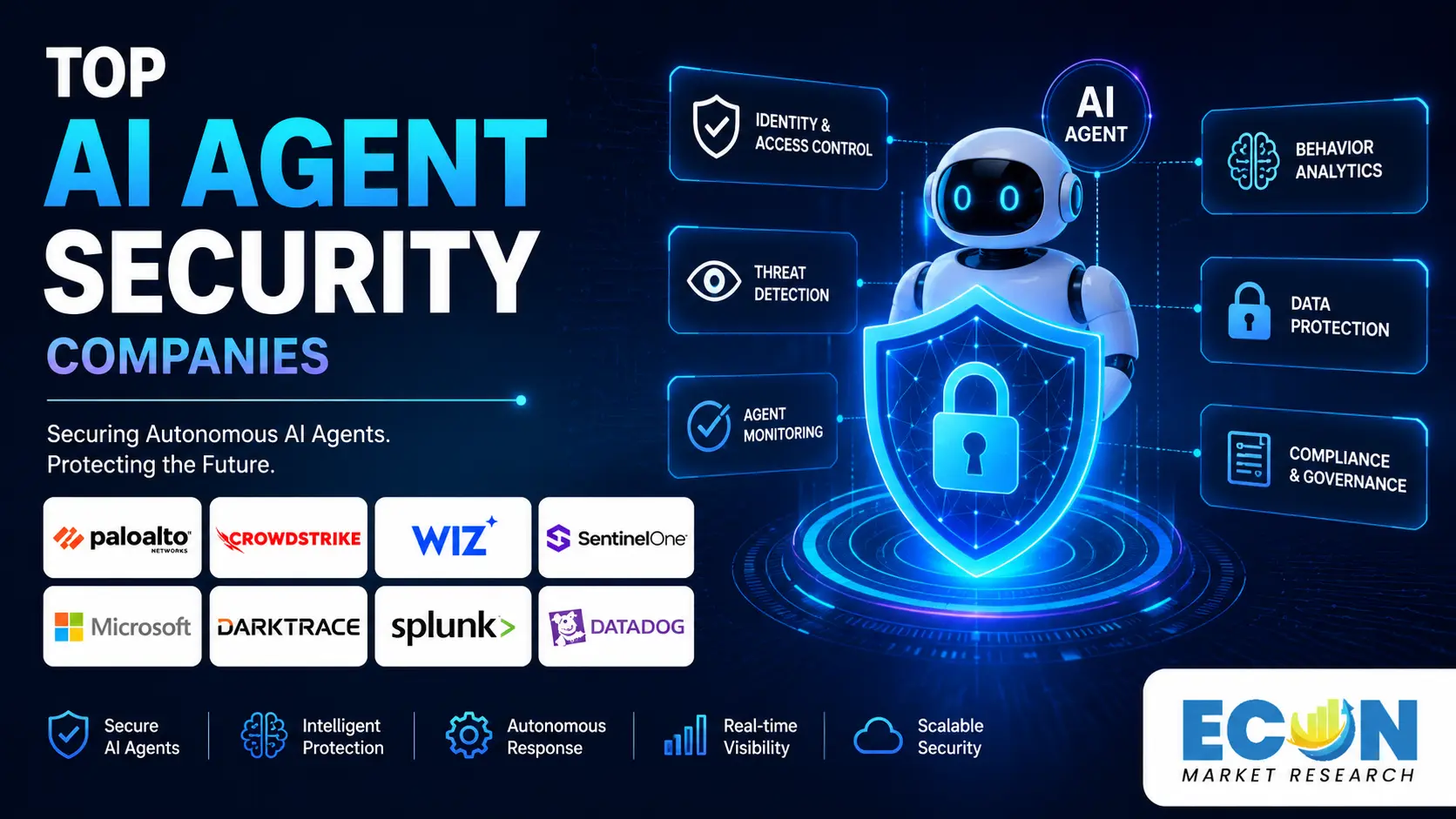
Overview of the Global AI Agent Security Industry
The global AI agent security industry is developing rapidly as autonomous systems move beyond answering questions and begin executing multi-step business processes. In 2025, 83% of surveyed organizations reported plans to develop or deploy AI agents, creating demand for security controls that protect agent identities, prompts, memory, application programming interfaces, tools, data connections, and automated actions. Unlike conventional chatbots, an AI agent can access 5 or more enterprise systems during a single workflow, increasing the potential impact of excessive permissions or manipulated instructions. AI agent security platforms address these risks through discovery, runtime monitoring, prompt-injection detection, data-loss prevention, behavioral analytics, identity governance, and human approval checkpoints.
Market Evolution and Growth Drivers
The AI agent security market evolved significantly between 2023 and 2026 as enterprises progressed from isolated generative AI experiments to production systems capable of calling APIs, modifying records, writing code, and initiating financial or operational transactions. Security requirements now extend across at least 6 areas: model behavior, agent reasoning, persistent memory, tool access, identity privileges, and agent-to-agent communication. Growth is being driven by expanding adoption of Model Context Protocol integrations, multi-agent architectures, cloud-hosted copilots, automated security operations, and non-human identities. Research published in 2026 identified 7 structural authorization requirements for multi-agent environments, demonstrating why traditional role-based access alone cannot fully control delegated AI activity.
Top 5 Latest Trends in the AI Agent Security
1. Runtime Security and Continuous Agent Behavior Monitoring
Runtime protection has become 1 of the most important AI agent security trends because predeployment testing cannot predict every action an autonomous agent may take after receiving live data. Modern security platforms inspect prompts, tool calls, API requests, outputs, memory updates, and execution paths while an agent is operating. A single agent may complete 10 or more connected steps within seconds, meaning an unsafe action can occur before a human analyst reviews the original request. Runtime systems therefore apply policies at every action boundary, blocking suspicious instructions, unauthorized database queries, abnormal file transfers, and unapproved external connections.
The transition toward runtime AI agent security is also changing enterprise monitoring architecture. Instead of evaluating only the initial prompt, security teams increasingly record the complete chain of reasoning-related events, including which tool was selected, what data was retrieved, which identity authorized the action, and whether the final result matched policy. Emerging platforms combine 2 control layers: deterministic rules for clearly prohibited activity and semantic detection models for context-dependent threats. A 2026 governance-aware security experiment reported a 98.1% F1 score from a 2-layer guardrail pipeline, illustrating how combined controls can improve detection accuracy while preserving operational speed.
2. Zero-Trust Identity Governance for AI Agents
Identity governance is becoming central to AI agent security because every autonomous agent functions as a non-human identity with access to sensitive enterprise resources. An agent may interact with 3 categories of credentials: its own service identity, delegated user authorization, and temporary credentials issued for individual tasks. Without strict separation, a compromised agent could inherit broad permissions and perform actions far beyond the user’s original intent. Zero-trust designs require every request to be authenticated, authorized, scoped, monitored, and logged, even when the agent previously completed an approved action.
Task-specific access is increasingly replacing long-lived credentials. Under this model, an AI agent receives permission to perform 1 defined activity, against 1 approved resource, during 1 limited time window. Capability tokens, execution-count restrictions, contextual policies, and automatic credential expiration help prevent lateral movement. Multi-agent systems add further complexity because a primary agent may delegate work to 2 or more specialized agents. Security controls must preserve authorization rules throughout the delegation chain rather than allowing each downstream agent to inherit complete access. This requirement is creating opportunities for identity providers, privileged-access vendors, and AI-native authorization companies.
3. Protection Against Indirect Prompt Injection
Indirect prompt injection is emerging as a major threat because AI agents process untrusted content from emails, websites, documents, databases, collaboration tools, and third-party APIs. A malicious instruction can be hidden inside 1 document or web page and interpreted by the agent as a legitimate command. The attacker may not require direct access to the agent or the organization’s internal systems. Instead, the agent reads the manipulated content and uses its authorized tools to expose data, change records, install code, send messages, or bypass workflow controls.
Organizations are responding with input classification, context isolation, prompt firewalls, instruction hierarchy enforcement, tool restrictions, output validation, and approval requirements for high-risk actions. System-level defenses are gaining importance because filtering individual prompts cannot address every context-sensitive attack. Research released in 2026 identified 3 essential design principles: dynamic security replanning, constrained model decision-making, and human interaction for ambiguous requests. Effective AI agent security platforms also distinguish between trusted system instructions and untrusted retrieved content, ensuring that 1 malicious paragraph cannot override enterprise policy.
4. Securing MCP and Agent-to-Agent Communication
Model Context Protocol and agent-to-agent communication standards are expanding the number of tools that AI agents can discover and use. An enterprise agent may connect to 20 or more internal applications through standardized servers, reducing development time but creating a larger attack surface. Security teams must verify the identity of each server, validate tool descriptions, inspect parameters, prevent unauthorized tool substitution, and monitor the information exchanged between agents. A compromised connector can manipulate an otherwise trusted agent by returning malicious instructions or falsified data.
Protocol security is therefore moving toward automated discovery, scanning, inventory management, and conformance testing. Security tools can identify malformed URLs, missing metadata, invalid data types, undeclared capabilities, and suspicious server behavior before an integration reaches production. Open-source scanners introduced in 2025 began evaluating agent communication against formal protocol specifications, allowing registries to flag unsafe or noncompliant components. Enterprises are also establishing approved catalogs in which every connector has 1 verified owner, 1 risk classification, and documented permission boundaries. These controls will become increasingly important as organizations deploy hundreds of agents across multiple business departments.
5. AI Red Teaming, Simulation, and Automated Security Testing
AI red teaming is expanding from model-level testing to full agent workflow simulation. Traditional model evaluations examine harmful outputs, bias, or jailbreak susceptibility, but agent security testing must also evaluate memory manipulation, credential misuse, unauthorized tool calls, excessive autonomy, data exfiltration, and unsafe delegation. Security teams now simulate 100s of adversarial scenarios across development and production-like environments to determine whether an agent follows instructions securely under pressure.
Continuous testing is becoming necessary because agent behavior may change after 1 model update, 1 new connector, or 1 modification to an orchestration prompt. Automated red-teaming platforms generate adversarial prompts, measure policy violations, replay known attacks, and compare results across model versions. Enterprises increasingly require risk scores before deployment and periodic reassessments after production changes. Security testing also supports regulatory documentation by producing evidence that controls were evaluated against defined attack categories. As the AI agent security industry matures, organizations will combine 3 testing stages: design-time threat modeling, predeployment adversarial evaluation, and continuous runtime validation.
Top 5 Companies in the AI Agent Security
1. Palo Alto Networks
Company overview: Palo Alto Networks is a cybersecurity company founded in 2005 that provides network, cloud, endpoint, security operations, and artificial intelligence protection technologies. Its expansion into AI agent security reflects the growing need to secure autonomous applications throughout development and runtime. The company completed its acquisition of Protect AI in July 2025, strengthening its capabilities across model scanning, AI risk assessment, red teaming, and machine learning supply-chain protection.
Headquarters: The company is headquartered in Santa Clara, California, United States, and serves customers across more than 150 countries. Its global presence allows the organization to support regulated sectors such as banking, healthcare, government, telecommunications, manufacturing, and energy.
Core AI agent security expertise: Its expertise includes real-time prompt inspection, tool-call monitoring, data-leakage prevention, model protection, agent discovery, cloud workload security, and behavioral policy enforcement. The company’s AI agent security approach protects at least 5 critical components: reasoning, memory, tools, actions, and interactions.
Major products and services: Key offerings include Prisma AIRS, Cortex Cloud, AI runtime security, AI security posture management, model scanning, red-team testing, and cloud-native application protection. Prisma AIRS provides inline defenses against prompt injection, malicious model responses, unsafe tool use, and sensitive-data exposure, while Cortex Cloud 2.0 uses autonomous agents to support security investigations and cloud defense.
2. Microsoft
Company overview: Microsoft was founded in 1975 and operates across enterprise software, cloud computing, identity management, productivity applications, and cybersecurity. The company has positioned security as a central component of its agent ecosystem by connecting AI governance with identity, data protection, endpoint defense, cloud security, and security operations.
Headquarters: Microsoft is headquartered in Redmond, Washington, United States, and maintains operations in more than 190 countries. Its installed enterprise base gives the company visibility across millions of devices, identities, applications, collaboration environments, and cloud workloads.
Core AI agent security expertise: Microsoft focuses on securing agent identities, controlling data access, detecting malicious prompts, monitoring application behavior, and keeping humans involved in sensitive decisions. Its security architecture emphasizes 3 principles for agent deployment: containment, alignment, and accountable ownership. AI agents can be assigned managed identities, conditional access rules, limited permissions, and auditable activity records.
Major products and services: Major offerings include Microsoft Defender, Microsoft Entra, Microsoft Purview, Microsoft Sentinel, Security Copilot, Azure AI security capabilities, and governance controls for enterprise agents. A Security Alert Triage Agent introduced in 2025 helped analysts identify up to 6.5 times as many malicious emails as professional graders in early testing, demonstrating the operational potential of controlled security agents.
3. Cisco
Company overview: Cisco was founded in 1984 and provides networking, identity, observability, cloud, collaboration, and cybersecurity technologies. The company entered the AI security market with an architecture designed to protect models, applications, infrastructure, data flows, and autonomous agents. Cisco strengthened its AI protection portfolio through the 2024 acquisition of Robust Intelligence, a specialist in AI validation and runtime protection.
Headquarters: Cisco is headquartered in San Jose, California, United States, and operates in more than 100 countries. Its networking footprint provides a strategic advantage because AI agent traffic can be monitored across data centers, cloud environments, branches, endpoints, and application connections.
Core AI agent security expertise: Cisco specializes in AI application discovery, model validation, prompt-attack protection, runtime enforcement, network visibility, and protocol security. Cisco AI Defense evaluates AI systems before deployment and monitors them during operation, while identity and network controls restrict how agents communicate with enterprise resources.
Major products and services: Its portfolio includes Cisco AI Defense, Secure Access, Identity Services Engine, Hypershield, Secure Firewall, XDR, Multicloud Defense, and open-source agent security scanners. In 2026, Cisco reported that 83% of companies intended to develop or deploy AI agents, reinforcing the need for security platforms capable of inspecting agent traffic and untrusted external content.
4. IBM
Company overview: IBM was founded in 1911 and has more than 100 years of experience in enterprise technology, research, security, automation, and regulated-industry systems. The company addresses AI agent security through an integrated approach combining governance, risk management, application security, data protection, model monitoring, and confidential computing.
Headquarters: IBM is headquartered in Armonk, New York, United States, and operates across more than 170 countries. Its consulting and technology teams serve sectors that require strict controls, including financial services, healthcare, government, aerospace, telecommunications, and industrial manufacturing.
Core AI agent security expertise: IBM treats autonomous agents as digital insiders whose actions must be governed through behavioral monitoring, least-privilege access, policy enforcement, traceability, and continuous risk assessment. Its capabilities cover at least 4 layers: agent development, model governance, runtime monitoring, and enterprise security operations.
Major products and services: Major offerings include watsonx.governance, Guardium AI Security, QRadar, Verify, Concert, consulting services, and tools for securing AI development lifecycles. In June 2025, IBM introduced software intended to unify agentic AI governance and security within 1 enterprise view, helping teams identify risks, enforce policies, and document compliance across multiple AI systems.
5. Google
Company overview: Google was founded in 1998 and operates major cloud, artificial intelligence, productivity, security, and data platforms. Its AI agent security strategy combines secure-by-design development, cloud identity, threat intelligence, data controls, model safety, infrastructure protection, and agent governance.
Headquarters: Google is headquartered in Mountain View, California, United States, and supports cloud and digital services across more than 200 countries and territories. Its security operations draw on large-scale telemetry from cloud workloads, email systems, endpoints, applications, and global internet activity.
Core AI agent security expertise: Google focuses on secure agent development, access control, tool governance, threat detection, data-loss prevention, and agent-assisted security operations. Its approach helps organizations control which tools agents can call, what data they can retrieve, and which actions require human approval.
Major products and services: Key offerings include Google Cloud Security, Security Command Center, Model Armor, Sensitive Data Protection, Cloud Identity, Gemini Enterprise Agent Platform, and agentic capabilities for security operations. In 2025, its security organization introduced agent-based workflows for triage, investigation, malware analysis, threat intelligence, and response while emphasizing continued human oversight.
Regional Outlook
North America
North America is a leading region in the AI agent security industry because it contains a high concentration of cloud providers, cybersecurity vendors, AI model developers, financial institutions, healthcare organizations, government agencies, and enterprise software companies. The United States hosts 5 of the companies profiled in this analysis, giving the region a strong base of product development, security research, venture investment, and early enterprise adoption. Organizations are deploying agents for coding, customer support, fraud detection, security investigations, procurement, document processing, and IT operations.
Regulatory and national-security activity is also influencing the North American AI agent security market. In July 2026, the United States announced an AI and cybersecurity coordination group involving multiple technology developers and federal agencies. The initiative is designed to improve the sharing of software vulnerabilities discovered by advanced AI systems and coordinate responses across critical sectors such as finance, healthcare, defense, and energy. This type of public-private cooperation is likely to increase demand for auditability, agent identity controls, secure disclosure processes, and standardized incident reporting.
Enterprise buyers in North America increasingly require security platforms to provide at least 6 capabilities: agent inventory, prompt protection, runtime monitoring, identity governance, data security, and complete audit trails. Financial institutions are particularly focused on approval boundaries because an autonomous agent may interact with payment systems, customer records, trading platforms, or regulated communications. Healthcare organizations require controls that prevent agents from exposing protected patient data, while software companies prioritize secure coding agents and sandboxed execution environments.
The region is also supporting a growing ecosystem of specialized AI agent security startups. New companies are developing authorization layers, secure agent gateways, MCP protection, behavioral monitoring, and agent-specific access controls. One agent authorization provider founded in 2024 raised $60 million in 2026 and employed about 40 people, showing that investors increasingly view secure execution and delegated authorization as standalone infrastructure categories.
Europe
Europe’s AI agent security industry is shaped by strict data-protection expectations, emerging AI regulations, cybersecurity directives, and extensive requirements for accountability. The European Union consists of 27 member states, creating a large but regulated market for autonomous AI systems. Organizations deploying AI agents must consider privacy, cybersecurity, transparency, human oversight, recordkeeping, risk management, and third-party technology dependencies throughout the complete agent lifecycle.
The phased implementation of the European Union’s artificial intelligence framework is encouraging companies to classify AI use cases and document risk controls before large-scale deployment. Security teams are therefore connecting agent inventories with governance registers, data-protection assessments, model documentation, incident-management systems, and supplier-risk programs. An enterprise agent that accesses personal data across 3 countries may be subject to multiple legal, operational, and contractual obligations, increasing demand for centralized policy management.
European financial services, automotive, pharmaceutical, manufacturing, telecommunications, and public-sector organizations are expected to be major adopters of AI agent security. Banks can use agents for fraud investigations and compliance reviews but require strict separation of duties. Manufacturers can deploy agents for predictive maintenance and supply-chain coordination while limiting access to operational technology. Pharmaceutical companies need complete audit trails when agents interact with research data, clinical documentation, or regulated quality systems.
Data sovereignty is another significant regional driver. Many European organizations require security telemetry, agent logs, prompts, and sensitive outputs to remain within approved geographic boundaries. This requirement supports demand for private-cloud deployment, regional data processing, encryption, confidential computing, and locally managed security operations. Vendors that provide at least 2 deployment models—cloud-hosted and customer-controlled—will be better positioned to serve European enterprises with differing sovereignty requirements.
Asia-Pacific
Asia-Pacific represents a major growth environment for AI agent security because the region includes advanced digital economies, large technology workforces, rapidly expanding cloud infrastructure, major manufacturing hubs, and highly connected consumer markets. The region contains more than 4 billion people and includes countries with significantly different cybersecurity, privacy, data-localization, and artificial intelligence policies. This diversity creates demand for security platforms that can adapt policies by country, industry, data category, and deployment model.
China, Japan, India, South Korea, Singapore, and Australia are important markets for autonomous AI deployment. Enterprises are introducing AI agents into customer service, banking, telecommunications, software engineering, healthcare administration, logistics, e-commerce, and manufacturing. A single regional company may operate across 10 or more languages, requiring security controls capable of identifying prompt injection, sensitive information, and policy violations in multilingual content rather than English alone.
India is emerging as a major location for AI development, cybersecurity services, global capability centers, and enterprise automation. The country’s technology workforce and large digital economy support increasing experimentation with agents for coding, business-process outsourcing, analytics, and customer operations. Security providers can address this opportunity through low-latency monitoring, regional data processing, role-based administration, and integrations with existing identity platforms.
Japan and South Korea are emphasizing reliable automation in manufacturing, robotics, automotive systems, and electronics. These environments require AI agent security controls that protect both information technology and operational technology. An agent that receives data from 5 factory systems may need permission to recommend a change but not directly modify production equipment. Human-in-the-loop approval, network segmentation, and action-specific authorization will therefore remain important requirements across industrial deployments.
Middle East & Africa
The Middle East and Africa AI agent security industry is developing alongside national digital-transformation programs, cloud infrastructure investments, smart-city projects, financial technology adoption, and government modernization. The region includes more than 70 countries with different levels of cybersecurity maturity, infrastructure availability, regulation, and technical expertise. This variation creates opportunities for managed AI security, cloud-based governance, regional security operations centers, and industry-specific consulting.
The United Arab Emirates, Saudi Arabia, Qatar, Bahrain, and Israel are among the leading Middle Eastern markets for AI adoption. Government agencies, banks, airlines, energy companies, healthcare providers, and telecommunications operators are exploring autonomous agents for service delivery, threat detection, data analysis, and operational efficiency. These organizations often manage critical infrastructure, meaning 1 unauthorized agent action could affect sensitive systems, citizen information, industrial processes, or national services.
Energy and utilities represent an important security use case. AI agents may analyze sensor data, maintenance records, supply networks, and operational alerts across 1,000s of assets. However, security architectures must prevent an analytical agent from gaining unrestricted control over industrial systems. Segmented networks, read-only permissions, approval workflows, and continuous monitoring can reduce the risk of accidental or malicious actions.
African markets are seeing increasing adoption of mobile banking, digital identity, cloud applications, and automated customer services. Limited cybersecurity staffing in some countries may encourage organizations to use agentic security operations for alert prioritization and incident investigation. Managed service providers can combine 24-hour monitoring with locally relevant compliance support. Vendors offering lightweight deployment, multilingual protection, flexible hosting, and integration with 3 or more common cloud environments can gain a competitive position across the region.
Future Opportunities in the AI Agent Security
The future of AI agent security will be shaped by the movement from small pilot projects to enterprise environments containing 100s or 1,000s of autonomous agents. Every agent will require a verified identity, named owner, approved purpose, access profile, risk classification, and complete activity history. This creates a major opportunity for centralized agent registries that discover sanctioned and unsanctioned agents across cloud platforms, employee applications, developer tools, and business workflows.
Agent authorization is another high-potential category. Traditional identity systems were designed primarily for human employees, service accounts, and predictable applications. AI agents create dynamic delegation chains in which 1 agent may assign tasks to 5 specialized agents, each requiring different access for limited periods. Security providers can develop task-scoped tokens, real-time authorization, cryptographic agent identities, execution limits, and automatic revocation based on changing risk.
The expansion of MCP and other interoperability standards will create demand for secure tool marketplaces. Enterprises will need to scan every server, validate every tool, examine data-handling behavior, and continuously verify software updates. A trusted marketplace could assign each connector a numerical risk score, permission profile, ownership record, and security-testing history. Protocol gateways may also inspect agent-to-tool traffic in the same way that web application firewalls inspect conventional internet traffic.
Further opportunities exist in agent-specific incident response, cyber insurance, compliance automation, digital forensics, and independent assurance. When an AI agent causes an unauthorized action, investigators must reconstruct the complete sequence across prompts, retrieved data, reasoning steps, tool calls, identity decisions, and system responses. Security platforms capable of producing 1 unified timeline will help organizations determine whether an incident resulted from malicious manipulation, model error, excessive permission, compromised data, or incorrect workflow design.
AI agents will also support defensive security teams. Governance-aware systems have already demonstrated an 87% incident-correlation F1 score, a 96.2% rule-acceptance rate, and a 1.58-second machine-side detection time in experimental environments. These results indicate that securely governed agents can accelerate threat detection, generate defensive rules, reconstruct attacks, and coordinate investigations. The strongest market opportunity will belong to platforms that secure AI agents while also using controlled agents to protect the broader enterprise.
Conclusion
The AI agent security industry has become a strategic cybersecurity category as autonomous systems gain access to enterprise data, tools, applications, identities, and operational workflows. Between 2023 and 2026, security priorities expanded from protecting model outputs to controlling complete agent ecosystems. Organizations now need defenses for at least 6 interconnected areas: prompts, reasoning, memory, identity, tools, and actions. The rapid adoption of agentic systems means that conventional security controls must be extended with runtime inspection, task-scoped authorization, protocol validation, behavioral monitoring, and human approval for high-impact decisions.
Leading companies such as Palo Alto Networks, Microsoft, Cisco, IBM, and Google are developing broad platforms that combine AI protection with cloud, network, identity, data, and security operations capabilities. At the same time, specialized vendors are targeting individual gaps such as MCP security, non-human identity governance, secure tool execution, and AI red teaming. Competition will intensify as enterprises move from 10 experimental agents to 100s of production agents.
The long-term success of AI agent security will depend on measurable controls rather than marketing claims. Enterprises should require every agent to have 1 accountable owner, clearly defined permissions, continuous monitoring, tested recovery procedures, and auditable action records. Companies that adopt these principles can benefit from autonomous AI while reducing the risks of prompt injection, data leakage, tool misuse, identity compromise, and uncontrolled delegation.