

Virtual Reality VR Market
Virtual Reality VR Market Size, Share, Trends, Growth, and Industry Analysis, By Component (Hardware, Software, Services), By Device Type (Head-Mounted Displays, Gesture Tracking Devices, Projectors & Display Walls, Others), By Technology (Non-Immersive, Semi-Immersive, Fully Immersive), By Application (Gaming & Entertainment, Healthcare, Education & Training, Retail & E-commerce, Automotive, Real Estate, Others), By End User (Consumer, Commercial, Enterprise), By Deployment Mode (Cloud, On-Premises), Regional Analysis and Forecast Period 2026-2035
Virtual Reality VR Market Overview
As per Econ Market Research analysis, the Global Virtual Reality VR Market reached a valuation of US$ 158.7 Billion in 2026 and is anticipated to grow to US$ 1418.1 Billion by 2035, at a CAGR of 27.55% during the forecast timeline 2026–2035. The base year considered is 2025.
Virtual Reality VR Market Size 2025-2035 (USD Billion)

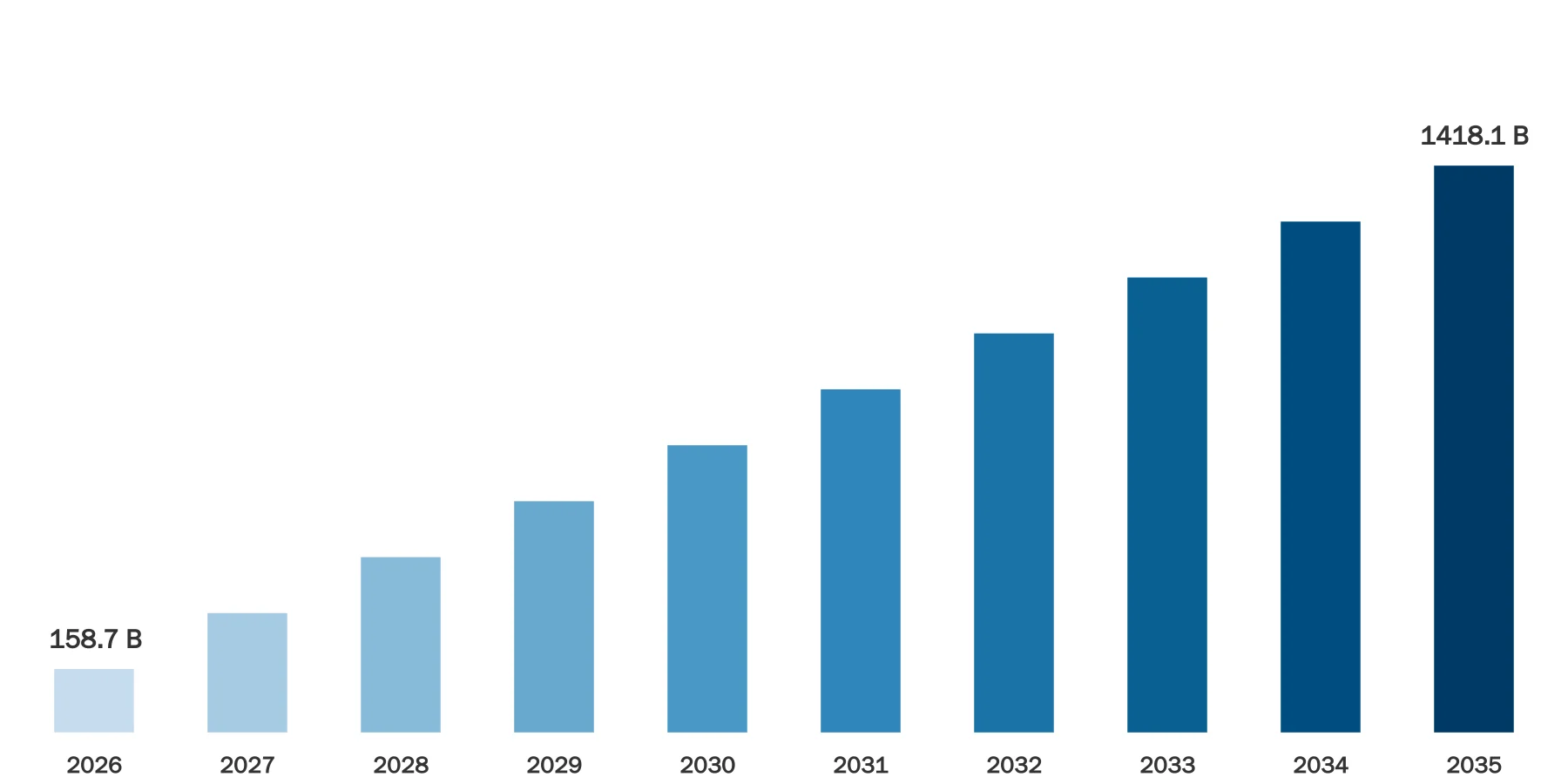
Source: Econ Market Research
The global Virtual Reality market continues to expand across gaming, healthcare, industrial training, education, and retail applications. In 2024, worldwide VR headset shipments reached nearly 9.6 million units, while more than 74% of shipments were controlled by a single leading vendor. Enterprise VR adoption increased by 32% in industrial training environments, especially across automotive manufacturing and aviation simulation programs. More than 58% of VR deployments in 2025 involved immersive training platforms, while healthcare-related VR simulation installations crossed 14,000 institutional deployments globally.
Gaming remained the dominant segment with over 43 million active VR gamers worldwide. Standalone headsets represented approximately 68% of total headset usage because of wireless functionality and improved battery life exceeding 2.5 hours in premium devices. More than 120 countries now support commercial VR ecosystems, while over 18,000 VR-focused software applications are available globally. Increasing integration of AI, spatial computing, and eye-tracking technologies continues to transform the Virtual Reality (VR) Market Report landscape for B2B customers and enterprise deployments.
The USA Virtual Reality (VR) Market accounted for nearly 36% of global VR device usage in 2025, supported by strong adoption across gaming, defense, healthcare, and enterprise collaboration. More than 5.6 million VR headsets were active in the United States during 2024, while over 3,500 hospitals and medical training institutions integrated VR simulation technologies into operational workflows. The U.S. defense sector increased immersive training simulation deployments by 28% between 2023 and 2025. Over 62% of Fortune 500 technology companies now use VR for employee onboarding, engineering visualization, or remote collaboration.
Consumer gaming demand remains strong, with more than 24 million VR-compatible gaming titles downloaded in the U.S. market during 2024. Educational VR installations expanded across approximately 11,000 schools and universities, particularly in STEM-focused programs. California, Texas, and Washington collectively represented over 48% of U.S. VR software development activity. Increasing investment in mixed reality devices, OLED displays, and AI-integrated wearables is strengthening the Virtual Reality (VR) Market Analysis ecosystem in the United States.
The European Virtual Reality (VR) Market demonstrated strong industrial and healthcare adoption across Germany, France, the United Kingdom, and the Nordic region during 2024 and 2025. Europe accounted for nearly 24% of global VR enterprise deployments, while industrial simulation represented approximately 41% of commercial installations. Germany alone operated more than 1,200 automotive VR simulation centers supporting product prototyping and assembly line training. The United Kingdom recorded over 7 million VR gaming users, while France expanded VR education deployments across 2,800 academic institutions. More than 55% of European healthcare research centers adopted VR-assisted rehabilitation systems for neurological therapy and pain management.
Manufacturing industries across Europe reduced physical training costs by approximately 30% using immersive VR learning platforms. The region also experienced rising demand for location-based VR entertainment centers, with more than 2,100 commercial VR arcades operating in 2025. Advanced 5G infrastructure across over 70 European smart cities improved low-latency VR streaming capabilities, supporting Virtual Reality (VR) Industry Analysis and enterprise cloud deployment growth across the regional digital economy.
Virtual Reality (VR) Market Latest Trends
The Virtual Reality (VR) Market Trends landscape is experiencing rapid transformation through AI integration, mixed reality convergence, and enterprise-focused deployment models. In 2024, standalone VR devices accounted for nearly 68% of total headset shipments, reflecting strong consumer preference for wireless and lightweight systems. More than 77% of global VR shipments were dominated by one major manufacturer, while premium mixed reality devices represented around 5% to 9% of total industry shipments.
OLED-on-silicon displays emerged as a major trend in high-end VR devices, delivering pixel densities exceeding 3,000 PPI in flagship products. Eye-tracking adoption increased by 34% in enterprise-grade VR systems, especially for healthcare diagnostics and Industrial Design simulations. Cloud-based VR collaboration platforms expanded by over 29% between 2023 and 2025 as hybrid workplaces increased demand for virtual meeting environments.
Gaming remains the largest application segment, accounting for nearly 52% of total VR software usage. However, healthcare VR simulation installations increased by 31% in surgical planning and rehabilitation programs. Educational institutions across North America and Europe expanded VR classroom integration by more than 26%, particularly in engineering and medical training.
Artificial Intelligence integration has become a critical differentiator in VR product development. AI-powered gesture recognition systems now achieve over 95% tracking accuracy in commercial headsets. More than 48% of newly launched VR devices include spatial mapping and environment recognition features. Battery performance also improved significantly, with average premium headset operation time rising from 1.8 hours in 2022 to over 2.7 hours in 2025.
Location-based VR entertainment centers expanded by approximately 18% globally during 2024, while enterprise metaverse projects increased across manufacturing, logistics, and architecture sectors. These developments continue shaping the Virtual Reality (VR) Market Forecast and Virtual Reality (VR) Industry Report environment for B2B stakeholders.
Virtual Reality (VR) Market Dynamics
The Virtual Reality (VR) Market Outlook is influenced by rapid advancements in immersive display technologies, rising enterprise digitization, and increasing deployment across healthcare, gaming, defense, and industrial simulation sectors. More than 58% of VR spending in 2025 originated from enterprise and commercial applications, while consumer gaming maintained over 43 million active users globally. Headset manufacturers improved display refresh rates beyond 120 Hz, reducing motion sickness by nearly 35% compared with earlier devices. Over 14,000 healthcare institutions globally adopted VR-assisted treatment or training platforms by 2025. Simultaneously, enterprise VR collaboration software usage increased by approximately 27% due to hybrid workplace expansion. However, hardware pricing, limited battery performance, and content fragmentation remain important concerns affecting mainstream consumer adoption.
DRIVER
Increasing Demand for Immersive Enterprise Training
Enterprise demand for immersive training environments represents the strongest driver in the Virtual Reality (VR) Market Growth ecosystem. More than 62% of large enterprises introduced VR-based workforce training programs between 2023 and 2025. Manufacturing companies reduced employee training duration by approximately 40% using immersive VR simulations for assembly operations and hazardous equipment handling. Aviation industries implemented VR flight simulations across over 3,800 pilot training facilities globally.
Healthcare organizations also accelerated adoption. More than 14,000 medical institutions integrated VR surgical simulations and rehabilitation systems, while VR-assisted therapy improved patient engagement by nearly 36% in neurological rehabilitation programs. In military applications, over 55 countries now utilize VR combat simulation platforms for tactical exercises and operational readiness programs.
Education is another major contributor. Approximately 11,000 schools and universities in North America adopted VR learning systems for STEM education, anatomy visualization, and engineering simulations. Enterprise collaboration platforms experienced over 29% growth in active VR meeting sessions during 2024 due to remote work expansion.
The automotive sector deployed VR prototyping systems across more than 1,200 facilities in Europe alone, reducing physical prototype requirements by nearly 25%. These factors continue supporting strong Virtual Reality (VR) Market Opportunities across industrial and enterprise environments.
RESTRAINT
High Hardware Costs and Limited Consumer Retention
High hardware costs remain a major restraint affecting broader Virtual Reality (VR) Market Share expansion. Premium VR and mixed reality devices continue to retail above $1,000 in many regions, limiting mass consumer accessibility. Industry data indicates that premium devices represented only 5% to 6% of global headset shipments during 2024.
Consumer retention also remains inconsistent. Approximately 38% of first-time VR buyers reduce usage frequency within 6 months because of limited content diversity and user discomfort. Motion sickness affects nearly 25% of new users during extended sessions exceeding 45 minutes. Battery limitations continue to impact adoption, with many devices offering operational durations below 3 hours.
The market also faces ecosystem fragmentation challenges. More than 15 major VR operating systems and development ecosystems currently exist, creating compatibility issues for software developers. Application optimization costs increased by around 22% between 2023 and 2025 due to cross-platform development requirements.
Physical discomfort remains another barrier. Average premium VR headsets weigh between 450 grams and 650 grams, contributing to neck strain during prolonged use. Consumer concerns regarding privacy and biometric data tracking have also increased, particularly with eye-tracking and spatial mapping technologies.
These limitations continue slowing consumer penetration despite ongoing technological advancements and expanding enterprise deployments.
OPPORTUNITY
Expansion of AI-Integrated Spatial Computing
AI-integrated spatial computing presents substantial Virtual Reality (VR) Market Opportunities for manufacturers, software developers, and enterprise service providers. More than 48% of newly launched VR devices in 2025 included AI-enabled spatial mapping systems capable of real-time environment recognition and gesture interpretation.
AI-driven eye-tracking solutions improved rendering efficiency by approximately 30%, reducing GPU workload and improving battery optimization. Over 41% of enterprise VR applications now utilize machine learning algorithms for predictive simulation analysis and workflow optimization.
Retail companies increasingly deploy VR commerce solutions. Approximately 19% of global luxury retailers implemented immersive virtual storefronts by 2025, improving customer engagement metrics by nearly 28%. Real estate developers adopted VR property walkthroughs across more than 8,500 projects worldwide.
The healthcare industry also represents a significant growth opportunity. AI-assisted VR rehabilitation systems improved therapy adherence rates by 33% among stroke recovery patients. Pharmaceutical companies expanded VR-based clinical training programs across more than 1,700 facilities globally.
Industrial metaverse initiatives are expanding rapidly. Manufacturing facilities integrating VR digital twin systems increased by approximately 24% during 2024 and 2025. Smart factory operators utilize immersive dashboards to improve maintenance accuracy and reduce operational downtime by nearly 18%. These developments continue supporting strong Virtual Reality (VR) Market Insights and enterprise-level investment activity.
CHALLENGES
Content Fragmentation and Technical Limitations
The Virtual Reality (VR) Industry Report environment faces multiple technical and operational challenges. Content fragmentation remains a major issue, with more than 15 competing hardware ecosystems requiring separate software optimization. Developers often spend 20% to 35% more time adapting applications across multiple VR platforms.
Hardware limitations also continue affecting adoption. Approximately 27% of VR users report discomfort related to headset weight, while nearly 25% experience motion sickness during sessions exceeding 45 minutes. Display resolution inconsistencies remain common among mid-range products, with many devices operating below 2K per eye.
Network infrastructure limitations affect cloud VR performance. Fully immersive cloud-streamed VR environments require stable internet speeds exceeding 100 Mbps and latency below 20 milliseconds, conditions unavailable in many emerging markets. Battery performance also remains a concern, with average standalone headset usage durations ranging from 2 to 3 hours.
Content availability continues challenging the consumer segment. Despite more than 18,000 VR applications globally, fewer than 12% achieve widespread user engagement exceeding 100,000 active monthly users. Enterprise buyers also face integration challenges with existing IT infrastructure and cybersecurity protocols.
Supply chain volatility impacted optical lens manufacturing and semiconductor availability during 2024, increasing production lead times by approximately 14%. These challenges continue influencing the broader Virtual Reality (VR) Market Research Report ecosystem.
SWOT Analysis
Strengths
More than 9.6 million VR and MR headsets shipped globally in 2024.
Enterprise VR training adoption increased by approximately 32% between 2023 and 2025.
Gaming applications account for nearly 52% of VR software usage worldwide.
Standalone VR devices represented around 68% of total headset shipments in 2025.
Healthcare VR deployments surpassed 14,000 institutional installations globally.
AI-enabled spatial computing features are integrated into over 48% of newly launched devices.
Weaknesses
Premium VR devices priced above $1,000 accounted for only 5% to 6% of shipments.
Nearly 25% of users experience motion sickness during extended VR sessions.
Average battery duration for standalone headsets remains below 3 hours.
More than 15 fragmented software ecosystems create compatibility challenges.
Approximately 38% of first-time buyers reduce usage frequency within 6 months.
Mid-range VR devices often operate below 2K resolution per eye.
Opportunities
Over 19% of luxury retailers adopted immersive VR storefront technology by 2025.
Manufacturing VR digital twin deployments increased by 24% globally.
More than 11,000 schools and universities integrated VR learning systems.
Healthcare VR rehabilitation programs improved therapy adherence by 33%.
Cloud VR collaboration sessions expanded by approximately 29% in hybrid workplaces.
AI-assisted rendering improved device efficiency by nearly 30%.
Threats
Global VR headset shipments declined by 12% in 2024 in some market reports.
Supply chain disruptions increased optical component lead times by 14%.
AR smart glasses are diverting consumer demand from VR ecosystems.
Privacy concerns related to eye tracking and biometric mapping are increasing.
Consumer retention rates remain inconsistent across gaming-focused products.
Rapid hardware obsolescence shortens average replacement cycles to less than 3 years.
Segmentation Analysis
The Virtual Reality (VR) Market segmentation structure includes component, device type, technology, application, end user, and deployment mode categories. Hardware remains the dominant segment, accounting for nearly 61% of total ecosystem deployment activity due to headset manufacturing and sensor integration. Gaming and entertainment maintain approximately 52% of software demand, while healthcare and education together contribute over 23% of enterprise VR usage.
Fully immersive systems represent nearly 57% of advanced enterprise deployments because of superior interaction quality and spatial realism. Consumer users account for more than 54% of overall installations, although commercial and enterprise adoption is accelerating faster across manufacturing, retail, healthcare, and defense sectors. Cloud deployment models expanded by approximately 29% during 2024 due to increasing remote collaboration requirements and 5G connectivity improvements.
By Component
Hardware dominates the Virtual Reality (VR) Market Size structure with nearly 61% share because of rising demand for head-mounted displays, motion sensors, controllers, and spatial computing processors. More than 9.6 million VR and MR devices shipped globally during 2024, supporting hardware expansion. Software accounts for approximately 28% of the market ecosystem, driven by gaming engines, immersive collaboration tools, healthcare simulation platforms, and AI-integrated applications. Over 18,000 VR applications are commercially available worldwide, with gaming titles contributing more than 52% of active software engagement.
Services represent around 11% of market activity, including consulting, system integration, maintenance, and enterprise deployment support. Training-related VR service contracts increased by 26% between 2023 and 2025. Healthcare institutions accounted for over 14,000 VR service integrations globally, particularly in therapy and surgical simulation programs. Manufacturing industries expanded custom VR deployment projects across more than 3,500 facilities worldwide. Cloud-based VR service subscriptions also increased significantly due to hybrid work adoption. These trends continue strengthening the Virtual Reality (VR) Market Forecast across enterprise and commercial ecosystems.
By Device Type
Head-mounted displays dominate the Virtual Reality (VR) Market Share landscape with approximately 72% of total installations. Standalone HMDs represented nearly 68% of global shipments because of wireless functionality and reduced setup complexity. Average premium headset refresh rates exceeded 120 Hz in 2025, improving motion smoothness and reducing latency-related discomfort.
Gesture tracking devices account for nearly 14% of the ecosystem. AI-powered hand-tracking systems achieved over 95% recognition accuracy in enterprise simulation environments. Industrial applications increasingly deploy gesture sensors for engineering visualization and maintenance training. More than 48% of newly released VR devices include integrated hand and eye-tracking functionality.
Projectors and display walls represent approximately 9% of deployments, especially in defense simulation centers, architecture visualization, and large-scale educational environments. Automotive companies across Europe operate over 1,200 immersive visualization facilities using projection-based VR systems. Other device categories, including haptic gloves and omnidirectional treadmills, contribute around 5% of the market. Haptic accessory usage increased by approximately 18% during 2024 and 2025 due to gaming and industrial simulation demand.
By Technology
Fully immersive technology leads the Virtual Reality (VR) Industry Analysis segment with nearly 57% share due to advanced head-mounted displays and spatial interaction systems. Fully immersive systems dominate gaming, healthcare simulation, and industrial training environments. More than 62% of enterprise VR deployments utilize fully immersive configurations for workforce training and digital twin visualization.
Semi-immersive technology accounts for approximately 28% of deployments. Educational institutions and automotive prototyping centers widely utilize semi-immersive systems with large display walls and projection-based interaction platforms. Europe alone operates more than 1,200 automotive VR prototyping centers using semi-immersive technology frameworks.
Non-immersive VR represents around 15% of the market and remains relevant in desktop-based simulations and entry-level educational applications. Non-immersive systems are commonly used in e-learning programs and remote collaboration platforms where hardware investment remains limited.
Technological improvements in OLED-on-silicon displays, AI-based rendering, and cloud streaming continue strengthening fully immersive solutions. Eye-tracking implementation increased by approximately 34% across premium VR systems during 2024 and 2025. These developments continue supporting Virtual Reality (VR) Market Opportunities in advanced enterprise and consumer ecosystems.
By Application
Gaming and entertainment dominate the Virtual Reality (VR) Market Growth structure with approximately 52% share of total software engagement. More than 43 million active VR gamers globally contributed to rising demand for immersive multiplayer and simulation experiences. Location-based VR entertainment centers exceeded 2,100 commercial facilities worldwide in 2025.
Healthcare accounts for nearly 14% of VR application deployments. More than 14,000 medical institutions globally utilize VR for rehabilitation, pain management, and surgical simulations. VR therapy improved neurological rehabilitation engagement by approximately 36%.
Education and training represent around 13% of the ecosystem. Approximately 11,000 schools and universities integrated VR systems for STEM learning and engineering visualization. Industrial training deployments reduced workforce training time by nearly 40%.
Retail and e-commerce contribute approximately 8% of the market, with 19% of luxury retailers deploying immersive virtual storefronts. Automotive applications account for around 7%, especially in digital prototyping and manufacturing simulations. Real estate contributes nearly 4% through virtual property walkthroughs across more than 8,500 global projects. Other applications include military simulation, tourism, and architecture visualization.
By End User
Consumer users account for approximately 54% of the Virtual Reality (VR) Market Size ecosystem, mainly driven by gaming, entertainment, and social VR platforms. More than 43 million active VR gamers globally support continued consumer engagement. Standalone headsets dominate consumer purchases with nearly 68% shipment share.
Commercial users represent around 24% of deployments. Retail companies, entertainment centers, educational institutions, and healthcare providers increasingly adopt VR technologies. More than 2,100 VR entertainment arcades were operational globally in 2025.
Enterprise users contribute approximately 22% of the market but demonstrate strong adoption momentum. Over 62% of Fortune 500 technology firms implemented VR collaboration or training solutions. Manufacturing facilities expanded VR digital twin deployments by 24% between 2024 and 2025. Defense organizations across over 55 countries integrated immersive combat simulation platforms.
Healthcare enterprises also increased adoption significantly, with VR rehabilitation and surgical planning systems installed across more than 14,000 facilities globally. These developments continue supporting Virtual Reality (VR) Market Research Report demand across professional environments.
By Deployment Mode
On-premises deployment currently dominates the Virtual Reality (VR) Market Outlook with nearly 63% share because of enterprise security requirements and low-latency operational demands. Manufacturing, defense, and healthcare organizations prefer localized VR infrastructure for data protection and real-time simulation processing.
Cloud deployment accounts for approximately 37% of the ecosystem and continues expanding rapidly. Cloud VR collaboration platforms experienced approximately 29% growth between 2023 and 2025 due to remote work expansion and 5G connectivity improvements. Businesses increasingly deploy cloud-rendered VR environments to reduce hardware dependency and improve scalability.
More than 48% of enterprise collaboration applications now support cloud-based immersive meeting environments. Educational institutions adopted cloud VR solutions across over 5,000 remote learning programs globally. Retail and real estate industries also expanded cloud VR adoption for virtual storefronts and property tours.
However, cloud VR deployment requires internet speeds above 100 Mbps and latency below 20 milliseconds for optimal immersive experiences. These infrastructure demands continue limiting adoption in developing regions. Nevertheless, improvements in Edge Computing and 5G networks are accelerating Virtual Reality (VR) Market Insights across cloud deployment ecosystems.
Regional Analysis
North America accounts for nearly 39% of global VR ecosystem activity.
Europe contributes approximately 24% of enterprise VR deployments.
Asia-Pacific leads hardware manufacturing and consumer device production.
Middle East & Africa show increasing adoption in education and defense simulation.
More than 70 smart cities globally support advanced 5G-enabled VR environments.
Enterprise training and healthcare applications are accelerating across all regions.
North America
North America dominates the Virtual Reality (VR) Market Analysis landscape with approximately 39% share of global VR ecosystem activity. The United States remains the primary contributor, supported by advanced gaming infrastructure, strong enterprise digitization, and extensive healthcare technology investments. More than 5.6 million active VR headsets were operational in the United States during 2024.
Gaming applications continue driving regional demand, with over 24 million VR-compatible game downloads recorded in the U.S. market during 2024. Enterprise adoption also expanded significantly. More than 62% of Fortune 500 technology companies integrated VR systems for employee training, engineering visualization, or collaborative design processes.
Healthcare remains another major growth area. Over 3,500 hospitals and medical institutions across North America implemented VR simulation systems for rehabilitation and surgical planning. Defense organizations also increased immersive combat simulation deployments by approximately 28% between 2023 and 2025.
Canada expanded VR education programs across over 1,400 academic institutions, while cloud VR collaboration usage increased by nearly 31% across North American hybrid workplaces. The region also benefits from strong semiconductor manufacturing and AI research ecosystems supporting advanced headset development.
Standalone VR devices accounted for approximately 69% of regional consumer shipments because of wireless accessibility and simplified setup requirements. These trends continue supporting Virtual Reality (VR) Market Opportunities across North America.
Europe
Europe represents approximately 24% of global Virtual Reality (VR) Industry Report activity, driven by industrial simulation, healthcare innovation, and educational technology adoption. Germany, the United Kingdom, France, and Nordic countries lead regional deployments across manufacturing and enterprise collaboration applications.
Germany operates more than 1,200 automotive VR simulation facilities supporting digital prototyping and assembly-line workforce training. Manufacturing industries across Europe reduced physical training expenses by approximately 30% using immersive VR systems. The United Kingdom recorded over 7 million VR gaming users during 2025, maintaining strong consumer engagement.
Healthcare VR adoption increased substantially across the region. More than 55% of European neurological rehabilitation centers integrated VR therapy systems to improve patient recovery engagement. France expanded VR classroom installations across approximately 2,800 schools and universities, particularly in engineering and medical programs.
Europe also leads sustainability-focused VR deployment strategies. More than 41% of industrial VR systems implemented energy-efficient cloud rendering architectures by 2025. Smart city infrastructure across over 70 European urban centers improved low-latency VR streaming performance using advanced 5G networks.
Location-based entertainment remains another important segment. More than 850 commercial VR arcades operate across Europe, attracting millions of annual visitors. These developments continue strengthening the Virtual Reality (VR) Market Forecast throughout the region.
Asia-Pacific
Asia-Pacific represents the fastest-expanding Virtual Reality (VR) Market Growth region because of large-scale electronics manufacturing, increasing gaming populations, and expanding digital infrastructure. China, Japan, South Korea, and India dominate regional hardware production and software ecosystem development.
China remains the largest manufacturing hub for VR headsets and optical components. Consumer XR device sales in China exceeded 190,000 units during Q1 2026, while AR glasses shipments increased by 111% year-over-year. Japan and South Korea lead OLED display and semiconductor innovation supporting high-resolution VR devices.
Asia-Pacific accounts for approximately 34% of global VR gaming users, supported by strong esports and immersive entertainment demand. More than 1,000 VR gaming arcades operate across China, Japan, and South Korea collectively. Educational VR deployments also increased significantly, particularly in STEM-focused universities and technical institutes.
Industrial VR training adoption expanded across automotive and electronics manufacturing sectors. More than 2,500 factories in Asia-Pacific integrated VR simulation systems for equipment maintenance and workforce safety training. Cloud-based VR collaboration usage increased by approximately 27% because of remote workforce expansion.
India demonstrated increasing enterprise adoption across architecture, healthcare, and retail sectors. More than 600 startups across Asia-Pacific now specialize in VR software, haptics, or immersive AI applications. These developments continue supporting strong Virtual Reality (VR) Market Share growth across the region.
Middle East & Africa
The Middle East & Africa Virtual Reality (VR) Market Outlook is expanding steadily across education, defense, healthcare, and tourism sectors. The region currently contributes approximately 6% to 8% of global enterprise VR deployments, with the Gulf Cooperation Council countries leading adoption.
The United Arab Emirates implemented VR-based smart city planning projects across more than 12 urban development programs. Saudi Arabia expanded immersive tourism and entertainment experiences through large-scale digital infrastructure investments. More than 180 commercial VR entertainment venues operate across the GCC region.
Healthcare institutions across the Middle East increasingly deploy VR rehabilitation and surgical simulation technologies. Approximately 420 hospitals in the region integrated VR-assisted therapy systems by 2025. Defense organizations also expanded combat simulation programs using immersive VR environments for military readiness training.
Africa is experiencing gradual adoption in education and workforce development. More than 300 universities and vocational institutes across South Africa, Kenya, and Nigeria implemented VR-enabled technical training platforms. Mining companies in South Africa introduced VR safety training systems across multiple industrial facilities, reducing workplace training risks by approximately 22%.
Cloud-based VR collaboration tools increased by nearly 24% across regional enterprise sectors because of remote workforce growth. Expanding 5G infrastructure and government-led digital transformation programs continue supporting Virtual Reality (VR) Market Research Report opportunities throughout the Middle East & Africa.

Competitive Landscape
The Virtual Reality (VR) Market competitive landscape remains highly concentrated among global technology companies specializing in hardware manufacturing, gaming ecosystems, semiconductor development, and immersive software platforms. More than 74% to 77% of global VR headset shipments during 2024 were controlled by the leading manufacturer, highlighting significant market concentration.
Competition focuses heavily on display quality, AI integration, spatial computing capabilities, and standalone headset performance. Premium devices increasingly incorporate OLED-on-silicon displays exceeding 3,000 PPI resolution alongside eye-tracking systems with over 95% gesture recognition accuracy. Major vendors also emphasize mixed reality integration and enterprise productivity applications.
Gaming ecosystems remain central to competitive positioning. More than 43 million active VR gamers globally influence software partnerships, content exclusivity agreements, and multiplayer ecosystem expansion. Cloud collaboration platforms also became major differentiators as hybrid workplace demand increased by approximately 29%.
Several manufacturers expanded enterprise partnerships across healthcare, automotive, defense, and education sectors. Industrial VR simulation deployments increased by 24% between 2024 and 2025, creating new opportunities for enterprise-focused vendors. Semiconductor companies strengthened GPU optimization and AI rendering performance to improve immersive experiences and battery efficiency.
Competition is also intensifying around lightweight wearable devices and AI-enabled smart glasses. Some manufacturers redirected investment toward AR and mixed reality ecosystems because of changing consumer preferences. Meanwhile, enterprise demand remains comparatively resilient despite fluctuations in consumer headset shipments. These dynamics continue shaping the Virtual Reality (VR) Industry Analysis environment globally.
List of Top Virtual Reality (VR) Companies
Meta Platforms
Sony Group
HTC Corporation
Microsoft Corporation
Google
Samsung Electronics
Apple Inc.
Valve Corporation
NVIDIA Corporation
Unity Technologies
Leading Companies by Market Share
Meta Platforms held approximately 74% to 77% of global VR headset shipments during 2024, supported by strong Quest-series demand and widespread gaming ecosystem adoption. Q4 2024 market share exceeded 84% following the release of lower-cost standalone devices.
Sony Group represented approximately 4% to 9% of global VR shipments during 2024, driven by PlayStation VR ecosystem integration and seasonal promotional activity. Strong gaming content partnerships supported continued adoption in console-based VR environments.
Investment Trends & Opportunities
Investment activity in the Virtual Reality (VR) Market continues focusing on AI integration, spatial computing, enterprise collaboration, and immersive healthcare technologies. More than 600 startups globally are actively developing VR software, haptic systems, cloud rendering platforms, or AI-powered immersive applications.
Enterprise VR investment increased significantly between 2023 and 2025, particularly in workforce training and digital twin infrastructure. Manufacturing industries expanded VR simulation deployments across over 3,500 facilities worldwide, while automotive prototyping centers exceeded 1,200 locations in Europe alone.
Healthcare remains a major investment segment. More than 14,000 healthcare institutions globally implemented VR-assisted rehabilitation or surgical simulation systems. Medical training simulation deployments increased by approximately 31% during 2024. Pharmaceutical companies also invested in immersive clinical training across more than 1,700 facilities.
Cloud-based collaboration platforms attracted substantial investment because enterprise VR meeting activity increased by nearly 29%. AI-enabled eye tracking and spatial recognition systems improved rendering efficiency by approximately 30%, encouraging additional semiconductor and GPU optimization investments.
Retail and real estate sectors expanded immersive commerce initiatives. Nearly 19% of luxury retailers introduced VR shopping environments by 2025, while over 8,500 real estate projects globally adopted VR walkthrough technologies.
Governments also increased funding for VR-enabled defense and education infrastructure. More than 55 countries implemented immersive military simulation programs, while approximately 11,000 schools and universities integrated VR learning systems. These factors continue supporting Virtual Reality (VR) Market Insights and long-term B2B investment potential.
Product Innovation & Development
Product innovation within the Virtual Reality (VR) Market focuses heavily on lightweight headset design, AI integration, high-resolution displays, and mixed reality convergence. Premium VR devices launched during 2024 and 2025 achieved refresh rates above 120 Hz while incorporating OLED-on-silicon displays exceeding 3,000 PPI.
Standalone devices represented approximately 68% of shipments because of wireless functionality and simplified usability. AI-powered gesture recognition systems improved interaction accuracy to more than 95%, while eye-tracking integration increased by 34% across advanced enterprise products.
Battery efficiency remains a major innovation priority. Average premium headset operation time improved from approximately 1.8 hours in 2022 to over 2.7 hours in 2025. Manufacturers also reduced headset weight, with several flagship products targeting less than 500 grams for improved ergonomic performance.
Mixed reality integration became increasingly important. More than 48% of newly released VR devices included spatial mapping and environmental awareness systems. Enterprise-focused devices increasingly support digital twin visualization and cloud collaboration workflows.
Software development innovation also accelerated. More than 18,000 VR applications are now available globally, while AI-assisted rendering reduced GPU workload by nearly 30%. Healthcare-focused developers introduced advanced rehabilitation systems improving patient therapy engagement by approximately 36%.
Haptic innovation expanded across gaming and industrial simulation. Advanced haptic gloves and wearable feedback systems increased commercial deployments by approximately 18% during 2024 and 2025. These developments continue shaping the Virtual Reality (VR) Market Trends environment.
Recent Developments
In 2024, global VR and MR headset shipments reached approximately 9.6 million units, while one leading manufacturer captured nearly 73% to 77% shipment share worldwide.
During Q4 2024, a major VR vendor increased market share to approximately 84% following the launch of a lower-cost standalone headset.
In 2024, enterprise VR demand increased significantly across healthcare, military, education, and location-based entertainment sectors, with healthcare VR deployments surpassing 14,000 institutional installations globally.
AI-integrated VR and AR systems improved rendering efficiency by nearly 30% in 2025 through advanced eye-tracking and spatial mapping technologies.
During 2025, cloud-based immersive collaboration sessions increased by approximately 29% globally as hybrid workplaces expanded enterprise VR adoption.
Scope of the Virtual Reality (VR) Market Report
The Virtual Reality (VR) Market Report covers comprehensive analysis across hardware, software, services, deployment models, end users, applications, and regional ecosystems. The report evaluates more than 18,000 VR software applications and tracks headset shipment activity exceeding 9.6 million units during 2024.
The scope includes detailed segmentation by component, including hardware, software, and integration services. Hardware analysis examines standalone headsets, tethered systems, motion controllers, haptic accessories, and eye-tracking technologies. Software coverage includes gaming platforms, healthcare simulations, industrial training, cloud collaboration, and educational applications.
Application analysis covers gaming, healthcare, retail, manufacturing, automotive, education, defense, architecture, and real estate sectors. More than 14,000 healthcare institutions and over 3,500 industrial facilities currently using VR systems are evaluated within enterprise deployment frameworks.
Regional analysis includes North America, Europe, Asia-Pacific, and Middle East & Africa, examining infrastructure readiness, enterprise adoption rates, 5G integration, and consumer usage trends. The report also analyzes competitive positioning among leading technology providers controlling over 74% of global shipment activity.
Additional scope areas include AI integration, mixed reality convergence, OLED display advancements, battery optimization, cloud rendering, and spatial computing technologies. The Virtual Reality (VR) Market Research Report further evaluates enterprise training adoption, digital twin deployments, immersive collaboration platforms, and evolving B2B investment strategies shaping the future immersive technology ecosystem.
Virtual Reality VR Market Report Scope & Segmentation
| Attributes | Details |
|---|---|
Market Size (Current) | US$ 158.7 Billion in 2026 |
Market Size (Forecast) | US$ 1418.1 Billion in 2035 |
Growth Rate | CAGR of 27.55% from 2026 to 2035 |
Forecast Period | 2026 – 2035 |
Base Year | 2025 |
Historical Data Available | Yes |
Regional Scope | Global |
Segments Covered | By Component
By Device Type
By Technology
By Application
By End User
By Deployment Mode
|
Frequently Asked Questions
Common questions about this report
The study period covers historical insights and forecast projections for the period 2026-2035.
About the Author
Market research expert with years of industry experience

Dipali Bhingare serves as the Market Research Director at Econ Market Research. With a focus on translating complex global economic shifts into actionable business intelligence, she oversees the strategic direction of comprehensive market studies. Her work empowers organizations to navigate volatile industries through data-driven forecasting and deep-dive competitive analysis.
Related Reports
Explore more market insights from the same category