

Virtual Reality (VR) in Gaming Market
Virtual Reality (VR) in Gaming Market Size, Share, Trends, Growth, and Industry Analysis, By Component (Gaming Software, Gaming Hardware), By Device Type (Head-Mounted Displays, VR Consoles, VR Accessories, Sensors), By Game Type (Action, Adventure, Simulation, Sports, Racing, Others), By Platform (PC, Console, Mobile, Arcade), By End User (Individual Gamers, Gaming Arcades, Esports Organizations), Regional Analysis and Forecast Period 2026-2035
Virtual Reality (VR) in Gaming Market Overview
As per Econ Market Research analysis, the Global Virtual Reality (VR) in Gaming Market was valued at approximately US$ 48.08 Billion in 2026 and is predicted to reach US$ 280.54 Billion by 2035, expanding at a CAGR of 21.65% over the forecast duration. The base year is 2025.
Virtual Reality (VR) in Gaming Market Size 2025-2035 (USD Billion)

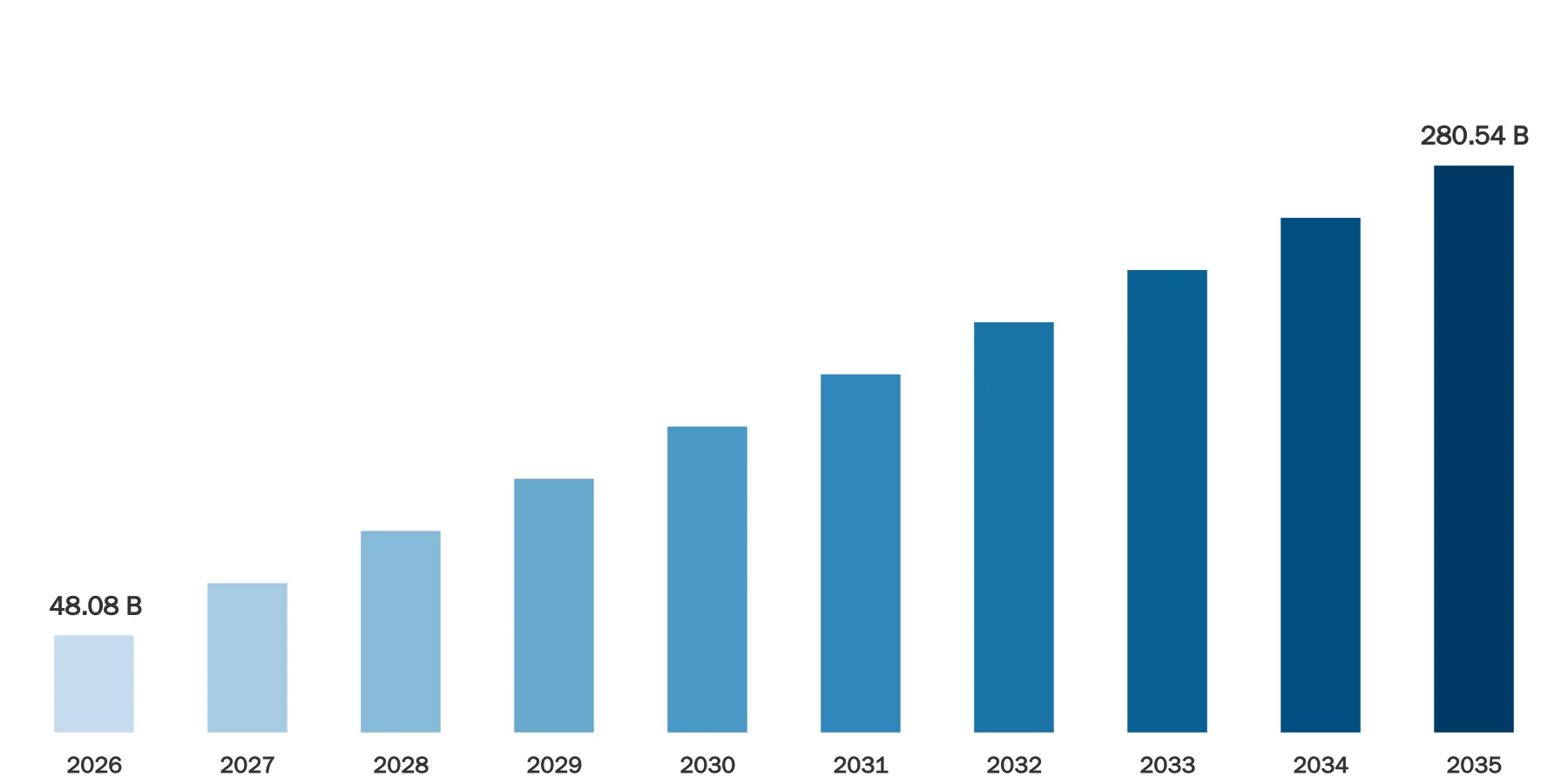
Source: Econ Market Research
The global Virtual Reality gaming ecosystem expanded significantly during 2024, with more than 9.6 million VR and mixed-reality headsets shipped worldwide. Meta controlled nearly 73% of global headset shipments in 2024, while Sony represented approximately 9% of the installed gaming VR base. More than 1.77% of Steam users actively used VR headsets during early 2026, demonstrating sustained engagement among PC gamers. Standalone VR devices accounted for over 68% of total gaming headset usage because of wireless functionality and lower hardware dependency. Around 63% of SteamVR-connected devices belonged to the Meta Quest family, highlighting strong platform dominance.
The Virtual Reality (VR) in Gaming Market Report indicates that over 35% of game developers are currently involved in VR or AR project development. Simulation and action games together represented nearly 54% of VR game downloads across major digital stores in 2025. Approximately 70% of total VR gameplay time originated from free-to-play content ecosystems, reinforcing subscription-based and downloadable content expansion in the Virtual Reality (VR) in Gaming Industry Analysis.
The United States remained the largest national contributor to the Virtual Reality (VR) in Gaming Market Size during 2025, supported by more than 57 million active VR gamers and over 38 million VR-capable gaming PCs. More than 46% of American VR users preferred standalone headsets compared with tethered systems. SteamVR data showed that US-based users accounted for approximately 31% of global VR gaming activity during 2025. More than 4,500 VR gaming studios and immersive entertainment developers operated across California, Texas, Washington, and New York.
The USA market also recorded over 12,000 VR arcade installations, including Esports simulation centers and multiplayer gaming zones. Approximately 72% of US VR gamers were aged between 18 and 34 years, reflecting strong adoption among younger consumers. Console-based VR systems represented around 21% of the domestic VR gaming ecosystem, driven by PlayStation VR installations. The Virtual Reality (VR) in Gaming Market Research Report further identified that over 61% of VR game purchases in the United States were completed through digital storefronts during 2025.
Europe represented nearly 27% of the global Virtual Reality (VR) in Gaming Market Share during 2025, supported by rising adoption across Germany, the United Kingdom, France, Spain, and the Netherlands. Germany accounted for approximately 22% of Europe’s VR gaming device installations, while the UK represented nearly 19%. More than 8,000 VR entertainment arcades and simulation gaming facilities operated across Europe in 2025. The region also recorded over 14 million active VR gaming participants, with multiplayer and esports-oriented VR titles accounting for 37% of total downloads.
PC-connected VR gaming remained highly popular in Europe, where nearly 48% of VR users relied on SteamVR-compatible devices. Approximately 43% of European VR consumers used VR systems for both gaming and social interaction platforms. Nordic countries reported VR penetration rates exceeding 9% among gamers aged 18–30 years. The Virtual Reality (VR) in Gaming Market Outlook for Europe remained favorable due to the expansion of 5G networks, which reached more than 82% population coverage across Western Europe during 2025, supporting cloud-based VR gameplay and lower latency experiences.
Virtual Reality (VR) in Gaming Market Latest Trends
The Virtual Reality (VR) in Gaming Market Trends indicate rapid migration toward lightweight standalone headsets, mixed-reality integration, AI-assisted gameplay, and cloud-based VR streaming technologies. During 2025, standalone VR systems represented more than 68% of total consumer headset adoption because users increasingly preferred wireless gaming environments with lower setup complexity. Meta Quest devices accounted for approximately 77% of the VR headset market during 2024, while top manufacturers collectively controlled more than 90% of global shipments. VR accessories such as haptic gloves, motion trackers, and full-body sensors recorded adoption increases exceeding 24% across gaming arcades and esports facilities.
Cross-platform VR gaming compatibility emerged as another major trend in the Virtual Reality (VR) in Gaming Industry Report. More than 45% of newly launched VR titles during 2025 supported PC, console, and standalone device synchronization. Multiplayer VR environments expanded rapidly, with social gaming platforms recording user session durations above 78 minutes per day on average. Cloud rendering technologies reduced latency by approximately 32 milliseconds in advanced gaming networks, improving immersive responsiveness.
Mixed reality gaming adoption accelerated due to passthrough camera enhancements and AI-powered environmental mapping. More than 52% of new VR headsets launched in 2025 included mixed-reality capabilities. Developers increasingly focused on simulation, fitness, and military-inspired gaming applications, which together represented around 39% of VR software launches. SteamVR ecosystem participation also remained stable, with VR-connected users fluctuating between 1.7% and 2% of total platform users globally.
Subscription-driven gaming libraries became increasingly important in the Virtual Reality (VR) in Gaming Market Forecast, as more than 41% of VR users downloaded at least one subscription-based title package monthly during 2025. Free-to-play gaming environments represented nearly 70% of headset engagement time, while esports-oriented VR tournaments expanded by over 18% in participant registrations globally. Hardware manufacturers also improved refresh rates, with premium headsets supporting 120 Hz displays and latency reductions below 20 milliseconds in competitive gaming applications.
Virtual Reality (VR) in Gaming Market Dynamics
The Virtual Reality (VR) in Gaming Market Analysis demonstrates strong momentum through technological innovation, expanding developer ecosystems, and increasing adoption of immersive gaming environments. More than 35% of global gaming developers currently work on VR or AR-related projects, while over 63% of SteamVR users rely on Meta Quest devices for gameplay compatibility. Consumer demand for wireless and standalone gaming systems accelerated significantly between 2024 and 2026. Approximately 52% of VR hardware launches now include mixed-reality features, while multiplayer VR gaming participation increased by more than 22% globally.
Gaming arcades, esports arenas, and simulation centers also contributed to market expansion, especially across North America and Asia-Pacific. However, the market continues facing challenges associated with high hardware costs, battery limitations, and limited mainstream adoption. Steam data revealed that only 1.77% of platform users actively engage with VR systems, highlighting the niche nature of the industry despite growing investments and technological advancements.
DRIVER
Increasing Demand for Immersive Multiplayer Gaming
The strongest growth driver in the Virtual Reality (VR) in Gaming Market Growth is increasing consumer demand for immersive multiplayer experiences. More than 58% of active VR gamers participate in multiplayer or cooperative gaming sessions at least three times weekly. VR esports tournaments recorded participant growth above 18% during 2025, while average gameplay session lengths exceeded 78 minutes daily across social VR platforms. Simulation and action-based multiplayer games represented approximately 54% of total VR gaming downloads worldwide.
Cloud gaming integration further accelerated immersive engagement by reducing latency below 20 milliseconds in advanced gaming ecosystems. More than 48% of newly released VR games now include multiplayer synchronization and cross-platform support. The rollout of 5G infrastructure across North America, Europe, Japan, South Korea, and China improved low-latency gameplay accessibility for more than 1.2 billion mobile users globally. Gaming arcades also contributed to multiplayer expansion, with over 25,000 VR entertainment venues operating worldwide during 2025.
The Virtual Reality (VR) in Gaming Market Opportunities increased further as AI-powered NPC interactions and haptic technologies improved realism. Motion tracking accuracy improved by approximately 35% in newer VR systems, while hand-tracking support expanded across more than 60% of premium gaming devices.
RESTRAINT
High Hardware Costs and Limited Consumer Penetration
The primary restraint in the Virtual Reality (VR) in Gaming Market Outlook remains the relatively high cost of advanced VR hardware and accessories. Premium VR gaming systems frequently exceed $500 equivalent retail pricing, while high-performance PC configurations required for advanced VR experiences often require GPUs with more than 8 GB dedicated memory and processors exceeding 3.5 GHz performance thresholds. During 2026, several major headset manufacturers increased prices by up to $100 due to rising Semiconductor and memory component costs.
Consumer adoption also remains limited because only around 1.77% of Steam users currently utilize VR hardware. Motion sickness and eye fatigue remain major concerns, particularly during sessions exceeding 90 minutes. Battery limitations also restrict portable headset usage to approximately 2–3 hours in many mainstream systems. Around 42% of surveyed consumers identified comfort and weight concerns as barriers to prolonged gameplay.
The Virtual Reality (VR) in Gaming Industry Analysis additionally highlights software fragmentation challenges. More than 35% of VR titles remain platform-exclusive, limiting interoperability between PC, console, and standalone ecosystems. Developers also face optimization complexities due to varying headset resolutions, refresh rates, and tracking systems. Enterprise and arcade adoption continues growing, but mainstream household penetration remains below 10% in most countries outside early-adopter regions.
OPPORTUNITY
Expansion of Mixed Reality and Cloud Gaming Platforms
The strongest opportunity within the Virtual Reality (VR) in Gaming Market Research Report involves mixed-reality gaming integration and cloud-based rendering services. More than 52% of VR headsets launched during 2025 incorporated mixed-reality passthrough capabilities, enabling users to blend digital gaming elements with physical environments. This functionality significantly expanded gameplay diversity in simulation, sports, educational, and fitness categories.
Cloud-rendered VR gameplay also improved accessibility by reducing local hardware requirements. Average latency reductions of nearly 32 milliseconds improved multiplayer responsiveness in competitive gaming environments. More than 82% of Western Europe and approximately 76% of North America gained access to advanced 5G infrastructure by 2025, strengthening low-latency streaming support.
The VR arcade sector also presents major opportunities, with over 25,000 location-based VR entertainment centers globally. Asia-Pacific alone represented more than 11,000 active VR gaming arcades during 2025. Educational simulation games expanded rapidly as universities and training institutes integrated VR systems for engineering, military, and healthcare instruction.
AI-generated environments further enhanced scalability within the Virtual Reality (VR) in Gaming Market Trends. Procedural content generation reduced game development timelines by approximately 28%, enabling smaller studios to launch immersive titles faster. Over 63% of developers now prioritize standalone headset compatibility for future releases.
CHALLENGES
Content Fragmentation and Limited Long-Term User Retention
One of the major challenges in the Virtual Reality (VR) in Gaming Market Share landscape is maintaining long-term user engagement while addressing fragmented content ecosystems. Approximately 35% of VR games remain tied to exclusive storefronts or hardware ecosystems, limiting cross-platform compatibility. Users frequently require separate purchases or adapters for PC, console, and standalone experiences, reducing convenience.
Long-term retention also remains difficult because average monthly active VR users decline significantly after the first 6–8 months of device ownership. More than 40% of first-time VR buyers reduce usage frequency due to motion discomfort, limited game libraries, or insufficient social features. Steam surveys showed that VR participation remained below 2% of total users despite significant headset availability.
Developer sustainability presents another challenge. Independent studios rely heavily on platform funding, and several publishers reduced support for internal VR projects during 2025 and 2026. Hardware optimization costs also increased because modern VR titles must support refresh rates above 90 Hz and resolutions exceeding 2K per eye for competitive visual quality.
Battery efficiency and heat management continue affecting gameplay quality. Many standalone headsets still operate for only 2–3 hours before requiring recharge cycles. Weight distribution above 500 grams also contributes to physical fatigue during extended sessions.
SWOT Analysis
Strengths
More than 9.6 million VR and MR headsets shipped globally during 2024.
Meta controlled approximately 77% of the global VR headset ecosystem during 2024.
Over 35% of game developers currently work on VR or AR projects.
Multiplayer VR gameplay sessions average more than 78 minutes daily.
Standalone VR systems represent over 68% of total consumer adoption.
More than 25,000 VR gaming arcades operate globally.
VR headsets now support refresh rates up to 120 Hz for smoother gameplay.
Simulation and action titles account for approximately 54% of VR game downloads.
Weaknesses
Only around 1.77% of Steam users actively use VR hardware.
Premium VR systems often exceed $500 equivalent retail pricing.
Average standalone battery life remains limited to 2–3 hours.
Around 42% of consumers report discomfort or eye fatigue concerns.
More than 35% of VR titles remain platform-exclusive.
Device weights frequently exceed 500 grams.
Hardware shipment declines reached 12% during 2024.
High-performance PCs still require GPUs above 8 GB memory thresholds.
Opportunities
More than 82% of Western Europe has 5G coverage supporting cloud VR gaming.
Mixed-reality functionality exists in over 52% of new VR devices.
Asia-Pacific operates more than 11,000 VR gaming arcades.
AI-driven procedural content generation reduces development timelines by 28%.
Esports VR tournament participation increased by over 18% globally.
Educational VR simulation adoption expanded across engineering and healthcare sectors.
More than 63% of developers prioritize standalone headset optimization.
Cross-platform compatibility now exists in approximately 45% of new VR releases.
Threats
Rising semiconductor costs increased headset pricing by up to $100 during 2026.
Consumer retention drops significantly after 6–8 months of ownership.
Hardware market concentration exceeds 90% among the top three manufacturers.
Motion sickness impacts approximately 40% of first-time users.
Platform fragmentation limits interoperability between ecosystems.
Several major publishers reduced first-party VR studio investments during 2026.
Declining headset shipments persisted for three consecutive years through 2024.
Limited mainstream adoption keeps household VR penetration below 10% in many regions.
Segmentation Analysis
The Virtual Reality (VR) in Gaming Market segmentation reflects evolving consumer preferences, gaming hardware innovations, and platform diversification. Application-based segmentation includes simulation gaming, multiplayer social gaming, esports VR, educational gaming, and fitness-oriented VR experiences. Multiplayer and action-oriented applications together represented nearly 54% of VR gameplay demand during 2025. Installation methods include standalone wireless systems, PC-connected tethered devices, and console-integrated VR systems. Standalone installations represented approximately 68% of global deployments because users preferred portability and lower setup complexity.
Tethered PC systems accounted for nearly 24% of the market due to higher graphical processing capabilities, while console-connected installations maintained around 8% market penetration. Gaming arcades increasingly adopted room-scale VR systems with full-body tracking technology, especially in Asia-Pacific and Europe. More than 45% of new VR software launches during 2025 supported cross-platform synchronization between PC, console, and standalone environments, improving user accessibility and ecosystem integration.
By Component
Gaming hardware represented approximately 62% of the Virtual Reality (VR) in Gaming Market Share during 2025 because headset manufacturing, controllers, sensors, and GPUs remain central to immersive gameplay delivery. More than 9.6 million VR and MR headsets were shipped globally during 2024. Head-mounted displays with resolutions above 2K per eye represented nearly 58% of premium hardware sales. Gaming software accounted for around 38% of the ecosystem, driven by multiplayer titles, subscription-based libraries, simulation games, and downloadable content expansion.
Action and simulation software categories together represented approximately 54% of VR title downloads. More than 70% of total VR usage time originated from free-to-play ecosystems integrated with digital microtransactions. Cloud-enabled software engines also improved accessibility by reducing hardware dependency. Approximately 35% of developers currently focus on VR or AR projects, indicating a strong pipeline for software innovation. AI-generated gaming environments shortened content production cycles by nearly 28%. Hardware demand also accelerated because over 63% of SteamVR users relied on Meta Quest systems, reinforcing ecosystem-centric purchasing behavior.
By Device Type
Head-mounted displays dominated the Virtual Reality (VR) in Gaming Market Size with approximately 71% market share during 2025. Standalone wireless HMDs became increasingly popular because of lower latency, inside-out tracking, and simplified installation. More than 52% of newly launched HMDs included mixed-reality passthrough features and refresh rates up to 120 Hz. VR consoles represented around 11% of device adoption, primarily driven by PlayStation VR systems and console-based immersive gaming ecosystems.
VR accessories, including haptic gloves, treadmills, vests, and advanced controllers, accounted for approximately 10% of the market. Sensor systems represented nearly 8% of total device installations and remained essential for room-scale tracking, motion capture, and esports simulation applications. Full-body tracking adoption increased by more than 24% among gaming arcades and competitive VR facilities during 2025. Motion-tracking precision improved by nearly 35% in advanced sensor-equipped systems. Eye-tracking technology also expanded rapidly, appearing in more than 29% of premium VR headsets. The Virtual Reality (VR) in Gaming Industry Report identified increasing consumer preference for lightweight devices below 500 grams, improving comfort during extended gameplay sessions.
By Game Type
Action games LED the Virtual Reality (VR) in Gaming Market Trends with nearly 31% of total downloads during 2025 due to immersive combat mechanics, multiplayer engagement, and esports integration. Adventure games represented approximately 19% of VR gaming demand because narrative-driven environments benefit strongly from immersive storytelling capabilities. Simulation titles accounted for around 23% market share, supported by military, aviation, driving, and sports training applications.
Sports-based VR games represented nearly 11% of the ecosystem, particularly fitness-oriented experiences that combine physical movement with multiplayer interaction. Racing games accounted for approximately 9% of VR gameplay because high-refresh-rate headsets significantly improved realism and cockpit immersion. Other categories, including puzzle, horror, social, and educational VR titles, collectively represented around 7%.
More than 54% of all VR gameplay time was concentrated in action and simulation categories. Multiplayer integration existed in nearly 48% of new game launches during 2025. Average gameplay sessions in social and adventure VR titles exceeded 70 minutes daily. Developers also increasingly implemented AI-powered NPCs and procedural environment generation to improve replayability and engagement metrics across multiple genres.
By Platform
PC platforms represented approximately 46% of the Virtual Reality (VR) in Gaming Market Share during 2025 because high-performance GPUs enabled superior rendering and advanced simulation environments. SteamVR remained the dominant PC VR ecosystem, with Meta Quest devices accounting for more than 63% of connected headsets. Console platforms represented nearly 21% of the market, driven largely by PlayStation VR ecosystems and exclusive gaming content.
Mobile VR platforms accounted for around 17% market share due to the expansion of smartphone-integrated VR experiences and cloud gaming accessibility. Arcade-based VR gaming represented approximately 16% of total deployments globally. More than 25,000 VR gaming arcades operated worldwide during 2025, with Asia-Pacific contributing over 11,000 facilities.
Cloud-rendered VR streaming improved platform interoperability by reducing latency below 20 milliseconds in optimized gaming networks. Cross-platform compatibility existed in nearly 45% of VR titles launched during 2025. Esports-focused PC VR gaming also expanded rapidly, with tournament registrations increasing by more than 18% globally. Console users favored action and sports games, while PC gamers demonstrated stronger demand for simulation and multiplayer experiences.
By End User
Individual gamers represented approximately 74% of the Virtual Reality (VR) in Gaming Market Outlook during 2025. More than 57 million active VR gamers operated globally across standalone, PC, and console ecosystems. Consumers aged 18–34 years accounted for nearly 72% of total VR gaming participation. Average headset usage among active gamers exceeded 6.5 hours weekly.
Gaming arcades represented around 18% of the market and remained highly concentrated in China, Japan, South Korea, and Southeast Asia. More than 25,000 VR entertainment centers globally supported multiplayer simulation gaming, free-roam experiences, and esports tournaments. Room-scale VR installations in arcades increased by approximately 21% during 2025.
Esports organizations accounted for nearly 8% of market demand but demonstrated rapid expansion due to immersive competitive gameplay. VR esports tournament participation grew by more than 18% globally between 2024 and 2025. Approximately 41% of esports-focused VR facilities integrated haptic feedback systems and advanced motion tracking technology. Simulation racing, tactical shooters, and multiplayer combat games represented the largest esports VR categories during 2025.
Regional Analysis
North America maintained the largest regional market share at approximately 38%.
Europe represented nearly 27% of global VR gaming adoption.
Asia-Pacific accounted for around 29% of global headset installations.
Middle East & Africa contributed approximately 6% of the total market.
Standalone VR systems represented over 68% of deployments globally.
Multiplayer and simulation titles dominated across all major regions.
More than 25,000 VR gaming arcades operated worldwide during 2025.
5G infrastructure expansion significantly improved cloud VR accessibility.
North America
North America represented approximately 38% of the Virtual Reality (VR) in Gaming Market Share during 2025 due to strong consumer spending, advanced gaming infrastructure, and high developer concentration. The United States accounted for nearly 84% of regional VR gaming activity, while Canada contributed approximately 11%. More than 57 million active VR gamers operated across North America during 2025. SteamVR participation remained highly concentrated in the region, with approximately 31% of global VR gaming sessions originating from US-based users.
The region hosted more than 4,500 VR game development studios and immersive technology companies. California, Texas, Washington, and New York represented the leading innovation hubs. More than 12,000 VR gaming arcades and simulation entertainment centers operated across North America, particularly in metropolitan areas.
Standalone VR devices accounted for approximately 61% of headset usage, while PC-connected VR systems represented around 28%. Console-based VR platforms contributed nearly 11% of regional deployments. More than 72% of North American VR gamers belonged to the 18–34 age demographic. High-speed internet penetration exceeded 92%, supporting cloud-rendered gaming and multiplayer VR ecosystems.
Advanced esports integration also accelerated adoption. VR esports tournaments in North America increased participant registrations by approximately 19% during 2025. Simulation racing, tactical shooters, and fitness-oriented VR experiences remained the most popular categories. More than 48% of newly launched regional VR titles included multiplayer synchronization and AI-driven gameplay mechanics.
Europe
Europe accounted for approximately 27% of the Virtual Reality (VR) in Gaming Market Size during 2025, supported by strong gaming communities, advanced broadband infrastructure, and increasing investments in immersive entertainment. Germany represented nearly 22% of regional headset installations, while the United Kingdom contributed approximately 19%. France, Spain, Italy, and the Netherlands collectively accounted for more than 31% of Europe’s VR gaming ecosystem.
More than 14 million active VR gamers participated across Europe during 2025. PC-connected VR gaming remained particularly strong, with nearly 48% of users preferring SteamVR-compatible systems. Approximately 43% of European VR gamers used immersive systems for both entertainment and social interaction applications.
Western Europe achieved more than 82% 5G population coverage by 2025, supporting low-latency cloud gaming environments. VR arcades expanded rapidly across Germany, the UK, and France, with more than 8,000 immersive entertainment facilities operating regionally. Multiplayer VR games represented nearly 39% of software downloads across Europe.
Nordic countries demonstrated some of the highest gamer penetration rates, exceeding 9% VR adoption among users aged 18–30 years. Environmental simulation, sports gaming, and educational VR experiences gained popularity in Scandinavian markets. European esports participation also increased by approximately 17% during 2025, especially in simulation racing and tactical combat genres.
The Virtual Reality (VR) in Gaming Market Forecast for Europe remains influenced by digital infrastructure investments, AI-driven content generation, and increased standalone headset adoption. Wireless VR systems represented approximately 64% of consumer installations across Western Europe during 2025.
Asia-Pacific
Asia-Pacific represented approximately 29% of the Virtual Reality (VR) in Gaming Market Growth during 2025 and remained the fastest-expanding regional ecosystem because of rising gaming populations, smartphone penetration, and arcade-based entertainment demand. China accounted for nearly 41% of regional VR gaming activity, followed by Japan at approximately 18%, South Korea at 14%, and India at around 9%.
More than 11,000 VR gaming arcades operated across Asia-Pacific during 2025, representing the highest concentration globally. China and Japan together contributed over 62% of all regional arcade installations. Multiplayer free-roam VR systems gained strong popularity among urban consumers aged 18–35 years.
Mobile VR and standalone headset usage represented approximately 59% of the Asia-Pacific market because smartphone gaming ecosystems remain highly influential across the region. PC VR systems accounted for around 27%, while console VR contributed nearly 14%. Simulation, racing, and action games represented more than 57% of total regional downloads.
South Korea and Japan demonstrated strong esports integration, with VR tournament participation increasing by approximately 22% during 2025. Cloud gaming infrastructure expansion accelerated due to advanced fiber broadband and 5G deployment. More than 76% of urban consumers in technologically advanced markets gained access to low-latency gaming networks.
India also emerged as an important growth market, supported by rising gaming smartphone adoption and increasing investments in esports facilities. Educational VR gaming applications expanded across universities and engineering institutions, while affordable standalone headsets improved accessibility among first-time users.
Middle East & Africa
The Middle East & Africa represented approximately 6% of the global Virtual Reality (VR) in Gaming Market Outlook during 2025, supported by increasing digital infrastructure investments and expanding esports ecosystems. The United Arab Emirates and Saudi Arabia together accounted for nearly 48% of regional VR gaming activity due to strong entertainment investments and smart city initiatives.
More than 1,700 VR entertainment centers and gaming arcades operated across the region during 2025. Dubai, Riyadh, Abu Dhabi, and Johannesburg emerged as major immersive gaming hubs. Standalone VR systems represented approximately 66% of headset installations because wireless systems reduced dependency on expensive gaming PCs.
Youth demographics significantly supported regional adoption, with approximately 64% of VR gamers aged below 35 years. Mobile and cloud-integrated VR gaming environments gained popularity because smartphone penetration exceeded 78% in Gulf countries. Multiplayer social VR platforms represented nearly 33% of software downloads across the region.
Esports participation increased by approximately 16% during 2025, particularly in tactical shooter and simulation gaming categories. Government-led digital transformation initiatives also encouraged investments in immersive educational and entertainment technologies. More than 58% of VR gaming startups in the region focused on Arabic-language multiplayer content and local cultural experiences.
South Africa represented the leading Sub-Saharan African market, contributing approximately 21% of regional VR gaming activity. Improved broadband infrastructure and 5G pilot programs supported cloud-rendered VR expansion across urban areas. Gaming arcades increasingly adopted motion-tracking systems and haptic accessories to improve immersion and customer retention.

Competitive Landscape
The Virtual Reality (VR) in Gaming Market Analysis demonstrates a highly consolidated competitive environment dominated by a limited number of hardware and software ecosystem providers. Meta maintained approximately 77% of global VR headset shipments during 2024, while Sony represented nearly 9% market share in gaming-focused VR devices. The top three manufacturers collectively controlled more than 90% of worldwide VR headset shipments, reflecting strong market concentration.
Competition intensified through advancements in mixed reality, refresh rate optimization, AI-enhanced gameplay, and lightweight headset design. More than 52% of newly introduced VR headsets during 2025 included passthrough mixed-reality features. Several manufacturers introduced devices supporting 120 Hz refresh rates and latency reductions below 20 milliseconds for esports and simulation gaming applications.
Platform ecosystem integration became a critical competitive factor. Meta Quest devices represented more than 63% of SteamVR-connected systems, while console-oriented ecosystems remained heavily dependent on PlayStation VR compatibility. Approximately 45% of new VR game launches supported cross-platform synchronization during 2025.
Software developers also intensified competition through multiplayer social gaming environments, subscription libraries, and AI-generated content systems. More than 35% of global game developers currently participate in VR or AR development projects. Independent studios increasingly focused on simulation, racing, and tactical shooter categories because these genres demonstrated higher engagement rates and longer average gameplay sessions.
Competitive differentiation additionally emerged through haptic technologies, eye tracking, cloud-rendered VR gaming, and standalone wireless devices. Companies prioritized weight reduction below 500 grams and battery optimization exceeding 2-hour gameplay durations to improve long-term consumer retention and comfort.
List of Top Virtual Reality (VR) in Gaming Companies
Meta Platforms
Sony Group
HTC Corporation
Valve Corporation
Microsoft Corporation
Google
Samsung Electronics
Unity Technologies
NVIDIA Corporation
Epic Games
Leading Companies by Market Share
Meta Platforms – approximately 77% global VR headset shipment share during 2024, with Quest devices representing more than 63% of SteamVR-connected systems.
Sony Group – approximately 9% market share in VR gaming hardware shipments during 2024, supported by PlayStation VR ecosystem integration.
Investment Trends & Opportunities
Investment activity in the Virtual Reality (VR) in Gaming Market Research Report intensified during 2024–2026 due to strong demand for immersive entertainment ecosystems, AI-powered gameplay, and cloud-based VR rendering infrastructure. More than 35% of game developers currently allocate resources toward VR or AR content development. Gaming studios increasingly prioritized standalone wireless compatibility because standalone devices represented over 68% of total VR adoption.
Investments in mixed-reality technologies accelerated significantly, with more than 52% of newly introduced VR systems integrating passthrough capabilities and environmental mapping features. Venture-backed VR startups increasingly focused on haptic feedback systems, eye-tracking sensors, and AI-driven procedural game generation. Procedural development tools reduced content creation timelines by nearly 28%, improving scalability for smaller studios.
Location-based entertainment remained another major investment area. More than 25,000 VR gaming arcades operated globally during 2025, while Asia-Pacific alone represented over 11,000 immersive gaming centers. Investors increasingly targeted free-roam multiplayer systems and esports-oriented VR venues because tournament participation increased by approximately 18% globally.
Cloud gaming infrastructure also attracted substantial investments because 5G coverage exceeded 82% across Western Europe and approximately 76% across North America. Reduced latency below 20 milliseconds improved VR streaming performance and multiplayer synchronization. Educational simulation gaming, fitness-oriented VR platforms, and military training systems additionally emerged as important investment segments within the broader Virtual Reality (VR) in Gaming Industry Analysis ecosystem.
Product Innovation & Development
Product innovation within the Virtual Reality (VR) in Gaming Market Trends focused heavily on mixed reality, lightweight hardware, AI integration, and immersive sensory technologies during 2024–2026. More than 52% of VR headsets launched during 2025 featured mixed-reality passthrough functionality, enabling simultaneous interaction with digital and physical environments. Manufacturers also prioritized ergonomic improvements, reducing headset weights closer to the 500-gram threshold.
Advanced display systems became a critical innovation segment. Premium gaming headsets increasingly supported refresh rates up to 120 Hz and resolutions exceeding 2K per eye. Motion tracking precision improved by approximately 35% due to advanced inside-out sensor systems and AI-assisted positional tracking. Eye-tracking capabilities appeared in nearly 29% of premium VR devices during 2025.
Battery optimization also improved significantly, with newer systems supporting approximately 2–3 hours of continuous gameplay while reducing heat generation. Haptic technologies expanded rapidly through gloves, vests, and motion-sensitive accessories designed for simulation and esports applications.
Software development innovations included AI-generated gaming environments, procedural storytelling, and multiplayer synchronization. Approximately 45% of newly launched VR games supported cross-platform compatibility across PC, console, and standalone systems. Cloud-rendered gameplay reduced dependency on high-end local hardware and improved accessibility for mobile and standalone users.
Developers additionally focused on social VR ecosystems, where average session durations exceeded 78 minutes daily. Multiplayer simulation games, tactical shooters, and fitness-oriented VR experiences demonstrated the highest innovation activity during 2025.
Recent Developments
Meta Platforms launched the Quest 3S during 2024, contributing to approximately 84% market share in Q4 2024 VR headset shipments.
Sony Group expanded PlayStation VR2 distribution and promotional campaigns during late 2024, increasing shipment share to approximately 9% during Q4 2024.
Apple entered the immersive device ecosystem with Vision Pro, accounting for approximately 5% of global VR/MR shipments during 2024.
SteamVR data during 2025 showed Meta Quest 3 and 3S devices reaching approximately 34.6% combined usage share among SteamVR users.
More than 45% of newly released VR games during 2025 introduced cross-platform compatibility across PC, standalone, and console ecosystems, improving multiplayer integration and accessibility.
Scope of the Virtual Reality (VR) in Gaming Market Report
The Virtual Reality (VR) in Gaming Market Report provides extensive analysis of gaming hardware, immersive software ecosystems, multiplayer technologies, regional adoption trends, and competitive developments across the global VR industry. The report evaluates more than 25 countries and examines standalone, PC-connected, console-integrated, and arcade-based VR gaming systems.
The study covers segmentation by component, device type, platform, game category, and end-user applications. Gaming hardware analysis includes head-mounted displays, controllers, sensors, haptic systems, and eye-tracking technologies. Software coverage includes multiplayer gaming, simulation platforms, esports VR, AI-driven content generation, and subscription-based ecosystems.
The Virtual Reality (VR) in Gaming Market Insights section examines shipment statistics, headset penetration rates, developer participation, and user engagement patterns. More than 9.6 million VR and MR devices shipped globally during 2024, while over 35% of developers participated in VR or AR content production. The report additionally evaluates cross-platform synchronization trends, where approximately 45% of new titles support multi-device compatibility.
Regional coverage includes North America, Europe, Asia-Pacific, and Middle East & Africa. The report investigates standalone headset adoption exceeding 68%, VR arcade installations surpassing 25,000 globally, and esports participation increases above 18%. Competitive analysis covers market concentration, ecosystem integration, AI-powered gameplay innovations, cloud-rendering infrastructure, and mixed-reality expansion strategies shaping the future of the Virtual Reality (VR) in Gaming Industry Report.
Virtual Reality (VR) in Gaming Market Report Scope & Segmentation
| Attributes | Details |
|---|---|
Market Size (Current) | US$ 48.08 Billion in 2026 |
Market Size (Forecast) | US$ 280.54 Billion in 2035 |
Growth Rate | CAGR of 21.65% from 2026 to 2035 |
Forecast Period | 2026 – 2035 |
Base Year | 2025 |
Historical Data Available | Yes |
Regional Scope | Global |
Segments Covered | By Component
By Device Type
By Game Type
By Platform
By End User
|
Frequently Asked Questions
Common questions about this report
The study period covers historical insights and forecast projections for the period 2026-2035.
About the Author
Market research expert with years of industry experience

Related Reports
Explore more market insights from the same category