

Transportation Management System Market
Transportation Management System Market Research Report: By Solution (Operational Planning, Fright & Order Management, Payment & Claims Management, Monitoring & Tracking, Reporting & Analytics, Others), By Deployment (On-premise, Cloud), By Mode of Transportation (Roadways, Railways, Waterways, Airways), By End User (Retail & Ecommerce, Manufacturing, Logistics, Government Organizations, Others), and Region (North America, Europe, Asia-Pacific, and Rest of the World) Global Industry Analysis, Size, Share, Growth, Trends, Regional Analysis, Competitor Analysis and Forecast
Market Overview
As per Econ Market Research analysis, the Global Transportation Management System Market was valued at approximately US$ 18.7 Billion in 2026 and is predicted to reach US$ 48.8 Billion by 2035, expanding at a CAGR of 11.2% over the forecast duration. The base year is 2025.
Transportation Management System Market Size 2025-2035 (USD Billion)

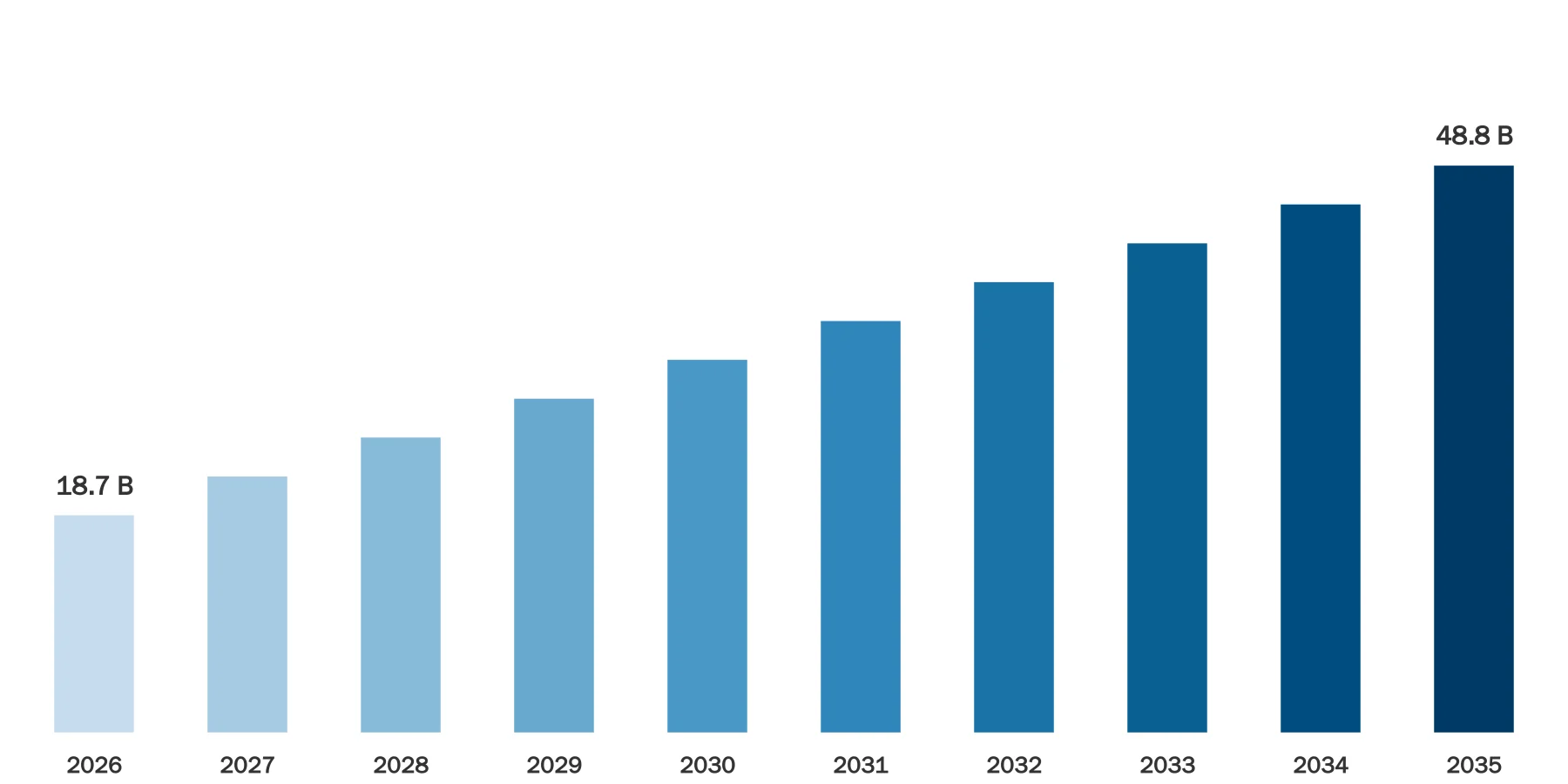
Source: Econ Market Research
The market for transportation management systems (TMS) has expanded rapidly as a crucial tool in the logistics industry, transforming how companies maximize their freight movements. TMS, which first appeared in the latter half of the 20th century, was designed to optimize transportation procedures by using technology to plan and manage the movement of freight within supply chains. It has developed into a complex platform over time with features including carrier management, freight audit/payment, shipment tracking, and route optimization.
Companies can effectively plan, carry out, and optimize the transportation of goods using this software-driven system, which reduces costs and improves operational efficiency and customer service. The demand for real-time visibility and control, e-commerce growth, and globalization all contributed to the increased growth of the TMS industry. With the introduction of cloud computing and the incorporation of AI and machine learning, the TMS market is still developing and providing more resilient, scalable, and flexible solutions that meet the needs of many industry verticals. This is spurring innovation and changing the global logistics scene.
Transportation Management System Market Dynamics
A plethora of factors are included in market dynamics, such as industry trends, legislative changes, technical breakthroughs, and evolving customer expectations. The TMS industry has been greatly impacted by ongoing technological breakthroughs like the integration of IoT, AI, and machine learning. These developments have strengthened the capabilities of TMS platforms, making it possible to track in real-time, use predictive analytics to make smarter decisions, and automate logistics procedures to increase productivity and cut expenses.
In addition, changing consumer habits especially the rise in online shopping have increased the need for quick and flexible transit options. The necessity for scalable, adaptable, and user-friendly systems that meet the requirements of many industries has driven TMS suppliers to meet this demand. Furthermore, as a result of rising trade volumes brought about by globalization, TMS is now required to offer smooth international logistics management, regulatory compliance, and visibility throughout global supply chains. Moreover, legislative modifications and sustainability programs have a big impact on market dynamics.
Route optimization to reduce carbon footprints and other eco-friendly transportation tactics are integrated into TMS solutions as a result of regulatory compliance and the growing focus on sustainable practices. All things considered, the TMS market dynamics are still changing, shaped by a combination of technical advancements, industry demands, changing regulations, and sustainability imperatives.
Transportation Management System Market Drivers
Technological Advancements
The continuous advancement of technology, encompassing artificial intelligence, machine learning, the Internet of Things, and cloud computing, has greatly improved the features and functionality of TMS systems. These developments enable TMS technologies to provide hitherto unseen degrees of automation, optimization, and real-time data insights, completely changing the way transportation and logistics are managed. Predictive analytics is made possible by AI and machine learning algorithms, which facilitate accurate demand forecasting, route optimization, and proactive problem solving.
Real-time tracking and monitoring of shipments is made possible by IoT integration, which guarantees improved supply chain visibility and effective asset management. Additionally, cloud-based TMS systems are affordable, accessible, and scalable, making them suitable for companies of all sizes. These developments improve decision-making, save costs, and improve supply chain performance in addition to streamlining processes. The logistics market is always changing, and there is a great deal of room for innovation in TMS going forward. This could lead to even more advanced solutions to satisfy these demands.
E-commerce Expansion
The rapid expansion of e-commerce has altered customer expectations and increased the need for quick and flexible logistical solutions. E-commerce requires a strong TMS infrastructure to handle the intricacies of order fulfillment, last-mile delivery, and inventory management because of its quick transactions and varied shipping requirements. TMS technologies, with features like real-time tracking, route optimization, and inventory visibility, are essential in satisfying these needs.
Furthermore, the rise in shipments from small and large e-commerce companies directly to consumers highlights the necessity for TMS solutions with the scalability and flexibility to accommodate changing delivery requirements and shipment quantities. TMS use is further fueled by the e-commerce industry',s emphasis on quicker delivery times and more affordable shipping choices, which allow enterprises to optimize routes, combine shipments, and improve overall operational efficiency. The TMS market is leading the way as e-commerce keeps growing and providing essential solutions to satisfy the changing needs of this fast-paced sector.
Restraints:
The initial cost of deploying TMS, which includes infrastructure setup, software license, employee training, and customisation, might be prohibitive for smaller businesses or those with tighter budgets. Some firms may decide not to pursue TMS adoption due to the additional costs associated with continuing maintenance, updates, and possible integration with current systems, which can add to the initial outlay. Furthermore, it is difficult for organizations to precisely budget for the switch to a TMS platform because to the uncertainty that arises from the complexity of assessing the entire scope of installation expenses up front. Furthermore, the hesitancy to incur such significant expenses is exacerbated by the perceived risk of not realizing quick returns on investment.
The expense of switching to a new TMS and the possible disruptions during the transition increase the reluctance of firms who are currently using traditional logistics systems to embrace change. The high upfront installation costs are still a major obstacle to TMS adoption, even with the long-term benefits. To reduce these financial constraints and justify TMS adoption, firms must carefully analyze their options through strategic planning and cost-benefit analysis.
Lack of Skilled Workforce
To properly utilize TMS platforms, one must possess specialist understanding in supply chain management, technology, and logistics. These are complex platforms. Nevertheless, companies looking to implement or enhance TMS solutions face a barrier due to a lack of personnel with the knowledge and experience needed to operate these systems. Because TMS is so complicated, it requires a combination of technical expertise and industry-specific knowledge.
Examples of this include understanding the complexities of supply chain dynamics and complex algorithms for route optimization. The dynamic character of technology and the continuous upgrades to TMS software compound this difficulty, necessitating continuous staff training and upskilling. Furthermore, as TMS grows more and more essential to logistics operations, the market for qualified workers gets more competitive, making it difficult to find and retain such expertise. The specialized skill set that TMS requires frequently leads to a small pool of eligible applicants, which exacerbates the labor scarcity in this industry.
Opportunities:
Rise of Cloud-based Solutions
Because cloud computing offers so many benefits, including as cost-effectiveness, scalability, accessibility, and flexibility, it has completely changed the TMS landscape. With cloud-based TMS solutions, enterprises can use a scalable platform that adjusts to changing demands and workloads without having to invest in a large amount of on-premises infrastructure. For businesses that are growing or who see swings in shipping volumes, this scalability is especially helpful. Another essential advantage of cloud-based TMS is accessibility, which allows for real-time data sharing, decision-making, and collaboration from any location with an internet connection.
Additionally, by letting companies pay only for the resources and capabilities they use, the pay-as-you-go model of cloud services enables cost optimization by lowering initial costs and continuing maintenance charges. Because cloud-based solutions are flexible by nature, they can be easily integrated, updated, and customized, allowing organizations to customize the TMS to meet their unique requirements without having to completely rebuild their infrastructure. Strong data protection is another feature of contemporary cloud systems', security protocols, which allay worries about sensitive data in logistical operations.
IoT and Real-time Tracking
IoT-enabled TMS systems collect and send real-time data along the supply chain via networked devices and sensors. This feature makes it possible to keep a close eye on assets, trucks, and shipments during the whole transportation process. The chance is in the unmatched control and visibility that this technology provides. Businesses may use IoT to track shipments in real time, which allows for accurate location tracking, temperature control for perishables, and condition monitoring for delicate items.
Proactive decision-making, like rerouting to minimize delays or improving delivery schedules, is made easier with this degree of detailed data. Additionally, IoT makes predictive analytics easier by gathering massive volumes of data, which allows TMS platforms to produce insights that are useful. These insights enable companies to increase overall operational efficiency, optimize routes, and manage their fleets better. Furthermore, real-time vehicle health monitoring using IoT-driven TMS reduces downtime and increases the dependability of transportation assets, enabling preventive maintenance.
Segment Overview
By Solution
Based on solution, the global transportation management system market is divided into operational planning, fright &, order management, payment &, claims management, monitoring &, tracking, reporting &, analytics, others. The fright &, order management category dominates the market with the largest revenue share in 2023. This segment deals with the end-to-end management of freight and orders. It involves functionalities related to order processing, freight booking, and managing the transportation lifecycle.
Freight and order management within TMS streamline workflows, track shipments, manage carriers, and ensure that goods are transported efficiently from origin to destination while maintaining visibility throughout the process. Operational planning segment focuses on planning and optimizing transportation operations. It involves functionalities like route planning, load optimization, and carrier selection.
Operational planning within TMS aims to streamline processes, reduce transportation costs, and ensure efficient use of resources by creating optimized plans for shipments and logistics operations. Payment &, claims management aspect of TMS involves functionalities related to invoicing, auditing, and managing payments for transportation services. It ensures accurate billing, verifies carrier invoices against agreed-upon rates, and handles claims or discrepancies that may arise during transportation operations.
Monitoring &, tracking segment focuses on real-time monitoring and tracking of shipments and vehicles. It utilizes technologies like GPS and IoT to provide visibility into the location and status of shipments, enabling proactive decision-making, and ensuring timely deliveries. Monitoring and tracking functionalities within TMS enhance visibility and enable stakeholders to address issues promptly. Reporting &, analytics aspect involves generating reports and leveraging analytics to derive insights from transportation data. It includes functionalities for generating performance reports, analyzing key metrics (e.g., delivery times, costs), and using data-driven insights to optimize transportation strategies and operations.
By Deployment
Based on the deployment, the global transportation management system market is categorized into on-premise, cloud. The on-premise category leads the global transportation management system market with the largest revenue share in 2023. On-premise TMS solutions involve software installed and operated from the client',s physical servers and infrastructure. With on-premise deployment, the software is purchased outright, and the organization is responsible for installation, maintenance, upgrades, and data security.
It offers a high level of control and customization, allowing businesses to tailor the system to their specific needs. Cloud-based TMS solutions operate on remote servers hosted by the TMS provider and are accessed via the internet. In this deployment model, users subscribe to the software on a pay-as-you-go or subscription basis, eliminating the need for extensive upfront costs. The TMS provider manages maintenance, updates, and security, offering scalability, flexibility, and accessibility from any location with internet access.
By Mode of Transportation
Based on mode of transportation, the global transportation management system market is segmented into roadways, railways, waterways, airways. The roadways segment dominates the transportation management system market. TMS designed for road transportation focuses on managing and optimizing the movement of goods via trucks, trailers, and other vehicles on road networks. This segment of TMS includes functionalities such as route optimization, load planning, fleet management, and real-time tracking for shipments transported via roads.
TMS for railways deals with the logistics and operations associated with freight transportation via rail networks. It includes functionalities related to rail freight management, scheduling, tracking, and optimizing cargo movements via trains. Railway-focused TMS aims to enhance the efficiency of freight operations, optimize rail routes, manage railcar utilization, and ensure seamless coordination within rail logistics.
TMS for water transportation involves managing freight movement through rivers, canals, seas, and oceans using vessels such as ships, barges, and boats. This segment of TMS includes functionalities for managing maritime logistics, port operations, cargo handling, freight scheduling, and optimizing shipping routes. It addresses the complexities of waterborne transportation, including vessel tracking, port congestion management, and compliance with maritime regulations. TMS catering to air transportation focuses on managing air cargo operations, including freight scheduling, airline cargo management, cargo tracking, and optimizing air routes. It ensures efficient handling of goods transported by airplanes, offering functionalities for real-time monitoring, route optimization, and managing air freight capacity.
By End User
Based on end user, the global transportation management system market is divided into operational retail &, ecommerce, manufacturing, logistics, government organizations, others. The manufacturing category dominates the market with the largest revenue share in 2023. TMS within the manufacturing sector concentrates on coordinating the transportation of raw materials, components, and finished goods between suppliers, production facilities, and distribution centers. It includes functionalities for managing inbound and outbound logistics, optimizing supply chain flows, coordinating shipments, and ensuring timely deliveries to support manufacturing operations.
Operational retail &, e-commerce segment involves retailers, e-commerce companies, and businesses engaged in direct-to-consumer operations. TMS within this sector focuses on managing the movement of goods from warehouses or distribution centers to customers', doorsteps. It encompasses functionalities such as order fulfillment, last-mile delivery optimization, inventory management, and shipment tracking tailored specifically to meet the demands of retail and e-commerce logistics. Logistics segment encompasses logistics service providers, third-party logistics (3PL) companies, and freight forwarders.
TMS solutions in the logistics sector are designed to handle various aspects of transportation, freight management, and supply chain operations for multiple clients. It includes functionalities such as carrier management, route optimization, freight consolidation, and multi-client logistics operations. Government entities, such as transportation departments, municipal bodies, or agencies involved in public transportation and infrastructure management, utilize TMS for optimizing transportation networks, managing public transit, and ensuring efficient movement of goods and people. TMS functionalities here focus on traffic management, route planning, and logistics optimization within public sectors.
Transportation Management System Market Overview by Region
The global transportation management system market is categorized into North America, Europe, Asia-Pacific, and the Rest of the World. North America emerged as the leading region, capturing the largest market share in 2023. The region',s sophisticated logistics infrastructure, wide-ranging trade networks, and strong economy have all added to the demand for effective transportation solutions.
The established industries of manufacturing, retail, e-commerce, and logistics have made supply chain operations optimization necessary. This has led to the use of TMS to optimize logistical procedures. Furthermore, North America has led the way in technical innovation, which has aided in the creation and incorporation of state-of-the-art technology into TMS. This includes the integration of advanced analytics, cloud-based solutions, IoT, and AI, providing organizations with unmatched ability to optimize routes, improve visibility, and make data-driven decisions.
TMS adoption has been further pushed by the region',s emphasis on customer-centric logistics as a result of the booming e-commerce sector. Businesses place a high priority on real-time tracking and faster, more dependable delivery, which has led to the use of TMS in response to changing customer needs. Adoption of TMS solutions compliant with these directives has also been encouraged by the proactive regulatory environment that supports efficiency, sustainability, and compliance in the transportation and logistics sectors. North America is a leader in the growth and development of the transportation management system market because of its robust economy, innovative technology, changing customer preferences, and governmental backing.
Transportation Management System Market Competitive Landscape
In the global transportation management system market, a few major players exert significant market dominance and have established a strong regional presence. These leading companies remain committed to continuous research and development endeavors and actively engage in strategic growth initiatives, including product development, launches, joint ventures, and partnerships. By pursuing these strategies, these companies aim to strengthen their market position, expand their customer base, and capture a substantial share of the market.
Some of the prominent players in the global transportation management system market include BluJay Solutions Ltd., Cargobase, Cerasis, Inc., GoComet, 3GTMS, Infor Inc., IBM Corporation, JDA Software Group, Inc., Manhattan Associates, MercuryGate International, Inc., Oracle Corporation, SAP SE, The Descartes System Group Inc., The Descartes System Group Inc., Trimble Transportation Enterprise Solutions, Inc., and various other key players.
Transportation Management System Market Recent Developments
In November 2023, By acquiring the UK-based 3T Logistics &, Technology Group, Aptean expands its transportation management capabilities in Europe. Aptean',s TMS products for shippers and carriers that service manufacturers and distributors in the food and beverage, fast-moving consumer goods, industrial machinery, automotive, and building product verticals will now include additional capabilities thanks to the acquisition of 3T.
Transportation Management System Market Report Segmentation
Transportation Management System Market Report Scope & Segmentation
| Attributes | Details |
|---|---|
Market Size (Current) | US$ 18.7 Billion in 2026 |
Market Size (Forecast) | US$ 48.8 Billion in 2035 |
Growth Rate | CAGR of 11.2% from 2026 to 2035 |
Forecast Period | 2026 – 2035 |
Base Year | 2025 |
Historical Data Available | Yes |
Regional Scope | Global |
Segments Covered | By Component
By Deployment
By Mode of Transportation
By Industry Vertical
|
Frequently Asked Questions
Common questions about this report
The study period covers historical insights and forecast projections for the period 2026-2035.
About the Author
Market research expert with years of industry experience

Related Reports
Explore more market insights from the same category