

Sprinkler Irrigation Systems Market
Sprinkler Irrigation Systems Market Size, Share, Trends, Growth, and Industry Analysis, By Type (Center Pivot, Lateral Move, Solid Set, Others), By Component (Sprinkler Heads, Piping, Pumps, Couplers), By Crop Type (Cereals andamp; Grains, Oilseeds andamp; Pulses, Fruits andamp; Vegetables, Others), Regional Analysis and Forecast Period 2026-2035
Sprinkler Irrigation Systems Market Overview
As per Econ Market Research analysis, the Global Sprinkler Irrigation Systems Market generated revenue of US$ 3.43 Billion in 2026 and is forecast to achieve US$ 4.49 Billion by 2035, at a CAGR of 3.04% during the study period 2026–2035. The base year considered is 2025.
Sprinkler Irrigation Systems Market Size 2025-2035 (USD Billion)

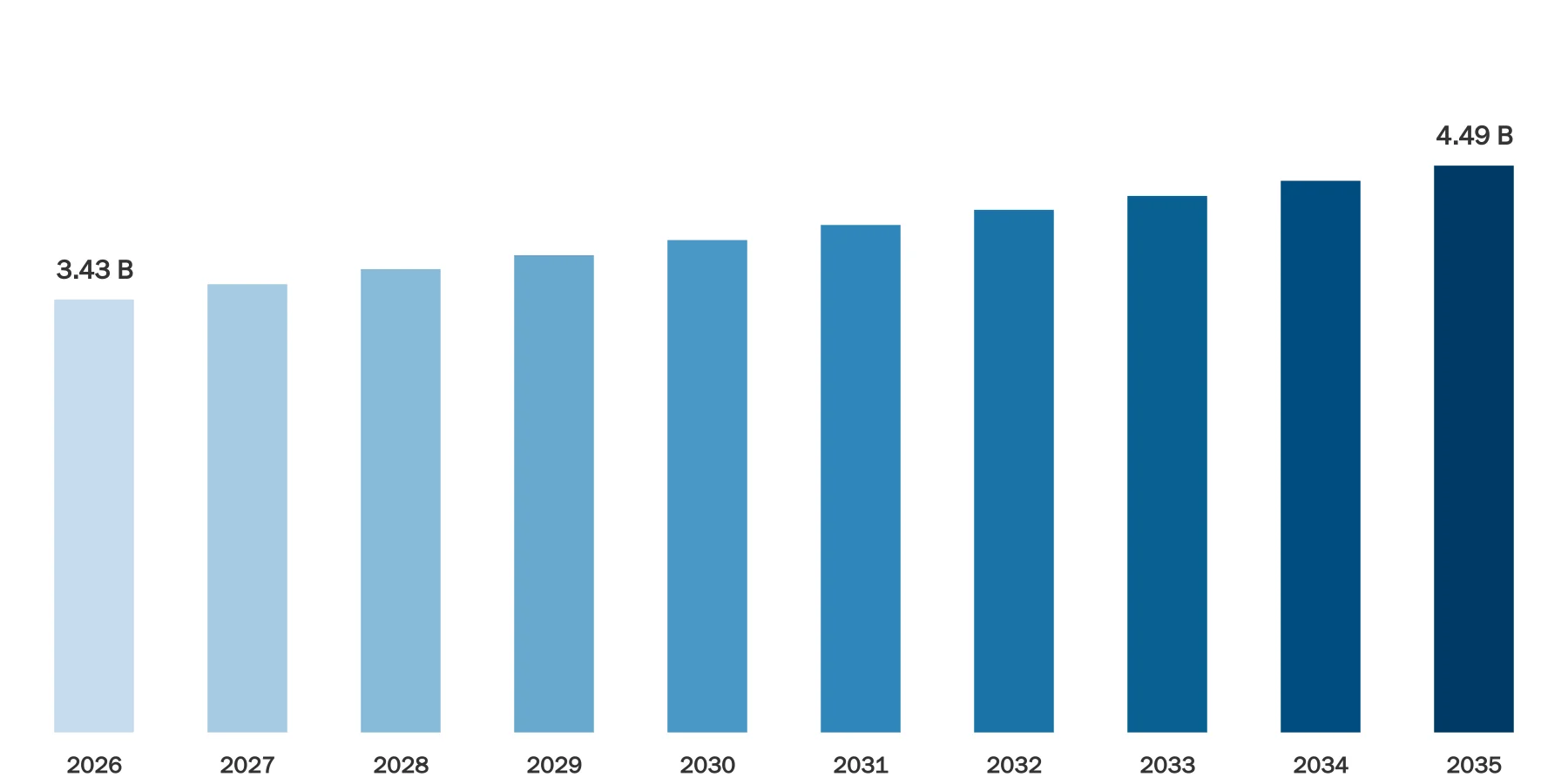
Source: Econ Market Research
The global sprinkler irrigation systems market refers to the industry involved in the manufacturing, distribution, and installation of irrigation systems that utilize sprinklers to distribute water over crops, lawns, and other agricultural or landscape areas. These systems typically consist of pipes, pumps, valves, and sprinkler heads designed to efficiently and effectively distribute water to targeted areas, thereby optimizing water usage and enhancing crop yields or maintaining green spaces. With increasing concerns over water scarcity and the need for efficient water management practices, the demand for sprinkler irrigation systems has been steadily rising across agricultural, residential, and commercial sectors worldwide.
The market is characterized by technological advancements aimed at improving system efficiency, reducing water wastage, and integrating smart irrigation solutions for enhanced control and monitoring. Factors such as growing population, urbanization, changing climatic conditions, and government initiatives promoting sustainable agriculture further drive the adoption of sprinkler irrigation systems globally. Major players in the market compete through product innovation, strategic partnerships, and expansion of distribution networks to gain a competitive edge and capture a larger market share.
Sprinkler Irrigation Systems Dynamics
Sprinkler irrigation systems are becoming more and more popular in the commercial, residential, and agricultural sectors due to growing concerns about water scarcity and the necessity for sustainable water management techniques. In addition, the need for effective irrigation systems to maintain green spaces in urban areas and increase crop yields is being driven by the growing global population and urbanisation. Furthermore, to lessen the effects of droughts and guarantee a steady supply of water for crops and landscapes, dependable irrigation systems are required due to shifting climatic conditions and irregular rainfall patterns.
Additionally, technology is a major factor in market dynamics. New technologies are constantly being developed with the goal of increasing system efficiency, decreasing water waste, and incorporating smart irrigation solutions for better control and monitoring. Precision farming and Internet of Things (IoT)-enabled irrigation systems have made it possible for farmers and landscape managers to maximise water use and raise overall productivity. Government programmes that support water conservation and sustainable agriculture also encourage market expansion by offering financial incentives and subsidies for the adoption of cutting-edge irrigation technologies.
Sprinkler Irrigation Systems Drivers
Growing Concerns Over Water Scarcity
Sprinkler irrigation systems are in high demand because of growing concerns over water scarcity worldwide brought on by urbanisation, population growth, and climate change. These systems provide an effective way to distribute water, guaranteeing maximum use and reducing waste. Sprinkler irrigation systems are essential for sustainable landscaping and agriculture practices as water resources become more scarce, especially in arid and semi-arid areas. In addition, government policies and programmes that encourage water conservation drive the market forward by motivating players to spend money on cutting-edge sprinkler technologies in order to successfully handle the problems associated with water scarcity.
Technological Advancements
Constant technological innovation in sprinkler irrigation systems boosts system performance, dependability, and efficiency, which drives up market growth. Users can maximise water use, reduce energy use, and increase overall crop yields with the help of innovations like sensor-based automation, Precision Irrigation, and remote monitoring. Real-time decision-making is made possible by smart irrigation systems that are integrated with Data Analytics and machine learning algorithms. This ensures that water is applied precisely according to crop requirements, soil moisture levels, and meteorological conditions. Furthermore, the introduction of microsprinkler and drip irrigation systems provides water-saving options appropriate for a variety of landscape and agricultural applications, propelling the global adoption of cutting-edge irrigation technologies.
Restraints:
One of the primary restraints hindering the widespread adoption of sprinkler irrigation systems is the high initial investment costs associated with equipment purchase, installation, and maintenance. The deployment of comprehensive irrigation infrastructure, including pipes, pumps, valves, and sprinkler heads, requires substantial capital investment, particularly for large-scale agricultural and commercial projects. Additionally, ongoing operational expenses, such as energy costs and periodic maintenance, add to the overall cost of ownership, posing financial challenges for small-scale farmers and budget-constrained organizations seeking to invest in modern irrigation technologies.
Limited Access to Water Resources
In certain regions characterized by limited access to water resources or unreliable water supply, the adoption of sprinkler irrigation systems may face constraints due to inadequate infrastructure and resource constraints. Water availability and quality issues, exacerbated by droughts, groundwater depletion, and competing water demands, pose significant challenges for irrigation-intensive agriculture and landscaping activities. Moreover, regulatory restrictions on water usage and allocation further restrict the expansion of sprinkler irrigation systems in water-stressed regions, necessitating alternative water management strategies and conservation measures to address resource constraints effectively.
Opportunities:
Emerging Agricultural Technologies
The convergence of advanced agricultural technologies, including precision farming, Vertical Farming, and controlled environment agriculture, creates new opportunities for the adoption of sprinkler irrigation systems in modern agricultural practices. By incorporating sensor-based monitoring, data analytics, and automation solutions, farmers can optimize water usage, improve crop productivity, and mitigate environmental risks associated with conventional irrigation methods.
The adoption of precision irrigation techniques, such as variable rate irrigation and soil moisture monitoring, enables farmers to tailor water application to specific crop requirements, soil conditions, and microclimatic variations, resulting in efficient resource utilization and enhanced farm profitability. Moreover, the integration of sprinkler irrigation systems with renewable energy sources, such as solar-powered pumps and drip irrigation systems, offers sustainable solutions for off-grid farming operations and remote agricultural areas, expanding the market potential for innovative irrigation technologies.
Segment Overview
By Type:
The segmentation by type categorizes sprinkler irrigation systems into four main groups - Center Pivot, Lateral Move, Solid Sets, and Others. Center Pivot systems are characterized by a rotating sprinkler that pivots around a central point, providing efficient coverage over large circular areas. Lateral Move systems, on the other hand, consist of laterally moving pipes with sprinklers, covering rectangular or square fields as they traverse back and forth.
Solid Sets are stationary sprinklers arranged in a set pattern, typically used in smaller, irregularly shaped fields. The ',Others', category encompasses various innovative sprinkler systems not falling into the defined Center Pivot, Lateral Move, or Solid Sets classifications. This diverse category may include emerging technologies, customized solutions, or niche applications tailored to specific irrigation needs.
By Mobility:
The mobility segment classifies sprinkler irrigation systems based on their mobility characteristics - Stationary and Towable. Stationary systems remain fixed in one location, providing consistent and reliable irrigation to a designated area. Towable systems, on the other hand, offer the flexibility to be moved or transported from one location to another. This mobility feature is particularly advantageous in situations where irrigation needs vary across different fields or where a single system serves multiple plots. Towable systems can be repositioned as needed, allowing for adaptable and dynamic irrigation strategies based on changing agricultural or landscaping requirements.
By Application:
The application segment categorizes sprinkler irrigation systems based on their intended use - Field Crops, Orchard Crops, Landscape &, Turf, and Others. Field Crops refer to large-scale agricultural crops grown in open fields, benefitting from the even distribution of water provided by sprinkler systems. Orchard Crops, including fruits and nuts, require specialized irrigation to support their growth and production.
Landscape &, Turf applications focus on maintaining green spaces in urban areas, parks, and sports fields. The ',Others', category encompasses a diverse range of applications such as Forest Crops, Vegetables, Nursery, and other specific agricultural or horticultural uses. This segmentation allows for a tailored approach, recognizing the unique irrigation needs across various crops and landscaping scenarios.
Sprinkler Irrigation Systems Overview by Region
In North America, the market is characterized by widespread adoption driven by the presence of large-scale agricultural operations, stringent water regulations, and technological advancements. The United States leads the region with significant investments in precision agriculture and smart irrigation solutions, aimed at optimizing water usage and improving crop productivity. In Europe, the market is propelled by growing concerns over water scarcity, sustainable agriculture practices, and government initiatives promoting efficient irrigation technologies.
Countries like Spain, Italy, and France are key contributors to the European market, leveraging advanced irrigation systems to enhance crop yields and conserve water resources. In Asia-Pacific, rapid urbanization, expanding agricultural activities, and increasing adoption of modern farming practices stimulate market growth. Emerging economies like China and India exhibit strong demand for sprinkler irrigation systems, driven by the need to improve agricultural productivity, ensure food security, and address water management challenges.
In Latin America, favorable climatic conditions, extensive agricultural land, and government support for irrigation infrastructure development fuel market expansion. Brazil, Argentina, and Mexico are prominent markets in the region, adopting sprinkler irrigation systems to enhance crop yields, mitigate weather-related risks, and sustain agricultural growth. The Middle East and Africa region witness growing investments in irrigation projects, driven by water scarcity concerns, population growth, and agricultural development initiatives. Countries like Israel, Saudi Arabia, and South Africa are at the forefront of implementing advanced irrigation technologies to maximize water efficiency and support agricultural sustainability efforts.
Sprinkler Irrigation Systems Market Competitive Landscape
Leading companies such as Lindsay Corporation, Valmont Industries, Jain Irrigation Systems Ltd., and The Toro Company dominate the market with a diverse portfolio of sprinkler irrigation solutions catering to agricultural, residential, and commercial applications. These industry players focus on research and development initiatives to introduce advanced technologies, including precision irrigation systems, sensor-based automation, and cloud-based monitoring platforms, aimed at improving irrigation efficiency and water management practices.
Furthermore, strategic partnerships, mergers, and acquisitions are prominent strategies adopted by companies to strengthen their competitive position and broaden their geographic reach. Collaborations with technology providers, agricultural associations, and government agencies enable companies to leverage expertise, access new markets, and capitalize on emerging opportunities in the irrigation sector. Additionally, investments in marketing, branding, and customer support initiatives play a crucial role in enhancing brand visibility, building customer trust, and fostering long-term relationships within the competitive landscape.
Sprinkler Irrigation Systems Market Leading Companies:
Valmont Industries, Inc.
Lindsay Corporation
Jain Irrigation Systems Ltd.
Netafim Limited
The Toro Company
Rain Bird Corporation
Reinke Manufacturing Co., Inc.
Nelson Irrigation Corporation
Hunter Industries
Rivulis Irrigation Ltd.
Sprinkler Irrigation Systems Recent Developments
March 2022, PepsiCo and N-Drip have formed a partnership aimed at facilitating the adoption of groundbreaking water efficiency technology among farmers worldwide. The initiative targets a total of 10,000 hectares (25,000 acres) to be covered by 2025.
March 2023, Irrigreen, a top player in robotic irrigation systems, revealed the successful acquisition of $15 million in Seed Financing. Ulu Ventures spearheaded the funding round, joined by Sage Hill Investors, Burnt Island Ventures, MFV Partners, Anorak Ventures, Echo River Capital, Tamiami, Catalyst Innovation Lab, and Sum Ventures as additional participants.
Global Sprinkler Irrigation Systems Report Segmentation
Sprinkler Irrigation Systems Market Report Scope & Segmentation
| Attributes | Details |
|---|---|
Market Size (Current) | US$ 3.43 Billion in 2026 |
Market Size (Forecast) | US$ 4.49 Billion in 2035 |
Growth Rate | CAGR of 3.04% from 2026 to 2035 |
Forecast Period | 2026 – 2035 |
Base Year | 2025 |
Historical Data Available | Yes |
Regional Scope | Global |
Segments Covered | By Type
By Component
By Crop Type
|
Frequently Asked Questions
Common questions about this report
The study period covers historical insights and forecast projections for the period 2026-2035.
About the Author
Market research expert with years of industry experience

Dipali Bhingare serves as the Market Research Director at Econ Market Research. With a focus on translating complex global economic shifts into actionable business intelligence, she oversees the strategic direction of comprehensive market studies. Her work empowers organizations to navigate volatile industries through data-driven forecasting and deep-dive competitive analysis.
Related Reports
Explore more market insights from the same category