

Crop Protection Chemicals Market
Crop Protection Chemicals Market Size, Share, Trends, Growth, and Industry Analysis, By Type (Herbicides, Insecticides, Fungicides, Others), By Origin (Synthetic, Biopesticides), By Mode of Application (Foliar Spray, Seed Treatment, Soil Treatment), Regional Analysis and Forecast Period 2026-2035
Market Overview
As per Econ Market Research analysis, the Global Crop Protection Chemicals Market reached a valuation of US$ 71.11 Billion in 2026 and is anticipated to grow to US$ 114.74 Billion by 2035, at a CAGR of 5.4% during the forecast timeline 2026–2035. The base year considered is 2025.
Crop Protection Chemicals Market Size 2025-2035 (USD Billion)

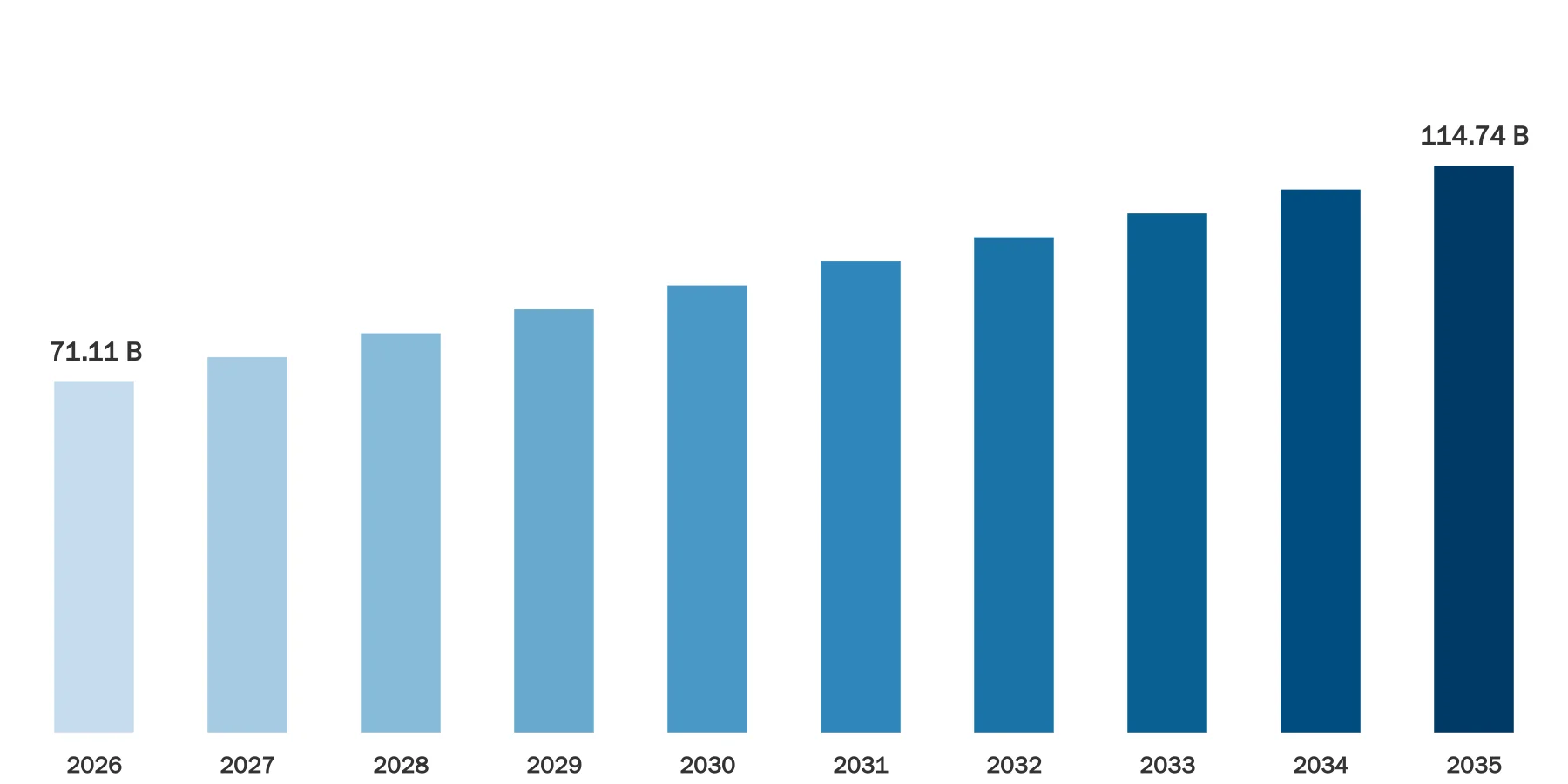
Source: Econ Market Research
The Global Crop Protection Chemicals market refers to the industry involved in the production, distribution, and application of chemical substances designed to safeguard crops from pests, diseases, and weeds. These chemicals, including herbicides, insecticides, fungicides, and others, play a crucial role in ensuring agricultural productivity and food security worldwide. With the escalating demand for food owing to population growth and the need to enhance agricultural yields, the market for crop protection chemicals has witnessed significant growth over the years. The market is influenced by various factors, including technological advancements in pesticide formulations, increasing adoption of integrated pest management practices, stringent regulatory policies, and growing awareness among farmers regarding the benefits of crop protection chemicals.
The trends and dynamics of the global crop protection chemicals market have undergone significant changes in recent years. Climate change, the emergence of pesticide resistance in weeds and pests, and growing concerns about the effects of chemical pesticides on the environment and human health have forced stakeholders to look into sustainable alternatives and create safer, more environmentally friendly formulations. Furthermore, the development, application, and monitoring of crop protection products have undergone a radical transformation thanks to the introduction of precision agriculture, Biotechnology, and digital farming technologies. Businesses in the industry are concentrating on R&,D projects to bring new active ingredients with enhanced efficacy and reduced environmental impact.
Crop Protection Chemicals Dynamics
One of the primary drivers is the increasing global population, which necessitates higher agricultural productivity to meet rising food demand. This, coupled with the need to mitigate crop losses caused by pests, diseases, and weeds, propels the demand for crop protection chemicals. Moreover, factors such as changing climatic conditions and evolving pest and weed populations contribute to the complexity of crop protection strategies, driving the need for innovative and effective chemical solutions. Furthermore, regulatory policies play a significant role in shaping market dynamics.
Stringent regulations governing the registration, use, and disposal of pesticides impact product development, market entry, and operational practices of industry players. Environmental concerns and public awareness regarding the potential risks associated with chemical pesticides also influence regulatory frameworks, driving the demand for safer and more sustainable alternatives. Additionally, technological advancements in pesticide formulations, such as the development of biopesticides, nanotechnology-based solutions, and precision application techniques, contribute to the evolving landscape of the market. Digital Agriculture technologies, including remote sensing, drones, and data analytics, are also transforming crop protection practices by enabling more targeted and efficient pest management strategies.
Crop Protection Chemicals Drivers
Growing Global Population and Food Demand:
One of the main factors propelling the market for crop protection chemicals is the growing world population. In order to meet the needs of an expanding population, farmers must increase agricultural productivity as the demand for food rises. Chemicals used in crop protection are essential for protecting plants from weeds, pests, and diseases. This increases crop yields and promotes global food security. The market is being driven forward by the growing demand for dependable and effective pest management solutions to maximise crop productivity.
Technological Advancements and Innovation:
The continuous evolution of technology in the agricultural sector is a significant driver for the crop protection chemicals market. Ongoing research and development efforts have led to the introduction of advanced formulations, precision agriculture techniques, and digital farming technologies. Innovations such as biopesticides, which offer environmentally friendly alternatives, and the integration of artificial intelligence in pest monitoring and control contribute to the market',s growth. These technological advancements enhance the efficacy of crop protection chemicals, optimize their application, and address environmental concerns, driving the adoption of novel solutions in the agricultural landscape.
Restraints:
Stringent Regulatory Policies:
The global agricultural chemicals market is confronted with obstacles as a result of strict regulations enforced by various governments. Regulations governing product registration, use, and disposal are being strictly enforced by regulatory bodies due to growing concerns about the effects of chemical pesticides on the environment and human health. In order to assure the safety and effectiveness of products, compliance with these regulations frequently necessitates significant investments in research and development. Companies in the industry may find it difficult to enter new markets or innovate due to the lengthy and complicated regulatory approval procedures.
Rising Environmental and Health Concerns:
Growing awareness of the environmental and health implications associated with chemical pesticides acts as a restraint on the market. Public concerns regarding pesticide residues in food, soil, and water, as well as the development of pesticide-resistant pests, have led to increased scrutiny of conventional crop protection chemicals. This has fuelled a demand for sustainable and eco-friendly alternatives, putting pressure on industry players to invest in the development of bio-based and organic solutions. The shift towards more environmentally conscious farming practices represents a challenge for traditional chemical pesticides, requiring the industry to adapt to changing consumer preferences and regulatory expectations.
Opportunities:
Integration of Digital Agriculture Technologies:
The market for crop protection chemicals has a promising opportunity due to the integration of digital agriculture technologies. Precision farming, drones, and data analytics are examples of technologies that help farmers apply pesticides more effectively by enabling them to target specific areas that require protection. This lessens the overall impact on the environment while also increasing the efficacy of pest management. In order to provide integrated solutions that support sustainable farming methods and satisfy the changing demands of contemporary agriculture, industry participants can investigate collaborations and investments in digital agriculture.
Segment Overview
By Product
By product, the market encompasses herbicides, fungicides, insecticides, and biopesticides. Herbicides target unwanted vegetation, controlling weeds that compete with crops for nutrients and sunlight. Fungicides are designed to combat fungal diseases that can devastate crops, particularly in humid environments. Insecticides are formulated to eliminate insect pests that damage crops by feeding on plant tissues or transmitting diseases. Biopesticides, derived from natural materials like plants, bacteria, and fungi, offer eco-friendly alternatives to synthetic chemicals, providing effective pest and disease management while minimizing environmental impact.
By Source
Source segmentation distinguishes between synthetic and natural crop protection chemicals. Synthetic chemicals are chemically manufactured compounds designed to control pests and diseases efficiently. Natural pesticides, derived from plant extracts, minerals, or beneficial microorganisms, offer sustainable alternatives to synthetic chemicals, appealing to consumers and farmers seeking environmentally friendly solutions.
By Crop Type
Crop type segmentation categorizes crops into cereal and grains, fruits and vegetables, and oilseed and pulses. Each crop category presents unique challenges and requirements for pest and disease management. Cereal and grains, including wheat, corn, and rice, are staple crops with diverse pest and disease pressures. Fruits and vegetables encompass a wide variety of crops, each susceptible to specific pests and diseases that can impact yield and quality. Oilseed and pulses, such as soybeans, peanuts, and lentils, face distinct pest challenges that vary based on crop species and cultivation practices.
By Form
Form segmentation classifies crop protection chemicals as dry or liquid formulations. Dry formulations typically include powders, granules, or dusts, offering convenience in storage, handling, and application. Liquid formulations, including emulsifiable concentrates, solutions, and suspensions, provide ease of mixing and application, ensuring uniform coverage and effectiveness across the target area.
Crop Protection Chemicals Overview by Region
The global crop protection chemicals market exhibits diverse regional dynamics shaped by varying agricultural practices, climate conditions, regulatory landscapes, and socioeconomic factors. North America represents a prominent market driven by advanced farming techniques, extensive adoption of genetically modified crops, and a strong emphasis on maximizing agricultural productivity. In Europe, stringent regulatory frameworks govern the use of crop protection chemicals, driving demand for sustainable and eco-friendly solutions while fostering innovation in pesticide formulations and application methods.
The Asia-Pacific region accounts for a significant share of the market, propelled by rapid population growth, expanding arable land, and increasing adoption of modern farming practices. In Latin America, intensive agriculture and large-scale commercial farming operations drive demand for crop protection chemicals, particularly in major crop-producing countries like Brazil and Argentina. The Middle East and Africa region, characterized by diverse climatic conditions and agricultural landscapes, presents opportunities for market growth driven by the need to improve food security, enhance crop yields, and mitigate the impact of pests and diseases on agricultural productivity.
Crop Protection Chemicals Market Competitive Landscape
Major companies such as Bayer CropScience, Syngenta AG, BASF SE, Corteva Agriscience, and FMC Corporation dominate the market with extensive product portfolios, strong R&,D capabilities, and global distribution networks. These industry giants invest heavily in research and development to innovate new active ingredients, formulations, and delivery systems, enhancing product efficacy, safety, and environmental sustainability. Strategic partnerships, acquisitions, and collaborations are common strategies employed by key players to expand market presence, access new technologies, and diversify product offerings.
Additionally, regulatory compliance and sustainability initiatives play an increasingly pivotal role in shaping competitive dynamics, with companies focusing on developing eco-friendly solutions and promoting responsible pesticide use to meet evolving consumer and regulatory expectations. Alongside established players, emerging companies and startups are leveraging advancements in biotechnology, digital agriculture, and sustainable crop protection to carve out niche markets and disrupt traditional business models. Regional players also contribute to the competitive landscape, catering to local agricultural needs and preferences while competing with multinational corporations for market share.
Crop Protection Chemicals Market Leading Companies:
Syngenta Group
Bayer CropScience
BASF SE
Corteva Agriscience
FMC Corporation
UPL Limited
Sumitomo Chemical Co., Ltd.
Nufarm
American Vanguard Corporation
Adama Agricultural Solutions
Crop Protection Chemicals Recent Developments
March 2023, Coromandel International Ltd, a prominent agrochemical company, has revealed its intentions to broaden its operations in Crop Protection Chemicals and venture into Contract Development &, Manufacturing Organization (CDMO) services. Additionally, the Board has endorsed the expansion into new growth sectors, including Speciality and Industrial Chemicals. This strategic move aligns with the company',s objective of establishing a significant foothold in the Crop Protection Chemicals market and utilizing its extensive technical expertise and top-tier infrastructure to explore related areas such as CDMO, Specialty, and Industrial Chemicals.
Global Crop Protection Chemicals Report Segmentation
Crop Protection Chemicals Market Report Scope & Segmentation
| Attributes | Details |
|---|---|
Market Size (Current) | US$ 71.11 Billion in 2026 |
Market Size (Forecast) | US$ 114.74 Billion in 2035 |
Growth Rate | CAGR of 5.4% from 2026 to 2035 |
Forecast Period | 2026 – 2035 |
Base Year | 2025 |
Historical Data Available | Yes |
Regional Scope | Global |
Segments Covered | By Type
By Origin
By Mode of Application
|
Frequently Asked Questions
Common questions about this report
The study period covers historical insights and forecast projections for the period 2026-2035.
About the Author
Market research expert with years of industry experience

Dipali Bhingare serves as the Market Research Director at Econ Market Research. With a focus on translating complex global economic shifts into actionable business intelligence, she oversees the strategic direction of comprehensive market studies. Her work empowers organizations to navigate volatile industries through data-driven forecasting and deep-dive competitive analysis.
Related Reports
Explore more market insights from the same category