Powered Surgical Tools Market Overview
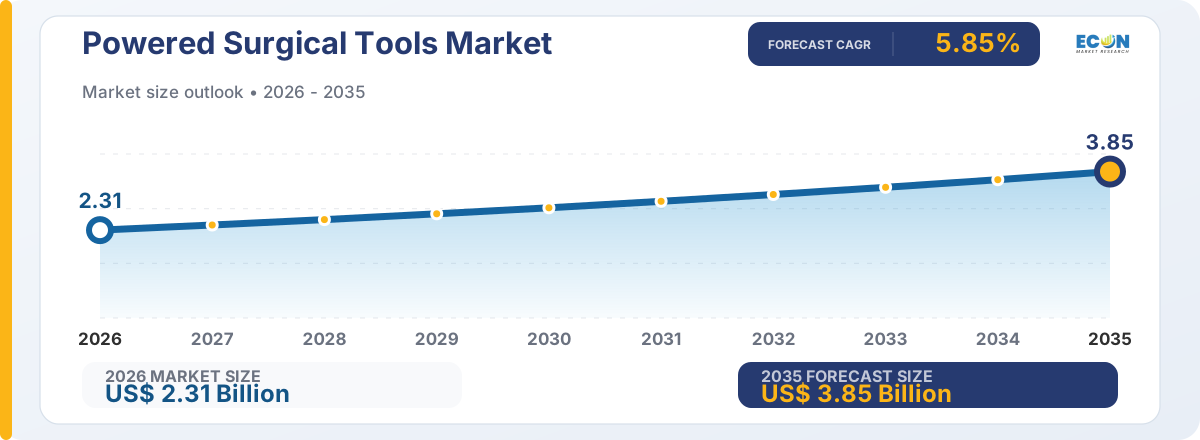
As per Econ Market Research analysis, the Global Powered Surgical Tools Market valuation stood at US$ 2.31 Billion in 2026 and is expected to reach US$ 3.85 Billion by 2035, growing at a steady CAGR of 5.85% from 2026 to 2035. 2025 serves as the base year.
The Powered Surgical Tools Market is expanding due to the increasing volume of orthopedic, neurosurgery, and ENT procedures worldwide. More than 310 million major surgeries are performed globally every year, with orthopedic procedures accounting for nearly 46% of powered surgical tool usage in 2025. Hospitals represented approximately 71% of total end-user adoption because of higher operating room volumes and advanced infrastructure. Battery-powered instruments accounted for nearly 11% of total installations in 2025 due to portability advantages. Electric-powered systems remained dominant with over 55% share across hospitals and ambulatory surgery centers. More than 600,000 hip and knee replacement surgeries in 2024 utilized powered drills, reamers, and saw systems for precision-based operations.
The USA Powered Surgical Tools Market remains the largest contributor in North America due to high procedural volumes and strong adoption of minimally invasive surgery technologies. The United States had approximately 6,093 hospitals operating in 2025, creating substantial demand for powered handpieces, battery systems, and surgical accessories. More than 70% of joint replacement centers in the country use powered instrumentation exclusively for orthopedic surgery applications. Around 58% of Zimmer Biomet’s global sales originated from the U.S. market in 2025, highlighting strong domestic demand for powered orthopedic systems. The country also recorded over 1 million joint replacement procedures annually, increasing utilization of surgical drills, saws, and robotic-assisted systems.
The European Powered Surgical Tools Market is driven by rising aging populations, increasing trauma surgeries, and strong adoption of robotic-assisted surgical technologies. Germany, France, Italy, and the United Kingdom collectively accounted for more than 58% of regional orthopedic surgical procedures in 2025. Europe performed over 1.2 million orthopedic implant procedures annually, supporting high utilization of powered reamer and drill systems. Pneumatic-powered tools represented nearly 22% of neurosurgical cutting instruments across European hospitals due to reduced heat generation and lightweight operation. Ambulatory surgical centers expanded by more than 12% between 2022 and 2025, increasing demand for cordless battery-powered surgical instruments. The region also reported strong adoption of minimally invasive ENT and cardiothoracic procedures across tertiary hospitals.
Powered Surgical Tools Market Latest Trends
The Powered Surgical Tools Market is witnessing rapid technological advancements focused on precision, portability, and minimally invasive procedures. Battery-powered instruments gained nearly 11% market penetration in 2025 because surgeons increasingly preferred cordless devices for mobility and reduced operating room clutter. Orthopedic surgery continued leading applications with approximately 46% market share due to rising knee replacement, trauma fixation, and spinal procedures worldwide. Robotic-assisted surgery integration increased significantly, with global robotic procedure volumes rising by nearly 19% during 2025. Hospitals and ambulatory surgery centers accounted for approximately 67% of powered surgical instrument demand because outpatient surgeries expanded substantially across developed economies.
Manufacturers increasingly focused on ergonomic handpieces, lightweight materials, and noise reduction technologies. Pneumatic systems maintained nearly 22% utilization in neurosurgical departments because of lower heat production and improved surgeon handling. Smart surgical systems equipped with navigation compatibility and torque-controlled motors became widely adopted in spine and cranial surgeries. More than 200,000 knee replacement procedures were conducted annually in India by 2025, increasing demand for powered orthopedic tools in emerging economies. Hospitals also accelerated adoption of rechargeable lithium-ion battery systems capable of operating continuously for 2–4 hours during complex procedures. Miniature robotic handheld systems introduced in 2024 and 2025 further enhanced precision during arthroplasty and trauma surgeries.
Powered Surgical Tools Market Dynamics
The Powered Surgical Tools Market Analysis indicates strong expansion due to rising surgical volumes, increasing geriatric populations, and growing demand for minimally invasive procedures. More than 310 million surgeries occur globally each year, creating continuous demand for powered drills, saws, and shavers. Orthopedic procedures contributed nearly 46% of total demand in 2025, while hospitals maintained over 71% end-user share. Battery-powered systems gained traction because operating room efficiency improved by approximately 15% when cordless technologies were used. Technological advancements in robotic-assisted surgeries and navigation-compatible tools are further reshaping Powered Surgical Tools Industry Report projections.
DRIVER
Increasing Volume of Orthopedic and Minimally Invasive Surgeries
The primary growth driver in the Powered Surgical Tools Market Forecast is the increasing number of orthopedic and minimally invasive procedures worldwide. More than 600,000 hip and knee replacements globally in 2024 used powered surgical systems for drilling, sawing, and fixation procedures. Orthopedic surgery represented approximately 46% of overall market demand in 2025 due to rising sports injuries, trauma cases, and aging populations. Global robotic-assisted procedures increased by nearly 19% in 2025, further boosting adoption of precision-powered instruments. More than 70% of U.S. joint replacement centers exclusively use powered instrumentation because powered systems reduce procedure time by nearly 20% and improve surgical precision during bone cutting and implant placement.
RESTRAINT
Growing Preference for Refurbished Equipment
A major restraint affecting the Powered Surgical Tools Market Growth is the increasing preference for refurbished surgical systems among small hospitals and clinics. Refurbished powered drills and saw systems are often priced 35%–50% lower than newly manufactured devices, encouraging adoption in cost-sensitive healthcare facilities. Nearly 28% of small surgical centers in developing countries rely on refurbished powered systems because of limited procurement budgets. Maintenance expenses for electric-powered systems increased by approximately 14% between 2022 and 2025 due to battery replacement and sterilization requirements. Pneumatic instruments also require compressed air infrastructure, limiting penetration in rural hospitals. These pricing and infrastructure concerns continue restricting new equipment adoption in lower-income healthcare systems.
OPPORTUNITY
Rising Adoption of Ambulatory Surgical Centers
The expansion of ambulatory surgical centers presents substantial opportunities for the Powered Surgical Tools Market Outlook. Ambulatory centers expanded by more than 12% globally between 2022 and 2025 due to rising outpatient procedures and lower hospitalization costs. Hospitals and ASCs together represented approximately 67% of end-user demand in 2026. Battery-powered surgical systems are increasingly preferred in ASCs because they reduce operating room setup complexity by nearly 18%.
Compact cordless systems are also supporting mobile trauma units and emergency surgery applications. Emerging economies including India, China, Brazil, and Indonesia are rapidly increasing investments in outpatient orthopedic centers, creating additional opportunities for lightweight handpieces and rechargeable power platforms across Powered Surgical Tools Market Opportunities analysis.
CHALLENGES
Increasing Operational and Development Costs
One of the major challenges in the Powered Surgical Tools Industry Analysis is the increasing operational and development costs associated with advanced surgical technologies. Robotic-assisted surgical systems require integration with navigation software, imaging systems, and precision motor components, increasing production complexity by nearly 25%. Hospitals also face sterilization compliance costs rising by approximately 11% annually for reusable powered instruments.
Battery-powered systems require regular charging infrastructure and lithium-ion battery replacements after approximately 500–700 charging cycles. Regulatory approvals for powered surgical devices in Europe and North America may require 12–24 months, delaying commercialization timelines. Skilled surgeon shortages in developing countries further reduce adoption of technologically advanced powered surgical systems.
SWOT Analysis
Strengths
Orthopedic surgery accounts for nearly 46% of powered surgical tool utilization globally.
Hospitals represent approximately 71% of total end-user adoption due to high surgical throughput.
Battery-powered systems improve operating room mobility by nearly 18%.
Robotic-assisted surgical procedure volumes increased by approximately 19% in 2025.
More than 600,000 global joint replacement procedures used powered tools in 2024.
Weaknesses
Refurbished equipment costs are 35%–50% lower than new systems.
Pneumatic systems require compressed air infrastructure unavailable in many rural hospitals.
Battery systems require replacement after approximately 500–700 charging cycles.
Maintenance costs for powered tools increased by nearly 14% between 2022 and 2025.
High sterilization costs limit adoption among smaller clinics.
Opportunities
Ambulatory surgical centers expanded by over 12% globally from 2022 to 2025.
India performs more than 200,000 knee replacement surgeries annually.
Cordless surgical systems reduce setup time by nearly 18%.
Emerging markets are increasing orthopedic infrastructure investments significantly.
Smart navigation-compatible powered systems are gaining widespread acceptance.
Threats
Regulatory approval timelines extend between 12 and 24 months.
Increasing competition from local low-cost manufacturers pressures pricing.
Surgical robotics integration increases manufacturing complexity by approximately 25%.
Cyber Security risks associated with connected surgical systems continue increasing.
Supply chain disruptions impact lithium-ion battery availability and component procurement.
Segmentation Analysis
The Powered Surgical Tools Market Research Report categorizes the industry by power source, product type, and application. Electric instruments remain dominant because they provide continuous torque and precision for orthopedic and neurosurgical procedures. Battery-powered systems are rapidly expanding in ambulatory surgery centers because of portability advantages. Handpieces accounted for the largest product demand due to widespread use in drilling and reaming applications. Orthopedic surgery represented the leading application segment with nearly 46% market share, followed by cardiothoracic and neurosurgery procedures. ENT and oral surgery applications are also witnessing increasing demand for compact high-speed powered instruments.
By Power Source
Electric instruments dominated the Powered Surgical Tools Market Share with more than 55% utilization across hospitals and surgical centers in 2025. Electric-powered systems are preferred for orthopedic and spine surgeries because they provide stable torque and continuous performance during long procedures. Battery-powered instruments represented approximately 11% of total installations due to increasing adoption in outpatient facilities and emergency trauma care. Rechargeable lithium-ion systems support uninterrupted operation for nearly 2–4 hours per cycle.
Pneumatic instruments accounted for approximately 22% of neurosurgical cutting tool usage because they generate less heat and provide lightweight handling. Pneumatic systems also represented around 9% of powered instrument orders in Latin America during 2024. Increasing demand for cordless surgical environments is accelerating battery-powered device adoption across ambulatory surgical centers.
By Product
Handpieces accounted for the largest product segment in the Powered Surgical Tools Market Insights because drills, saws, reamers, and shavers are essential across orthopedic and trauma surgeries. Drill systems remained the leading sub-segment in 2025 because of high utilization in fracture fixation and spinal procedures. Power sources and control systems represented nearly 28% of installations due to rising adoption of rechargeable battery consoles and smart control platforms.
Accessories including blades, burrs, and attachments accounted for approximately 24% share because consumables require regular replacement after sterilization cycles. More than 70% of orthopedic operating rooms globally utilize advanced handpiece systems integrated with digital navigation technologies. Manufacturers are increasingly introducing ergonomic lightweight handpieces to reduce surgeon fatigue during procedures lasting longer than 3 hours.
By Application
Orthopedic surgery dominated the Powered Surgical Tools Market Size with approximately 46% share in 2025 due to increasing joint replacement and trauma surgeries. More than 600,000 hip and knee replacements globally utilized powered systems in 2024. Neurosurgery represented nearly 18% market share because cranial and spinal interventions require torque-controlled drills and micro-saws. Cardiothoracic surgery accounted for approximately 22% due to demand for precision cutting instruments in thoracic and cardiac procedures.
ENT surgery represented around 14% share because minimally invasive sinus and otology procedures increasingly use compact powered systems. Oral and maxillofacial surgery continues growing because dental implant procedures increased significantly across Asia-Pacific and Europe. Plastic and reconstructive surgery also witnessed increased demand for dermal shavers and precision-powered tools supporting cosmetic procedures.
Regional Analysis
North America maintained the largest Powered Surgical Tools Market Share with more than 31% global contribution in 2025.
Europe remained a strong regional market due to high orthopedic procedure volumes and robotic surgery adoption.
Asia-Pacific showed rapid expansion because of increasing healthcare infrastructure and surgical volumes.
Middle East & Africa experienced rising demand driven by trauma care investments and hospital modernization.
Orthopedic procedures represented the leading application segment across all major regions.
North America
North America accounted for approximately 31.42% of the Powered Surgical Tools Market in 2025.
The United States remained the dominant contributor due to over 6,093 hospitals and high procedural volumes.
More than 70% of joint replacement centers in North America use powered instrumentation exclusively.
Hospitals and ASCs represented nearly 68% of total regional demand because outpatient surgeries increased significantly.
Robotic-assisted surgeries expanded by approximately 19% in 2025, accelerating powered system integration.
Orthopedic procedures represented more than 41% of powered instrument usage across North America.
Battery-powered systems gained traction in ambulatory centers because setup time reductions reached nearly 18%.
Canada also increased investments in minimally invasive surgery programs and orthopedic infrastructure.
Europe
Europe represented one of the largest Powered Surgical Tools Industry Report regions due to aging demographics.
Germany, France, Italy, and the United Kingdom collectively contributed over 58% of regional orthopedic surgeries.
Pneumatic-powered systems accounted for nearly 22% of neurosurgical cutting instruments across European hospitals.
More than 1.2 million orthopedic implant procedures are performed annually across Europe.
Ambulatory surgery center expansion exceeded 12% between 2022 and 2025, increasing demand for cordless systems.
ENT and maxillofacial procedures continued increasing because minimally invasive techniques became more widely adopted.
Hospitals increasingly implemented navigation-compatible powered instruments for spinal and cranial surgeries.
Eastern European countries expanded healthcare modernization programs supporting orthopedic equipment procurement.
Asia-Pacific
Asia-Pacific is emerging as a rapidly expanding Powered Surgical Tools Market Growth region.
India performs more than 200,000 knee replacement surgeries annually, supporting orthopedic tool demand.
China and India collectively accounted for more than 45% of hospital orthopedic equipment procurement in 2024.
Japan continues increasing robotic-assisted surgery adoption because of aging populations exceeding 29% elderly citizens.
Battery-powered systems are increasingly preferred in urban hospitals due to mobility and lower maintenance requirements.
Rising medical tourism in Thailand, India, and Singapore is supporting demand for advanced surgical infrastructure.
Orthopedic trauma and spinal procedures increased by approximately 12% across Asia-Pacific during 2024.
Governments across Southeast Asia expanded healthcare investments and tertiary hospital construction programs.
Middle East & Africa
The Middle East & Africa Powered Surgical Tools Market Outlook is improving due to hospital modernization projects.
Gulf countries increased healthcare infrastructure spending by more than 15% between 2022 and 2025.
Orthopedic and trauma surgeries represent nearly 38% of powered surgical tool demand across the region.
Saudi Arabia and the UAE expanded robotic surgery capabilities in tertiary hospitals during 2024 and 2025.
Battery-powered portable systems gained adoption in emergency trauma and military healthcare facilities.
South Africa remains a major regional market because of rising private healthcare investments and surgical center expansion.
Neurosurgical procedures increased across urban healthcare facilities due to growing specialist availability.
Limited rural infrastructure and surgeon shortages continue restricting broader regional penetration.

Competitive Landscape
The Powered Surgical Tools Market Competitive Landscape is moderately consolidated with multinational medical device manufacturers dominating orthopedic and neurosurgical segments. Leading companies focus on battery-powered systems, robotic integration, ergonomic handpieces, and minimally invasive surgical technologies. North America represented more than 31% of global market share in 2025 because major manufacturers maintain extensive distribution networks across the United States and Canada. Companies increasingly invest in navigation-compatible drills, cordless surgical systems, and high-speed pneumatic instruments to strengthen product portfolios. Orthopedic surgery applications accounted for nearly 46% of industry demand, encouraging strategic investments in joint replacement and trauma surgery technologies.
Manufacturers are also emphasizing acquisitions, collaborations, and robotic-assisted surgery innovations. In 2024, Zimmer Biomet partnered with THINK Surgical to expand robotic-assisted arthroplasty solutions using miniature handheld robotic systems. Medtronic, Stryker, and CONMED continue expanding their battery-powered and navigation-enabled orthopedic portfolios to improve precision during spinal and trauma surgeries. Hospitals and ASCs represented nearly 67% of total demand, encouraging companies to introduce compact cordless systems for outpatient procedures. Product differentiation increasingly focuses on lightweight designs, noise reduction, and battery efficiency lasting over 2–4 operational hours per cycle.
List of Top Powered Surgical Tools Companies
Stryker Corporation
B. Braun Melsungen AG
Medtronic
Zimmer Biomet Holdings, Inc.
Smith & Nephew
CONMED Corporation
De Soutter Medical
MicroAire Surgical Instruments
Adeor Medical AG
Panther Healthcare
Leading Companies by Market Share
Stryker Corporation and Medtronic are among the leading companies by Powered Surgical Tools Market Share due to extensive orthopedic and minimally invasive surgery portfolios. These companies maintain strong distribution across more than 100 countries and continuously invest in robotic-assisted surgery technologies, cordless systems, and navigation-enabled instruments. Stryker remains highly active in orthopedic reconstruction and trauma surgery technologies, while Medtronic focuses on neurosurgery, spinal procedures, and advanced powered systems. Both companies significantly benefit from rising global orthopedic procedure volumes exceeding 600,000 major joint replacement surgeries annually.
Market Investment Outlook
The Powered Surgical Tools Market Investment Outlook remains positive because healthcare providers continue increasing expenditures on minimally invasive and robotic-assisted surgical technologies. Global orthopedic procedure volumes increased substantially between 2023 and 2025, creating higher demand for powered drills, saws, and shavers. Hospitals represented approximately 71% of end-user demand due to increasing operating room modernization initiatives. Battery-powered instruments attracted growing investments because cordless systems improve mobility and reduce operating room clutter by nearly 18%. Ambulatory surgical centers also expanded by more than 12% globally, creating new opportunities for portable powered systems.
Investments are increasingly concentrated in Asia-Pacific and Middle Eastern healthcare infrastructure. China and India accounted for more than 45% of orthopedic equipment procurement growth in 2024 due to expanding hospital networks and aging populations. Robotic-assisted surgery technologies are also attracting significant strategic partnerships and acquisitions. Manufacturers are focusing on lithium-ion battery innovations, navigation integration, and ergonomic handpiece development to improve procedural efficiency. More than 200,000 knee replacement procedures annually in India alone create substantial opportunities for orthopedic-powered systems. Demand for outpatient surgery capabilities and compact battery-powered devices is expected to remain strong across emerging healthcare markets.
New Product Development
The Powered Surgical Tools Market Trends indicate strong innovation in robotic-assisted technologies, cordless instruments, and precision surgical systems. Manufacturers are increasingly developing lightweight ergonomic handpieces to reduce surgeon fatigue during procedures exceeding 3 hours. Rechargeable lithium-ion battery systems capable of continuous operation for 2–4 hours are becoming standard across advanced surgical platforms. Smart navigation-compatible drills and saws are also expanding across spine and neurosurgery applications. Pneumatic systems continue evolving with reduced vibration and lower noise generation technologies for delicate cranial surgeries.
In 2024, Zimmer Biomet introduced collaboration-based miniature handheld robotic systems for total knee arthroplasty procedures. Robotic-assisted surgery volumes globally increased by approximately 19% in 2025, accelerating demand for integrated powered tools. Manufacturers are also launching digital control systems capable of torque monitoring and automatic speed adjustment for enhanced surgical accuracy. Battery-powered trauma kits designed for emergency and military healthcare applications are increasingly adopted because of portability advantages. ENT and maxillofacial surgery applications are driving innovation in micro-drills and compact shavers supporting minimally invasive procedures. The industry also witnessed increasing use of advanced alloys and surgical-grade materials improving durability and sterilization resistance.
Recent Developments
In June 2024, Zimmer Biomet collaborated with THINK Surgical to introduce the TMINI handheld robotic system for knee arthroplasty procedures, enhancing wireless orthopedic surgery capabilities.
In 2025, robotic-assisted surgical procedures globally increased by approximately 19%, significantly boosting demand for powered drills and navigation-compatible instruments.
Hospitals and ambulatory surgical centers accounted for nearly 67% of powered surgical instrument demand in 2026 because outpatient procedures expanded rapidly worldwide.
India surpassed 200,000 annual knee replacement procedures in 2025, driving higher demand for orthopedic-powered surgical systems.
Battery-powered surgical instruments achieved approximately 11% market penetration in 2025 due to increasing adoption in ambulatory surgery centers and emergency trauma units.
Report Coverage of Powered Surgical Tools Market
The Powered Surgical Tools Market Report provides detailed analysis of industry trends, product segmentation, application outlook, competitive benchmarking, and regional performance across North America, Europe, Asia-Pacific, and Middle East & Africa. The report evaluates electric, battery-powered, and pneumatic systems while assessing technological developments including robotic-assisted surgery integration and navigation-compatible surgical instruments. Orthopedic surgery remains the leading application segment with approximately 46% market share due to rising trauma and joint replacement procedures globally. Hospitals accounted for nearly 71% of end-user demand because of increasing surgical volumes and operating room modernization programs.
The Powered Surgical Tools Industry Analysis also includes evaluation of handpieces, power source systems, accessories, and application-specific tools used in neurosurgery, ENT surgery, oral surgery, cardiothoracic procedures, and reconstructive surgery. The report highlights emerging trends including battery-powered cordless systems, ergonomic handpieces, and miniature robotic-assisted surgical technologies. Regional analysis identifies North America as the dominant market with over 31% global share in 2025, while Asia-Pacific demonstrates strong growth potential due to increasing healthcare infrastructure investments. Competitive analysis covers strategic partnerships, product launches, and technology innovation initiatives undertaken by leading manufacturers operating across global healthcare markets.
Powered Surgical Tools Market Report Scope & Segmentation
| Attributes | Details |
|---|---|
| Market Size (Current)Current market valuation | US$ 2.31 Billion in 2026 |
| Market Size (Forecast)Projected market valuation | US$ 3.85 Billion in 2035 |
| Growth RateCompound Annual Growth Rate | CAGR of 5.85% from 2026 to 2035 |
| Forecast PeriodAnalysis timeline | 2026 – 2035 |
| Base YearReference year for analysis | 2025 |
| Historical Data AvailablePast market data availability | Yes |
| Regional ScopeGeographical coverage | Global |
| Segments CoveredMarket segments analyzed | By Product
By Power Source
By Application
|
Leading companies covered in this report
- Stryker
- Medtronic
- Johnson and Johnson (DePuy Synthes)
- ConMed Corporation
- Zimmer Biomet
- B. Braun
- Smith and Nephew
Frequently Asked Questions
Common questions about this report
The study period covers historical insights and forecast projections for the period 2026-2035.
About the Author
Market research expert with years of industry experience

Dipali Bhingare serves as the Market Research Director at Econ Market Research. With a focus on translating complex global economic shifts into actionable business intelligence, she oversees the strategic direction of comprehensive market studies. Her work empowers organizations to navigate volatile industries through data-driven forecasting and deep-dive competitive analysis.