

Photoacoustic Imaging Market
Photoacoustic Imaging Market Size, Share, Trends, Growth, and Industry Analysis, By Product (Imaging Systems, Transducers, Software andamp; Accessories), By Application (Pre-clinical, Clinical), By End-User (Academic andamp; Research Institutes, Hospitals andamp; Clinics, Pharmaceutical andamp; Biotechnology Companies), Regional Analysis and Forecast Period 2026-2035
Photoacoustic Imaging Market Overview
As per Econ Market Research analysis, the Global Photoacoustic Imaging Market size amounted to US$ 0.11 Billion in 2026 and is anticipated to grow to US$ 0.4 Billion by 2035, recording a CAGR of 15.7% during 2026–2035. The base year taken for analysis is 2025.
Photoacoustic Imaging Market Size 2025-2035 (USD Billion)

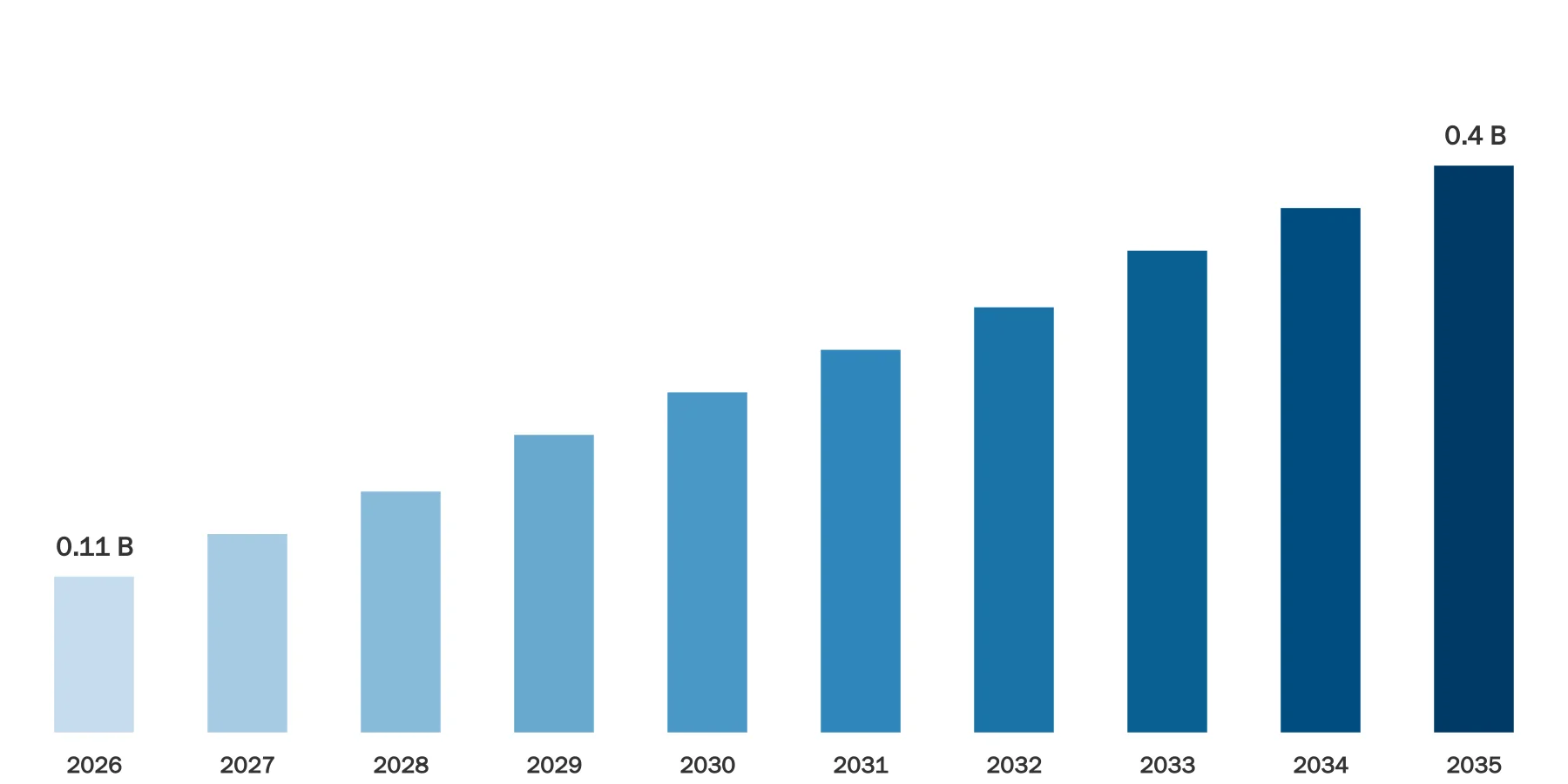
Source: Econ Market Research
Optoacoustic imaging, sometimes referred to as photoacoustic imaging, is a newly developed non-invasive imaging method that combines the benefits of ultrasound and optical imaging. It produces high-resolution, real-time images of biological tissues using laser-induced ultrasound waves, offering important new information about the makeup and operation of organs as well as anomalies. Because this cutting-edge imaging technique can provide precise information about tissue oxygenation, blood perfusion, and molecular composition, it is becoming more and more popular in medical research and clinical applications.
Photoacoustic Imaging Dynamics
Technological developments are important, more complex and effective imaging systems are introduced as a result of continuous research and development. The combination of machine learning and Artificial Intelligence with photoacoustic imaging leads to improved efficiency and accuracy of diagnosis. The rising incidence of chronic diseases, especially cancer and cardiovascular disorders, is another factor driving market dynamics and calling for the need for sophisticated diagnostic tools for early detection and treatment monitoring.
Because photoacoustic imaging can provide detailed information about tissue characteristics without using ionising radiation, it is a valuable tool in the growing field of non-invasive imaging solutions. Partnerships and collaborations between healthcare facilities, research centres, and business leaders also influence the market by encouraging creativity and the creation of new applications. The market dynamics are further influenced by regulatory support and approvals for photoacoustic imaging systems, which guarantee the safe and efficient application of these technologies in clinical settings.
Photoacoustic Imaging Drivers
Technological Advancements
The steady advancement of photoacoustic imaging technologies is a major factor propelling the market expansion. More sophisticated and effective imaging systems are being developed as a result of ongoing research and development efforts. Advancements like functional and multispectral photoacoustic imaging, along with better hardware and software capabilities, increase the accuracy of diagnosis and increase the scope of use. These technological developments not only draw medical professionals looking for state-of-the-art diagnostic instruments but also increase market competition, which promotes long-term growth.
Increasing Prevalence of Chronic Diseases
The escalating global burden of chronic diseases, particularly cancer and cardiovascular disorders, acts as a strong driver for the adoption of photoacoustic imaging. As the demand for early and accurate diagnosis rises, healthcare providers are turning to advanced imaging modalities like photoacoustic imaging to enable precise detection and monitoring of diseases. The capability of photoacoustic imaging to offer detailed information about tissue characteristics, blood perfusion, and molecular composition positions it as a valuable tool in the diagnosis and management of various medical conditions, contributing to the expanding market demand.
Restraints:
High Initial Costs and Limited Reimbursement Policies
The high upfront costs associated with acquiring and implementing photoacoustic imaging systems pose a significant restraint to market growth. Healthcare institutions may face financial challenges in adopting these advanced technologies, limiting their accessibility. Additionally, the lack of comprehensive reimbursement policies for photoacoustic imaging procedures further impedes market expansion. Overcoming these financial barriers and establishing favorable reimbursement frameworks is essential to widespread adoption and sustained market growth.
Limited Awareness and Skill Set
Patients', and healthcare professionals', lack of awareness of photoacoustic imaging is impeding its widespread use, despite its potential. Because of the way the technology combines optical and ultrasonic imaging, accurate interpretation and diagnosis necessitate specialised training. The integration of this novel modality into standard clinical practice is hampered by the lack of qualified professionals who are proficient in photoacoustic imaging techniques. To overcome this barrier and realise the full market potential, it is imperative to address these knowledge gaps through focused education and training initiatives.
Opportunities:
Expanding Applications in Research and Clinical Fields
The versatility of photoacoustic imaging presents ample opportunities for its expansion into diverse research and clinical applications. Beyond oncology, where it has shown significant promise, there is potential for growth in areas such as neurology, dermatology, and ophthalmology. The exploration of new applications and the development of specialized imaging probes can open doors to untapped markets, driving the technology',s adoption across various medical disciplines.
Segment Overview
By Product
The photoacoustic imaging market is categorized by product into two main segments &ndash, Photoacoustic Tomography (PAT) and Photoacoustic Microscopy (PAM). Photoacoustic Tomography involves the use of ultrasound waves generated by laser-induced photoacoustic signals to create detailed three-dimensional images of tissues and organs. This modality is particularly valuable for its depth penetration and imaging capabilities in pre-clinical and clinical settings. On the other hand, Photoacoustic Microscopy focuses on achieving high-resolution images at the microscopic level, providing detailed insights into cellular and subcellular structures. Both PAT and PAM contribute to the versatility of photoacoustic imaging, catering to various research and diagnostic needs across different scales.
By Type
The segmentation by type encompasses Pre-Clinical and Clinical applications of photoacoustic imaging. In the Pre-Clinical domain, the technology is predominantly employed in research settings, facilitating in-depth studies on animal models and experimental setups. This allows for a comprehensive understanding of biological processes, disease mechanisms, and potential treatment responses. In the Clinical realm, photoacoustic imaging transitions into practical healthcare applications, aiming to diagnose and monitor diseases in human patients. The dual categorization reflects the diverse utility of photoacoustic imaging across both investigative and diagnostic contexts, contributing to its overall market significance.
By Application
The segmentation based on application highlights the diverse uses of photoacoustic imaging in different medical fields. In Oncology, photoacoustic imaging proves instrumental in early cancer detection, characterization of tumors, and monitoring treatment responses. Cardiology utilizes this imaging modality to assess cardiac function, blood flow, and tissue oxygenation, providing valuable insights for cardiovascular diagnosis and management. Angiology involves the study of blood vessels, and photoacoustic imaging aids in visualizing vascular structures and assessing perfusion.
Histology benefits from the detailed imaging capabilities to study cellular and tissue structures. Lastly, Interventional Radiology utilizes photoacoustic imaging for real-time guidance during minimally invasive procedures, enhancing precision and safety. The segmentation by application underscores the adaptability of photoacoustic imaging across various medical specialties, positioning it as a versatile and valuable diagnostic tool in the broader landscape of healthcare.
Photoacoustic Imaging Overview by Region
North America and Europe stand out as key hubs for photoacoustic imaging adoption, driven by well-established healthcare systems, a robust research environment, and significant investments in medical technologies. In North America, the United States, in particular, leads the market with a strong presence of key industry players and a proactive approach to integrating advanced imaging modalities into clinical practice. Similarly, European countries such as Germany, the United Kingdom, and France are at the forefront of embracing photoacoustic imaging, leveraging their advanced healthcare networks and research capabilities.
The Asia-Pacific region is emerging as a high-potential market for photoacoustic imaging, propelled by increasing healthcare expenditure, a growing awareness of advanced diagnostic technologies, and a rising burden of chronic diseases. Countries like China and Japan are witnessing a surge in demand for innovative medical imaging solutions, presenting significant opportunities for market players to expand their presence. The Latin American and Middle Eastern regions also demonstrate potential for market growth, driven by improving healthcare infrastructure and a growing focus on enhancing diagnostic capabilities.
Photoacoustic Imaging Market Competitive Landscape
Leading companies such as Fujifilm VisualSonics, iThera Medical GmbH, and Endra Life Sciences dominate the market with their technologically advanced photoacoustic imaging systems and a strong global presence. These key players focus on continuous research and development to enhance their product portfolios, introducing cutting-edge features that cater to the evolving needs of the healthcare industry.
In addition to established market players, a wave of startups and smaller companies is contributing to the competitive dynamics by introducing novel technologies and approaches. These entrants, driven by entrepreneurial spirit and agility, bring fresh perspectives to the market, fostering a climate of innovation. Collaborations and partnerships between industry participants and research institutions are also prevalent, fostering the exchange of knowledge and expertise to accelerate technological advancements and expand market reach.
Photoacoustic Imaging Market Leading Companies:
Fujifilm VisualSonics Inc.
iThera Medical GmbH
Endra Life Sciences Inc.
Seno Medical Instruments
TomoWave Laboratories Inc.
PhotoSound Technologies Inc.
Kibero GmbH
IllumiSonics Inc.
Aspectus GmbH
Vibronix Inc.
Photoacoustic Imaging Recent Developments
May 2023, FUJIFILM VisualSonics Inc., a global pioneer in ultra-high frequency ultrasound and photoacoustic imaging systems, has unveiled the Vevo®, F2, marking the world',s inaugural preclinical imaging system with an extraordinary range from ultra-high to low frequencies (71MHz-1MHz). The Vevo F2 incorporates advanced HD image processing technology and introduces a revolutionary signal pathway, optimizing clarity from the transducer to the display screen. This innovative design, coupled with multi-line processing, substantially enhances frame rates compared to previous generation platforms.
Global Photoacoustic Imaging Report Segmentation
Photoacoustic Imaging Market Report Scope & Segmentation
| Attributes | Details |
|---|---|
Market Size (Current) | US$ 0.11 Billion in 2026 |
Market Size (Forecast) | US$ 0.4 Billion in 2035 |
Growth Rate | CAGR of 15.7% from 2026 to 2035 |
Forecast Period | 2026 – 2035 |
Base Year | 2025 |
Historical Data Available | Yes |
Regional Scope | Global |
Segments Covered | By Product
By Application
By End-User
|
Frequently Asked Questions
Common questions about this report
The study period covers historical insights and forecast projections for the period 2026-2035.
About the Author
Market research expert with years of industry experience

Dipali Bhingare serves as the Market Research Director at Econ Market Research. With a focus on translating complex global economic shifts into actionable business intelligence, she oversees the strategic direction of comprehensive market studies. Her work empowers organizations to navigate volatile industries through data-driven forecasting and deep-dive competitive analysis.
Related Reports
Explore more market insights from the same category