

Indoor Distributed Antenna Systems Market
Indoor Distributed Antenna Systems Market Size, Share, Trends, Growth, and Industry Analysis, By Type (Active DAS, Passive DAS, Hybrid DAS), By Application (Office Buildings, Shopping Malls, Airports andamp; Transportation, Hospitals andamp; Clinics, Higher Education), Regional Analysis and Forecast Period 2026-2035
Indoor Distributed Antenna Systems Market Overview
As per Econ Market Research analysis, the Global Indoor Distributed Antenna Systems Market was recorded at US$ 14.23 Billion in 2026 and is projected to expand to US$ 26.48 Billion by 2035, registering a CAGR of 7.14% over the forecast period. The base year used is 2025.
Indoor Distributed Antenna Systems Market Size 2025-2035 (USD Billion)

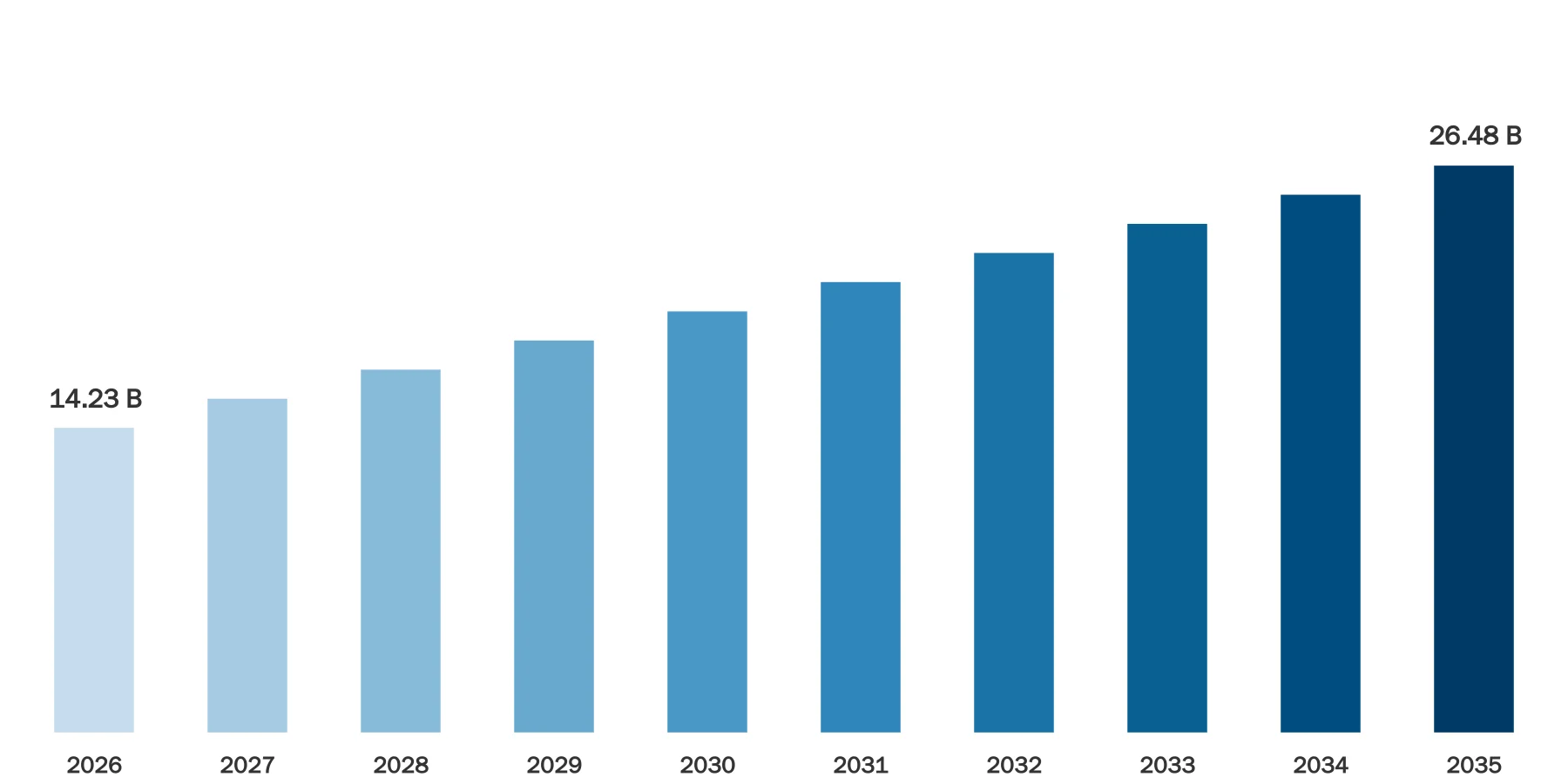
Source: Econ Market Research
The market for indoor Distributed Antenna Systems has become important for improving wireless coverage in enclosed areas. The increasing need for dependable, high-performing wireless connectivity in places like stadiums, airports, retail centers, and corporate buildings is met by this technology. Through the planned placement of a network of antennas, DAS enhances signal dispersion, reduces coverage gaps, and guarantees uninterrupted mobile device connectivity in these interior environments. The indoor DAS market is critical in meeting the changing needs of modern interior communication infrastructure by offering scalable and effective solutions, especially as the demand for reliable wireless connectivity keeps rising.
Indoor Distributed Antenna Systems Market Dynamics
The growing need for seamless wireless communication, especially in crowded interior environments, is driving the market for indoor distributed antenna systems (DAS). The emergence of 5G technology, growing data consumption, and the spread of IoT devices all support the market',s expansion. To satisfy client expectations and operational requirements, businesses and venues give priority to upgraded communication infrastructure.
Further propelling industry expansion are regulatory actions that support enhanced indoor coverage. On the other hand, difficulties include the requirement for significant investments and complicated installation. The dynamic environment of the indoor DAS market is being shaped by ongoing technological breakthroughs and the emergence of smart buildings.
Indoor Distributed Antenna Systems Market Drivers
Proliferation of IoT Devices
Companies are looking to improve productivity, automation, and data-driven decision-making as internet of things (IoT) devices proliferate. IoT devices monitor, evaluate, and optimize operations in a variety of industries, including manufacturing, healthcare, and smart cities. Desires for remote monitoring, real-time analytics, and better resource use are driving this explosion in IoT usage. Encouraging innovation and reshaping the landscape of contemporary digital infrastructure, the requirement to build intelligent, networked ecosystems plays a part in the widespread IoT Device adoption
Rising Demand for Seamless Connectivity
Strong and reliable wireless connectivity is essential as more and more people, organizations, and sectors rely on real-time communication. Users expect smooth access to high-speed data and applications whether they are in residential regions, congested public locations, or corporate surroundings. This forces the use of cutting-edge technologies such as indoor distributed antenna systems (DAS), which fulfill the growing demand for connectivity in a variety of contexts by optimizing signal dispersion, mitigating coverage gaps, and guaranteeing a consistently fast and dependable wireless experience.
Restraints:
Adoption may be significantly hampered by the high upfront costs of obtaining and deploying DAS solutions, which include those for infrastructure, equipment, and deployment. This cost barrier might discourage organizations from investing in these systems, especially small and medium-sized businesses, which would restrict the general adoption of DAS technology. Realizing the long-term benefits of improved indoor connection and guaranteeing wider accessibility to cutting-edge wireless communication technologies depend on overcoming the challenge of a hefty initial investment.
Integration Challenges with Existing Infrastructure
Older structures may contain legacy systems that are difficult to integrate with contemporary DAS technology. Deployment delays and higher costs can result from the difficulties of integrating new DAS components with existing infrastructure. Compatibility problems could prevent a smooth integration and impair the system',s overall performance. The quick and economical deployment of indoor DAS is hampered by the need for careful planning and financial expenditure in retrofitting or updating existing structures to overcome these obstacles, especially in settings with outdated and diversified technological foundations.
Opportunities:
5G Network Evolution
To handle the faster data rates and larger capacity that 5G technology offers, there is an increasing need for improved indoor connectivity as it spreads throughout the world. Indoor DAS solutions might be crucial in fulfilling the needs of 5G-enabled devices and applications by offering smooth, fast, and dependable connectivity inside buildings. To fully realize the potential of 5G connection indoors, DAS suppliers now have the opportunity to position their solutions as crucial parts of the larger ecosystem of 5G network infrastructure.
Collaboration with Building Automation Systems
Complete smart building solutions can be created by integrating DAS and BAS. Synchronized communication made possible by this synergy enables the effective administration of several interconnected systems, including security, lighting, and HVAC. DAS providers can take advantage of this by providing seamless connectivity solutions that improve smart buildings', general intelligence, responsiveness, and energy efficiency. In addition to improving interior communication, this partnership establishes DAS as a key element in the development of intelligent and networked building infrastructure.
Segment Overview
By Type
Based on type, the global indoor distributed antenna systems market is divided into hybrid, active, and passive. The active category dominates the market with the largest revenue share in 2023. Active DAS is frequently installed in locations with high user density, like university campuses, commercial centers, and hospitals. In big, complicated indoor locations like stadiums, airports, or conference centers, where a customized strategy is needed, hybrid DAS is frequently used. Applications for passive DAS can be found in settings with relatively modest coverage areas, such as hotels, office buildings, and smaller retail establishments.
By Component
Based on the components, the global indoor distributed antenna systems market is categorized into hardware, software, and services. The hardware category leads the global indoor distributed antenna systems market with the largest revenue share in 2023. The DAS system is primarily composed of hardware components, which provide effective signal transmission and coverage over the specified indoor space. The DAS must be configured and adjusted by software to maximize performance, adjust to shifting network conditions, and offer functions like load balancing and interference reduction. Services are necessary for the effective setup and continuous functioning of indoor DAS.
By Application
Based on application, the global indoor distributed antenna systems market is segmented into healthcare, hospitality &, commercial, manufacturing, transportation &, logistics, and others. The healthcare segment dominates the indoor distributed antenna systems market. The healthcare sector consists of clinics, hospitals, and other medical establishments where strong indoor wireless connectivity is crucial. Critical functions in healthcare facilities, including patient monitoring, staff communication, and the usage of medical technology, are supported by indoor DAS. In the manufacturing sector, wireless communication is essential for automation, real-time monitoring, and operational efficiency in factories and other industrial facilities.
Indoor Distributed Antenna Systems Market Overview by Region
The global indoor distributed antenna systems market is categorized into North America, Europe, Asia-Pacific, and the Rest of the World. North America emerged as the leading region, capturing the largest market share in 2023. The need for improved indoor connection is driven by the region',s sophisticated telecommunications infrastructure and the widespread adoption of 4G and 5G technologies.
Robust wireless communication solutions are additionally required by the high density of metropolitan areas, a population that is tech-savvy, and the existence of many large-scale organizations. North America',s dominance in the development and implementation of advanced indoor DAS technologies is largely due to continuous smart building projects and the significance of seamless connectivity across many sectors. Throughout the forecast period, Asia-Pacific is anticipated to post a significant CAGR.
The region',s fast urbanization, growing population, and rising use of cutting-edge technologies are all blamed for this increase. Significant investments in 5G infrastructure, along with growing demand for seamless connection in densely populated urban areas, are driving the market ahead. The implementation of indoor DAS solutions across multiple industries is encouraged by the changing economic landscape, especially in emerging nations. Asia-Pacific is positioned as a major growth region in the global indoor DAS market thanks to its proactive approach to digital transformation and connectivity advances.
Indoor Distributed Antenna Systems Market Competitive Landscape
In the global indoor distributed antenna systems market, a few major players exert significant market dominance and have established a strong regional presence. These leading companies remain committed to continuous research and development endeavors and actively engage in strategic growth initiatives, including product development, launches, joint ventures, and partnerships. By pursuing these strategies, these companies aim to strengthen their market position, expand their customer base, and capture a substantial share of the market.
Indoor Distributed Antenna Systems Market Leading Companies:
Commscope
Corning Incorporated
Comba Telecom Systems Holdings Ltd.
ATC TRS V LL
HUBER+SUHNER
TE Connectivity
Galtronics
Boingo Wireless, Inc
PBE Group, and various others
Indoor Distributed Antenna Systems Market Recent Developments
In November 2021, An agreement was struck by JMA Wireless and Kyocera Corporation to collaborate on the development of a 5G millimeter-wave backhaul infrastructure.
In July 2021, In order to assist 3 Hong Kong, a mobile network operator, with the extension and deepening of its 5G indoor network coverage, Comba Telecom Systems Holdings Limited successfully installed its ComFlex Pro solution.
In January 2021, The world',s first 5G inside Distributed Antenna System (DAS), developed by the Electronics and Telecommunications Research Institute (ETRI), is a ground-breaking invention that can channel millimeter-wave (28GHz) broadband 5G signals into inside locations from base stations.
Indoor Distributed Antenna Systems Market Report Segmentation
Indoor Distributed Antenna Systems Market Report Scope & Segmentation
| Attributes | Details |
|---|---|
Market Size (Current) | US$ 14.23 Billion in 2026 |
Market Size (Forecast) | US$ 26.48 Billion in 2035 |
Growth Rate | CAGR of 7.14% from 2026 to 2035 |
Forecast Period | 2026 – 2035 |
Base Year | 2025 |
Historical Data Available | Yes |
Regional Scope | Global |
Segments Covered | By Type
By Application
|
Frequently Asked Questions
Common questions about this report
The study period covers historical insights and forecast projections for the period 2026-2035.
About the Author
Market research expert with years of industry experience

Dipali Bhingare serves as the Market Research Director at Econ Market Research. With a focus on translating complex global economic shifts into actionable business intelligence, she oversees the strategic direction of comprehensive market studies. Her work empowers organizations to navigate volatile industries through data-driven forecasting and deep-dive competitive analysis.
Related Reports
Explore more market insights from the same category