

Electro-Mechanical Brake Market
Electro-Mechanical Brake Market Research Report: Information Based on By Brake Type (Single Face Brake, Particle Brake, Hysteresis Power Brake, Multiple Disk Brake, and Power-Off Brake), By Technology (Smart Braking Systems and Regenerative Braking), By Application (Locomotives, Automotive, Aircraft, Robotic, Marine, and Others), and Region (North America, Europe, Asia-Pacific, and Rest of the World) Global Industry Analysis, Size, Share, Growth, Trends, Regional Analysis, Competitor Analysis and Forecast
Market Overview
As per Econ Market Research analysis, the Global Electro-Mechanical Brake Market was estimated at US$ 0.91 Billion in 2026 and is forecast to attain US$ 1.19 Billion by 2035, expanding at a CAGR of 3.2% between 2026 and 2035. The base year for the study is 2025.
Electro-Mechanical Brake Market Size 2025-2035 (USD Billion)

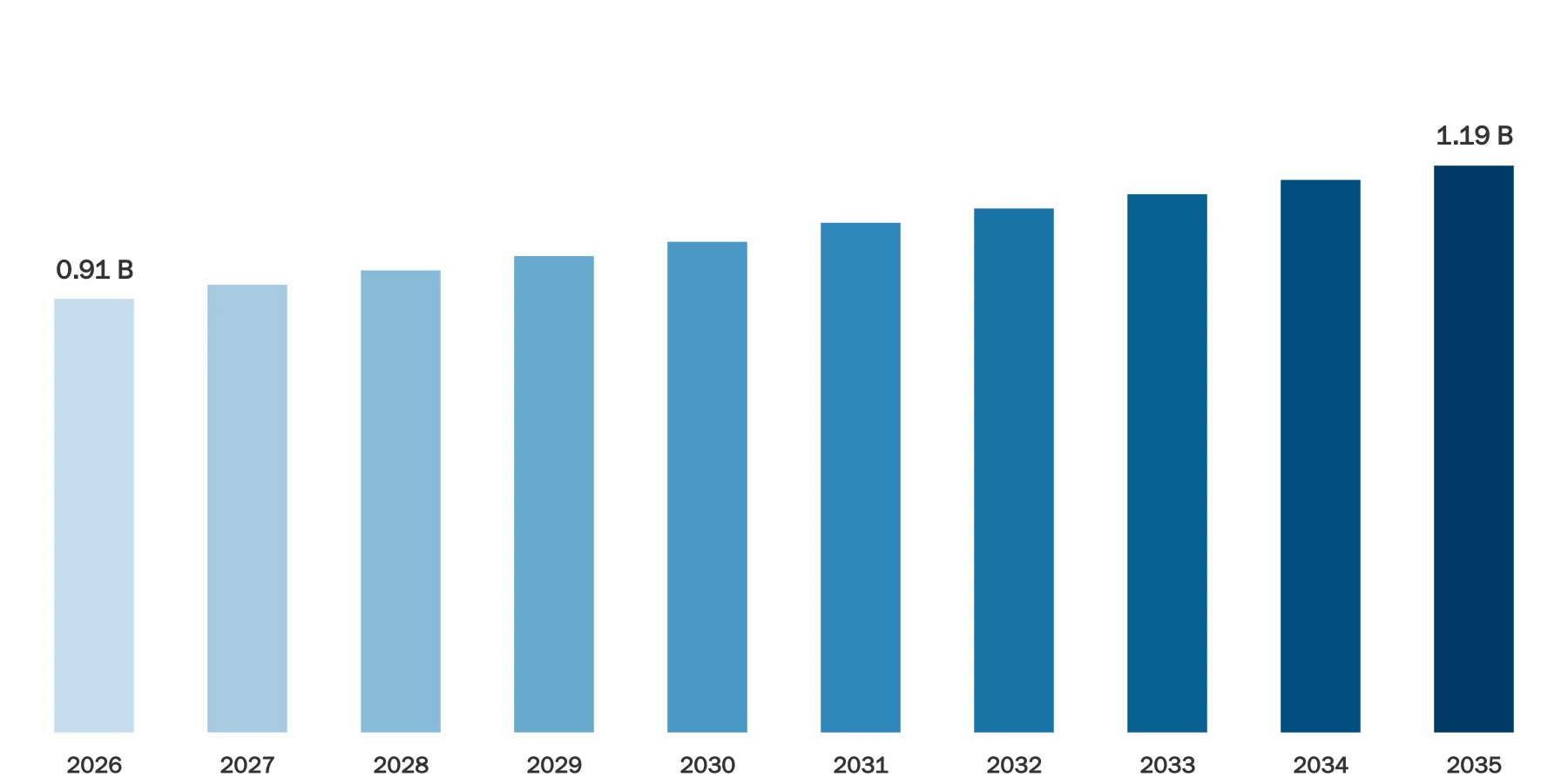
Source: Econ Market Research
An electro-mechanical brake also referred to as an electromagnetic brake, is a hybrid braking mechanism integrating electrical and mechanical elements to slow down or halt vehicles and machinery. This system operates by controlling an electric current through a brake coil, generating a potent magnetic field that manipulates a framework onto or off a magnetic surface, thereby converting kinetic energy into thermal energy. Instead of relying on hydraulic pressure as seen in conventional hydraulic braking systems, an EMB utilizes an electric motor or actuator to initiate braking actions.
Electro-mechanical Brake Market Dynamics
The market dynamics of the Electro-mechanical Brake industry are shaped by various factors. Drivers include the Increasing demand for electric vehicles and growing technological advancement. However, there are also restraints such as supply chain disruption due to the pandemic. The major opportunities in the electro-mechanical market are intensifying investment in the automotive and logistics industry. The market is highly competitive, with major players continually innovating and majorly focusing on research &, development in the market.
Electro-Mechanical Brake Market Drivers
The Electro-Mechanical Brake Market is intensifying technological advancement, encompassing enhanced sensors, control systems, and materials. The increasing demand for this technology is boosting both the effectiveness and dependability of electro-mechanical brakes. For instance, on 5th October 2022, Sensata Technologies announced a fresh Brake Pedal Force Sensor designed for electromechanical brakes (EMBs), aiming to enhance the safety and performance of braking systems.
Integrating this sensor results in a decreased stopping distance for vehicles when compared to current technologies. It enhances braking by swiftly and precisely capturing the driver',s braking intention. The sensor can withstand forces up to 600N (adjustable for different capacities), Sensata',s brake pedal force sensor meets ASIL C safety standards, operating effectively in temperatures up to 140°,C. Its small size, adaptable integration choices, and diverse output selections enable engineers to tailor it effortlessly to suit their specific application needs.
Furthermore, the Electric Vehicle (EV) market has experienced remarkable expansion in recent years. EVs play a pivotal role in decarbonizing road transport, a sector responsible for one-sixth of global emissions. The surge in EV sales contributes significantly to reducing CO2 emissions and is anticipated to aid in achieving Net Zero Emissions by 2050. Both developing and developed economies, including China, the US, Europe, and Norway, are intently motivated to raise EV production. For instance, in 2022, China dominated with nearly 60% of new electric car registrations worldwide. The country achieved a substantial milestone with electric cars constituting 29% of total domestic car sales, surpassing the 2025 national target of 20% for new energy vehicles (NEVs).
Restraints:
The electro-mechanical brake market faces several restraining factors that influence its growth and adoption across various industries. One significant challenge is the initial high cost associated with implementing electro-mechanical brake systems compared to traditional hydraulic braking systems. The advanced technology and components involved in electro-mechanical brakes contribute to their higher upfront costs, which can deter potential buyers, especially in price-sensitive markets. As a result, manufacturers and suppliers in the industry are under pressure to develop cost-effective solutions and enhance production efficiency to make electro-mechanical brake systems more economically viable.
Another restraint is the potential complexity in integrating electro-mechanical brake systems into existing vehicle architectures. Retrofitting these systems into vehicles designed for traditional braking systems can pose challenges in terms of compatibility, space constraints, and system integration. This complexity may slow down the adoption of electro-mechanical brakes, particularly in industries where existing infrastructure heavily relies on conventional braking technologies.
Furthermore, concerns related to the reliability and durability of electro-mechanical brake systems may limit their widespread acceptance. End-users, especially in safety-critical applications such as automotive and aerospace, demand robust and fail-safe braking solutions. The industry must address any apprehensions regarding the long-term performance and reliability of electro-mechanical brake systems to build trust among consumers and promote broader adoption.
Opportunities:
Electro-mechanical brakes play a key role in industrial automation and production. Anticipated investments and initiatives are composed to drive significant growth in the automotive and logistics sectors. For instance, the US government has announced a substantial US$1.0 billion towards advancing Industry 4.0 technologies, emphasizing automation, robotics integration, and CO2 emission reduction. Over five years, funding from entities like the White House, the National Science Foundation (NSF), and the Department of Energy (DoE) will establish new AI and R&,D hubs. The convergence of cutting-edge systems and sustainable mobility not only fosters innovation but also creates expansive opportunities for market expansion in the forecast period.
Segment Overview
By Type
The global Electro-Mechanical Brake market is segmented based on the Types Single Face Brake, Particle Brake, Hysteresis Power Brake, Multiple Disk Brake, and Power-Off Brake. A single-face electromechanical brake (EMB) functions by utilizing one or more electro-mechanical discs to decelerate or halt a vehicle. Predominantly found in trains, trams, and locomotives, these EMB devices feature a power-off brake mechanism that disengages the vehicle',s engine when the brakes are activated. This system is made for cars that shift gears automatically. It saves fuel by turning off the engine when you hit the brakes.
By monitoring wheel speed and initiating brake application as necessary, the power-off brake reduces engine workload, contributing to fuel conservation. Particle-off EMBs, a subset of electrical brakes, operate by generating friction through particles. Commonly employed in heavy vehicles like locomotives, this type of brake offers superior braking performance compared to traditional single-face or power-off brakes. Additionally, a feedback power brake within the electromechanical brake category regulates braking energy using the hysteresis principle. On the other hand, the power-off brake segment',s growth is propelled by the rising acceptance of power-off brakes in Textile machinery, packaging machinery, cranes, hoists, conveyors, and various other specialized machinery. At the end, this type boosts the market growth in the forecasting period.
By Technology
The global Electro-Mechanical Brake market is segmented based on technology into Smart Braking Systems and Regenerative Braking. Smart Braking Systems aid drivers in preventing collisions with vehicles and pedestrians ahead. By monitoring the area in front of the vehicle, this system identifies vehicles and pedestrians, mitigating or preventing collision damage. However, it',s important to note that not all Intelligent Emergency Braking systems are configured to detect pedestrians.
However, Regenerative Braking is to capture, store, and subsequently utilize a portion of a vehicle',s braking energy, enhancing fuel efficiency or extending the range of electric and hybrid vehicles (FEV and HEV). Various energy storage mediums such as electric batteries, ultracapacitors, flywheels, and hydraulic accumulators are employed for this purpose. Hence, this technology helps to drive the market growth in upcoming years.
By Application
The global Electro-Mechanical Brake market is segmented based on application into, Locomotives, Automotive, Aircraft, Robotic, Marine, and Others. Increasing awareness of vehicle safety features such as anti-lock braking systems, traction control systems, and electronic stability control systems helps to increase the automotive industry. On the other hand, the ability to handle the high torque of locomotives and the transition toward high-speed &, electric locomotives globally is increasing the popularity of electro-mechanical brakes.
Electro-Mechanical Brake Market Overview by Region
North America
Electro-mechanical brakes are becoming popular in North America and Europe because people are leaning towards electric and hybrid cars. These regions are big on reducing emissions and using greener transportation. So, there',s a growing demand for smart braking systems like electro-mechanical brakes that fit well with these eco-friendly vehicles. People are choosing electric and hybrid cars more because they',re better for the environment, and that',s boosting the electro-mechanical brake market in this region.
Additionally, the automotive industry in North America and Europe is moderately huge and competitive. The consumers are all about making better and safer cars so they',re into using high-tech brakes like electro-mechanical ones. Also, the rules about car safety are super strict here, which means these advanced braking systems are becoming a standard thing in new cars. All these factors together are making North America and Europe the main places where these new brake technologies are growing and getting better.
Europe
13.1 million motor vehicles, including car, vans, trucks and busses, are manufactured in the European Union per year.This remarkable upswing in motor vehicle manufacturing directly translates to a heightened demand for automotive components and technologies, including electro-mechanical brakes. As the automotive sector rebounds and experiences such noticeable growth, the need for advanced braking systems compatible with modern vehicle designs escalates. The robust expansion in motor vehicle production serves as a pivotal factor propelling the electro-mechanical brake market forward within the European Union, as manufacturers respond to the heightened demand for these innovative braking solutions.
Electro-Mechanical Brake Market Competitive Landscape
The electro-mechanical brake industry',s competitive climate is dynamic, with established manufacturers, young innovators, and a worldwide market ready for developments. The emphasis is on lightweight materials, sophisticated technology, and customized choices. The market is adaptable to shifting demographics and accessibility requirements, promoting continual expansion. The competitive environment is characterized by partnerships with industries biggest players. The major players in the market are
The Carlyle Johnson Machine Company, LLC.,
KTR Systems
Lenze SE
Warner Electric
Robert Bosch GmbH
Emco Dynatorq Pvt. Ltd.
Ogura Industrial Corp.
KEB Automation KG
Magnetic Technologies
PRECIMA Magnettechnik GmbH
REACH MACHINERY CO., LTD.
Ortlinghaus-Werke GmbH
MIKI PULLEY CO., LTD., and others.
Electro-Mechanical Brake Market Recent Developments
On July 2021 ZF initiated a series of production of a pioneering EV Braking System, reinforcing its position as a key technology and system provider in the realm of electromobility. ZF secured a significant production order, solidifying its role as a supplier for Volkswagen',s ID.3 and ID.4 models, as well as for the Volkswagen Group',s widely utilized modular e-drive system MEB platform, featuring the latest ZF brake control solutions as standard features.
Global Electro-Mechanical Brake Market Report Segmentation
Electro-Mechanical Brake Market Report Scope & Segmentation
| Attributes | Details |
|---|---|
Market Size (Current) | US$ 0.91 Billion in 2026 |
Market Size (Forecast) | US$ 1.19 Billion in 2035 |
Growth Rate | CAGR of 3.2% from 2026 to 2035 |
Forecast Period | 2026 – 2035 |
Base Year | 2025 |
Historical Data Available | Yes |
Regional Scope | Global |
Segments Covered | By Type
By Application
By Sales Channel
|
Frequently Asked Questions
Common questions about this report
The study period covers historical insights and forecast projections for the period 2026-2035.
About the Author
Market research expert with years of industry experience

Dipali Bhingare serves as the Market Research Director at Econ Market Research. With a focus on translating complex global economic shifts into actionable business intelligence, she oversees the strategic direction of comprehensive market studies. Her work empowers organizations to navigate volatile industries through data-driven forecasting and deep-dive competitive analysis.
Related Reports
Explore more market insights from the same category