AI Image Upscaler Market Overview
As per Econ Market Research analysis, the Global AI Image Upscaler Market was valued at approximately US$ 8.08 Billion in 2026 and is predicted to reach US$ 73.47 Billion by 2035, expanding at a CAGR of 27.8% over the forecast duration. The base year is 2025.
The AI Image Upscaler Market is expanding rapidly due to the massive increase in digital visual content across social media, advertising, gaming, and e-commerce platforms. More than 34 million AI-generated images are created every day, creating strong demand for tools capable of enhancing image resolution and quality. Over 15 billion AI-generated images were produced between 2022 and 2023, demonstrating the growing reliance on Artificial Intelligence in visual processing. AI image upscaling technology uses deep learning models and convolutional neural networks to increase resolution by 2×, 4×, and 8× while preserving details. More than 50 million images have already been processed using AI upscaling tools globally, highlighting the rising adoption of automated visual enhancement solutions across industries including media, retail, and digital marketing.
In the United States AI Image Upscaler Market, adoption is driven by strong digital media industries, high internet penetration exceeding 92% of the population, and large-scale AI investments. North America holds more than 31.5% of global AI image enhancement technology usage, with the United States representing the largest share of regional adoption. Over 70% of creative agencies and digital marketing companies in the U.S. use AI-powered editing tools to optimize visual content for online platforms. In addition, U.S. e-commerce platforms process millions of product images every month, and more than 30% of online retailers have integrated automated image optimization tools for product listings, which directly supports the growth of the AI Image Upscaler Industry Analysis and enterprise-level AI visual processing solutions.
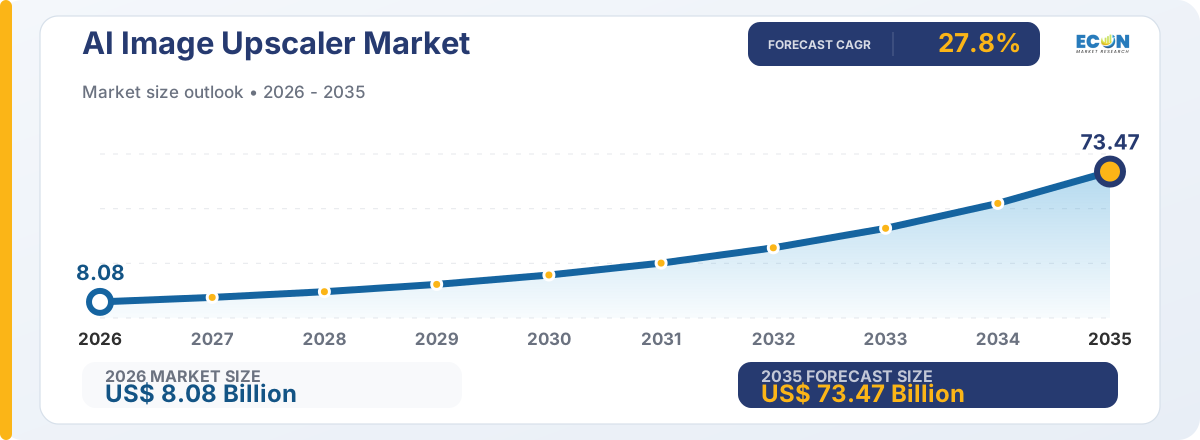
Key Insights
Growth Drivers: Adoption of AI image enhancement tools is increasing across industries with 62% usage in digital marketing, 58% adoption in e-commerce platforms, 54% usage in gaming graphics enhancement, 49% integration in photography workflows, and 46% demand growth in social media visual optimization systems.
Major Market Challenges: Approximately 41% of enterprises report high AI model training costs, 37% face GPU infrastructure limitations, 35% struggle with data privacy concerns, 32% experience algorithm accuracy issues, and 29% report compatibility challenges with existing image editing software ecosystems.
Emerging Trends: AI super-resolution technology adoption accounts for 64% of new image editing tools, 59% integration with generative AI platforms, 52% deployment in cloud-based image processing, 47% adoption in mobile photo enhancement applications, and 44% usage in automated content creation systems.
Regional Analysis: North America contributes around 35% of global technology adoption, Asia-Pacific accounts for 29%, Europe holds approximately 23%, while Middle East & Africa and Latin America together contribute close to 13% of the global AI image upscaler ecosystem.
Competitive Landscape: Approximately 48% of the market share is controlled by top 10 AI image enhancement platforms, 36% is distributed among emerging startups, 28% of companies focus on SaaS deployment models, 22% specialize in creative industry solutions, and 19% target enterprise-level automation tools.
Market Segmentation: Software-based AI image upscaling tools represent nearly 74% of product offerings, services account for 16%, hardware acceleration tools represent 10%, cloud-based deployment accounts for 75%, while on-premises infrastructure represents 25% of installations.
Recent Development: Approximately 61% of product launches between 2023 and 2025 included real-time upscaling features, 55% integrated generative AI models, 49% introduced GPU-accelerated processing, 43% improved multi-resolution image enhancement, and 38% incorporated automated batch processing capabilities.
Market Latest Trends
The AI Image Upscaler Market Trends are strongly influenced by the explosive growth in digital image creation and consumption. Global digital platforms process billions of visual files every month, and artificial intelligence technologies are becoming essential for improving image clarity, resolution, and visual accuracy. With more than 34 million AI-generated images produced daily, demand for advanced AI image upscaling tools is growing significantly in industries such as advertising, streaming media, and online retail.
One of the most important trends in the AI Image Upscaler Market Analysis is the increasing use of deep learning-based super-resolution models capable of enlarging images by 2× to 8× resolution without losing quality. These algorithms analyze millions of training images to predict missing pixels and restore details in low-resolution images. In addition, cloud-based image processing platforms are becoming more common, with approximately 75% of AI image enhancement tools operating through cloud deployment models.
Another trend shaping the AI Image Upscaler Industry Report is the integration of AI image enhancement with generative AI platforms used for digital art creation, social media content production, and gaming graphics optimization. AI platforms based on diffusion models have produced more than 12.5 billion images globally, which has increased the need for automated image enhancement and resolution improvement technologies.
Mobile photography applications are also contributing to the AI Image Upscaler Market Growth, as smartphone cameras generate billions of images every year. Many smartphone editing apps now include AI-powered upscaling features capable of improving image resolution by 400% or more, enabling users to convert low-resolution photos into high-definition images suitable for professional publishing.
Market Dynamics
The AI Image Upscaler Market Outlook is shaped by multiple technological and economic factors including rapid digital content creation, the expansion of e-commerce, and the integration of artificial intelligence in visual media production. AI image enhancement tools rely on machine learning models trained on millions of images to reconstruct high-resolution visuals from compressed or low-quality images.
The global digital ecosystem processes billions of images across social media platforms, marketing campaigns, and online product catalogs. AI tools are increasingly used to automate visual optimization processes, reducing manual editing workloads. For example, automated AI editing systems helped photographers process 8.8 billion images in 2025, saving approximately 89 million hours of editing work, demonstrating the productivity impact of AI-based visual technologies.
In addition, enterprise adoption of AI image upscaling is increasing due to the need for scalable visual processing solutions. Industries such as e-commerce, digital marketing, and gaming rely heavily on high-quality visual assets, and AI-based enhancement systems enable companies to convert low-resolution images into high-resolution formats suitable for advertising and media distribution.
DRIVER
Rising demand for high-resolution digital visual content
The primary driver in the AI Image Upscaler Market Growth is the increasing demand for high-quality digital images across industries such as social media, advertising, e-commerce, and entertainment. Digital platforms host billions of images every day, and the number of AI-generated images has already surpassed 15 billion globally, creating significant demand for automated image enhancement technologies.
Streaming platforms and gaming companies also require high-resolution graphics for immersive visual experiences. Many modern gaming engines require 4K resolution textures, which are 4 times larger than standard HD images, creating demand for AI-powered upscaling algorithms capable of converting legacy graphics into high-resolution assets.
E-commerce platforms are another major driver. Online retailers display millions of product images every day, and studies show that 75% of consumers prefer high-resolution product images before making purchasing decisions. AI image upscaling tools enable companies to enhance product photos without reshooting them, reducing production costs and improving online product visibility.
RESTRAINT
High computational requirements and infrastructure costs
One of the major restraints in the AI Image Upscaler Market Analysis is the high computational requirement associated with deep learning-based image enhancement algorithms. AI super-resolution models require large datasets containing millions of training images and advanced GPU processing capabilities to generate accurate high-resolution outputs.
Training a deep learning image enhancement model may require processing datasets exceeding 10 million images, which demands powerful graphics processing units and significant energy consumption. Many enterprises report infrastructure limitations because high-performance GPUs can cost 3–5 times more than standard computing hardware, creating a barrier for small organizations adopting AI-based image enhancement systems.
Additionally, large-scale AI image processing systems require significant Cloud Computing resources to process high-resolution images in real time. Processing a 4K resolution image may require 16 times more pixel data than a standard HD image, increasing storage and computational requirements for organizations using AI image upscaling technologies.
OPPORTUNITY
Expansion of AI Powered Content Creation platforms
The AI Image Upscaler Market Opportunities are expanding due to the rapid growth of AI-powered content creation platforms used in design, marketing, and entertainment. Generative AI systems are capable of producing millions of images every day, and most of these images require post-processing enhancements such as noise reduction, sharpening, and resolution scaling.
The increasing popularity of AI-generated artwork, NFTs, and digital media is creating strong demand for automated image upscaling tools capable of enhancing visual quality. Platforms producing 34 million AI-generated images daily require scalable image optimization systems to ensure high visual quality across different publishing formats.
Another major opportunity is the integration of AI upscaling technologies into mobile photography applications. Smartphones capture billions of photos every year, and AI-based enhancement tools can automatically increase resolution by 200% to 400%, enabling users to transform low-quality images into professional-grade visuals.
CHALLENGE
Data privacy and image authenticity concerns
One of the key challenges in the AI Image Upscaler Industry Analysis is the increasing concern regarding data privacy and image authenticity. AI systems require large image datasets for training, and many datasets contain copyrighted or personal images that raise legal and ethical concerns.
Additionally, AI-generated and AI-enhanced images may blur the line between original and modified visual content. In digital journalism and social media environments, image authenticity is critical, and the use of AI image upscaling tools can sometimes introduce synthetic details that were not present in the original image.
Another challenge is algorithm bias and inconsistency in enhancement results. Some AI models perform better on specific image categories such as landscapes or portraits but may struggle with complex textures or low-light images. As a result, maintaining consistent enhancement quality across millions of images remains a technical challenge for AI developers.
Segmentation Analysis
The AI Image Upscaler Market Research Report categorizes the industry based on offering types and deployment modes. These segmentation categories help enterprises evaluate suitable technologies for large-scale image processing workflows. Software solutions dominate the market due to their scalability and integration with digital content creation platforms. Cloud deployment is widely adopted because it enables real-time image processing without requiring expensive local infrastructure.
By Offering
Hardware
Hardware components in the AI Image Upscaler Market include GPU accelerators, AI processing units, and high-performance computing systems used for image enhancement workloads. Hardware solutions account for nearly 10% of the AI image upscaling ecosystem, primarily used in research institutions, data centers, and large media production companies. Modern GPU architectures can process thousands of image frames simultaneously, enabling real-time upscaling for video streaming platforms and gaming engines. AI hardware capable of processing 4K or 8K resolution images is increasingly used in broadcasting and cinematic production environments.
Software
Software represents the largest segment in the AI Image Upscaler Market Share, accounting for approximately 74% of total technology adoption. AI image enhancement software uses deep learning algorithms such as convolutional neural networks and generative adversarial networks to reconstruct high-resolution images from compressed or low-quality inputs. Many platforms allow users to upscale images by 200%, 400%, or even 800% resolution, while preserving details and textures. Software tools are widely used by photographers, graphic designers, video editors, and e-commerce companies.
Services
Services account for approximately 16% of the AI Image Upscaler Industry, including consulting, integration, and managed AI solutions. Many enterprises rely on AI consulting firms to implement automated image enhancement workflows within digital marketing platforms or e-commerce systems. AI service providers also offer custom training models designed for industry-specific applications such as satellite image enhancement, medical imaging improvement, and security surveillance image optimization.
By Deployment Mode
Cloud
Cloud deployment dominates the AI Image Upscaler Market, accounting for nearly 75% of system installations. Cloud-based platforms enable organizations to process millions of images without maintaining expensive hardware infrastructure. Many AI image processing services support batch processing systems capable of enhancing thousands of images per hour, making them suitable for large-scale e-commerce and media applications.
On-Premises
On-premises deployment represents about 25% of the AI Image Upscaler Market, primarily used by organizations requiring strict data privacy and internal processing control. Industries such as government agencies, healthcare institutions, and defense organizations often deploy AI image enhancement systems locally to ensure that sensitive images remain within internal networks. On-premises systems are typically integrated with high-performance computing clusters capable of processing large image datasets.
Regional Insights
The AI Image Upscaler Market Insights show strong global demand driven by digital media growth, e-commerce expansion, and increasing AI adoption. North America leads the market due to advanced AI infrastructure, while Asia-Pacific shows the fastest technology adoption due to expanding internet users and smartphone photography markets.
North America
North America holds approximately 35% of the global AI Image Upscaler Market Share, making it the largest regional market for AI-based visual enhancement technologies. The region benefits from strong technology infrastructure, high internet penetration exceeding 90%, and a large number of AI software developers.
The United States plays a dominant role in the regional market due to its strong digital media and technology industries. Major sectors such as advertising, streaming services, and online retail rely heavily on high-resolution digital images. For example, the U.S. e-commerce industry hosts millions of product listings, and product images often require high-resolution optimization to meet platform quality standards.
Another factor supporting market expansion in North America is the presence of AI startups and advanced research institutions. Many companies are developing advanced super-resolution algorithms capable of enhancing image resolution by 4× to 8× while preserving details.
In addition, the growing popularity of AI-generated artwork and digital design tools has increased the demand for automated image enhancement technologies across creative industries.
Europe
Europe accounts for approximately 23% of the global AI Image Upscaler Market, supported by strong digital transformation initiatives and increasing adoption of artificial intelligence technologies in creative industries.
Countries such as Germany, the United Kingdom, and France are investing heavily in AI research and development. European creative industries produce millions of digital assets every year, and AI-based enhancement tools are widely used in photography, advertising, and film production.
The European gaming industry is another key driver of AI image upscaling technologies. Many gaming companies use AI super-resolution techniques to upgrade legacy graphics for modern gaming platforms.
In addition, the European e-commerce sector processes millions of product images daily, and companies are increasingly using AI enhancement tools to improve visual quality and reduce manual editing workloads.
Asia-Pacific
Asia-Pacific represents approximately 29% of the global AI Image Upscaler Market, making it one of the fastest-growing regions in the industry.
The region benefits from a large digital population exceeding 2.7 billion internet users, which creates massive demand for visual content across social media platforms and e-commerce websites. Countries such as China, Japan, South Korea, and India are investing heavily in artificial intelligence technologies and digital media infrastructure.
Asia-Pacific also has one of the largest smartphone photography markets in the world. Smartphones capture billions of images every year, and AI-powered editing applications are widely used to enhance image resolution automatically.
Additionally, gaming and animation industries in the region rely heavily on AI image upscaling tools to improve graphics quality and visual performance.
Middle East & Africa
The Middle East & Africa region accounts for nearly 8–10% of the global AI Image Upscaler Market, supported by expanding digital infrastructure and growing adoption of artificial intelligence technologies.
Countries such as the United Arab Emirates and Saudi Arabia are investing heavily in digital transformation initiatives, including AI research and smart city development. These initiatives create demand for AI-based image processing technologies used in security surveillance, digital media production, and advertising.
The region also has a rapidly growing social media user base exceeding 400 million users, generating large volumes of digital images and videos that require optimization for online platforms.
Additionally, tourism and media industries in the Middle East use AI-powered visual enhancement technologies to produce high-quality promotional content for global audiences.
Top AI Image Upscaler Companies
Topaz Labs
Let's Enhance
AVC Labs
Icons8
Bigjpg
AI Image Enlarger
Vance AI
Deep Image AI
Waifu2x
UpscalePics
EnhanceFox
Remini
Fotor
GigaPixel AI
PhotoZoom Pro
Pixbim
ImgLarger
Krea
Leading companies with highest market share:
Topaz Labs – approximately 18% technology adoption share in professional photography and creative media tools.
Remini – nearly 14% adoption share in mobile AI photo enhancement applications with millions of global users.
Market Investment Outlook
The AI Image Upscaler Market Opportunities are attracting strong investments from technology companies, venture capital firms, and digital media platforms. Investment activity is increasing due to the rising demand for automated visual processing tools capable of handling millions of images per day.
AI-driven image enhancement startups are receiving funding to develop advanced super-resolution algorithms capable of improving image resolution by 4× to 8× without losing details. Investors are particularly interested in platforms that combine generative AI and image upscaling technologies to create fully automated visual production pipelines.
Cloud infrastructure companies are also investing in GPU-accelerated AI processing systems designed to handle large-scale image datasets. High-performance computing clusters capable of processing thousands of images per minute are becoming a critical infrastructure component for enterprise AI image enhancement platforms.
In addition, mobile photography applications integrating AI image upscaling technology are attracting significant investment due to the large global smartphone user base exceeding 6.8 billion devices.
New Product Development
Innovation in the AI Image Upscaler Market Trends is focused on improving algorithm accuracy, processing speed, and real-time enhancement capabilities. Recent product developments include AI models capable of enhancing images up to 8× resolution while maintaining texture details. These models use deep convolutional neural networks trained on millions of high-resolution images to reconstruct missing visual information.
Many AI platforms are also introducing real-time image upscaling systems capable of processing high-resolution images within seconds. Some advanced models can upscale 4K images in less than 2 seconds, making them suitable for live video streaming and gaming applications.
Another major innovation is the integration of AI image enhancement with generative AI tools. These systems automatically generate and upscale images simultaneously, reducing the need for manual editing.
Mobile applications are also introducing AI-powered portrait enhancement tools capable of improving image resolution by 300% to 400%, while maintaining facial detail accuracy.
Recent Developments
In 2023, AI image processing platforms introduced models capable of increasing image resolution by 800% while preserving texture details for professional photography workflows.
In 2024, AI-powered editing tools processed more than 8.8 billion images globally, demonstrating large-scale adoption in photography and digital media industries.
In 2024, generative AI platforms surpassed 12.5 billion AI-generated images, increasing demand for automated image upscaling technologies.
In 2025, AI photo editing platforms reported saving photographers nearly 89 million hours of manual editing work through automated image enhancement.
In 2025, cloud-based AI image enhancement systems processed thousands of images per hour, enabling large-scale visual optimization for e-commerce platforms and digital marketing campaigns.
AI Image Upscaler Market Report Scope & Segmentation
| Attributes | Details |
|---|---|
| Market Size (Current)Current market valuation | US$ 8.08 Billion in 2026 |
| Market Size (Forecast)Projected market valuation | US$ 73.47 Billion in 2035 |
| Growth RateCompound Annual Growth Rate | CAGR of 27.8% from 2026 to 2035 |
| Forecast PeriodAnalysis timeline | 2026 – 2035 |
| Base YearReference year for analysis | 2025 |
| Historical Data AvailablePast market data availability | Yes |
| Regional ScopeGeographical coverage | Global |
| Segments CoveredMarket segments analyzed | By Offering Outlook
By Deployment Mode
By Organization Size
By Function
By End Use
|
Leading companies covered in this report
- Key Players in the AI Image Upscaler Market: Topaz Labs
- Let's Enhance
- AVC Labs
- Icons8
- Bigjpg
- AI Image Enlarger
- Vance AI
- Deep Image AI
- Waifu2x
- UpscalePics
- EnhanceFox
- Remini
- Fotor
- GigaPixel AI
- PhotoZoom Pro
- Pixbim
- ImgLarger
- and Krea
Frequently Asked Questions
Common questions about this report
The study period covers historical insights and forecast projections for the period 2026-2035.
About the Author
Market research expert with years of industry experience