


Top Smart Manufacturing Companies Transforming Industry 4.0
The top smart manufacturing companies are advancing Industry 4.0 through industrial AI, robotics, digital twins, automation, IoT, and connected factories.
Introduction
Overview of the Global Smart Manufacturing Industry
The global smart manufacturing industry is transforming conventional factories into connected, data-driven production environments through industrial automation, artificial intelligence, robotics, digital twins, cloud platforms, and Industrial Internet of Things technologies. In 2024, manufacturers installed 542,000 industrial robots worldwide, marking the 4th consecutive year in which annual installations remained above 500,000 units. The global operational stock reached 4,663,773 industrial robots, while average robot density increased to 177 robots per 10,000 manufacturing employees. These figures demonstrate how smart manufacturing has progressed from isolated automation projects to integrated factory systems capable of monitoring equipment, controlling production, identifying defects, and optimizing resources in real time.
Market Evolution and Growth Drivers
Smart manufacturing has evolved through 4 major industrial stages, beginning with mechanized production, followed by electrification, computerized automation, and today’s connected Industry 4.0 environment. Modern factories now combine operational technology, information technology, engineering systems, sensors, machine vision, edge computing, and AI-based analytics within 1 digital production architecture. Global robot installations in 2024 were more than 2 times the level recorded 10 years earlier, while Asia accounted for 74% of new deployments, Europe represented 16%, and the Americas held 9%. Labor shortages, mass customization, supply-chain disruptions, energy-efficiency requirements, quality regulations, and the need for 24-hour production visibility are accelerating smart manufacturing adoption across automotive, electronics, pharmaceuticals, food processing, aerospace, chemicals, metals, and consumer goods.
Top 5 Latest Trends in the Smart Manufacturing
1. Industrial Artificial Intelligence and Predictive Operations
Industrial artificial intelligence has become 1 of the most influential smart manufacturing trends because it enables factories to transform equipment data into operational decisions. AI algorithms can examine vibration, temperature, pressure, speed, energy consumption, acoustic signals, production cycles, and maintenance records to identify patterns that human operators may overlook. Instead of servicing machines every 30 or 60 days, manufacturers can use predictive models to estimate when specific components are likely to fail. This condition-based approach supports higher equipment availability, lower spare-parts consumption, and more accurate maintenance scheduling.
The latest industrial AI systems connect production data from operational technology, business information from IT platforms, and engineering parameters from design systems. However, industrial companies still use less than 20% of the data generated across their operations, leaving up to 80% underutilized. Smart manufacturing platforms are addressing this problem through contextualized data models, machine learning, anomaly detection, and asset-performance applications. Certain industrial AI deployments have demonstrated potential reductions of 50% or higher in unplanned downtime, productivity improvements above 20%, maintenance-cost reductions above 15%, and machine-life improvements above 15%, although actual outcomes depend on the plant, equipment condition, and deployment quality.
AI is also being introduced into engineering workflows. Generative AI assistants can review specifications, I/O lists, process diagrams, standards documents, PDFs, images, and existing control programs before recommending design changes. These tools can generate initial programmable logic controller code, identify missing requirements, and summarize complex documentation while keeping engineers responsible for final approval. A 2026 smart manufacturing roadmap identified industrial big-data analytics, advanced sensing, autonomous systems, digital twins, robotics, sustainable production, explainable AI, foundation models, and data-centric metrology as major development areas.
2. Digital Twins and Virtual Commissioning
Digital twins are changing smart manufacturing by creating a synchronized virtual representation of a machine, production line, process, factory, or complete supply network. A digital twin can combine 3D geometry, engineering specifications, control logic, sensor information, maintenance history, and real-time operational data. Engineers use these models to evaluate production capacity, test layouts, simulate material flows, identify bottlenecks, and examine equipment behavior before making physical modifications.
Virtual commissioning allows manufacturers to test automation programs and production sequences before new equipment reaches the factory floor. A company planning a 20-station assembly line can model robots, conveyors, safety zones, operators, tooling, and cycle times within a virtual environment. Engineers can then verify PLC logic, robot movements, collision risks, and emergency-stop procedures without interrupting live production. This approach reduces the number of design corrections required during installation and helps manufacturers achieve stable production faster after commissioning.
Digital manufacturing platforms increasingly integrate simulation, 3D visualization, analytics, and collaboration tools so that product design and production planning can occur simultaneously. The connection between product lifecycle management, manufacturing execution systems, automation platforms, and digital twins creates a continuous digital thread from initial concept to production and service. This integration is particularly important in automotive and electronics manufacturing, where factories may manage 1,000s of product configurations, frequent engineering changes, and strict traceability requirements.
Digital twins are also becoming more intelligent through AI. A traditional simulation predicts behavior using predefined equations, whereas an AI-enhanced digital twin can continuously learn from real production outcomes. A 2024 experimental manufacturing system demonstrated how generative AI and heterogeneous robots completed a production process in 119.10 minutes compared with 528.64 minutes for a human expert team. The same experiment completed an early blueprinting task in 0.5 minutes compared with 23.5 minutes for human CAD operators, illustrating the long-term potential of AI-assisted virtual manufacturing.
3. Collaborative Robots and Autonomous Material Movement
Collaborative robots, commonly called cobots, are gaining importance because they are designed to perform tasks near human employees when the application and safety assessment permit shared operation. Traditional industrial robots are frequently enclosed within guarded cells, while cobots may use force limitation, speed monitoring, vision systems, proximity sensors, and automatic stopping technologies. Their flexible programming makes them useful for repetitive assembly, machine tending, inspection, packaging, palletizing, laboratory handling, and small-batch production.
Global robot density reached 177 units per 10,000 manufacturing employees, but adoption varies significantly by country. South Korea recorded 1,220 robots per 10,000 workers, Singapore recorded 818, China reached 567, Germany recorded 449, and Japan reached 446. These figures indicate that manufacturers in highly automated economies are using robotics not only to replace repetitive manual activity but also to strengthen production consistency, address workforce shortages, and maintain international competitiveness.
Autonomous mobile robots are another major component of this smart manufacturing trend. Unlike conventional automated guided vehicles that frequently follow magnetic strips or fixed routes, advanced mobile robots can use simultaneous localization and mapping, cameras, lidar, and onboard intelligence to navigate dynamic factory environments. They transport components between warehouses, workstations, inspection areas, and packaging lines while adjusting routes when people or equipment block the preferred path.
The combination of cobots, autonomous mobile robots, machine vision, and AI is creating flexible production cells capable of adapting to changing orders. In a 2026 survey of 220 Japanese companies, 4% reported that they were already using AI-powered robots, 5% planned implementation, and 25% were considering adoption. Among transportation-equipment manufacturers, 80% were using or evaluating AI robots, while 71% of intended applications were connected to manufacturing tasks.
4. Edge Computing, Industrial IoT, and 5G Connectivity
Industrial Internet of Things technology connects machines, controllers, sensors, instruments, cameras, energy meters, and manufacturing software so that information can move across the factory. A connected production line may collect 1,000s of data points every second, including cycle time, motor current, temperature, humidity, torque, vibration, dimensional measurements, scrap levels, and energy consumption. This data supports real-time dashboards, predictive maintenance, quality control, production scheduling, and automated decision-making.
Edge computing is becoming essential because manufacturers cannot send every data point to a distant cloud platform. Edge devices process information close to the machine, enabling responses within milliseconds instead of waiting for cloud communication. For example, a machine-vision system inspecting 100 components per minute may need to identify a defect and reject the affected component before it moves to the next station. Local processing supports the required speed while reducing bandwidth usage and maintaining production continuity during temporary network interruptions.
Private 5G networks are strengthening industrial connectivity by supporting low-latency communication, high device density, predictable performance, and controlled network access. Manufacturers can use private wireless networks to connect mobile robots, handheld devices, sensors, cameras, automated vehicles, and temporary production cells without installing extensive physical cabling. A large factory may contain 10,000s of connected assets, making network architecture and device management central elements of the smart manufacturing strategy.
Modern industrial software now scales from edge environments to on-premises servers and cloud platforms. Integrated solutions combine industrial IoT, machine learning, augmented reality, data operations, visualization, and enterprise analytics. This edge-to-cloud structure allows plant personnel to manage immediate production decisions locally while enabling corporate teams to compare performance across 5, 20, or 100 manufacturing locations.
5. Sustainable and Energy-Efficient Smart Factories
Sustainability has become a measurable smart manufacturing priority as factories face energy constraints, emissions targets, resource scarcity, waste regulations, and customer requirements. Connected energy meters and industrial software can monitor electricity, gas, compressed air, steam, water, and process heat across individual machines, production lines, and entire facilities. Manufacturers can identify abnormal consumption, compare shifts, detect leaks, and schedule energy-intensive processes during preferred operating periods.
Smart manufacturing systems also improve material efficiency. Machine-vision inspection can identify defective products earlier, digital work instructions can reduce assembly mistakes, and advanced process control can maintain tighter temperature, pressure, speed, and dimensional tolerances. Detecting an error at production stage 2 instead of stage 10 prevents additional materials, labor, and energy from being invested in a component that will ultimately be rejected.
Industrial analytics deployments have reported up to 25% improvement in energy and emissions optimization and up to 30% improvement in production efficiency under defined operating conditions. These results are not universal guarantees, but they illustrate how integrated data and automation can support both productivity and environmental performance. Smart factories increasingly measure energy consumption per unit, waste per batch, water use per product, first-pass yield, and carbon intensity instead of tracking only total monthly consumption.
Circular manufacturing is another developing opportunity. Sensors and digital records can track the condition, composition, origin, and service history of products or components. Manufacturers can use this information to repair equipment, recover valuable materials, remanufacture components, and verify recycled content. As regulations and customer expectations increase, the ability to trace 1 component through 10 or more production and service stages will become an important smart manufacturing capability.
Top 5 Companies in the Smart Manufacturing
1. Siemens
Company overview: Siemens is a global technology company with operations spanning industry, infrastructure, mobility, software, automation, artificial intelligence, and digital transformation. Founded in 1847, the company has accumulated more than 175 years of engineering experience and has become 1 of the most established providers of industrial digitalization solutions. Its smart manufacturing strategy focuses on connecting real-world automation with software, simulation, data, and AI.
Headquarters: Munich and Berlin, Germany.
Core smart manufacturing expertise: Siemens specializes in factory automation, process automation, industrial software, digital twins, manufacturing operations management, industrial AI, industrial IoT, motion control, drives, product lifecycle management, and software-defined automation. Its Digital Enterprise approach integrates engineering, manufacturing, and operational information across 1 connected digital thread.
Major products and services: Major offerings include SIMATIC automation systems, SINAMICS drives, Industrial Edge, Insights Hub, Teamcenter, NX, Tecnomatix, Opcenter, digital-twin applications, manufacturing execution capabilities, industrial cybersecurity, and engineering services. These technologies support discrete and process manufacturers in automotive, aerospace, electronics, machinery, pharmaceuticals, chemicals, food, and energy-intensive industries.
2. Rockwell Automation
Company overview: Rockwell Automation is a specialist industrial automation and digital-transformation company whose history began with a $1,000 investment and an early controller prototype. The company is strongly associated with connected manufacturing, industrial control, plant-floor visibility, production software, safety systems, and lifecycle services. Its portfolio combines hardware and software to connect production information from individual machines to enterprise-level decision platforms.
Headquarters: Milwaukee, Wisconsin, United States.
Core smart manufacturing expertise: Rockwell Automation focuses on programmable automation, motor control, industrial networks, manufacturing execution, industrial IoT, predictive maintenance, visualization, cybersecurity, digital engineering, data operations, and connected-worker applications. Its Connected Enterprise model integrates control systems and manufacturing information to improve productivity, resilience, quality, and workforce effectiveness.
Major products and services: The company’s leading brands include Allen-Bradley and FactoryTalk. Major solutions include ControlLogix and CompactLogix controllers, PowerFlex drives, FactoryTalk View, FactoryTalk Optix, FactoryTalk ProductionCentre, FactoryTalk Design Studio, FactoryTalk DataMosaix, Plex smart manufacturing platforms, industrial networks, safety systems, sensors, and professional services. FactoryTalk solutions can operate from edge environments to cloud platforms and support discrete, batch, and process applications.
3. Schneider Electric
Company overview: Schneider Electric is an energy-technology and industrial-automation company operating in more than 100 countries. The company combines electrification, automation, digitalization, software, and energy management to help factories improve reliability and resource efficiency. Its smart manufacturing approach connects power systems and automation data, enabling facilities to evaluate production performance and energy consumption within 1 operating environment.
Headquarters: Rueil-Malmaison, France.
Core smart manufacturing expertise: Schneider Electric specializes in industrial control, energy management, process automation, machine automation, open software-defined automation, digital power systems, industrial cybersecurity, asset performance, robotics, motion control, and smart-factory consulting. The company has also developed more than 100 global innovation hubs for demonstrating advanced energy-management and automation technologies.
Major products and services: Major offerings include EcoStruxure, Modicon programmable controllers, AVEVA industrial software, Altivar variable-speed drives, Harmony interfaces, Lexium motion-control products, SCADA systems, distributed-control solutions, industrial robots, digital energy platforms, and lifecycle services. Its industrial hardware portfolio includes controllers, drives, human-machine interfaces, motor control products, sensors, relays, and connected automation components.
4. ABB
Company overview: ABB is a global automation, electrification, robotics, motion, and digital-technology company with an industrial heritage extending across more than 130 years. The company serves automotive, electronics, food and beverage, metals, mining, chemicals, energy, marine, pulp and paper, logistics, and general manufacturing. ABB is also recognized as 1 of the major global robotics suppliers.
Headquarters: Zurich, Switzerland.
Core smart manufacturing expertise: ABB’s expertise includes industrial and collaborative robots, autonomous mobile robots, process control, machine automation, drives, motors, electrification, industrial analytics, artificial intelligence, asset-performance management, digital twins, and energy optimization. The company integrates operational, engineering, business, and location data to improve decision-making across production environments.
Major products and services: ABB’s portfolio includes industrial robots, GoFa and YuMi collaborative robots, OmniCore controllers, autonomous mobile robots, ABB Ability digital solutions, ABB Genix Industrial IoT and AI Suite, distributed-control systems, variable-speed drives, motors, machine automation, electrification equipment, and lifecycle services. ABB Genix includes applications for asset-performance management, anomaly detection, production-loss analysis, analyzer monitoring, and generative AI assistance.
5. Honeywell
Company overview: Honeywell is a diversified technology and industrial company with more than 100 years of experience across automation, aerospace, energy, buildings, safety, and advanced materials. Within smart manufacturing, the company serves process-intensive and regulated industries that require high availability, precise control, cybersecurity, and extensive operational visibility. Its technologies are commonly applied in refining, chemicals, pharmaceuticals, life sciences, pulp and paper, metals, energy, and advanced manufacturing.
Headquarters: Charlotte, North Carolina, United States.
Core smart manufacturing expertise: Honeywell specializes in process automation, distributed-control systems, industrial cybersecurity, advanced process control, connected-worker technologies, production optimization, asset monitoring, warehouse automation, machine vision, and industrial data analytics. Its smart manufacturing capabilities connect field instrumentation, control platforms, operational applications, and enterprise systems.
Major products and services: Major offerings include Experion process-control technologies, Honeywell Forge industrial software, advanced process-control applications, safety systems, connected plant solutions, warehouse automation, scanning technologies, sensing equipment, cybersecurity services, instrumentation, and lifecycle support. These solutions help manufacturers monitor 1,000s of operating variables, maintain process stability, manage alarms, and coordinate production across complex industrial facilities.
Regional Outlook
North America
North America remains 1 of the most advanced smart manufacturing regions due to its large automotive, aerospace, electronics, semiconductor, pharmaceutical, food-processing, machinery, and energy industries. The United States accounted for 6% of worldwide industrial robot installations in 2024, maintaining its position as the world’s 3rd-largest robot market. The United States also held 8.4% of the global operational robot stock, demonstrating the scale of automation already installed across American factories.
Automotive manufacturing remains an important automation user, but adoption is expanding into metal fabrication, logistics, packaging, food, consumer goods, and life sciences. North American manufacturers are investing in connected controllers, machine vision, industrial AI, digital work instructions, cloud manufacturing systems, autonomous mobile robots, and cybersecurity. The regional emphasis has shifted from automating 1 isolated process toward connecting complete facilities and supplier networks.
Nearshoring and supply-chain localization are supporting new factory construction across the United States, Mexico, and Canada. Mexico installed 5,832 industrial robots in 2023, while Canada installed 4,311 units during the same year. Investments in electric vehicles, batteries, semiconductors, medical products, and clean-energy equipment require plants with high traceability, precise process control, and flexible production capabilities.
North America also has a strong industrial software ecosystem supported by automation suppliers, cloud providers, engineering companies, research institutions, system integrators, and manufacturing institutes. Many factories still operate equipment that is 10, 20, or 30 years old, creating demand for edge gateways and retrofit sensors that connect legacy machinery without requiring immediate replacement. The central challenge is integrating old and new systems while protecting industrial networks against cyberattacks.
Workforce development will remain equally important. Smart factories need controls engineers, robotics technicians, data specialists, cybersecurity professionals, maintenance experts, and production employees who can work with digital systems. Companies implementing 5 or 10 new technologies without structured training may struggle to achieve operational value. North America’s future leadership will therefore depend on combining capital investment with technical skills, standards, secure architectures, and scalable use cases.
Europe
Europe has a mature smart manufacturing ecosystem supported by strong automotive, machinery, chemicals, pharmaceuticals, aerospace, electronics, food, and industrial-equipment sectors. The region accounted for 16% of global industrial robot installations in 2024. Germany represented 5% of global installations and ranked as the world’s 5th-largest industrial robot market, while its robot density reached 449 units per 10,000 manufacturing workers.
Germany plays a central role in European Industry 4.0 development through its manufacturing base, automation suppliers, engineering companies, research institutes, and machinery producers. France, Italy, Spain, the United Kingdom, Switzerland, Sweden, Denmark, Austria, the Netherlands, and the Czech Republic also maintain advanced manufacturing clusters. These countries are investing in robotics, digital twins, industrial IoT, additive manufacturing, machine vision, energy-management systems, and manufacturing software.
European smart manufacturing programs place significant emphasis on interoperability, data governance, cybersecurity, sustainability, worker participation, and industrial sovereignty. Manufacturers are increasingly expected to measure energy use, material consumption, product traceability, waste generation, and supply-chain emissions. A connected factory can track these indicators at 1-minute, 1-hour, shift, batch, and product levels rather than relying only on monthly utility statements.
Small and medium-sized manufacturers form a significant portion of Europe’s industrial base, but these companies may face limited budgets and shortages of automation specialists. Modular systems, subscription-based software, collaborative robots, low-code applications, and retrofit monitoring solutions are making smart manufacturing more accessible to factories with fewer than 250 employees. Instead of replacing complete production lines, an SME can begin with 1 machine-monitoring application and expand after proving measurable value.
Europe’s transition toward Industry 5.0 adds human-centricity, resilience, and sustainability to the Industry 4.0 technology framework. A 2025 systematic review evaluated 36 studies related to Industry 5.0 and smart factory production, identifying the growing importance of human-machine collaboration and worker-centered production design. European factories are likely to combine automation with ergonomic technologies, collaborative robotics, digital training, and decision-support systems rather than pursuing fully unmanned production in every application.
Asia-Pacific
Asia-Pacific is the largest smart manufacturing region by industrial robot deployment, accounting for 74% of new global installations in 2024. China, Japan, South Korea, India, Singapore, Taiwan, and Southeast Asian manufacturing economies are expanding automation across automotive, electronics, batteries, semiconductors, appliances, machinery, metals, chemicals, textiles, food processing, and consumer goods.
China installed 295,000 industrial robots in 2024, representing 54% of the global total. The country had an operational stock of roughly 2 million robots and recorded robot density of 567 units per 10,000 manufacturing employees. China has remained the world’s largest industrial robot market since 2013 and continues to expand domestic production of robots, sensors, drives, machine-vision systems, industrial software, and automation components.
Japan accounted for 8% of global robot installations in 2024 and maintained a robot density of 446 units per 10,000 manufacturing employees. The country combines major robotics producers with advanced automotive, electronics, machinery, and precision-manufacturing industries. Labor shortages and an aging population are encouraging greater use of autonomous material handling, AI-enabled robots, digital work assistance, and remote factory operations.
South Korea recorded the world’s highest robot density at 1,220 units per 10,000 manufacturing employees. Its electronics, semiconductor, automotive, battery, and shipbuilding industries require high-speed automation, precision control, clean manufacturing environments, and extensive quality monitoring. Singapore ranked 2nd globally with 818 robots per 10,000 workers, reflecting the city-state’s emphasis on advanced electronics, pharmaceuticals, aerospace maintenance, and high-value production.
India is progressing from standalone automation toward integrated smart factory systems. Automotive, pharmaceuticals, steel, chemicals, electronics, food processing, and general engineering companies are adopting robotics, cloud platforms, connected maintenance, and digital quality systems. However, the region contains both highly automated factories and labor-intensive facilities, creating demand for flexible solutions that can support 1 production cell, 1 factory, or a multinational network.
Asia-Pacific’s primary advantages include manufacturing scale, dense supplier networks, engineering talent, strong electronics ecosystems, and expanding domestic demand. Its challenges include cybersecurity, technology integration, uneven digital maturity, workforce transitions, and the need to standardize information across 1,000s of suppliers. The region’s leadership will continue as manufacturers combine physical automation with AI, digital twins, industrial data platforms, and energy-management systems.
Middle East & Africa
The Middle East and Africa smart manufacturing landscape is developing through industrial diversification, infrastructure investment, energy modernization, food-security programs, mining digitalization, and local production initiatives. Adoption is strongest in the Gulf countries, South Africa, Egypt, Morocco, Kenya, and selected industrial zones. Key applications include oil and gas processing, chemicals, metals, mining, food and beverage, pharmaceuticals, utilities, automotive assembly, logistics, and building materials.
Saudi Arabia and the United Arab Emirates are investing in advanced industrial zones, digital infrastructure, localized manufacturing, and non-oil industries. Smart manufacturing technologies help new plants establish high automation levels from the beginning instead of retrofitting equipment after 20 or 30 years. Greenfield facilities can integrate sensors, control systems, cybersecurity, digital twins, and manufacturing software within 1 coordinated architecture.
The Middle East’s energy and process industries are major users of distributed-control systems, asset-performance management, remote operations, industrial AI, and predictive maintenance. A large refinery, chemical complex, or metals facility can contain 10,000s of instruments and operating variables. Smart manufacturing platforms contextualize this data so operators can identify abnormal conditions, optimize maintenance schedules, improve energy use, and reduce production interruptions.
Africa presents significant long-term potential because its population, urbanization, consumer demand, natural resources, and regional trade networks are expanding. However, unreliable electricity, high connectivity costs, limited technical skills, and restricted access to capital can slow adoption. Research on manufacturing digitalization has found that internet costs in some markets can be over 250 times the cost in the least-expensive country, illustrating the infrastructure gap facing manufacturers.
Practical adoption in Africa will often begin with mobile applications, cloud-based maintenance systems, affordable sensors, energy monitoring, and targeted automation rather than complete factory replacement. A food processor may initially connect 10 critical machines, while a mining operator may prioritize remote equipment monitoring and worker safety. These focused projects can create operational evidence before expansion to 50 or 100 assets.
Regional development will require collaboration among governments, manufacturers, universities, automation vendors, telecommunications providers, and training institutions. Smart manufacturing can support local processing of minerals, agricultural products, pharmaceuticals, and consumer goods, helping countries move beyond exporting raw materials. The opportunity is significant, but successful programs must account for local infrastructure, workforce capabilities, maintenance resources, and long-term technology support.
Future Opportunities in the Smart Manufacturing
Future opportunities in smart manufacturing will emerge from the convergence of AI, robotics, digital twins, industrial IoT, additive manufacturing, advanced sensing, cloud-edge architectures, and sustainable production. Global industrial robot installations are expected to reach 575,000 units in 2025 and surpass 700,000 annual units by 2028, indicating that automation demand will continue expanding across both established and emerging manufacturing economies.
AI-enabled quality inspection is 1 major opportunity. Machine-vision systems can examine surface defects, dimensions, labels, welds, packaging, colors, component presence, and assembly accuracy at production speed. As cameras, edge processors, and AI models become easier to deploy, inspection applications will expand from high-volume automotive and electronics plants to smaller food, textile, plastics, and metalworking businesses.
Autonomous manufacturing is another opportunity, although most factories will develop gradually instead of becoming fully autonomous in 1 step. AI agents may schedule production, prepare engineering documentation, recommend maintenance, generate control logic, optimize material movement, and coordinate robots. Human employees will remain responsible for safety, process knowledge, unusual situations, ethical decisions, and final authorization in high-risk environments.
Brownfield modernization represents a substantial opportunity because millions of machines currently operating worldwide were manufactured before cloud computing and industrial IoT became common. Manufacturers can install retrofit sensors, gateways, machine-vision cameras, and edge devices on equipment that is 10 or 20 years old. This approach allows facilities to collect performance information without replacing every machine.
Cybersecurity will become a core smart manufacturing service category as factories connect more assets. A plant with 5,000 connected devices has a larger attack surface than a traditional isolated production line. Future systems will require network segmentation, identity management, continuous monitoring, secure remote access, asset inventories, software updates, backup strategies, and employee training.
Manufacturing-as-a-service and flexible microfactories also offer potential. Digital production platforms can match available capacity with customer demand, while modular automation can help facilities switch between 2 or 3 product families. Additive manufacturing can support low-volume parts, tooling, fixtures, prototypes, and replacement components. Digital twins can verify production feasibility before physical scheduling.
Sustainable smart manufacturing will create further opportunities through energy optimization, water monitoring, material traceability, remanufacturing, and circular production. Companies will need accurate data at product, machine, batch, and facility levels. Smart manufacturing providers that can combine production performance with energy and environmental intelligence will be positioned strongly for the next industrial investment cycle.
Conclusion
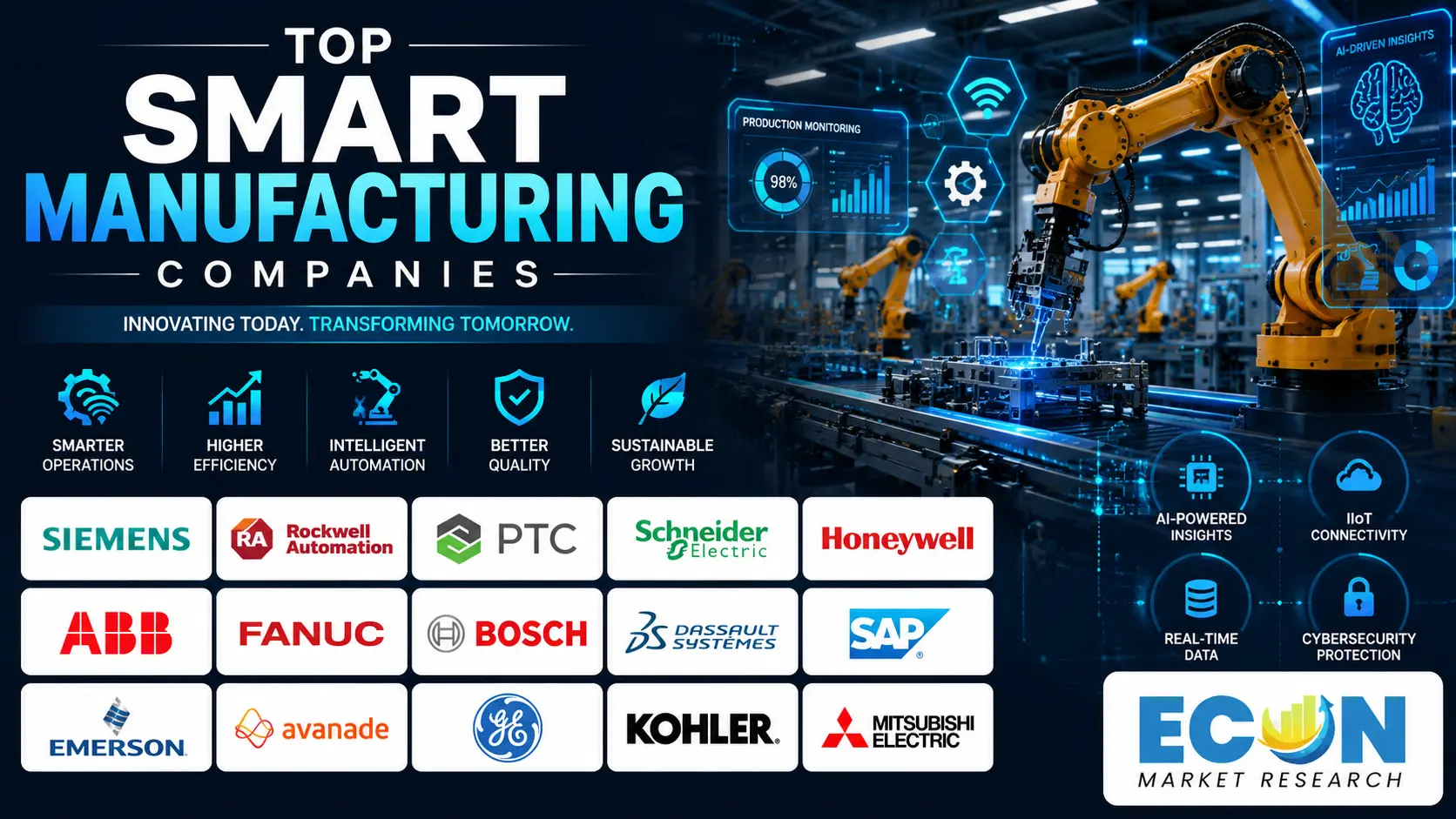
The top companies in the smart manufacturing industry are shaping a production environment in which machines, people, software, robots, sensors, and business systems operate through connected digital architectures. Siemens, Rockwell Automation, Schneider Electric, ABB, and Honeywell each provide distinct capabilities covering factory automation, process control, industrial software, robotics, energy management, artificial intelligence, digital twins, cybersecurity, and lifecycle services.
The global smart manufacturing transition is supported by 542,000 industrial robot installations in 2024, an operational stock of 4,663,773 robots, and worldwide robot density of 177 units per 10,000 manufacturing employees. These figures show that smart manufacturing is no longer limited to experimental factories or a small number of automotive plants. It is expanding into pharmaceuticals, food processing, chemicals, electronics, metals, aerospace, logistics, consumer goods, and medium-sized industrial operations.
Successful smart manufacturing requires more than purchasing 1 robot or installing 1 software platform. Manufacturers must define measurable objectives, connect reliable data, protect industrial networks, train employees, integrate legacy systems, and expand technologies only after operational value is demonstrated. The strongest companies will combine technical expertise with practical manufacturing knowledge and long-term service capabilities.
Over the next 5 to 10 years, industrial AI, digital twins, autonomous material movement, connected workers, edge computing, private 5G, energy intelligence, and software-defined automation will become increasingly important. Manufacturers that implement these technologies with disciplined governance can improve production flexibility, quality, equipment reliability, workforce safety, traceability, and resource efficiency. Smart manufacturing will therefore remain 1 of the central forces influencing global industrial competitiveness and the future design of factories.