


Top Physics-Informed AI Companies Advancing Engineering Intelligence
The top Physics-Informed AI companies are advancing neural operators, digital twins, engineering copilots, surrogate models, and physics-based simulation AI.
1. Introduction
Overview of the Global Physics-Informed AI Industry
The global Physics-Informed AI industry is emerging at the intersection of artificial intelligence, computational physics, computer-aided engineering, high-performance computing, and digital twins. Unlike general-purpose AI systems that learn primarily from statistical patterns, physics-informed models incorporate governing equations, boundary conditions, simulation data, geometry, or first-principles constraints. By 2026, commercial applications extend across aerospace, automotive engineering, semiconductor design, thermal management, energy systems, materials, industrial machinery, electronics, autonomous systems, and medical-device engineering. PhysicsX alone has expanded to more than 300 employees, while Dassault Systèmes supports engineering customers across 159 countries and COMSOL operates through 16 offices, illustrating the increasingly international ecosystem supporting physics-aware AI workflows.
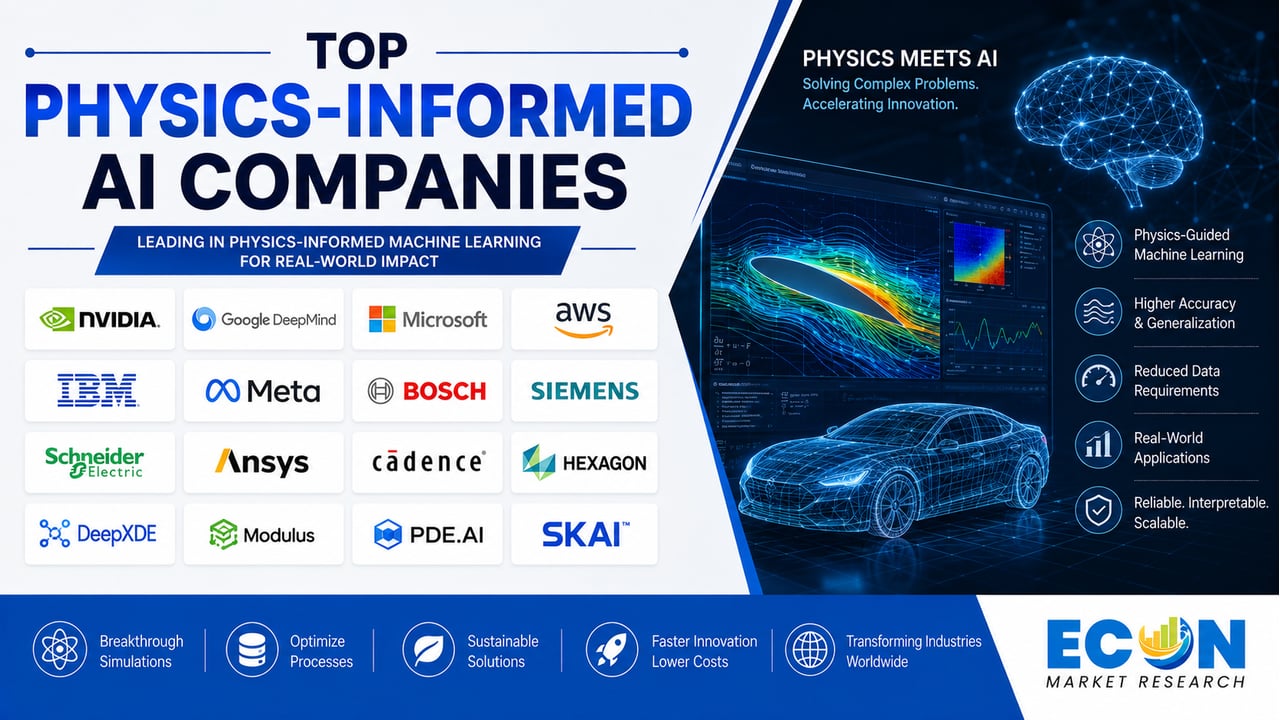
Commercial maturity is most visible in simulation acceleration. NVIDIA PhysicsNeMo supports physics-informed and data-driven machine-learning approaches for physical simulation, Neural Concept introduced a physics- and geometry-aware AI Design Copilot in January 2026, and Luminary now provides Large Physics Models capable of generating predictions of physical fields in less than 1 second for supported applications. Synopsys' Ansys 2026 R1 release combines multiphysics simulation with AI-powered engineering and introduces the portfolio's first agentic capabilities. These developments show that Physics-Informed AI is moving beyond laboratory PINN demonstrations toward repeatable engineering platforms capable of operating inside CAD, CAE, digital-twin, optimization, and product-development environments.
Market Evolution and Growth Drivers
Physics-informed machine learning originated primarily as a research approach for embedding differential equations into neural-network training, but the commercial landscape changed markedly between 2023 and 2026. COMSOL added machine-learning surrogate-model functionality in 2023, Siemens completed its acquisition of Altair in March 2025 and integrated simulation, HPC, data science, and AI technologies into its industrial software portfolio, while PhysicsX and NVIDIA announced work on open Physics AI architectural standards in March 2026. The progression from individual PINNs toward neural operators, graph neural networks, surrogate models, geometry-aware networks, and Large Physics Models has expanded the range of engineering problems that AI can address.
Computing infrastructure is another adoption driver. The U.S. El Capitan system demonstrated 1.742 exaFLOPS in 2024, Europe has established a network reaching 19 AI Factories and 13 AI Factory Antennas, and India's national AI compute infrastructure has expanded beyond 18,000 GPUs. Physics-Informed AI benefits directly from this capacity because training surrogate and foundation models can require hundreds or thousands of high-fidelity simulations before inference becomes fast enough for interactive use. At the same time, the European AI Act entered broad application on 2 August 2026, increasing attention to documentation, validation, transparency, risk management, and model governance in engineering AI deployments.
2. Top 5 Latest Trends in the Physics-Informed AI Industry
Large Physics Models and Neural Operators
Real-Time AI Surrogate Models for Engineering
Physics- and Geometry-Aware AI Design Copilots
AI-Enhanced Digital Twins and Multiphysics Engineering
Open Physics AI Standards, Validation, and Model Governance
Trend 1: Large Physics Models and Neural Operators
Large Physics Models are emerging as one of the most important developments among the Top Companies in the Physics-Informed AI Industry. Instead of developing an isolated neural network for every individual component, developers are working toward models that generalize across geometries, physical regimes, operating conditions, and engineering systems. In March 2026, PhysicsX and NVIDIA announced collaboration on common Physics AI architecture standards covering neural operators, graph neural networks, integral-transform architectures, and multi-resolution approaches. PhysicsX's Opora framework is designed to make these architectures configurable and reproducible, supporting a transition from experimental models toward reusable industrial engineering infrastructure.
Luminary is pursuing a similar direction with its SHIFT family and Large Physics Model architecture. Its SHIFT-Pump reference model was trained using a dataset exceeding 5,500 high-fidelity RANS simulations, while other pre-trained models address aerodynamic and industrial engineering problems. NVIDIA PhysicsNeMo provides another foundation for neural operators and physics-machine-learning workflows. The operational significance is scalability: a validated model that captures a broader class of physical behavior can support thousands of engineering design evaluations without executing a complete CFD, FEA, thermal, or electromagnetic simulation for every new configuration.
Trend 2: Real-Time AI Surrogate Models for Engineering
Physics AI surrogates are reducing simulation inference from hours to seconds or milliseconds for appropriately bounded problems. Luminary states that its Large Physics Models can predict how designs flow, deform, heat, or move in less than 1 second after training and validation, while PhysicsX describes industrial models that convert simulation workflows lasting hours or days into predictions delivered within seconds. These models do not eliminate traditional solvers; high-fidelity simulations remain essential for producing training datasets, establishing physical validity, and identifying model boundaries. The resulting workflow separates computationally expensive data generation from extremely fast repeated inference.
Aerospace provides a measurable example. A Physics AI virtual wind-tunnel project involving Rune Aero produced design changes associated with a 50% reduction in fuel burn and a doubling of payload capacity in the company's aircraft-development program. COMSOL also supports deep-neural-network, Gaussian-process, polynomial-chaos, and spatially varying surrogate models generated from multiphysics simulations. These implementations demonstrate why real-time surrogates matter commercially: engineers can compare a much larger design space while preserving traditional physics simulation as the validation reference.
Trend 3: Physics- and Geometry-Aware AI Design Copilots
Engineering copilots are becoming physically aware rather than relying exclusively on language models. Neural Concept introduced its Physics- and Geometry-Aware AI Design Copilot on 7 January 2026, integrating spatial reasoning, physics awareness, and CAD-ready geometry generation into its Engineering Intelligence platform. The technology is intended to connect engineering requirements directly with geometry creation and performance prediction so designers can assess whether proposed configurations satisfy physical constraints earlier in the design process. Neural Concept reports adoption across automotive, aerospace, energy, electronics, semiconductor, and defense engineering organizations.
Agentic engineering is developing simultaneously. Ansys 2026 R1 introduced the first agentic capabilities across the Ansys portfolio alongside generative AI and multiphysics engineering tools, while MathWorks' R2026a environment includes expanded physics-informed machine-learning examples such as Fourier Neural Operators for 3D battery-module cooling and neural ODE modeling. This convergence indicates that future engineering copilots will increasingly need to interpret design objectives, construct models, call simulation tools, evaluate physical outputs, and recommend changes while keeping engineers in control of validation.
Trend 4: AI-Enhanced Digital Twins and Multiphysics Engineering
Digital twins are evolving from computational replicas into continuously usable physics-AI systems. Synopsys' Ansys 2026 R1 combines multiphysics simulation, AI capabilities, and real-world digital-twin technology, while Cadence has expanded physical-system workflows linking agentic AI, high-accuracy multiphysics simulation, world models, and real-world feedback. The objective is to create models that can operate faster than traditional solvers while remaining connected to validated physical behavior. This approach is especially relevant for autonomous vehicles, data centers, aerospace systems, thermal management, electronics, and industrial equipment where operating conditions change continuously.
NVIDIA and Luminary have also demonstrated real-time CAE digital-twin workflows using NVIDIA PhysicsNeMo and Omniverse technologies. Luminary's cloud-native CFD system can generate large simulation datasets on GPU infrastructure, after which Physics AI models provide interactive prediction and visualization. COMSOL supports similar workflows through surrogate models embedded in simulation applications, producing near-instantaneous responses after the underlying multiphysics model has supplied training data. The trend effectively creates a 2-layer engineering architecture: high-fidelity numerical simulation establishes physical truth, while accelerated AI models distribute that insight across interactive design and operational workflows.
Trend 5: Open Physics AI Standards, Validation, and Model Governance
Model reliability is becoming as important as inference speed. PhysicsX and NVIDIA began collaborating in 2026 on common architecture definitions, benchmarking methods, evaluation approaches, and interoperable Physics AI tooling. Luminary's production platform includes model registries, regression testing, traceability, defined usage boundaries, model-health monitoring, and retraining workflows. These features reflect an industry shift from experimental neural networks toward governed engineering models whose dataset lineage, error characteristics, approved operating domains, and deployment versions can be audited.
Regulation reinforces this trend. The European AI Act entered into force on 1 August 2024 and became broadly applicable on 2 August 2026, while specific high-risk requirements extend into 2027 and 2028. Engineering AI used inside regulated products will therefore face increasing expectations for technical documentation, testing, risk controls, human oversight, and traceability. Physics-Informed AI technology providers that can quantify uncertainty and define where a model should not be trusted may gain an operational advantage over systems optimized solely for prediction speed.
3. Top 10 Companies in the Physics-Informed AI Industry
The following companies are not presented as a strict ranking. Selection reflects active Physics-Informed AI products, physics-aware engineering software, simulation-trained machine learning, scientific computing capabilities, digital-twin technology, industrial deployments, and direct relevance to physics-based AI development in 2026.
1. NVIDIA Corporation
Company Overview: NVIDIA was founded on 5 April 1993 and introduced the GPU concept commercially in 1999. The company has subsequently expanded accelerated computing into AI, scientific computing, simulation, robotics, and industrial digitalization. Headquarters: Santa Clara, California, United States. Core Physics-Informed AI Expertise: GPU-accelerated scientific AI, physics-informed neural networks, neural operators, simulation AI, and digital twins.
Major Products and Services: NVIDIA PhysicsNeMo provides both physics-informed and data-driven machine-learning methods for physical simulation, including tools that express governing equations and derivatives within model-training workflows. NVIDIA also integrates PhysicsNeMo with CUDA, accelerated computing, and Omniverse technologies for interactive engineering. Its 2026 collaboration with PhysicsX is developing shared Physics AI architectural conventions and benchmarking approaches, placing NVIDIA at the infrastructure layer used by industrial Physics AI developers.
2. Siemens AG
Company Overview: Siemens traces its operating history to 1847 and employed roughly 312,000 people across continuing operations at the end of fiscal 2024. The company completed its Altair acquisition on 26 March 2025, adding simulation, HPC, data science, optimization, and AI capabilities to Siemens Xcelerator. Headquarters: Berlin and Munich, Germany. Core Physics-Informed AI Expertise: industrial digital twins, simulation AI, computational engineering, machine learning, and engineering optimization.
Major Products and Services: Siemens' portfolio now includes Altair PhysicsAI technology alongside Simcenter, HEEDS, NX, industrial software, HPC, and digital-twin capabilities. PhysicsAI uses geometric deep learning to learn relationships between product geometry and simulation responses, allowing engineers to evaluate new design candidates without repeating every full numerical simulation. During 2026, Siemens continued integrating Altair technologies into its broader Xcelerator software environment, strengthening the connection between simulation-trained AI and enterprise engineering workflows.
3. Synopsys, Inc.
Company Overview: Synopsys was co-founded in 1986 and employed more than 20,000 people worldwide by December 2024. Following its combination with Ansys, its engineering portfolio also incorporates an Ansys workforce exceeding 6,200 employees across 97 offices. Headquarters: Sunnyvale, California, United States. Core Physics-Informed AI Expertise: multiphysics simulation, AI-enhanced engineering, semiconductor physics, digital twins, reduced-order models, and physical-system validation.
Major Products and Services: Ansys SimAI, TwinAI, Discovery, Fluent, Mechanical, AVxcelerate, and the broader Ansys simulation portfolio provide the physics foundation for AI-enhanced engineering. Ansys 2026 R1 introduced generative and agentic capabilities while integrating AI with multiphysics simulation and real-world digital twins. AVxcelerate Sensors also provides GPU-native physics simulation for cameras, radar, lidar, and thermal sensing, supporting physically grounded training and validation for autonomous systems.
4. PhysicsX
Company Overview: PhysicsX was founded in 2020 according to its 2025 company profile and had expanded to more than 300 employees by June 2026, more than doubling its team within 12 months. The company operates from London and New York with an expanding presence in the San Francisco Bay Area and Singapore. Headquarters: London, United Kingdom. Core Physics-Informed AI Expertise: Large Physics Models, neural operators, simulation AI, engineering optimization, and real-time multiphysics prediction.
Major Products and Services: PhysicsX develops an AI-native engineering platform for aerospace, defense, semiconductors, automotive, energy, materials, and industrial machinery. Its Opora modeling framework contains neural operators, graph neural networks, integral-transform architectures, and multi-resolution models. In March 2026, PhysicsX began working with NVIDIA on open Physics AI standards intended to improve reproducibility and interoperability as Large Physics Models move into production engineering environments.
5. Neural Concept
Company Overview: Neural Concept was founded in 2019 in Lausanne and had more than 60 employees across Switzerland, Germany, and the United States by 2024. Its geographic footprint expanded further with its first Asia-Pacific office in Seoul in June 2026. Headquarters: Lausanne, Switzerland. Core Physics-Informed AI Expertise: geometry-aware deep learning, physics prediction, AI-assisted product design, engineering optimization, and simulation surrogate modeling.
Major Products and Services: Neural Concept's Engineering Intelligence platform learns relationships among CAD geometry, CAE simulation results, test information, and engineering constraints. In January 2026, the company launched a Physics- and Geometry-Aware AI Design Copilot capable of combining spatial reasoning with CAD-ready geometry generation. Its technology is used across automotive, aerospace, semiconductors, energy, electronics, and other engineering sectors requiring rapid evaluation of complex 3D designs.
6. Luminary Cloud, Inc.
Company Overview: Luminary was founded in 2019 by Jason Lango and Juan Alonso and operates from San Mateo, California. The company has evolved from cloud-native GPU CFD into a full-stack Physics AI platform covering model training, validation, deployment, governance, and continuous improvement. Headquarters: San Mateo, California, United States. Core Physics-Informed AI Expertise: Large Physics Models, GPU-native simulation, aerodynamic AI, thermal and structural prediction, and AI model factories.
Major Products and Services: Luminary's Physics AI Factory combines simulation, test, and operational data with model training and deployment. Its SHIFT models include applications for automotive aerodynamics and centrifugal pumps, with SHIFT-Pump trained on more than 5,500 high-fidelity RANS simulations. The company also achieved ISO/IEC 27001:2022 certification for its information-security management environment, supporting Physics AI adoption in aerospace, defense, automotive, electronics, and other engineering contexts requiring controlled data handling.
7. Cadence Design Systems, Inc.
Company Overview: Cadence was formed in 1988 and had roughly 12,700 employees at the end of 2024. Its workplace organization manages more than 50 sites worldwide, while its engineering activities increasingly connect semiconductor design with system-level physics, computational fluid dynamics, structural analysis, electronics cooling, and AI. Headquarters: San Jose, California, United States. Core Physics-Informed AI Expertise: computational engineering, multiphysics AI, reduced-order modeling, geometric deep learning, and physical AI.
Major Products and Services: Cadence ODYSSEE uses reduced-order modeling and machine learning for AI-powered CAE prediction and optimization. Cadence's Physical AI Stack combines agentic AI, multiphysics simulation, world models, and real-world feedback, while its thermal and data-center engineering products can generate physics-based synthetic datasets for AI surrogate models. In 2026, Cadence described hybrid modeling—physics simulation augmented by AI—as an increasingly important method for balancing accuracy and speed.
8. Dassault Systèmes
Company Overview: Dassault Systèmes has operated for more than 40 years and employs roughly 25,000 people. The company supports more than 370,000 enterprise customers and has active customers across 159 countries. Headquarters: Vélizy-Villacoublay, France. Core Physics-Informed AI Expertise: realistic simulation, multiphysics engineering, virtual twins, simulation data science, optimization, and AI-supported product development.
Major Products and Services: SIMULIA provides simulation across structural mechanics, CFD, electromagnetics, multibody dynamics, automation, optimization, and other multiphysics domains. Abaqus, CST Studio Suite, PowerFLOW, Simpack, and 3DEXPERIENCE SIMULIA create high-fidelity physics data that can support AI surrogate and engineering-intelligence workflows. Its Simulation Data Science architecture also enables organizations to capture, publish, reuse, and replay simulation knowledge rather than treating every engineering study as an isolated computational task.
9. COMSOL AB
Company Overview: COMSOL was founded in Stockholm in 1986 and reached its 40th year of multiphysics simulation development in 2026. The COMSOL Group operates through 16 offices and employs more than 600 people globally. Headquarters: Stockholm, Sweden. Core Physics-Informed AI Expertise: multiphysics modeling, simulation-generated machine-learning datasets, surrogate models, digital twins, and physics-based engineering applications.
Major Products and Services: COMSOL Multiphysics added functionality for machine-learning surrogate models in 2023. Engineers can now generate deep-neural-network, Gaussian-process, polynomial-chaos, and spatially varying surrogates from validated multiphysics models. One demonstrated DNN workflow predicts voltage, temperature, displacement, and stress fields across varying model parameters. This combination gives COMSOL a direct role in Physics-Informed AI even though its foundation remains deterministic multiphysics simulation.
10. MathWorks
Company Overview: MathWorks was founded in 1984 and employs more than 6,500 people across 16 countries, including more than 1,200 employees in India. Headquarters: Natick, Massachusetts, United States. MATLAB and Simulink are widely used across automotive, aerospace, robotics, communications, industrial systems, and medical-device engineering. Core Physics-Informed AI Expertise: PINNs, neural differential equations, Fourier Neural Operators, scientific machine learning, system identification, and model-based engineering.
Major Products and Services: MATLAB's Physics-Informed Machine Learning environment supports PINNs for PDEs and ODEs, inverse-problem solving, neural ODEs, graph neural networks, and Fourier Neural Operators. R2026a added an example using an FNO for 3D battery-module cooling and expanded neural ODE capabilities. This makes MathWorks particularly relevant to researchers and industrial engineering teams that need to combine mathematical modeling, experimental data, simulation, control design, and custom Physics-Informed AI algorithms within one environment.
4. Regional Outlook
North America
North America has a strong Physics-Informed AI position because the region combines AI software companies, engineering software suppliers, universities, aerospace and semiconductor industries, and exascale computing infrastructure. The U.S. Department of Energy operates 3 exascale-class systems—Frontier, Aurora, and El Capitan—and El Capitan achieved 1.742 exaFLOPS on the HPL benchmark in 2024. Oak Ridge's computing environment provides more than 36 million computing hours annually to scientists and engineers. Such infrastructure supports the high-resolution simulation datasets and large-scale training workloads required by scientific AI, neural operators, digital twins, and physics foundation models.
The United States hosts NVIDIA, Synopsys, Cadence, Luminary, and MathWorks, while PhysicsX and Neural Concept maintain American operations. Canada complements this ecosystem through 3 national AI institutes—Amii in Edmonton, Mila in Montreal, and the Vector Institute in Toronto—which support AI research and commercialization. Public deployment counts for dedicated Physics-Informed AI systems in Mexico and Canada remain limited as of 2026, making direct cross-country penetration comparisons unreliable. Mexico's opportunity is therefore likely to emerge predominantly through engineering and manufacturing adoption rather than through a large domestic Physics AI software-vendor base.
Europe
Europe combines established CAE expertise with increasingly structured AI regulation. Siemens is headquartered in Germany, Dassault Systèmes in France, COMSOL in Sweden, Neural Concept in Switzerland, and PhysicsX in the United Kingdom. The region's compute infrastructure has also expanded substantially: by June 2026, EuroHPC was overseeing 19 AI Factories and 13 AI Factory Antennas. JUPITER became Europe's first exascale system, while additional AI-focused infrastructure is being deployed across Germany, France, Austria, Bulgaria, Poland, Slovenia, and other European locations.
Regulation is an equally important regional differentiator. The EU AI Act entered into force on 1 August 2024, while its broader enforcement framework became active on 2 August 2026. High-risk rules continue on a staged timeline into December 2027 and August 2028. Physics-Informed AI applied to regulated machinery, infrastructure, medical technologies, and autonomous physical systems must therefore increasingly support validation, documentation, traceability, human oversight, cybersecurity, and defined model limitations. Europe's combination of 27 EU member states, established industrial engineering, exascale infrastructure, and formal AI governance may encourage development of physics models that prioritize verifiability alongside inference performance.
Asia-Pacific
Asia-Pacific offers a strong Physics-Informed AI foundation through semiconductor manufacturing, automotive engineering, electronics, batteries, robotics, aerospace, and expanding AI compute infrastructure. India has established national AI infrastructure exceeding 18,000 GPUs, while Japan's RIKEN is designing FugakuNEXT with operations targeted around 2030. The project aims for application performance improvements of up to 100 times over Fugaku in selected workloads and explicitly combines AI with HPC. Japan is also deploying an AI-focused system equipped with more than 2,000 NVIDIA Blackwell GPUs during 2026.
Commercial presence is also expanding. Neural Concept opened its first Asia-Pacific office in Seoul in June 2026 to support South Korean automotive, shipbuilding, electronics, semiconductor, and industrial organizations. PhysicsX has identified Singapore as an expanding operating location, while MathWorks maintains 3 Japanese offices with more than 250 employees and 2 Chinese offices with more than 100 employees. China, Taiwan, South Korea, Singapore, India, Japan, and Australia therefore provide different Physics-Informed AI opportunities, but dedicated regional installation counts are not yet consistently disclosed across vendors in 2026.
Middle East & Africa
Middle East Physics-Informed AI development is supported increasingly by advanced scientific computing. Saudi Arabia's KAUST placed Shaheen III into operation with a GPU partition containing 2,800 NVIDIA GH200 Grace Hopper Superchips. The GPU system recorded 122.8 PFlop/s of HPL performance and ranked 18th globally on the November 2025 TOP500 list. Physics-based AI can use this class of infrastructure for computational fluid dynamics, combustion, materials, climate modeling, energy systems, optimization, and training surrogate or foundation models based on high-resolution simulation data.
Africa's public HPC capacity is smaller but provides an existing foundation for scientific AI. South Africa's Lengau system has more than 24,000 cores and operates at roughly 1 petaFLOP, while the national CHPC continues running HPC and machine-learning training programs in 2026. Across the 6 Gulf Cooperation Council countries, as well as Israel, Egypt, Kenya, Nigeria, and South Africa, Physics-Informed AI adoption remains at an earlier stage than in North America, Europe, or East Asia. Opportunities are strongest in energy, aerospace, water systems, climate, construction engineering, industrial processing, and materials, while limitations include specialist talent, access to simulation datasets, HPC availability, and dependence on imported engineering platforms.
5. Future Opportunities in the Physics-Informed AI Industry
Future opportunities for the Top Companies in the Physics-Informed AI Industry will center on making physics intelligence reusable across entire product families rather than building one model for one simulation. Large Physics Models, neural operators, graph neural networks, uncertainty-aware surrogates, and multimodal engineering models can allow companies to capture knowledge from thousands of simulations, experiments, and sensor records. Japan's FugakuNEXT program is targeting operations around 2030 and aims for application performance improvements of up to 100 times over Fugaku in selected workloads, creating infrastructure that could support increasingly sophisticated scientific and engineering AI.
Real-time operational digital twins represent another opportunity. Physics AI inference delivered in less than 1 second can make high-fidelity engineering insight usable by designers, plant operators, control systems, maintenance teams, and autonomous machines rather than only specialist CAE analysts. Future applications may include battery thermal management, semiconductor cooling, aircraft aerodynamics, industrial pumps, turbine systems, robotics, medical devices, data-center thermal control, materials processing, and energy infrastructure. The emergence of 19 European AI Factories and more than 18,000 GPUs within India's national compute environment also broadens access to the infrastructure needed to train such models.
Trustworthy deployment will be equally important. The EU AI Act's broader implementation began on 2 August 2026, with additional high-risk requirements scheduled through 2027 and 2028. Engineering organizations will consequently need model validation, uncertainty quantification, dataset provenance, version control, regression testing, approved operating envelopes, and documented human oversight. The collaboration announced by PhysicsX and NVIDIA in March 2026 to develop open architectural conventions indicates that interoperability and standardized evaluation could become competitive factors alongside raw predictive accuracy.
6. Conclusion
The Physics-Informed AI industry has moved beyond early PINN experiments into commercial engineering platforms that combine neural networks, governing physics, simulation datasets, geometry, high-performance computing, and digital twins. During the 2023–2026 period, surrogate modeling entered mainstream multiphysics tools, Large Physics Models emerged as a distinct development direction, and physics-aware engineering copilots began reaching commercial users. The 5 major trends—Large Physics Models, real-time surrogates, geometry-aware design copilots, AI-enhanced digital twins, and governed open Physics AI architectures—are all reducing the gap between conventional CAE and industrial artificial intelligence.
The 10 companies examined—NVIDIA, Siemens, Synopsys, PhysicsX, Neural Concept, Luminary, Cadence, Dassault Systèmes, COMSOL, and MathWorks—approach the opportunity from different technical positions. PhysicsX has expanded beyond 300 employees, Dassault Systèmes reaches customers in 159 countries, COMSOL operates through 16 offices, and MathWorks employs more than 6,500 people across 16 countries. Together, these participants demonstrate that Physics-Informed AI is developing through a mixture of specialist startups, scientific-computing companies, CAE vendors, industrial-software groups, and accelerated-computing providers rather than through one standardized commercial model.
Regional competition will increasingly depend on access to compute, engineering talent, simulation data, regulation, and industrial users. The United States operates 3 exascale-class Department of Energy systems, Europe supports 19 AI Factories and 13 associated antennas, India provides an AI infrastructure exceeding 18,000 GPUs, and Japan targets FugakuNEXT operation around 2030. As these resources converge with more reliable neural operators and physics foundation models, the Top Companies in the Physics-Informed AI Industry will be differentiated by their ability to deliver fast predictions while preserving physical consistency, quantified uncertainty, engineering traceability, cybersecurity, and regulatory confidence.