

Top Companies in Liquid Cooling Driving Data Center Innovation
The top liquid cooling companies are advancing data center efficiency with direct-to-chip, immersion, and high-density thermal management solutions.
Introduction
Overview of the Global Liquid Cooling Industry
The global liquid cooling industry has become a critical part of modern data center infrastructure as artificial intelligence, high-performance computing, cloud platforms, and accelerated computing increase server heat output. Data centers consumed an estimated 415 terawatt-hours of electricity in 2024, representing 1.5% of worldwide electricity use. New AI infrastructure is moving beyond conventional rack densities of 10–30 kilowatts toward configurations exceeding 100 kilowatts per rack. Product roadmaps for advanced AI training clusters indicate rack densities of 200 kilowatts and higher, creating thermal loads that traditional air-cooling systems cannot manage efficiently. Liquid cooling transfers heat directly from processors, memory modules, networking components, and server enclosures through controlled coolant loops.
Market Evolution and Growth Drivers
Liquid cooling evolved from specialized supercomputer installations into a mainstream technology for AI factories, hyperscale campuses, colocation facilities, edge computing sites, and enterprise data centers. Cooling systems can consume up to 40% of a data center’s total power budget, encouraging operators to adopt more efficient direct-to-chip, rear-door, and immersion technologies. Modern liquid cooling systems support rack densities above 140 kilowatts, while engineering plans are being developed for future configurations approaching 1 megawatt per rack. The strongest growth drivers include high-thermal-design-power GPUs, multi-chip processors, denser server architecture, limited floor space, water restrictions, grid constraints, and sustainability targets. Direct liquid cooling can transfer heat up to 3,000 times more effectively than air at the material level.
Top 5 Latest Trends in the Liquid Cooling
1. Direct-to-Chip Cooling for AI Servers
Direct-to-chip liquid cooling has become one of the most important liquid cooling trends because it removes heat directly from CPUs, GPUs, memory modules, and network accelerators. Cold plates are attached to high-temperature components, while pumps circulate water or water-glycol coolant through sealed loops. A coolant distribution unit separates the technology cooling loop from the facility water system, controls flow rates, maintains pressure, and transfers heat through a heat exchanger. Modern direct-to-chip systems can remove 70–80% of server heat through liquid, leaving only 20–30% for conventional airflow. One reference architecture assigns 76% of the thermal load to direct-to-chip liquid cooling and 24% to perimeter air systems.
The adoption of direct-to-chip liquid cooling is accelerating because AI processors operate at significantly higher thermal design power than earlier server chips. High-density AI racks containing 72 interconnected accelerator modules can require 120 kilowatts or more of cooling capacity. Current coolant distribution units are designed to support capacities from 70 kilowatts to 2,300 kilowatts, allowing deployment at rack, row, pod, and facility levels. Direct-to-chip cooling is also easier to integrate into existing data centers than full immersion systems because operators can retain standard 19-inch racks, familiar service procedures, conventional storage systems, and air cooling for secondary components.
2. Megawatt-Class Coolant Distribution Units
The transition toward megawatt-class coolant distribution units is transforming liquid cooling infrastructure. Earlier rack-mounted CDUs were commonly designed for capacities between 50 kilowatts and 200 kilowatts, but new row-based and facility-level systems can manage 1–14 megawatts. A 4U rack-mounted CDU can provide 200 kilowatts of cooling and support up to 200 servers, while a larger row-based system can deliver 2 megawatts in a footprint measuring 750 millimeters by 1,200 millimeters. One 2-megawatt CDU configuration can support as many as 12 AI racks rated at 120 kilowatts each.
Megawatt-class CDUs allow hyperscale operators to consolidate pumping, heat exchange, filtration, flow monitoring, and controls into scalable cooling platforms. New centralized CDU architectures can deliver up to 14 megawatts, enabling phased expansion of giga-scale AI campuses. These systems typically include N+1 pumps, redundant power supplies, automated valve controls, leak detection, pressure sensors, temperature monitoring, and software integration. Larger CDUs also reduce the number of individual cooling devices required across a data hall, simplifying maintenance and improving capacity planning. As data center campuses move toward 1-gigawatt and 5-gigawatt configurations, scalable liquid distribution infrastructure will become as important as electrical substations and backup generation systems.
3. Single-Phase and Two-Phase Immersion Cooling
Immersion cooling is expanding for applications requiring extreme density, compact footprints, low fan energy, and stable component temperatures. In single-phase immersion cooling, servers are submerged in a nonconductive dielectric liquid that remains in liquid form during operation. Pumps move the heated fluid through a heat exchanger before returning it to the tank. In two-phase immersion cooling, the dielectric liquid boils at a controlled temperature, converts into vapor, condenses on a cooling surface, and returns to the tank. Both methods can eliminate most server fans and reduce dependence on conventional computer-room air-conditioning equipment.
Current immersion platforms can dissipate more than 100 kilowatts in a footprint measuring close to 1 meter by 1.2 meters. Commercial systems are available with cooling capacities reaching 252 kilowatts per horizontal rack, supporting AI, high-performance computing, edge workloads, blockchain processing, and dense semiconductor research. One hyperscale immersion deployment supported a 40-megawatt IT load and reported 92.6% lower cooling energy consumption than an equivalent enterprise data center. Another installation achieved a power usage effectiveness value of 1.01, compared with a local reference level of 2.20.
4. Warm-Water Cooling and Heat Reuse
Warm-water liquid cooling is gaining importance because it can reduce chiller use and create opportunities for heat recovery. Traditional chilled-water systems may supply water below 16°C, but advanced liquid-cooled servers can operate with inlet temperatures of 17°C or higher under recognized warm-water classifications. Some CDUs are compatible with temperature ranges from W17 through W+, allowing data centers to use outdoor dry coolers during favorable weather conditions. Operating at higher coolant temperatures improves economizer hours, reduces compressor use, and increases the temperature of recovered heat.
Recovered data center heat can support district heating, offices, greenhouses, aquaculture, industrial drying, domestic hot-water systems, desalination processes, and agricultural facilities. A liquid loop captures heat in a concentrated form, making it easier to reuse than low-temperature exhaust air. Heat-reuse projects become increasingly practical when coolant outlet temperatures reach 40–60°C and the receiving facility is located within 1–5 kilometers. Operators evaluating liquid cooling are therefore considering energy reuse factor alongside power usage effectiveness and water usage effectiveness. Warm-water cooling can also support 0% evaporative water consumption when paired with dry heat-rejection equipment.
5. Intelligent Monitoring, Leak Detection, and Predictive Maintenance
Intelligent liquid cooling management is emerging as a major trend because the performance of a cooling loop depends on pressure, flow, temperature, coolant chemistry, pump health, filtration, and leak prevention. New CDUs integrate touchscreen interfaces, redundant controllers, humidity sensors, differential-pressure monitoring, flow meters, conductivity sensors, and remote management software. Operators can monitor individual racks, manifolds, cold plates, pumps, and secondary loops from centralized dashboards.
Predictive maintenance systems are being developed to identify abnormal behavior before a shutdown occurs. A 2025 proof-of-concept leak-monitoring system achieved 96.5% detection accuracy and 87% forecasting accuracy using pressure, humidity, and flow-rate signals. The model forecast potential leaks 2–4 hours before an incident and identified sudden events within 1 minute. In a simulated 47-rack facility, proactive monitoring was estimated to prevent 1,500 kilowatt-hours of annual energy waste. Although such results require validation in operational facilities, they demonstrate how artificial intelligence can protect the liquid cooling systems supporting AI infrastructure.
Top 5 Companies in the Liquid Cooling
1. Schneider Electric
Company overview: Schneider Electric is a global energy-management and automation company with an extensive data center infrastructure portfolio. The company strengthened its liquid cooling position in February 2025 by completing the acquisition of a 75% controlling interest in Motivair, with the remaining 25% expected to be acquired in 2028. Motivair contributes more than 15 years of experience in high-performance computing, accelerated computing, exascale systems, and advanced thermal management.
Headquarters: Schneider Electric is headquartered in Rueil-Malmaison, France, while Motivair maintains major operations in the United States. This combination gives the business access to customers across North America, Europe, Asia-Pacific, the Middle East, and Africa through an established manufacturing, engineering, service, and distribution network.
Core liquid cooling expertise: The company specializes in end-to-end liquid cooling for AI factories, hyperscale data centers, colocation sites, supercomputers, and high-performance computing installations. Its expertise covers chip-level heat capture, coolant distribution, facility heat rejection, power infrastructure, controls, digital monitoring, commissioning, and lifecycle services. Its systems are designed for racks exceeding 100 kilowatts and data center plans preparing for densities of 1 megawatt.
Major products and services: The liquid cooling portfolio includes megawatt-class CDUs, Dynamic cold plates, ChilledDoor rear-door heat exchangers, liquid-to-air heat-dissipation units, in-rack manifolds, chillers, technology cooling system loops, heat-rejection equipment, control software, installation, and maintenance. The company combines these technologies with electrical distribution, uninterruptible power supplies, prefabricated modules, and AI-ready reference designs.
2. Vertiv
Company overview: Vertiv is a global provider of critical digital infrastructure for data centers, telecommunications networks, cloud facilities, and high-performance computing environments. The company has expanded its liquid cooling portfolio to address AI deployments where rack density exceeds the practical limits of traditional perimeter cooling. Its thermal-management offering spans liquid-to-liquid, liquid-to-air, direct-to-chip, rear-door, and hybrid cooling architectures.
Headquarters: Vertiv maintains its global headquarters in Columbus, Ohio, United States, and operates engineering, manufacturing, sales, and service facilities across 130+ countries. Its international footprint supports global data center operators that require standardized liquid cooling equipment with regional commissioning and maintenance capabilities.
Core liquid cooling expertise: Vertiv specializes in integrating the facility cooling system with liquid-cooled IT hardware. Its CDUs create a controlled secondary loop that protects servers from contamination in the building water supply. The architecture manages coolant temperature above the dew point, reduces condensation risk, controls flow, and isolates high-value IT equipment from facility-side pressure fluctuations.
Major products and services: Major offerings include the Vertiv CoolChip CDU family, Liebert XDU systems, in-rack CDUs, in-row CDUs, liquid-to-air CDUs, liquid-to-liquid CDUs, rear-door heat exchangers, chillers, dry coolers, and prefabricated AI infrastructure. CoolChip CDU products cover cooling capacities from 70 kilowatts to 2,300 kilowatts, while one in-rack CDU configuration supplies 100 kilowatts of liquid cooling through liquid-to-liquid heat exchange.
3. CoolIT Systems
Company overview: CoolIT Systems is a dedicated liquid cooling company founded in 2001 and focused on direct liquid cooling for data centers, supercomputers, enterprise IT, AI infrastructure, and server manufacturers. The company has shipped more than 5 million cold plates and deployed technology in 300+ data centers. It operates multi-gigawatt manufacturing capacity across North America and Asia and became part of Ecolab in 2026.
Headquarters: CoolIT Systems is headquartered in Calgary, Alberta, Canada. It also maintains manufacturing and operational facilities in North America and Asia, a United States office in Wilmington, Delaware, a Taiwan office, and a regional presence in the United Arab Emirates.
Core liquid cooling expertise: CoolIT specializes in single-phase direct liquid cooling and works with processor manufacturers, server companies, and hyperscale operators to design cold plates, coolant loops, rack manifolds, and CDU platforms. Its engineering capabilities include thermal simulation, fluid design, precision manufacturing, automated assembly, pressure testing, leak testing, and integration support.
Major products and services: The company’s products include cold plates, cold-plate loops, rack manifolds, liquid-to-liquid CDUs, liquid-to-air CDUs, and professional services. The CHx80 supports 80 kilowatts in 4U, the CHx200 supports 200 kilowatts in 4U, and the CHx2000 delivers 2,000 kilowatts. The CHx2000 provides a flow rate of 1.2 liters per minute per kilowatt and can support 12 racks rated at 120 kilowatts.
4. Submer
Company overview: Submer is a liquid cooling specialist established to develop sustainable immersion-cooled infrastructure for data centers, edge computing, artificial intelligence, cloud platforms, blockchain workloads, and high-performance computing. The company focuses on reducing water use, improving computing density, enabling heat reuse, and supporting modular data center deployment.
Headquarters: Submer is headquartered in Barcelona, Spain, with a presence in the United States and other international markets. Its location provides access to major European data center hubs while supporting customers in North America, the Middle East, and Asia-Pacific through regional partners and deployment programs.
Core liquid cooling expertise: Submer specializes in single-phase immersion cooling using biodegradable dielectric coolant. Its technology immerses servers in a thermally conductive but electrically nonconductive fluid, removing heat from processors, boards, memory, storage, and power components. Certain coolant formulations are reported to be 8 times less conductive than air, supporting safe operation around electronic equipment.
Major products and services: Major solutions include SmartPod immersion platforms, SmartPodX, SmartPodXL, MicroPod edge systems, modular cooling infrastructure, coolant, deployment engineering, and lifecycle support. SmartPod systems can dissipate more than 100 kilowatts and support both 19-inch hardware and 21-inch Open Compute equipment. Selected configurations support 12-volt and 48-volt busbars and can achieve a power usage effectiveness value of 1.03.
5. LiquidStack
Company overview: LiquidStack develops direct-to-chip, single-phase immersion, and two-phase immersion cooling systems for AI, hyperscale data centers, high-performance computing, semiconductor development, and edge infrastructure. The company emerged as an independent business in 2021 after developing immersion technologies within a larger computing organization.
Headquarters: LiquidStack is headquartered in Carrollton, Texas, United States. It opened a manufacturing facility, research-and-development center, and headquarters at the location in 2024 and added a second Carrollton manufacturing facility in March 2025 to expand production capacity.
Core liquid cooling expertise: LiquidStack has expertise across 3 primary architectures: direct-to-chip cooling, single-phase immersion cooling, and two-phase immersion cooling. This broad portfolio allows customers to select solutions based on server compatibility, rack density, maintenance practices, floor-space constraints, fluid requirements, and heat-reuse objectives.
Major products and services: The company offers direct-to-chip CDUs with capacities reaching 1,350 kilowatts at N+1, a scalable GigaModular CDU platform with capacity up to 14 megawatts, and immersion systems delivering up to 252 kilowatts per unit. It also provides design consulting, installation, commissioning, operator training, preventive maintenance, and lifecycle support.
Regional Outlook
North America
North America is the largest and most mature region for liquid cooling adoption because it hosts extensive hyperscale, cloud, colocation, AI, and supercomputing infrastructure. The Americas account for close to 50% of global data center capacity, with the United States representing roughly 90% of regional capacity. The North American development pipeline reached 338 gigawatts in June 2026 after expanding 44% during the first 6 months of the year. Large projects in Virginia, Texas, Arizona, Ohio, Oregon, Louisiana, Georgia, and Nevada are being designed for high-density AI computing.
The region’s liquid cooling requirements are being shaped by campuses with electrical capacities measured in hundreds of megawatts or multiple gigawatts. One Louisiana AI campus was expanded to a planned 5 gigawatts in July 2026, demonstrating the scale at which thermal infrastructure must now be engineered. These campuses require direct-to-chip cold plates, redundant megawatt CDUs, central coolant loops, dry coolers, water-treatment systems, and automated leak monitoring.
North America also has a strong supplier ecosystem. Several leading liquid cooling companies maintain headquarters, manufacturing facilities, or engineering centers in the United States and Canada. CoolIT Systems has deployed its technology in 300+ data centers, while LiquidStack operates 2 manufacturing facilities in Carrollton, Texas. The region benefits from close collaboration among chip manufacturers, server makers, cloud companies, research laboratories, cooling suppliers, and colocation operators.
However, grid congestion, water scarcity, permitting delays, and climate risk are influencing cooling decisions. The Americas contain 86% of data center capacity exposed to elevated acute climate hazards in one 2026 analysis. Liquid cooling systems paired with closed loops and dry heat rejection can reduce dependence on evaporative water use, while warm-water operation can lower compressor energy. These advantages are expected to make liquid cooling a standard design requirement for North American AI facilities above 50–100 kilowatts per rack.
Europe
Europe has a diversified liquid cooling industry supported by established data center hubs, strict energy-efficiency regulations, district-heating networks, advanced research institutions, and a growing AI ecosystem. Major activity is concentrated in Frankfurt, London, Amsterdam, Paris, Dublin, Madrid, Milan, Stockholm, Helsinki, Warsaw, and Barcelona. European operators are adopting liquid cooling to overcome power constraints and increase computing capacity without proportionally expanding building area.
The EMEA region had 11,400 megawatts of live data center capacity in 2025 after adding 850 megawatts during the first 9 months. By the third quarter of 2025, 91% of available EMEA data center capacity had been leased, compared with 87% in 2022. Tight availability encourages operators to improve the computing output of existing buildings, making liquid cooling retrofits strategically important.
European liquid cooling adoption is also influenced by heat-reuse regulations and urban sustainability goals. Data centers equipped with warm-water direct-to-chip loops can deliver concentrated heat to district-heating systems at temperatures between 40°C and 60°C. Northern European cities with established heating networks provide favorable conditions for recovering server heat during 6–9 colder months each year. Immersion and direct-to-chip platforms can also reduce the fan energy and chilled-water requirements associated with high-density racks.
Europe hosts important suppliers and innovation centers, including companies based in France, Spain, Poland, Germany, the Netherlands, and the United Kingdom. Barcelona-based Submer develops immersion platforms exceeding 100 kilowatts, while French-headquartered Schneider Electric provides integrated electrical and liquid cooling infrastructure. As European grids face connection delays and energy-efficiency requirements, liquid cooling will be used to increase rack density, reduce cooling overhead, support waste-heat recovery, and extend the operational life of constrained facilities.
Asia-Pacific
Asia-Pacific is developing into a major liquid cooling growth region because of rapid cloud expansion, semiconductor manufacturing, AI development, digital services, and hyperscale construction. Key data center markets include China, Japan, Singapore, India, Australia, South Korea, Malaysia, Indonesia, Thailand, and Taiwan. Mumbai, Johor, Tokyo, Osaka, Sydney, Melbourne, Seoul, Singapore, and Hyderabad are attracting large-scale infrastructure projects.
Several Asia-Pacific cities face high temperatures and humidity for 8–12 months each year, making conventional air cooling more energy-intensive. A 2026 climate-risk analysis indicated that 89% of data center exposure in Asia-Pacific was vulnerable to chronic heat or drought conditions. Closed-loop liquid cooling and dry heat-rejection technologies can reduce evaporative water demand and improve thermal stability during extreme weather.
The region’s electronics manufacturing base also supports the production of cold plates, pumps, heat exchangers, manifolds, connectors, server chassis, and monitoring components. CoolIT Systems operates manufacturing capacity in Asia, while global suppliers maintain offices and integration partners in Taiwan, Singapore, Japan, India, and Australia. Local server manufacturers are increasingly designing liquid-ready platforms with standardized quick-disconnect fittings, 19-inch rack compatibility, and 48-volt power architectures.
India is expanding AI and cloud infrastructure across Mumbai, Chennai, Hyderabad, Bengaluru, Pune, and the National Capital Region. Malaysia is developing large campuses in Johor, while Japan and Australia continue to attract hyperscale investment. One Asia-based operator planned to increase capacity across India, Malaysia, and Thailand to 700 megawatts by mid-2027. As new AI racks move toward 100–200 kilowatts, Asia-Pacific operators will require factory-tested CDUs, modular piping, leak detection, water-quality controls, and trained liquid cooling technicians.
Middle East & Africa
The Middle East and Africa liquid cooling industry is developing alongside national AI strategies, cloud-region expansion, sovereign computing programs, smart-city projects, and digital transformation. Major Middle Eastern activity is concentrated in the United Arab Emirates, Saudi Arabia, Qatar, Bahrain, Oman, and Israel, while African development is led by South Africa, Kenya, Nigeria, Egypt, and Morocco.
High ambient temperatures exceeding 40°C during summer create significant cooling challenges across the Gulf region. Data centers operating in these conditions require efficient heat rejection, water-conscious design, filtration, redundant pumping, and automated controls. Liquid cooling can capture 70–90% of server heat directly at the rack, reducing the airflow volume needed inside the data hall. Warm-water systems can also operate at higher supply temperatures, improving the efficiency of dry coolers and hybrid heat-rejection equipment.
Saudi Arabia and the United Arab Emirates are supporting AI infrastructure through hyperscale projects, regional cloud availability zones, research programs, and government digital initiatives. Advanced liquid cooling demonstrations in Riyadh have highlighted CDUs, rear-door heat exchangers, cold plates, chillers, and integrated power infrastructure. A 75% acquisition of a specialist liquid cooling company strengthened the availability of these systems in Saudi Arabia, with full ownership planned for 2028.
Africa has a smaller installed data center base but substantial long-term demand. Regional data center capacity requirements are projected to reach 1.5–2 gigawatts by 2030. Between 60% and 70% of African demand is expected to come from facilities below 50 megawatts, creating opportunities for modular liquid cooling, edge systems, containerized data centers, and compact immersion platforms. Liquid cooling can help operators overcome limited grid capacity, high cooling costs, water constraints, and restricted floor space.
Future Opportunities in the Liquid Cooling
The future of liquid cooling will be shaped by AI racks exceeding 200 kilowatts, processors with higher thermal design power, and data center campuses approaching 1–5 gigawatts. Global data center capacity could reach 200 gigawatts by 2030 after adding 97 gigawatts between 2025 and 2030. This expansion will create demand for cold plates, CDUs, pumps, heat exchangers, dielectric fluids, manifolds, quick disconnects, sensors, controls, testing equipment, and maintenance services.
One major opportunity involves standardized liquid-cooled server platforms. Operators need interoperable connections, coolant specifications, pressure ranges, temperature classes, rack manifolds, and monitoring protocols. Standardization can shorten deployment schedules, reduce installation errors, and allow equipment from 2–5 suppliers to operate within the same cooling architecture. Suppliers that support open hardware formats, 19-inch racks, 21-inch racks, 12-volt systems, and 48-volt systems will be positioned to serve diverse installations.
Brownfield data center retrofits represent another significant opportunity. Thousands of existing facilities were designed for rack densities below 15 kilowatts, but AI deployments can require 100 kilowatts or higher. Liquid-to-air CDUs, rear-door heat exchangers, modular pipes, and skid-mounted systems can introduce liquid cooling without rebuilding the entire facility water system. A rack-mounted CDU occupying 4U can provide between 80 kilowatts and 200 kilowatts of cooling, enabling phased upgrades.
Heat recovery will also become commercially important. Liquid systems can provide outlet temperatures suitable for district heating, agriculture, industrial processes, and hot-water production. A 40-megawatt data center operating continuously can generate hundreds of gigawatt-hours of recoverable thermal energy each year, depending on utilization and heat-recovery efficiency. Cities with heating networks and sustainability requirements can encourage operators to treat server heat as a usable energy stream rather than waste.
Additional opportunities will emerge in dielectric fluids, waterless heat rejection, predictive maintenance, robotics, and generative thermal design. A 2026 direct-to-chip research project reduced average chip temperature by over 5°C and maximum temperature by more than 35°C by optimizing cold-plate channel geometry. Future commercial systems may use artificial intelligence to design flow paths, adjust pumps, forecast leaks, balance racks, and detect blockages automatically.
Conclusion
The liquid cooling industry has moved from a specialized technology into an essential foundation for artificial intelligence, high-performance computing, cloud services, and high-density data centers. Traditional racks operating at 10–30 kilowatts remain compatible with air cooling, but AI racks reaching 100–200 kilowatts require direct-to-chip, rear-door, immersion, or hybrid thermal architectures. Global data center electricity consumption reached 415 terawatt-hours in 2024, and cooling may account for up to 40% of a facility’s power budget, making thermal efficiency a strategic operational priority.
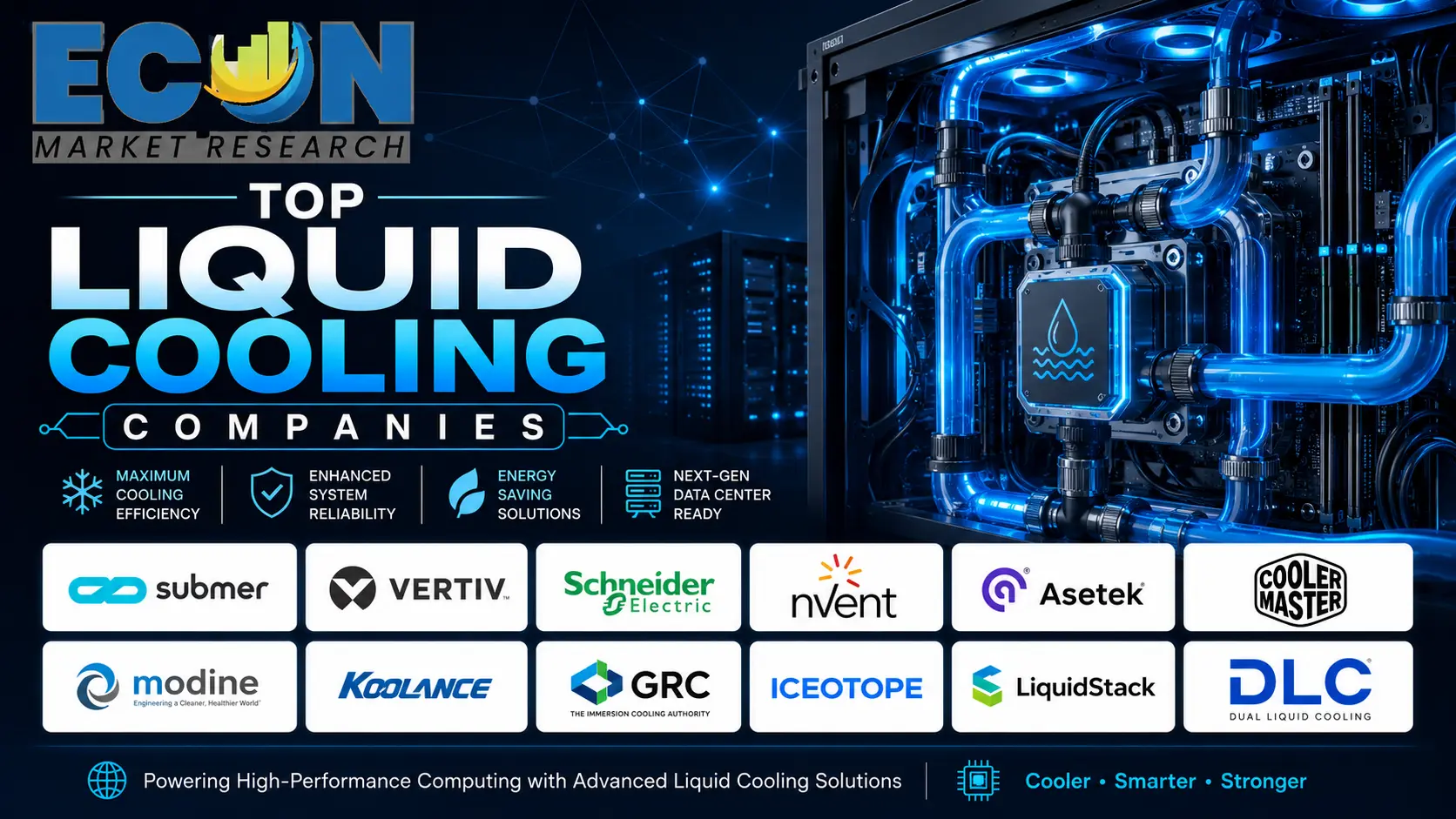
The top companies in liquid cooling are building complete ecosystems rather than individual cooling products. Schneider Electric, Vertiv, CoolIT Systems, Submer, and LiquidStack provide combinations of cold plates, CDUs, manifolds, immersion tanks, chillers, heat exchangers, controls, engineering, and lifecycle services. Product capacities now range from 80-kilowatt rack CDUs to centralized platforms delivering 14 megawatts.
Regional demand will differ according to climate, grid availability, water access, data center density, and AI investment. North America is leading hyperscale adoption, Europe is advancing heat reuse, Asia-Pacific is expanding manufacturing and cloud capacity, and the Middle East and Africa are adopting water-conscious modular solutions. By 2030, liquid cooling will increasingly determine how much computing capacity can be installed within a fixed building, electrical connection, and environmental limit. Companies that combine reliable hardware, intelligent controls, scalable manufacturing, standardized interfaces, and international service capabilities will lead the next phase of the liquid cooling industry.