


Top Companies Shaping the Generative AI Infrastructure Industry
The top Generative AI infrastructure companies driving advances in AI chips, cloud platforms, data centers, networking, computing, and model deployment.
Introduction
Overview of the Global Generative AI Infrastructure Industry
The global generative AI infrastructure industry has evolved into a critical technology ecosystem comprising AI accelerators, high-performance servers, cloud computing platforms, networking equipment, storage systems, cooling technologies, model-development software, and inference services. In 2026, AI-optimized servers are expected to consume 175 terawatt-hours of electricity, representing 31% of total global data-center power consumption. Modern generative AI infrastructure must support models containing 100 billion, 400 billion, or even 1 trillion parameters while processing millions of tokens across distributed computing environments. Organizations are consequently deploying GPU clusters with 8, 72, 256, 6,144, or 9,216 interconnected accelerators, depending on workload complexity, latency requirements, and deployment scale.
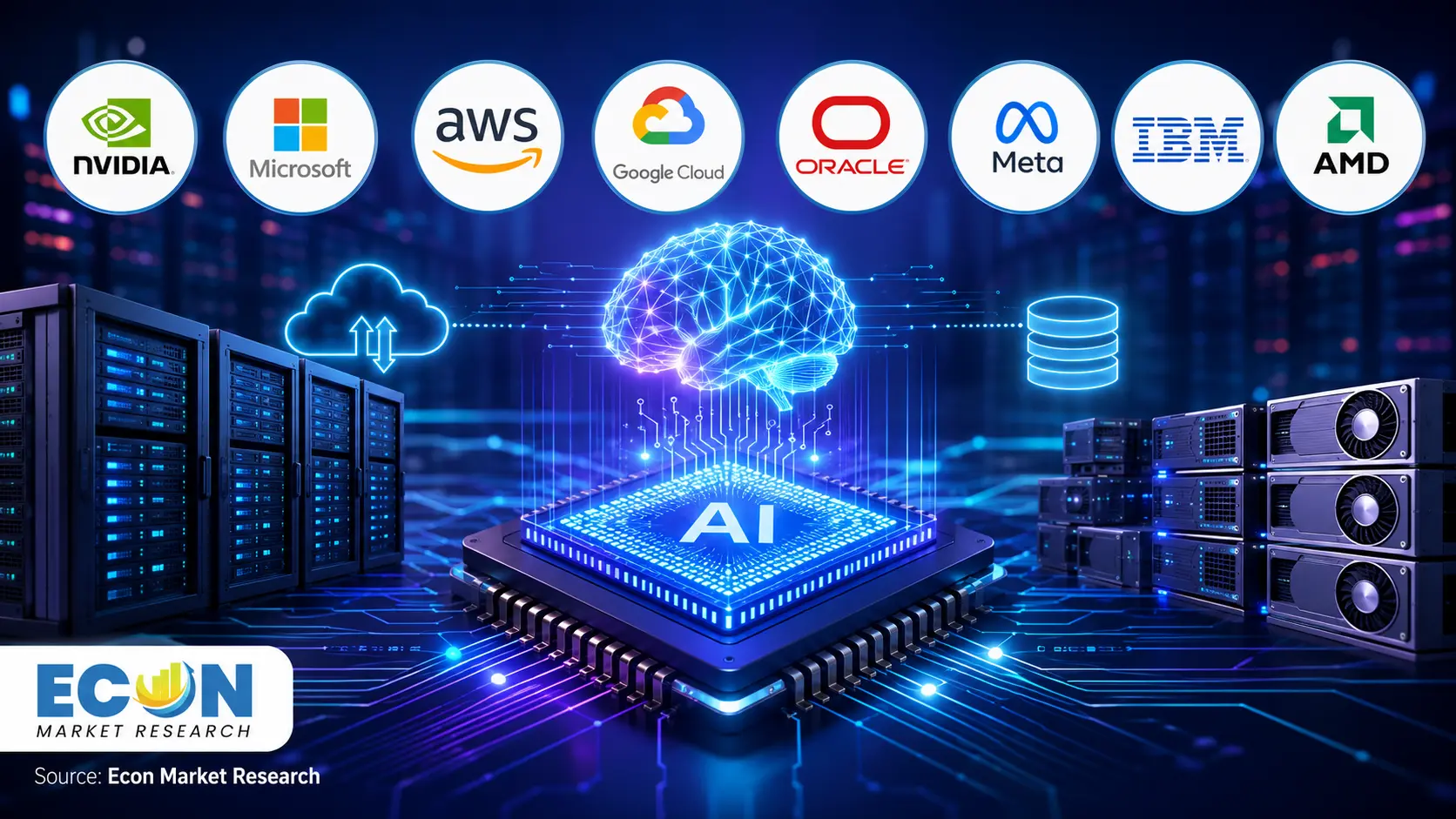
Market Evolution and Growth Drivers
Generative AI infrastructure has progressed from small experimental clusters containing 4 or 8 GPUs to rack-scale AI systems operating as unified supercomputers. This evolution is being driven by larger context windows, multimodal applications, agentic AI, retrieval-augmented generation, real-time inference, and enterprise requirements for secure private models. Global data-center electricity consumption is projected to reach 945 terawatt-hours by 2030, with AI serving as the most important growth driver. Infrastructure providers are responding with 3-nanometer accelerators, 216-gigabyte high-bandwidth memory systems, 800-gigabit networking, liquid-cooled racks, and specialized inference chips. These developments are converting traditional data centers into AI factories designed to generate, distribute, and optimize digital tokens at industrial scale.
Top 5 Latest Trends in the Generative AI Infrastructure
1. Rack-Scale AI Systems Are Replacing Standalone GPU Servers
Rack-scale computing is becoming one of the most influential generative AI infrastructure trends because model performance increasingly depends on the entire system rather than on 1 accelerator. A leading rack-scale platform connects 72 GPUs and 36 central processors through a unified high-bandwidth interconnect, allowing the complete rack to operate as 1 massive accelerator. This architecture can deliver up to 30 times faster real-time inference for trillion-parameter language models and up to 10 times higher performance for mixture-of-experts architectures. Rack-scale systems reduce communication bottlenecks that commonly emerge when thousands of accelerators exchange model weights, gradients, and activation data during distributed training.
Generative AI infrastructure buyers are also evaluating rack-level memory capacity, network topology, power distribution, serviceability, and thermal performance instead of comparing individual GPU specifications alone. A fully configured 72-GPU system can contain 13.4 terabytes of unified GPU memory and reach 1.44 exaflops of low-precision computing performance. Such systems are particularly suitable for models containing 1 trillion parameters, high-concurrency inference applications, and multimodal workloads involving text, images, video, and audio. However, rack-scale adoption requires facilities capable of supporting power densities above 100 kilowatts per rack, making electrical design and cooling capacity central purchasing considerations.
2. Custom AI Accelerators Are Expanding Beyond General-Purpose GPUs
Cloud providers and semiconductor companies are accelerating the development of custom AI chips optimized for training, inference, or specific model architectures. One next-generation AI UltraServer can scale to 144 custom accelerators while providing 362 FP8 petaFLOPS, 4 times lower latency, 4 times greater energy efficiency, and 4.4 times more compute performance than its preceding generation. Another inference-focused accelerator is manufactured using a 3-nanometer process and includes 216 gigabytes of HBM3e memory, 7 terabytes per second of memory bandwidth, and 272 megabytes of on-chip SRAM.
Custom silicon allows infrastructure operators to control chip design, compiler optimization, networking, scheduling, and model-serving economics across 1 integrated platform. One accelerator delivers over 10 petaFLOPS at 4-bit precision and more than 5 petaFLOPS at 8-bit precision, while its Ethernet-based architecture can scale to clusters containing 6,144 chips. Another tensor-processing platform is available in 256-chip and 9,216-chip configurations and delivers a 10-fold peak performance improvement over its earlier high-performance generation. These advances indicate that the generative AI infrastructure market is moving toward heterogeneous computing environments combining GPUs, CPUs, TPUs, custom inference processors, and smart networking devices.
3. Liquid Cooling Is Becoming Essential for High-Density AI Deployment
Liquid cooling is transitioning from a specialized engineering option into a standard requirement for high-density generative AI infrastructure. Air cooling becomes less effective when a single rack contains 72 accelerators, multiple CPUs, high-speed switches, memory modules, and power-conversion components operating continuously. Direct-to-chip liquid cooling removes thermal energy close to the processor package, enabling higher rack density and more stable performance. A 2026 cooling study demonstrated that optimized liquid-channel designs could reduce average chip temperature by more than 5 degrees Celsius and maximum temperature by over 35 degrees Celsius compared with a conventional parallel-channel design.
Advanced facilities are combining cold plates, coolant distribution units, rear-door heat exchangers, immersion cooling, and heat-recovery systems. Cooling electricity demand is expected to increase by 22.6% during 2026 as operators install denser AI hardware. The design challenge extends beyond temperature reduction because cooling systems must also address water consumption, pump efficiency, leakage detection, maintenance access, and waste-heat reuse. In regions with strict environmental regulations, generative AI infrastructure projects are increasingly evaluated according to power usage effectiveness, water usage effectiveness, and the percentage of recovered heat supplied to nearby buildings or industrial facilities.
4. Inference Optimization Is Becoming More Important Than Model Training
Training a foundation model remains computationally demanding, but inference now represents a growing share of daily generative AI infrastructure usage because deployed applications may serve 1,000, 100,000, or millions of requests. Production systems must generate tokens at low latency while maintaining predictable performance during traffic spikes. Long-context applications create an additional infrastructure problem because key-value caches can expand to hundreds of gigabytes when prompts contain thousands or millions of tokens. A 2026 hybrid CPU-GPU inference framework achieved average performance improvements ranging from 1.41 times to 3.2 times across 3 GPU platforms and 11 model sizes.
Organizations are adopting quantization formats such as FP8 and FP4, continuous batching, speculative decoding, prefix caching, memory pooling, expert parallelism, and disaggregated serving. Production benchmarking on an 8-GPU system containing 2 terabytes of aggregate HBM3e processed 18.9 million tokens across 17,406 requests with a 100% HTTP-level success rate. The tests also demonstrated that throughput saturation can occur at 500 concurrent requests for shorter sequences and between 100 and 200 requests for longer sequences. These figures show why generative AI infrastructure planning must account for model architecture, sequence length, concurrency, memory bandwidth, and service-level targets rather than relying on theoretical accelerator performance alone.
5. Energy Availability Is Becoming a Primary Infrastructure Constraint
Electricity access is emerging as a stronger constraint than land availability for several generative AI infrastructure projects. Global data-center electricity consumption is forecast to rise from 447 terawatt-hours in 2025 to 565 terawatt-hours in 2026, while peak power demand is expected to increase from 104 gigawatts to 132 gigawatts. AI-optimized server consumption could reach 258 terawatt-hours by 2027, exceeding the estimated 200 terawatt-hours used by conventional servers. These conditions are pushing data-center operators to secure grid connections several years before deploying computing hardware.
New generative AI infrastructure campuses are increasingly planned alongside dedicated substations, renewable energy installations, battery storage, natural-gas generation, nuclear power agreements, or other behind-the-meter resources. Between 2026 and 2030, close to 100 gigawatts of new global data-center capacity could be added, potentially doubling the installed base. Nevertheless, more than 75 data-center projects were reportedly blocked during early 2026 because of power and water concerns. Infrastructure competitiveness will therefore depend on tokens generated per watt, cooling efficiency, workload scheduling, grid flexibility, and the ability to locate computing capacity in regions with dependable electricity supplies.
Top 5 Companies in the Generative AI Infrastructure
1. NVIDIA
Company overview: NVIDIA was founded in 1993 and has become a central supplier of accelerated computing technologies used in generative AI training, fine-tuning, inference, networking, simulation, and high-performance computing. The company’s generative AI infrastructure approach combines accelerators, CPUs, data-processing units, high-speed interconnects, rack-scale systems, networking products, model-development software, and enterprise AI tools into 1 integrated technology stack.
Headquarters: Santa Clara, California, United States, with a corporate campus located at 2788 San Tomas Expressway and more than 50 offices worldwide.
Core generative AI infrastructure expertise: The company specializes in GPU-accelerated computing, rack-scale architectures, distributed model training, high-throughput inference, AI networking, model optimization, enterprise software, and digital-twin technologies. Its 72-GPU liquid-cooled rack platform links 36 Grace CPUs and 72 Blackwell GPUs through a unified NVLink domain, supporting real-time operation of trillion-parameter models.
Major products and services: Major offerings include Blackwell GPUs, Grace CPUs, GB200 and GB300 rack systems, DGX platforms, HGX systems, NVLink, InfiniBand networking, Ethernet networking, BlueField data-processing units, CUDA software, inference microservices, enterprise AI software, and AI cloud services. The rack architecture can deliver up to 30 times faster language-model inference and reduce energy consumption by up to 25 times for selected workloads compared with earlier systems.
2. Amazon Web Services
Company overview: Amazon Web Services entered the cloud infrastructure market in 2006 and now provides compute, storage, networking, databases, machine learning platforms, AI accelerators, model-development services, and managed generative AI capabilities. Its generative AI infrastructure strategy combines custom silicon, GPU instances, high-performance clusters, managed model services, scalable object storage, serverless tools, and global cloud regions.
Headquarters: Seattle, Washington, United States, where the Puget Sound region serves as Amazon’s original global headquarters location.
Core generative AI infrastructure expertise: The company focuses on elastic AI training, large-scale distributed inference, custom accelerator design, managed foundation-model access, model customization, secure data processing, and cloud-native deployment. Its second-generation AI UltraServers can connect 64 custom accelerator chips, while the third generation can scale to 144 chips in a unified architecture.
Major products and services: Major offerings include Trainium accelerators, Inferentia processors, Trn2 and Trn3 instances, GPU-powered EC2 instances, UltraClusters, UltraServers, managed foundation-model platforms, machine learning development environments, container orchestration, object storage, and high-speed networking. The latest 144-chip UltraServer delivers up to 362 FP8 petaFLOPS, 4 times greater energy efficiency, and close to 4 times more memory bandwidth than the preceding generation.
3. Google
Company overview: Google began operations in 1998 and has spent more than 10 years developing specialized tensor-processing systems for artificial intelligence. Its generative AI infrastructure includes custom accelerators, cloud computing services, high-speed optical networking, distributed storage, model-development frameworks, managed machine learning tools, and large-scale foundation-model services.
Headquarters: Mountain View, California, United States, with its primary corporate complex located at 1600 Amphitheatre Parkway and an additional Bay View campus at 100 Bay View Drive.
Core generative AI infrastructure expertise: The company specializes in tensor-processing units, distributed AI supercomputers, optical circuit switching, large-scale model training, inference optimization, data analytics, container orchestration, and globally distributed cloud platforms. Across 5 TPU generations developed during 8 years, per-node high-bandwidth memory capacity and bandwidth increased 10 times, peak node performance increased 100 times, and supercomputer performance advanced 3,600 times.
Major products and services: Major offerings include Ironwood TPUs, Trillium TPUs, TPU Pods, GPU virtual machines, managed machine learning platforms, Kubernetes services, foundation-model APIs, distributed databases, object storage, vector-search tools, and data analytics systems. Ironwood is offered in 256-chip and 9,216-chip configurations and provides 10 times higher peak performance than TPU v5p, along with more than 4 times stronger per-chip training and inference performance than TPU v6e.
4. Microsoft
Company overview: Microsoft was founded in 1975 and operates a global cloud and enterprise software ecosystem supporting generative AI development, deployment, governance, security, data management, and workplace applications. Its infrastructure strategy spans custom silicon, GPU clusters, cloud supercomputers, model-hosting services, enterprise development platforms, hybrid cloud systems, and AI-assisted software engineering.
Headquarters: Redmond, Washington, United States, where its principal campus supports cloud computing, software engineering, artificial intelligence research, and global corporate operations.
Core generative AI infrastructure expertise: The company specializes in hyperscale cloud computing, AI supercomputers, custom inference accelerators, distributed training, enterprise model deployment, hybrid infrastructure, identity management, and responsible AI governance. Its Maia 200 processor uses a 3-nanometer manufacturing process and contains 216 gigabytes of HBM3e, 7 terabytes per second of memory bandwidth, and 272 megabytes of on-chip SRAM.
Major products and services: Major offerings include Azure AI infrastructure, Maia accelerators, Cobalt CPUs, GPU virtual machines, confidential computing, machine learning platforms, managed model catalogs, enterprise copilots, data analytics services, container platforms, and hybrid cloud systems. Maia 200 delivers more than 10 petaFLOPS of FP4 performance and over 5 petaFLOPS of FP8 performance, while standard Ethernet networking can connect as many as 6,144 accelerators in large clusters.
5. AMD
Company overview: AMD was founded in 1969 and develops CPUs, GPUs, adaptive computing products, embedded processors, networking technologies, and open software for data centers. The company has expanded its generative AI infrastructure position by integrating Instinct accelerators, EPYC server processors, adaptive computing technology, high-speed networking assets, and the ROCm software ecosystem.
Headquarters: Santa Clara, California, United States, with its corporate office located at 2485 Augustine Drive.
Core generative AI infrastructure expertise: AMD focuses on high-memory AI accelerators, open software, CPU-GPU system integration, model training, low-latency inference, high-performance computing, and energy-efficient data-center processing. The MI350 generation is based on fourth-generation CDNA architecture and is designed for massive AI models, scientific simulation, complex data processing, and enterprise inference.
Major products and services: Major offerings include Instinct MI300, MI325X, MI350X, and MI355X accelerators, EPYC CPUs, Pensando data-processing units, adaptive computing products, ROCm software, AI development libraries, and rack-scale partner platforms. The MI350 Series provides up to 4 times greater generation-over-generation AI compute performance and up to 35 times higher generational inference performance for selected workloads.
Regional Outlook
North America
North America remains a central region for generative AI infrastructure because it combines advanced semiconductor design, hyperscale cloud platforms, established data-center markets, venture-backed AI companies, research universities, and extensive enterprise technology demand. The United States is expected to account for 204 terawatt-hours, or 36%, of global data-center electricity consumption in 2026. Approximately 1-third of that American total is associated with dedicated AI infrastructure, demonstrating the scale at which generative AI training and inference are reshaping regional power demand.
Major infrastructure corridors include Northern Virginia, Texas, Oregon, Arizona, Ohio, Georgia, Iowa, California, and the Pacific Northwest. Northern Virginia developed into one of the largest interconnected data-center ecosystems because of its fiber density, cloud connectivity, and proximity to enterprise and government customers. However, high concentration can create grid vulnerability, with research identifying power-stress index values above 0.25 in locations such as Virginia and Oregon. Developers are consequently exploring secondary markets where 100-megawatt, 500-megawatt, or 1-gigawatt campuses can secure land and electricity with fewer interconnection delays.
The North American generative AI infrastructure market is also characterized by rapid adoption of liquid-cooled GPU systems, custom AI chips, high-speed Ethernet, InfiniBand, private AI platforms, and dedicated inference clouds. Organizations are moving from isolated 8-GPU nodes toward clusters containing hundreds or thousands of accelerators. This transition increases demand for high-bandwidth memory, optical transceivers, electrical switchgear, backup generation, cooling distribution units, and specialized technical labor. Operators must also address permitting, water consumption, community opposition, cybersecurity, and supply-chain exposure before constructing facilities that may require 2 to 5 years of planning.
Energy availability will shape the next phase of regional expansion. The United States is expected to account for close to 50% of its electricity-demand growth through 2030 from data centers alone. At the same time, local authorities are tightening rules for large projects, including restrictions affecting facilities above 50 megawatts in selected jurisdictions. North American leadership in generative AI infrastructure will therefore depend not only on accelerator availability but also on transmission upgrades, faster grid interconnections, energy storage, small modular reactor development, natural-gas generation, and long-duration renewable power agreements.
Europe
Europe’s generative AI infrastructure development is increasingly influenced by sovereign computing requirements, data-protection regulations, public supercomputing programs, energy efficiency, and support for regional AI companies. The European Union has established 19 AI Factories and 13 AI Factory Antennas to provide computing resources and customized support to startups, small businesses, researchers, and public institutions. This distributed network aims to reduce dependence on external infrastructure while enabling European organizations to train and deploy models using locally governed computing environments.
The first 7 European AI Factory locations were selected in December 2024, followed by 6 additional facilities in March 2025 and another 6 locations announced in October 2025. These sites span countries including Finland, Germany, Greece, Italy, Luxembourg, Spain, Sweden, Austria, Bulgaria, France, Poland, Slovenia, the Czech Republic, Lithuania, the Netherlands, and Romania. The regional approach connects supercomputers, data resources, talent programs, model-development tools, and startup support services within 1 coordinated infrastructure framework.
Europe has significant opportunities in industrial generative AI, automotive engineering, pharmaceuticals, manufacturing, financial services, public administration, telecommunications, energy optimization, and multilingual language models. The region contains 24 official languages within the European Union, creating demand for localized models and inference systems that can process diverse linguistic and regulatory contexts. European enterprises are also prioritizing private AI, confidential computing, traceable training data, model transparency, and deployments that keep sensitive information within defined national or regional boundaries.
Energy policy remains a decisive factor for European generative AI infrastructure. Ireland’s data centers consumed 23% of national electricity during 2025, compared with 28% used by residential homes, while consumption increased 360% from 2015. The country hosts close to 89 facilities, demonstrating both the economic value and grid pressure associated with concentrated digital infrastructure. Future European projects will increasingly incorporate renewable electricity, nuclear generation, district heat recovery, water-efficient cooling, and workload scheduling based on hourly carbon intensity.
Asia-Pacific
Asia-Pacific is emerging as a highly diverse generative AI infrastructure region encompassing advanced semiconductor manufacturing, large digital populations, national AI programs, hyperscale cloud expansion, telecommunications investment, and enterprise modernization. China, India, Japan, South Korea, Singapore, Australia, Taiwan, and Southeast Asian markets are developing different combinations of sovereign computing, domestic accelerators, cloud infrastructure, GPU clusters, and high-performance research systems. The region’s scale is reinforced by populations exceeding 1 billion people in both India and China, creating substantial demand for language models, digital assistants, educational tools, healthcare applications, and public-sector AI.
India has accelerated public access to generative AI infrastructure through a national mission initially targeting 10,000 GPUs. By the end of 2025, the program reported access to 38,000 GPUs, representing 3.8 times the original target. This shared-compute model is intended to support startups, universities, researchers, public agencies, and companies that cannot independently purchase large accelerator clusters. India’s opportunity is particularly strong in multilingual AI because the country recognizes 22 scheduled languages and serves a population exceeding 1.4 billion.
Japan is expanding generative AI infrastructure through corporate GPU clouds, domestic data centers, research supercomputers, and government-backed technology programs. One Japanese AI supercomputer contains 928 A100 accelerators distributed across 116 GPU servers. Another private-sector system uses 100 compute nodes, each containing 8 H100 GPUs, for a total of 800 accelerators and 2 petabytes of all-flash storage. The latter achieved 33.95 petaFLOPS in a conventional benchmark and 339.86 petaFLOPS in an FP8 benchmark designed to represent lower-precision AI workloads.
Asia-Pacific infrastructure development will face challenges involving electricity supply, chip availability, water stress, land constraints, cross-border data rules, and shortages of experienced AI engineers. Singapore and other compact markets must balance data-center expansion against limited land and grid capacity, while Australia, India, and Southeast Asia offer larger development zones but may require additional transmission infrastructure. Long-term regional competitiveness will depend on 3 factors: access to advanced semiconductors, availability of low-carbon electricity, and the ability to build localized AI services for hundreds of languages and cultural contexts.
Middle East & Africa
The Middle East and Africa region is developing into an important generative AI infrastructure frontier because of its energy resources, young population, government-backed digital strategies, underdeveloped cloud capacity, and demand for Arabic and African-language AI systems. Saudi Arabia, the United Arab Emirates, and Qatar are collectively planning between 8 and 10 gigawatts of AI-related computing capacity distributed across multiple sites, operators, and electrical grids. This planned scale positions the Gulf as a potential bridge connecting computing demand across Europe, Asia, and Africa.
Gulf countries are combining sovereign wealth, large land parcels, modern telecommunications networks, and national transformation strategies to attract AI infrastructure providers. The United Arab Emirates has established a national objective of becoming a leading AI economy by 2031, while Saudi Arabia is integrating cloud computing, smart cities, digital government, healthcare AI, and industrial automation into its long-term development programs. New facilities are increasingly designed as multi-hundred-megawatt campuses that can support training clusters, inference platforms, government workloads, and regional cloud services.
The region’s climatic conditions create both infrastructure advantages and engineering challenges. Solar generation can provide high output during daylight hours, but ambient temperatures above 40 degrees Celsius increase cooling requirements during summer. Water scarcity further complicates the operation of evaporative cooling systems, encouraging the use of closed-loop liquid cooling, dry coolers, treated wastewater, and seawater-based heat rejection. Generative AI infrastructure developers must therefore optimize power, cooling, water consumption, and dust management within 1 coordinated facility design.
Africa represents a longer-term opportunity driven by a population exceeding 1.5 billion people, expanding mobile connectivity, financial technology adoption, digital public services, and growing demand for locally relevant language models. However, limited power reliability and lower data-center density restrict access to high-performance generative AI infrastructure in many countries. Regional hubs such as South Africa, Kenya, Nigeria, Egypt, and Morocco are likely to lead initial deployments. Smaller inference clusters containing 8 to 64 accelerators may often be more practical than 1,000-GPU training systems, particularly for healthcare, agriculture, education, financial inclusion, and government-service applications.
Future Opportunities in the Generative AI Infrastructure
Future opportunities in generative AI infrastructure will extend beyond the construction of larger GPU clusters. One major opportunity involves inference-as-a-service platforms optimized for specific industries, model sizes, latency requirements, and security policies. Organizations may use 7-billion-parameter models for local applications, 70-billion-parameter models for complex enterprise tasks, and models exceeding 400 billion parameters for advanced reasoning. Infrastructure providers that automatically select accelerators, quantization levels, batch sizes, and memory configurations can improve utilization while reducing the amount of idle computing capacity.
Sovereign AI infrastructure represents another substantial opportunity as governments seek domestic control over computing resources, model weights, training data, and sensitive public information. Europe already operates 19 AI Factories, India has reported access to 38,000 GPUs, and Gulf countries are planning 8 to 10 gigawatts of AI-related computing capacity. These initiatives will create demand for secure cloud platforms, regional data centers, locally hosted foundation models, national language datasets, identity controls, audit systems, and technical training programs.
Edge generative AI will create opportunities in factories, hospitals, vehicles, retail stores, telecommunications networks, defense systems, and smart-city infrastructure. Instead of transmitting every request to a distant hyperscale data center, organizations can deploy smaller models on local servers containing 1, 2, 4, or 8 accelerators. This architecture can reduce latency, improve privacy, support disconnected operations, and lower network costs. Hybrid systems may use regional data centers for complex reasoning while performing routine inference, filtering, caching, and data preparation at the edge.
Energy technology will become an integral part of the generative AI infrastructure value chain. Data-center electricity consumption could reach 945 terawatt-hours by 2030, creating opportunities in renewable generation, nuclear energy, battery storage, microgrids, grid-management software, heat recovery, and high-efficiency power conversion. Infrastructure developers that improve token output per kilowatt-hour by 2 times or 5 times can gain a meaningful advantage even without increasing total facility capacity.
Advanced cooling also offers strong future potential because racks operating above 100 kilowatts require new thermal-management methods. Direct-to-chip cooling, immersion systems, coolant distribution units, leak-detection sensors, digital twins, and AI-optimized cold plates will become essential components of next-generation facilities. Experimental generative cooling designs have already demonstrated maximum temperature reductions exceeding 35 degrees Celsius. Future systems may use real-time thermal data from thousands of sensors to adjust coolant flow, workload placement, pump speed, and server utilization every few seconds.
Open and heterogeneous generative AI infrastructure will provide another area of opportunity. Enterprises increasingly want to run models across different GPUs, CPUs, custom accelerators, and cloud providers without rewriting their complete software stack. Open compilers, model-serving frameworks, orchestration platforms, standard Ethernet, portable containers, and cross-platform optimization tools can reduce vendor dependence. A Japanese supercomputer ranked 49th globally while operating an open 800-gigabit Ethernet networking stack, demonstrating that high-performance infrastructure does not always require a completely proprietary architecture.
Conclusion
The generative AI infrastructure industry has become a foundational component of the global digital economy in 2026. Its competitive landscape is shaped by 5 interconnected capabilities: accelerator performance, memory bandwidth, high-speed networking, energy-efficient cooling, and production-grade software. Leading companies are no longer selling only chips or cloud instances; they are developing complete AI factories that integrate 72-GPU racks, 144-chip UltraServers, 9,216-chip TPU clusters, 6,144-accelerator Ethernet fabrics, and software platforms capable of managing models with hundreds of billions of parameters.
NVIDIA, Amazon Web Services, Google, Microsoft, and AMD are among the top companies in the generative AI infrastructure because each contributes a distinct combination of silicon, systems, networking, cloud services, software, and model deployment capabilities. At the same time, regional initiatives are broadening access to advanced computing, including 19 European AI Factories, 38,000 GPUs under India’s national program, and between 8 and 10 gigawatts of planned Gulf computing capacity.
The future of generative AI infrastructure will not be determined by raw accelerator counts alone. With global data-center electricity use projected to reach 945 terawatt-hours by 2030, infrastructure efficiency, grid access, water management, regulatory compliance, and model-serving economics will become equally important. Organizations that align computing capacity with real workload requirements, secure dependable energy, optimize inference, and maintain flexible multi-platform architectures will be better positioned to convert generative AI infrastructure into measurable operational value.