


Wearable Medical Device Companies Advancing Digital Health
The wearable medical device industry is advancing through glucose sensors, ECG patches, hospital biosensors, smartwatches, AI analytics, and connected care.
Introduction
Overview of the Global Wearable Medical Devices Industry
The wearable medical devices industry includes continuous glucose monitors, ambulatory ECG patches, medical smartwatches, adhesive biosensors, pulse-oximetry wearables, connected insulin-delivery components, blood-pressure wearables, and wireless hospital-monitoring systems. These products serve diabetes care, cardiology, respiratory monitoring, sleep medicine, rehabilitation, postoperative surveillance, and preventive health programs. Current operating scale is demonstrated by Abbott’s FreeStyle Libre systems serving 7 million users, OMRON supplying blood-pressure monitoring products in over 130 countries, and iRhythm analysing ECG data from over 12 million patients. These deployment levels show that wearable medical devices have progressed from experimental accessories into established components of clinical and home-based care.
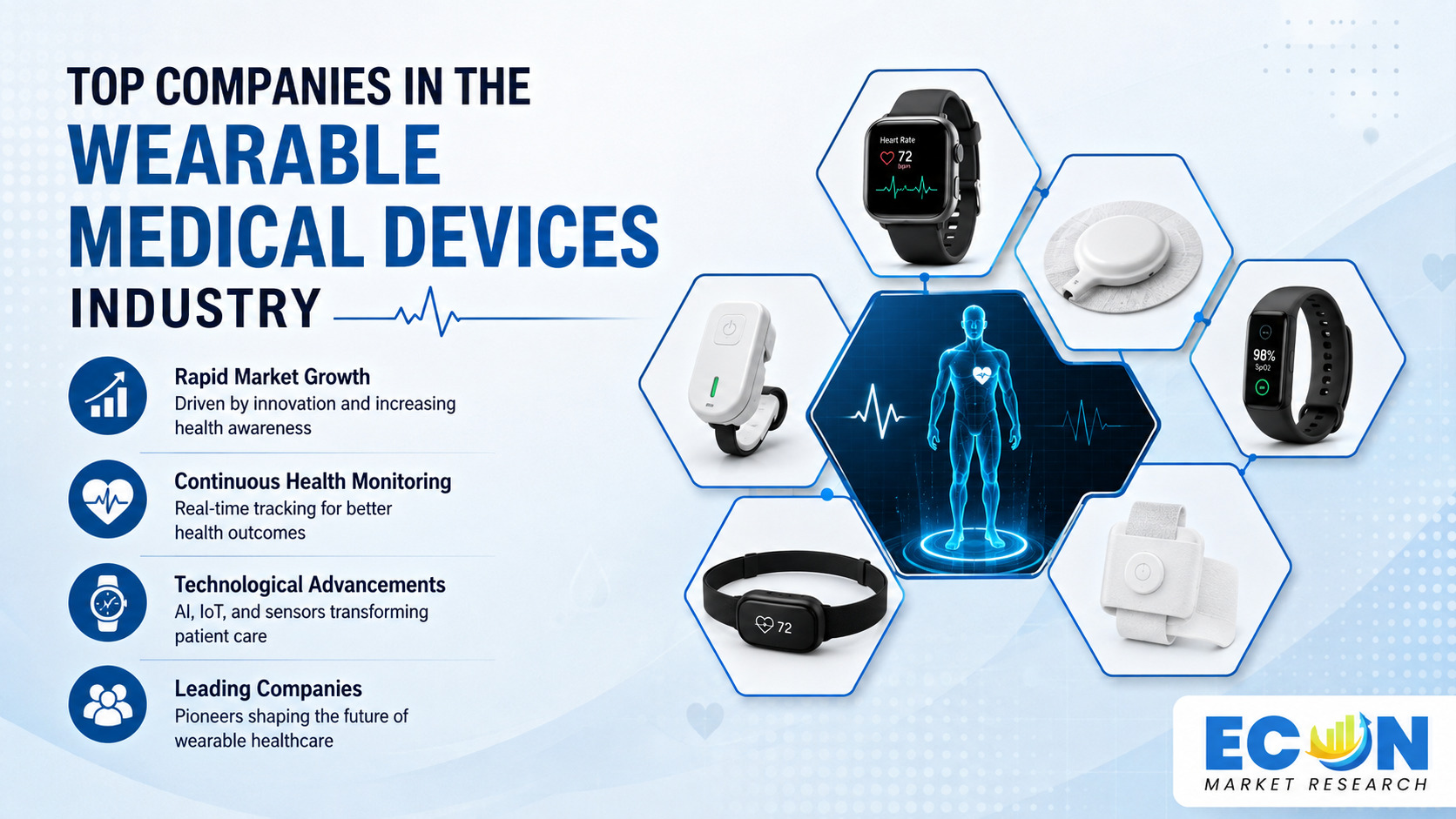
The Top Companies in the Wearable Medical Devices Industry compete across 2 overlapping product groups. The first consists of regulated devices prescribed or deployed by healthcare professionals, including glucose sensors, ECG patches, ward-monitoring biosensors, and medical pulse-oximetry systems. The second includes consumer wearables with authorised medical functions, such as ECG recording, irregular-rhythm notifications, sleep-apnoea screening, and hypertension alerts. Global connectivity supports both groups, with 6 billion people using the internet in 2025 and 96% of the world’s population living within reach of a mobile network. However, the remaining 2.2 billion offline population limits cloud-connected device access in lower-income regions.
Market Evolution and Growth Drivers
Wearable medical devices have evolved through improvements in miniaturised sensors, Bluetooth communication, medical-grade adhesives, smartphone applications, cloud analytics, battery efficiency, and artificial intelligence. Apple introduced the first Apple Watch in 2015, Medtronic secured European approvals for its Guardian 4 glucose sensor in 2021, Samsung received FDA De Novo authorisation for wearable sleep-apnoea detection in 2024, and Dexcom obtained FDA clearance for a 15.5-day glucose sensor in 2025. Each milestone extended wearable use beyond activity counting toward diagnosis, treatment adjustment, clinical surveillance, and long-duration disease management.
Demand is reinforced by chronic-disease prevalence, ageing populations, clinician shortages, and the need to identify deterioration between hospital visits. Noncommunicable diseases account for 74% of deaths worldwide, while 31% of adults and 80% of adolescents do not achieve recommended physical-activity levels. Wearables can provide objective measurements of glucose, ECG signals, oxygen saturation, respiration, pulse rate, sleep, temperature, and movement. Regulation is also shaping product development: the FDA maintains dedicated lists for authorised sensor-based digital health devices and AI-enabled medical devices, while European health-data rules entered into force on March 26, 2025.
Top 5 Latest Trends in the Wearable Medical Devices Industry
Longer-wear continuous glucose monitoring
AI-supported ambulatory cardiac monitoring
Wireless biosensors for hospital and home surveillance
Regulated smartwatch screening functions
Secure interoperability and lifecycle data management
Trend 1: Longer-Wear Continuous Glucose Monitoring
Continuous glucose monitoring is shifting toward smaller sensors, longer wear periods, automated data transmission, and integration with insulin-delivery systems. Abbott’s FreeStyle Libre 3 Plus is designed for 15 days of use and automatically streams readings to a compatible smartphone. Dexcom’s G7 15 Day system provides up to 15.5 days of wear for adults and entered the U.S. market in December 2025 after receiving FDA clearance in April. Medtronic’s Guardian 4 sensor operates for up to 7 days, while newer compatible sensors for the MiniMed 780G platform can measure glucose every 5 minutes. Longer duration reduces the number of annual sensor replacements and can support stronger adherence.
The commercial importance of this trend extends beyond sensor life. Abbott’s FreeStyle Libre systems serve 7 million people, while expanded U.S. Medicare coverage created potential access for over 2 million additional diabetes patients. Automated insulin systems can use wearable glucose readings to adjust treatment without waiting for manual entry. Medtronic’s MiniMed 780G analyses glucose information every 5 minutes and can provide automatic corrections, while Abbott has established compatibility partnerships involving 4 automated insulin-delivery platforms. These developments are turning continuous glucose monitors into active components of therapeutic ecosystems rather than standalone measurement devices.
Trend 2: AI-Supported Ambulatory Cardiac Monitoring
Wearable cardiac patches are extending ECG collection from traditional 24-to-48-hour Holter periods to monitoring windows of up to 14 days. iRhythm’s Zio platform combines a lightweight ECG patch, a deep-learning analysis system, qualified specialist review, and mobile symptom reporting. Large analyses presented in 2025 included data from over 1 million patients and found that shorter monitoring periods could miss arrhythmias detected later in the prescribed wear period. A separate Asian-population analysis covered over 400,000 patients monitored between 2018 and 2022, supporting the technology’s applicability across different demographic groups.
AI is valuable because a 14-day ECG patch can generate millions of individual heartbeat records. Algorithms classify rhythm patterns, identify suspected atrial fibrillation, and help prioritise events for technician and physician review. iRhythm has analysed over 3 billion hours of heartbeat data and produced clinical reports for over 12 million patients. Home enrolment pathways introduced for Zio monitoring allow patients to apply and activate the patch outside a clinic while maintaining wear compliance and data quality comparable with in-clinic application. This model expands cardiac diagnostics without requiring an additional facility visit for every patient.
Trend 3: Wireless Biosensors for Hospital and Home Surveillance
Healthcare providers are adopting adhesive and wrist-worn biosensors to continuously monitor patients who would otherwise receive intermittent vital-sign checks. Philips’ BX100 is a 5-day, single-use chest patch that measures heart rate and respiratory rate every minute while recording posture, activity, and ambulation. BioIntelliSense deployments have generated up to 1,440 sets of vital-sign measurements per patient per day, compared with manual checks that may occur only 4 to 6 times daily. VitalConnect’s wearable platform supports 7 days of continuous use without charging and stores up to 10 hours of information on the sensor.
These devices are expanding from intensive-care support into general wards, postoperative recovery, oncology, respiratory care, and hospital-at-home programs. GE HealthCare’s Portrait Mobile continuously measures respiration rate, oxygen saturation, and pulse rate while allowing patients to remain mobile. VitalPatch records 8 physiological or activity measurements, including single-lead ECG, heart rate variability, temperature, posture, and fall detection. Continuous surveillance can identify sustained changes that may be missed when nurses record vital signs only once every few hours, although hospitals must manage alarm thresholds carefully to prevent unnecessary alerts.
Trend 4: Regulated Smartwatch Screening Functions
Consumer smartwatches are gaining authorised medical functions that screen for specific conditions without converting every wellness metric into a diagnostic claim. Apple Watch supports ECG recording, irregular-rhythm notifications, fall detection, sleep-apnoea notifications, and other health functions. Apple’s sleep-apnoea feature is available in over 150 countries and regions and uses wrist movement to identify breathing disturbances. The company used over 5 million nights of study data to develop and test its newer sleep-scoring algorithms. These capabilities give wearable medical technology access to consumers who may never receive a prescribed patch or implant.
Samsung’s sleep-apnoea function received FDA De Novo authorisation in 2024 and reached 78 markets by 2026. The system is intended for adults aged 22 years and older who have not previously been diagnosed with sleep apnoea. Users record more than 4 hours of sleep on 2 nights within a 10-day period, after which the software evaluates signs associated with moderate-to-severe obstructive sleep apnoea. The regulatory distinction remains important: the FDA stated in 2024 that it had not authorised any smartwatch or smart ring to independently measure or estimate blood glucose without piercing the skin.
Trend 5: Secure Interoperability and Lifecycle Data Management
Wearable devices create continuous information streams that must move securely between sensors, smartphones, cloud platforms, electronic health records, clinicians, and caregivers. The European Health Data Space entered into force in 2025 and established a staged implementation process across the European Union’s 27 member states. Key implementing acts are due by March 2027, the first priority health-data categories are scheduled for cross-border exchange by March 2029, and medical images, laboratory results, and discharge reports are planned for exchange by March 2031. These deadlines influence how wearable technology providers design consent, interoperability, and data-export capabilities.
Cybersecurity must also remain active throughout the wearable’s operating lifecycle. Medical wearables may connect through Bluetooth, cellular networks, home Wi-Fi, hospital infrastructure, and third-party applications. End-to-end encryption, authenticated software updates, audit logging, vulnerability response, and data-minimisation practices are becoming procurement requirements. Apple states that Health app information synchronised through iCloud can use end-to-end encryption when account-protection requirements are enabled. GE HealthCare’s Portrait Mobile uses an edge-computing platform intended to support reliable data processing and future expansion without depending entirely on distant cloud infrastructure.
Top 10 Companies in the Wearable Medical Devices Industry
The following 10 companies are not presented as a strict market-share ranking. They were selected according to regulated product capabilities, technical expertise, deployment scale, geographic presence, clinical evidence, manufacturing resources, data platforms, and relevance to wearable patient monitoring.
1. Abbott
Company Overview: Abbott traces its history to 1888, employs 122,000 people, and operates in over 160 countries. Its corporate headquarters are located at Abbott Park in Illinois, United States. Core Wearable Medical Devices Expertise: Abbott specialises in minimally invasive glucose-sensing wearables, smartphone-connected monitoring, caregiver data sharing, and compatibility with automated insulin-delivery technologies. Major Products and Services: The FreeStyle Libre portfolio includes FreeStyle Libre 3 Plus, a 15-day water-resistant sensor that automatically sends glucose readings to a compatible smartphone. Abbott also offers LibreView for remote clinical data review and Lingo for eligible adults aged 18 years and older who are not using insulin.
2. Dexcom
Company Overview: Dexcom was founded in 1999 and is headquartered in San Diego, California, United States. The company operates across North America, Europe, and selected Asia-Pacific markets and has developed continuous glucose systems for over 25 years. Core Wearable Medical Devices Expertise: Dexcom focuses on real-time glucose biosensing, predictive alerts, smartphone connectivity, caregiver sharing, clinical analytics, and direct-to-consumer access. Major Products and Services: Dexcom G7 delivers glucose measurements every 5 minutes, while G7 15 Day supports up to 15.5 days of wear for approved adult users. Dexcom Follow permits sharing with up to 10 followers, and Stelo became the first over-the-counter glucose biosensor cleared in the United States in 2024.
3. Medtronic
Company Overview: Medtronic was founded in 1949, maintains its legal headquarters in Dublin, Ireland, and employs over 95,000 people across 150 countries and 350 locations. Core Wearable Medical Devices Expertise: Its wearable capabilities include continuous glucose monitoring, sensor-driven insulin delivery, ambulatory monitoring, and connected therapy management. Major Products and Services: Guardian 4 provides up to 7 days of glucose sensing, while the MiniMed 780G system processes readings every 5 minutes and adjusts insulin delivery using SmartGuard technology. The newer Simplera Sync sensor can be inserted in less than 10 seconds, and the extended infusion set supports up to 7 days of wear.
4. Masimo
Company Overview: Masimo was founded in 1989 and is headquartered in Irvine, California, United States. Its workforce includes over 7,000 people, and its SET pulse-oximetry technology is used to monitor over 200 million patients annually. Core Wearable Medical Devices Expertise: Masimo develops motion-tolerant pulse oximetry, continuous oxygen-saturation monitoring, wearable temperature sensors, medical watches, and cloud-based telemonitoring. Major Products and Services: The Masimo W1 Medical Watch connects with the SafetyNet telemonitoring system, while Radius PPG and Radius T provide wireless oxygen-saturation and temperature measurements. More than 100 independent studies have evaluated Masimo SET performance, including large newborn-screening studies involving over 300,000 infants.
5. iRhythm Technologies
Company Overview: iRhythm was established in 2006 and is headquartered in San Francisco, California, United States. Its platform has generated reports for over 12 million patients and analysed over 3 billion hours of heartbeat information. Core Wearable Medical Devices Expertise: The company combines extended-wear ECG patches, deep-learning algorithms, technician review, symptom-reporting applications, and electronic health-record integration. Major Products and Services: The Zio long-term continuous monitoring service records beat-to-beat ECG information for up to 14 days. ZioSuite supports clinical workflows, while the MyZio application enables symptom recording and patient education. The service is available in multiple European markets and entered nationwide commercial availability in Japan during 2025.
6. Royal Philips
Company Overview: Philips was founded in 1891 and is headquartered in Amsterdam, Netherlands. The company employed 64,800 people in 2025 and provided sales and services in over 100 countries. Core Wearable Medical Devices Expertise: Philips integrates adhesive biosensors, wearable vital-sign collection, early-warning software, bedside monitoring, and home-care platforms. Major Products and Services: The FDA-cleared BX100 is a single-use 5-day biosensor that records heart rate and respiration every minute. Philips also works with smartQare to integrate the reusable viQtor wearable, which measures pulse, respiration, oxygen saturation, temperature, activity, and falls across hospital and home settings.
7. GE HealthCare
Company Overview: GE HealthCare became an independent company in January 2023 and employs over 54,000 people while serving customers in over 160 countries. Its headquarters are in Chicago, Illinois, United States. Core Wearable Medical Devices Expertise: The company connects wireless patient sensors with central monitoring, clinical alarms, edge computing, and hospital information systems. Major Products and Services: Portrait Mobile continuously measures respiration rate, oxygen saturation, and pulse rate while allowing patient mobility. The platform uses dual-vector respiration sensing and configurable alarm limits. GE HealthCare also maintains an installed base of over 4 million pieces of equipment across imaging, ultrasound, patient-care, and diagnostic operations.
8. OMRON Healthcare
Company Overview: OMRON introduced its first electronic blood-pressure monitor in 1973 and now distributes healthcare products in over 130 countries and regions. By September 2025, cumulative blood-pressure monitor sales had passed 400 million units. The company is headquartered in Kyoto, Japan. Core Wearable Medical Devices Expertise: OMRON develops connected blood-pressure monitors, wearable cardiovascular devices, ECG-enabled systems, mobile applications, and remote hypertension-management platforms. Major Products and Services: HeartGuide applies an inflatable cuff inside a wristwatch form, while OMRON Connect has recorded over 15 million downloads. The company also develops devices that screen for possible atrial fibrillation during routine blood-pressure measurement.
9. Apple
Company Overview: Apple was founded on April 1, 1976, and is headquartered in Cupertino, California, United States. Apple introduced its watch platform commercially in 2015 and has since expanded its health functions across multiple hardware generations. Core Wearable Medical Devices Expertise: Apple combines optical sensors, electrodes, accelerometers, temperature sensing, on-device processing, encrypted health records, and regulated software functions. Major Products and Services: Apple Watch supports ECG recording, irregular-rhythm notifications, sleep-apnoea notifications, fall detection, heart-rate alerts, and retrospective ovulation estimates. Sleep-apnoea notifications are available in over 150 countries and regions, while Apple’s sleep-score algorithms were tested using over 5 million nights of data.
10. Samsung Electronics
Company Overview: Samsung Electronics was established in 1969 and is headquartered in Suwon, South Korea. Its wearable-health ecosystem combines Galaxy Watch hardware, Samsung Health, Samsung Health Monitor, smartphones, sensors, and AI software. Core Wearable Medical Devices Expertise: Samsung develops wrist-based ECG, heart-rate analysis, body-composition measurement, sleep tracking, and regulated sleep-apnoea detection. Major Products and Services: Its sleep-apnoea feature received FDA De Novo authorisation in 2024 and reached 78 markets by 2026. The function evaluates users aged 22 years and older after more than 4 hours of sleep monitoring on 2 nights within a 10-day period.
Regional Outlook
North America
North America has an established ecosystem for wearable-device research, regulatory review, reimbursement, manufacturing, software development, and clinical deployment. The United States is home to Abbott, Dexcom, Masimo, iRhythm, Apple, and GE HealthCare, while Medtronic maintains a major operational presence in Minnesota with 10,000 employees in the Twin Cities area. The FDA maintains dedicated public resources for sensor-based digital health technologies and AI-enabled medical devices, giving manufacturers clearer insight into authorised products. The region also supports diverse product categories, including 15.5-day glucose sensors, 14-day ECG patches, medical pulse-oximetry wearables, hospital biosensors, and smartwatch-based screening.
The United States drives commercial scale through specialist hospitals, private insurers, Medicare pathways, pharmaceutical distribution, and smartphone penetration. Expanded Medicare coverage for FreeStyle Libre created potential access for over 2 million additional diabetes patients. Canada applies a national medical-device licensing framework and granted a licence for Samsung’s sleep-apnoea feature in September 2024. Mexico participates through consumer-electronics distribution, private healthcare adoption, and regional manufacturing supply chains; Apple included Mexico among the 7 additional countries receiving Apple Watch availability in June 2015. Regional challenges include cybersecurity, reimbursement variation, health-data fragmentation, device affordability, and unequal access in rural areas.
Europe
Europe combines established medical-device manufacturing with strict requirements for safety, clinical evidence, privacy, and post-market surveillance. The European Union contains 27 member states, and the European Health Data Space entered into force on March 26, 2025. By early 2025, 15 EU countries supported patient-summary or electronic-prescription sharing through MyHealth@EU, while full exchange of the first priority health-data categories is scheduled for 2029. Wearable device providers operating in Europe must also comply with Medical Device Regulation requirements and national health-data rules, increasing the importance of documented risk management, secure software, and clinical performance.
The Netherlands is home to Philips, Germany and Switzerland support Medtronic and BIOTRONIK-related manufacturing and research ecosystems, and the United Kingdom is a major market for diabetes and cardiac monitoring. Apple introduced its ECG application across 19 European countries in 2019 after receiving CE marking. iRhythm’s Zio service is available in Austria, the Netherlands, Spain, and Switzerland, while Philips’ BX100 received both FDA clearance and CE marking before its first installation at a Dutch hospital. European opportunity is concentrated in remote chronic-disease management, decentralised clinical trials, ageing-population care, and cross-border health-data infrastructure. Challenges include regulatory-transition costs, national reimbursement differences, and environmental concerns surrounding disposable sensors.
Asia-Pacific
Asia-Pacific combines advanced electronics production, large chronic-disease populations, expanding smartphone use, and different levels of healthcare access. Internet use reached 77% across the region in 2025, supporting app-connected glucose sensors, cardiac patches, smartwatches, and remote-monitoring platforms. Japan is the headquarters market for OMRON Healthcare, South Korea hosts Samsung Electronics, and Singapore, Taiwan, China, and Malaysia contribute semiconductor, sensor, battery, and medical-device manufacturing capabilities. OMRON products are distributed in over 130 countries, and the company’s connected-health application has recorded over 15 million downloads.
Japan launched nationwide access to iRhythm’s Zio monitoring service in 2025, while an analysis of over 400,000 patients supported long-term ECG performance across Asian populations. India received Apple’s ECG and irregular-rhythm notification functions in 2019, and Apple’s sleep-apnoea notifications became available in India in May 2026. Australia and Singapore joined Samsung’s expanded sleep-apnoea availability as the feature reached 70 markets in 2025 and 78 markets in 2026. Regional opportunities include locally manufactured sensors, multilingual applications, lower-cost wearables, and chronic-disease screening. Risks include fragmented approval systems, rural connectivity gaps, and dependence on specialised semiconductor components.
Middle East & Africa
The Middle East and Africa contain sharply different digital and clinical operating environments. Internet use reached 70% in Arab States during 2025 but only 36% across Africa. Mobile-broadband coverage in Arab States reached 95%, giving Gulf Cooperation Council markets stronger infrastructure for smartphone-connected medical wearables, remote consultations, and cloud monitoring. Saudi Arabia, the United Arab Emirates, and Qatar are developing digital hospital systems, while South Africa, Egypt, Kenya, and Nigeria support growing private-sector health-technology communities. The region’s 6 GCC countries provide the strongest near-term environment for premium diabetes, cardiac, respiratory, and sleep-monitoring wearables.
Adoption across Africa is constrained by affordability, limited specialist capacity, electricity reliability, and the 64% of people who remained offline in 2025. These conditions favour wearables with longer battery life, offline storage, cellular gateways, durable adhesives, and low-bandwidth applications. The public-health need remains substantial because low- and middle-income countries account for over 75% of global noncommunicable-disease deaths and 86% of premature NCD deaths. Wearable technology providers can expand access through public-health partnerships, local distributors, clinician training, and devices designed for community health workers rather than relying exclusively on individually owned premium smartphones.
Future Opportunities in the Wearable Medical Devices Industry
Future opportunities will focus on longer-lasting sensors, multimodal wearables, edge processing, personalised algorithms, and integration with treatment systems. Current products already demonstrate 15.5-day glucose monitoring, 14-day ECG recording, 7-day vital-sign patches, and 5-day disposable hospital biosensors. Engineering programs can extend these operating periods through lower-power chips, improved adhesives, flexible batteries, and selective data transmission. Analytical expectations also include single devices that combine ECG, oxygen saturation, temperature, respiration, movement, and blood-pressure trends, although each medical claim will still require appropriate regulatory evidence.
Artificial intelligence will support signal cleaning, anomaly detection, clinical prioritisation, and personalised baselines. FDA resources already identify authorised AI-enabled medical devices, while WHO completed a 2025 scientific meeting examining wearable technologies for adult physical-activity measurement and published its report in February 2026. These developments could expand wearables into population-health surveillance, rehabilitation, decentralised trials, occupational health, and early deterioration detection. However, future systems must demonstrate that algorithms perform consistently across age groups, skin tones, disease stages, and geographic populations rather than producing only laboratory-level accuracy.
The Top Companies in the Wearable Medical Devices Industry can also benefit from interoperability deadlines and regional localisation. European implementing acts are due in 2027, priority data exchange begins in 2029, and additional health-data categories are scheduled for 2031. Manufacturers that provide secure APIs, multilingual applications, automated clinical documentation, and electronic-record integration will be better positioned for hospital procurement. Sustainability will create another opportunity because single-use biosensors generate electronic and adhesive waste. Recyclable packaging, sensor take-back programs, rechargeable transmitters, modular components, and lower-material designs can reduce lifecycle impact while preserving infection-control requirements.
Conclusion
The wearable medical devices industry now operates across diabetes management, ambulatory cardiology, continuous hospital surveillance, sleep screening, respiratory monitoring, blood-pressure management, and preventive care. Its current scale includes 7 million FreeStyle Libre users, over 12 million patients analysed through iRhythm, 400 million OMRON blood-pressure monitors sold, and Masimo technology used for over 200 million patients annually. The 5 major trends—longer-wear glucose sensors, AI-assisted ECG analysis, wireless biosensors, regulated smartwatch functions, and secure interoperability—show how wearables are progressing from isolated measurement tools into connected clinical systems.
The 10 selected companies contribute different strengths. Abbott, Dexcom, and Medtronic connect biosensors with diabetes treatment; Masimo, Philips, and GE HealthCare support continuous vital-sign surveillance; iRhythm applies AI to 14-day ECG monitoring; OMRON specialises in cardiovascular measurement; and Apple and Samsung distribute authorised health functions through global smartwatch ecosystems. North America leads regulatory commercialisation, Europe is building a 27-country data framework, Asia-Pacific combines 77% internet use with electronics manufacturing, and Africa’s 36% connectivity rate requires lower-bandwidth models. Future competitiveness will depend on clinical accuracy, wear duration, cybersecurity, equitable performance, environmental design, and integration with professional healthcare workflows.